Page 279 of 341

This section covers the more
common problems that motorists
experience with their vehicles. It
gives you inf ormation about how to
safely evaluate the problem and what
to do to correct it. If the problem has
stranded you on the side of the road,
you may be able to get going again.
If not, you will also f ind instructions
on getting your vehicle towed.......................
Compact Spare Tire .276
....................
Changing a Flat Tire .277
.............
If the Engine Won’t Start .285
................................
Jump Starting .286
..............
If the Engine Overheats .288
.........
Low Oil Pressure Indicator .290
..........
Charging System Indicator .290
.......
Malf unction Indicator Lamp .291
...............
Brake System Indicator .292
..............................................
Fuses .293
..............................
Fuse Locations .296
......................
Emergency Towing .298
..........
If Your Vehicle Gets Stuck .299
Taking Care of the Unexpected
T aking Care of t he Unexpect ed
275
�\f���—�\f���—�����y�
����
����
�\f�y���
�(���������\f�y�\f�����\f�y
2008 Ridgeline
Page 281 of 341

Turn on the hazard warning lights,
and turn the ignition switch to the
LOCK (0) position. Have all
passengers get out of the vehicle
while you change the tire.
Park the vehicle on f irm, level, and
non-slippery ground. Put the
transmission in Park. Apply the
parking brake.
If you are towing a trailer, unhitch
it.
If you have a f lat tire while driving,
stop in a saf e place to change it.
Drive slowly along the shoulder until
you get to an exit or an area to stop
that is far away from the traffic lanes.
If you tow a trailer f requently, we
recommend that you use a regular
tire as a spare. You can store the
regular size spare tire on the tire tray,
but store the tool kit at the side of
the In-Bed Trunk (see page ),
and secure it.
2.
1.
283
CONT INUED
Changing a Flat Tire
T aking Care of t he Unexpect ed
277
TOOL BOX SPARE TIRE
The vehicle can easily roll off
the jack, seriously injuring
anyone underneath.
Follow the directions for
changing a tire exactly, and
never get under the vehicle
when it is supported only by the
jack.
�\f���—�\f���—�����y�
����
��������y���
�(���������\f�y�\f�������y
2008 Ridgeline
Page 290 of 341

Are you using the proper starting
procedure? Ref er toon page .
There may be an electrical
problem, such as no power to the
f uel pump. Check all the f uses
(see page ).
If youfindnothingwrong,youwill
need a qualif ied technician to f ind
the problem. See on page . Although this seems like a simple
procedure, you should take several
precautions.
You cannot start your vehicle by
pushing or pulling it.
Do you have f uel? Check the f uel
gauge; the low f uel indicator may
not be working.
Turn of f all electrical accessories:
heater, A/C, climate control, audio
system, lights, etc. Put the
transmission in Park, and set the
parking brake.
Open the hood, and check the
physical condition of the battery.
In very cold weather, check the
condition of the electrolyte. If it
seems slushy or f rozen, do not try
jump starting until it thaws.
1.
2.
200
293 298 Starting the
Engine
Emergency
Towing Jump Starting
If the Engine Won’t Start, Jump Starting
To Jump Start Your Vehicle:
286
A battery can explode if you do
not follow the correct procedure,
seriously injuring anyone
nearby.
Keep all sparks, open flames,
and smoking materials away
from the battery.
If a battery sits in extreme cold, the
electrolyte inside can f reeze.
Attempting to jump start with a f rozen
battery can cause it to rupture.
�\f���—�\f���—�����y�
����
��������y���
�(���������\f�y�\f�����
�y
2008 Ridgeline
Page 293 of 341

If the temperature gauge stays at
the red mark, turn of f the engine.
Look f or any obvious coolant leaks,
such as a split radiator hose.
Everything is still extremely hot,
so use caution. If you f ind a leak, it
must be repaired bef ore you
continue driving (seeon page ).
Put the radiator cap back on
tightly. Run the engine, and check
the temperature gauge. If it goes
back to the red mark, the engine
needs repair (seeon page ).
If the temperature stays normal,
check the coolant level in the
radiator reserve tank. If it has
gone down, add coolant to the
MAX mark. Put the cap back on
tightly.
If you do not f ind an obvious leak,
check the coolant level in the
radiator reserve tank. Add coolant
if the level is below the MIN mark.
If there was no coolant in the
reserve tank, you may need to add
coolant to the radiator. Let the
engine cool down until the pointer
reaches the middle of the tempera-
ture gauge, or lower, bef ore check-
ing the radiator.
Using gloves or a large heavy
cloth, turn the radiator cap
counterclockwise, without pushing
down, to the f irst stop. Af ter the
pressure releases, push down on
the cap, and turn it until it comes
off.Start the engine, and set the
temperature to maximum heat
(climate control to AUTO at
‘‘ ’’). Add coolant to the
radiator up to the base of the f iller
neck. If you do not have the
proper coolant mixture available,
you can add plain water.
Remember to have the cooling
system drained and ref illed with
the proper mixture as soon as you
can.
4.
5.
6.
7. 8.9.
10.
11.
298
298
Emergency
Towing
Emergency
Towing
If theEngineOverheats
T aking Care of t he Unexpect ed
289
Removing the radiator cap
while the engine is hot can
cause the coolant to spray out,
seriously scalding you.
Always let the engine and
radiator cool down before
removing the radiator cap.
�\f���—�\f���—�����y�
����
��������y���
�(���������\f�y�\f�������y
2008 Ridgeline
Page 296 of 341

However, if the brake pedal does not
f eel normal, you should take
immediate action. A problem in one
part of the system’s dual circuit
design will still give you braking at
two wheels. You will f eel the brake
pedal go down much f arther bef ore
the vehicle begins to slow down, and
you will have to press harder on the
pedal.
Slow down by shif ting to a lower
gear, and pull to the side of the road
when it is saf e. Because of the long
distance needed to stop, it is
hazardous to drive the vehicle. You
should have it towed, and repaired as
soon as possible (seeon page ).
If you must drive the vehicle a short
distance in this condition, drive
slowly and caref ully.
The brake system
indicator normally
comes on when
you turn the ignition switch to the
ON (II) position, and as a reminder
to check the parking brake. It will
stay on if you do not f ully release the
parking brake.
If the brake system indicator comes
on while driving, the brake f luid level
is probably low. Press lightly on the
brake pedal to see if it f eels normal.
If it does, check the brake f luid level
thenexttimeyoustopataservice
station (see page ). If the ABS indicator and the VSA
system indicator come on with the
brake system indicator, have your
vehicle inspected by your dealer
immediately.
If the f luid level is low, take your
vehicle to a dealer, and have the
brake system inspected f or leaks or
worn brake pads. 298
255
Emergency
Towing
Brake System Indicator
292
Canada
U.S.
�\f���—�\f���—�����y�
������\f������y���
�(���������\f�y�\f�������y
2008 Ridgeline
Page 302 of 341

If , due to damage, your vehicle must
be towed with all f our wheels on the
ground, do the f ollowing:Release the parking brake.
Start the engine.
Shif t to D f or several seconds,
then to N.
Turn of f the engine. With all f our wheels on the ground,
it is best to tow the vehicle no farther
than 50 miles (80 km), and keep the
speedbelow35mph(55km/h).
If your vehicle needs to be towed,
call a prof essional towing service or
organization. Never tow your vehicle
with just a rope or chain. It is very
dangerous.
The operator will load
your vehicle on the back of a truck.
Any other method of towing will
damage the drive system. When you
contact the towing agency, inf orm
them a f lat-bed is required.
Emergency Towing
The only way you can saf ely tow
your vehicle is with f lat-bed
equipment.
298
Improper towing preparation will
damage the transmission. Follow the
above procedure exactly. If you cannot
shif t the transmission or start the
engine, your vehicle must be
transported with the all f our wheels of f
the ground. The steering system can be damaged if
the steering wheel is locked. Leave the
ignition switch in the ACCESSORY (I)
position, and make sure the steering
wheel turns f reely bef ore you begin
towing.
Towing your vehicle with two tires on
the ground will damage parts of the
4WD system. It should be transported
on a f lat-bed truck or trailer. Trying to lif t or tow your vehicle by the
bumpers will cause serious damage.
The bumpers are not designed to
support the vehicle’s weight.
�\f���—�\f���—�����y�
������
��
���y���
�(���������\f�y�\f���\f���y
2008 Ridgeline
Page 303 of 341
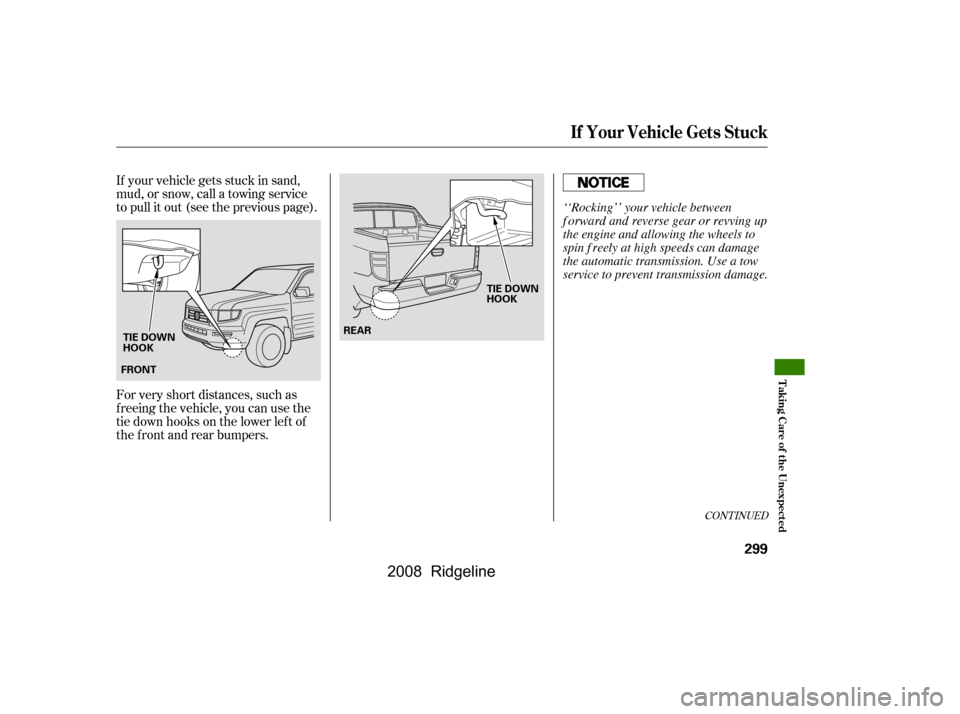
If your vehicle gets stuck in sand,
mud, or snow, call a towing service
to pull it out (see the previous page).
For very short distances, such as
f reeing the vehicle, you can use the
tie down hooks on the lower lef t of
the f ront and rear bumpers.
CONT INUED
If Your Vehicle Gets Stuck
T aking Care of t he Unexpect ed
299
FRONTREAR
TIE DOWN
HOOK TIE DOWN
HOOK
‘‘Rocking’’ your vehicle between
f orward and reverse gear or revving up
the engine and allowing the wheels to
spin f reely at high speeds can damage
the automatic transmission. Use a tow
service to prevent transmission damage.
�\f���—�\f���—�����y�
������
��
���y���
�(���������\f�y�\f���\f���y
2008 Ridgeline
Page 304 of 341
If Your Vehicle Gets Stuck
300
To avoid damage to your vehicle, use
the tie down hooks f or straight, f lat
ground towing only. Do not tow at an
angle. These hooks should not be used
f or open-road towing.
�\f���—�\f���—�����y�
������
������y���
�(���������\f�y�\f���\f���y
2008 Ridgeline