Page 230 of 341
The 7-pin trailer connector is needed
f or the trailer lights. To connect the
connector, do this:Make sure the connector and the
socketarefreeof dirt,moisture,
or other f oreign material.
Open the socket lid by pulling it up. Insert the connector securely into
the socket.
Hook the retaining tab on the
inner side of the lid against the
retaining tab of the connector to
prevent disconnection during
operation.
Remove the socket cover, and
attach it securely over the socket.
Insert the connector into the
socket securely to prevent
disconnection during operation.
The 4-pin trailer connector is also
needed f or the trailer lights. To
connect the connector, do this:
1. 1.
2. 3.
4.
2.
Connect ing t he T railer Connect ors
Towing a Trailer
226
7-PIN TRAILER CONNECTOR
SOCKETRETAINING
TAB
RETAINING
TAB
LID
4-PIN TRAILER CONNECTORSOCKET COVER
7-PIN TRAILER
CONNECTOR 4-PIN TRAILER
CONNECTOR
�\f���—�\f���—�����y�
����
�
����\f�y���
�(���������\f�y�\f�����
�y
2008 Ridgeline
Page 231 of 341
To disconnect the connectors,
reverse the connection steps, then
make sure the socket lid and
socket cover are securely in place.
Avoid using excessive f orce when
disconnecting the connectors.Electric current f lows through the
electrical supply circuit only when
the ignition switch is in the ON
(II) position.
Using the electrical supply circuit
when the engine is at a stop or
idling can discharge the battery.
Bef ore you submerge the trailer
hitchinwater(suchasataboat
ramp), make sure the connectors
are removed and the socket lid
and socket cover are securely in
place. Failure to do this will result
in electrical system problems.
Af ter the connectors are
submergedinwater,openthe
socket lid and the socket cover to
drain them.
CONT INUED
Import ant Precaut ions
Towing a Trailer
Driving
227
�\f���—�\f���—�����y�
����
�
������y���
�(���������\f�y�\f�������y
2008 Ridgeline
Page 232 of 341
�´
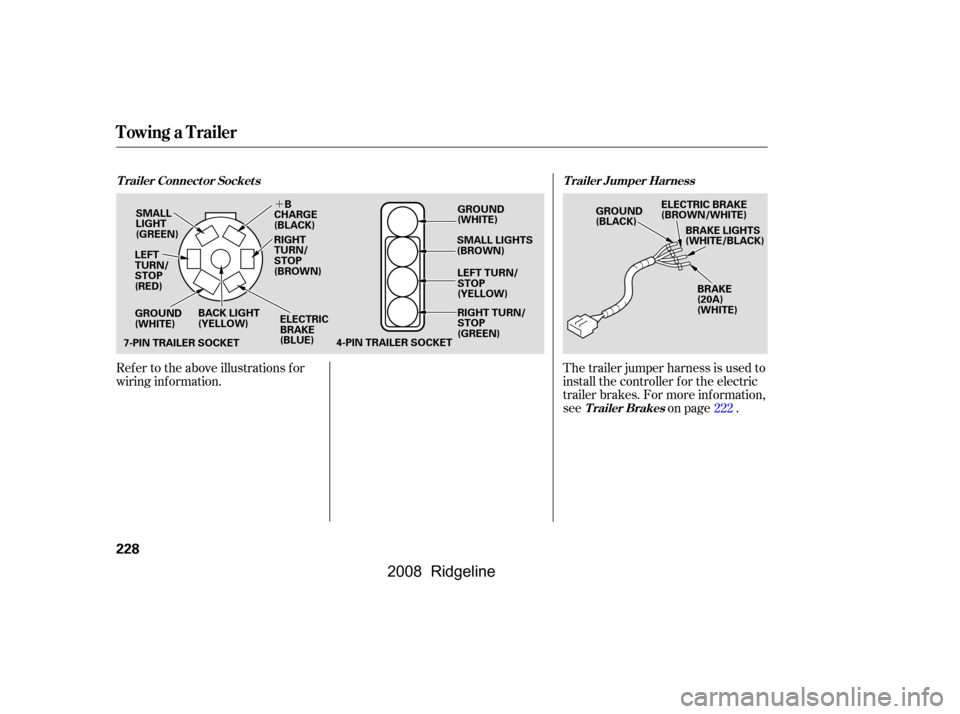
The trailer jumper harness is used to
install the controller f or the electric
trailer brakes. For more inf ormation,
see on page .
Ref er to the above illustrations f or
wiring information.
222
T railer Connect or Socket s
Trailer Brakes
T railer Jumper Harness
Towing a Trailer
228
7-PIN TRAILER SOCKET
ELECTRIC
BRAKE
(BLUE)
SMALL
LIGHT
(GREEN)
B
CHARGE
(BLACK)
BACK LIGHT
(YELLOW)
GROUND
(WHITE) GROUND
(WHITE)
GROUND
(BLACK)ELECTRIC BRAKE
(BROWN/WHITE)
BRAKE
(20A)
(WHITE)
LEFT TURN/
STOP
(YELLOW)
RIGHT TURN/
STOP
(GREEN)
SMALL LIGHTS
(BROWN)
LEFT
TURN/
STOP
(RED)
4-PIN TRAILER SOCKET BRAKE LIGHTS
(WHITE/BLACK)
RIGHT
TURN/
STOP
(BROWN)
�\f���—�\f���—�����y�
����
�
������y���
�(���������\f�y�\f�������y
2008 Ridgeline
Page 233 of 341

The added weight, length, and
height of a trailer will af f ect your
vehicle’s handling and perf ormance,
so driving with a trailer requires
some special driving skills and
techniques.
Your vehicle tires and spare are in
good condition and properly
inf lated.
The trailer tires and spare are in
good condition and inf lated as
recommended by the trailer
maker.
The vehicle has been properly
serviced, and the tires, brakes,
suspension, cooling system, and
lights are in good operating
condition.
The trailer has been properly
serviced and is in good condition.
All weights and loads are within
limits.
Thehitch,safetychains,andany
other attachments are secure.
Allitemsonandinthetrailerare
properly secured and cannot shif t
while you drive. Towing perf ormance can be
af f ected by high altitude, high
temperature, or when climbing
steep grades. Theref ore, premium
f uel (premium unleaded gasoline
with pump octane number of 91 or
higher) is recommended when
towing more than 3,500 lbs (1,590
kg).
Foryoursafetyandthesafetyof
others,taketimetopracticedriving
maneuvers bef ore heading f or the
open road, and f ollow the guidelines
below.
Avoid towing a trailer during your
vehicle’s f irst 600 miles (1,000 km).
When preparing to tow, and bef ore
driving away, be sure to check the
f ollowing:
CONT INUED
Driving Saf ely With a T railer
Pre-T ow Checklist
Break-In Period
Towing a Trailer
Driving
229
�\f���—�\f���—�����y�
����
�
������y���
�(���������\f�y�\f�������y
2008 Ridgeline
Page 234 of 341

If youmuststopwhenfacinguphill,
use the f oot brake or parking brake.
Do not try to hold the vehicle in
place by pressing on the accelerator,
as this can cause the automatic
transmission to overheat.
When driving down hills, reduce
your speed, and use D3. Do not
‘‘ride’’ the brakes.
Drive slower than normal in all
driving situations, and obey posted
speed limits f or vehicles with trailers.
When towing a f ixed-sided trailer
(e.g., camper), do not exceed 55 mph
(88 km/h). At higher speeds, the
trailer may sway or affect vehicle
handling.
Crosswinds and air turbulence
caused by passing trucks can disrupt
your steering and cause the trailer to
sway. When being passed by a large
vehicle, keep a constant speed, and
steer straight ahead. Do not try to
make quick steering or braking
corrections.
When towing a trailer on level roads
under normal driving conditions, do
not use D3. This will increase the
automatic transmission fluid
temperature and may cause
overheating. Maketurnsmoreslowlyandwider
than normal. The trailer tracks a
smaller arc than your vehicle, and it
canhitorrunoversomethingthe
vehicle misses.
Allow more time and distance f or
braking. Do not brake or turn
suddenly as this could cause the
trailer to jackknif e or turn over.
When climbing hills, closely watch
your temperature gauge. If it nears
the red (Hot) mark, turn the air
conditioning of f , reduce speed and, if
necessary, pull to the side of the
road to let the engine cool.
With heavy cargo on the pickup bed,
your vehicle has a higher center of
gravity. Drive slowly and cautiously,
and allow more time and distance f or
braking. Loading heavy cargo could
af f ect your vehicle’s handling and
perf ormance. Remember, it
takes longer to slow down and
stop when towing a trailer.T owing Speeds and Gears
Handling Crosswinds and Buf f et ing
Making T urns and Braking
Driving on Hills
Towing a Trailer
230
�\f���—�\f���—�����y�
����
�
������y���
�(���������\f�y�\f�������y
2008 Ridgeline
Page 235 of 341

Always drive slowly and have
someone guide you when backing up.
Grip the of the steering wheel,
then turn the wheel to the left to get
the trailer to move to the lef t. Turn
the wheel to the right to move the
trailer to the right.
Do not park on an incline unless it is
unavoidable. If you must park on an
incline, f ollow the steps below to
help prevent the vehicle and trailer
f rom rolling and possibly injuring
someone.Turn the f ront wheels toward the
curb on a downhill, and away f rom
the curb on an uphill.
With the f oot brake f ully pressed,
have someone place wheel chocks
on the downhill side of the vehicle
and trailer wheels.
Firmly apply the parking brake
bef ore you put the transmission in
Park. This keeps the vehicle f rom
putting pressure on the parking
mechanism in the transmission. It
also makes it easier to move the
shif t lever out of Park when you
want to drive away.
When parking on level ground,
f ollow all normal precautions (see
page ) including putting the
transmission in Park, and f irmly
setting the parking brake. If the vehicle’s tires slip when
retrieving a boat f rom the water,
shif t to f irst gear, and turn on VTM-4
lock (see page ). Disengage
VTM-4 lock as soon as the boat is
out of the water to prevent damage
to the VTM-4 system.
1.
2.
3.
211 206
bottom
Backing Up
Parking Ret rieving a Boat
Towing a Trailer
Driving
231
�����—�����—�����y�
����
��������y���
�(�����������y���������y
2008 Ridgeline
Page 239 of 341

The banks and surf ace under the
water provide good traction. The
water may hide hazards such as
rocks, holes, or mud.
Bef ore driving through water, stop,
get out if necessary, and make sure
that:
If you decide it is saf e to drive
through water, choose a suitable
speed, and proceed without shif ting,
changing speeds, stopping, or
shutting of f the engine.
Do not try to cross water at high
speeds, as this may cause severe
damage to the cooling system or
result in loss of control.
After driving through water, test
your brakes. If they got wet, gently
‘‘pump’’ them while driving slowly
until they operate normally.
If the water is deeper than the wheel
hubs, some additional service may
be required. This service is not
covered by your warranties.
The water is not f lowing too f ast.
Deep rushing water can sweep you
downstream. Even very shallow
rushingwatercanwashthe
ground f rom under your tires and
cause you to lose traction and
possibly roll over.
The banks are sloped so you can
drive out.
The water is not deep enough to
cover your wheel hubs, axles, or
exhaust pipe. You could stall and
not be able to restart your engine.
The water can also damage
important vehicle components. If you get stuck, and cannot get
unstuck with the VTM-4 system,
engage the VTM-4 Lock (see page
), and carefully try to go in the
direction (f orward or reverse) that
you think will get you unstuck. Do
notspinthetiresathighspeeds.It
will not help you get out and may
cause damage to the transmission or
VTM-4 system.
If you are still unable to f ree yourself ,
your vehicle is equipped with f ront
and rear tow hooks designed f or this
purpose (see page ). 299
206
CONT INUED
If You Get Stuck
Crossing a Stream
Of f -Highway Driving Guidelines
Driving
235
�\f���—�\f���—�����y�
����
��������y���
�(���������\f�y�\f�����\f�y
2008 Ridgeline
Page 240 of 341
Use a nylon strap to attach your
vehicle to the recovery vehicle, and
caref ully take out the slack in the
strap. Once the strap is tight, the
recovery vehicle should apply f orce.
Remember that the recovery vehicle
needs good traction to avoid
becoming stuck, too.
You should never use a jack to try to
get unstuck. Your vehicle could
easily slip of f the jack and hurt you
or someone else.You may saf ely tow a trailer of f -road
if you f ollow these guidelines:
Do not exceed the trailer weight
or tongue limits (see page ).
Stay on smooth, level dirt roads,
and avoid driving in hilly terrain.
Allow extra room f or starting,
stopping, and turning.
Slow down if you encounter bumps
or other obstacles. 219
Towing a Trailer Off-Road
Of f -Highway Driving Guidelines
236
�\f���—�\f���—�����y�
����
������
�y���
�(���������\f�y�\f�����
�y
2008 Ridgeline