Page 204 of 329

Determine the combined weight
of luggage and cargo being loaded
on the vehicle. That weight may
not saf ely exceed the available
cargo and luggage load capacity
calculated in Step 4.
If your vehicle will be towing a
trailer, the load f rom your trailer
will be transf erred to your vehicle.
Consult this manual to determine
how this reduces the available
cargo and luggage load capacity of
your vehicle.
In addition, the total weight of the
vehicle, all occupants, accessories,
cargo, and trailer tongue load must
not exceed the Gross Vehicle
Weight Rating (GVWR) or the Gross
Axle Weight Rating (GAWR). Both
areonalabelonthedriver’s
doorjamb.
(5)
(6)
Example 1
Example 2
Example 3
Carrying Cargo
200
Passenger Weight
(150 lbs x 2 = 300 lbs)
Passenger Weight
(150 lbs x 4 = 600 lbs)
Passenger Weight
(150 lbs x 5 = 750 lbs)
Max Load (1,322 lbs)
Max Load (1,322 lbs)
Max Load (1,322 lbs) Cargo Weight
(1,022 lbs)
Cargo Weight
(722 lbs)
Cargo Weight
(572 lbs)
�\f���—�\f���—�\f���y�
�
����\f��\f���y���
�(���+�����\f�y�\f���\f���y
2008 Pilot
Page 205 of 329

Store or secure all items that could
be thrown around and hurt
someone during a crash.
Be sure items placed on the f loor
behind the f ront seats cannot roll
underneath and interf ere with the
proper operation of the seats, the
sensors under the seats, or the
driver’s ability to operate the
pedals.
Keep the glove box closed while
driving. If it is open, a passenger
could injure their knees during a
crash or sudden stop.If you carry large items that
prevent you f rom closing the
tailgate, exhaust gas can enter the
passenger area. To avoid the
possibility of
, f ollow the instructions
on page .
If you carry any items on a roof
rack,besurethetotalweightof
the rack and the items does not
exceed 165 lbs (75 kg).
If you use an accessory roof rack,
the roof rack weight limit may be
lower. Ref er to the inf ormation that
came with your roof rack.
Distribute cargo evenly on the
f loor of the cargo area, placing the
heaviest items on the bottom and
as far forward as possible. Tie
down items that could be thrown
about the vehicle during a crash or
sudden stop.
If youfolddownthesecondor
third row seats, tie down items
that could be thrown about the
vehicle during a crash or sudden
stop.
57
Carrying Cargo
carbon monoxide
poisoning
Carrying Cargo in the Passenger
Compartment
Carrying Cargo in the Cargo A rea
or on a Roof Rack
Bef ore Driving
201
�\f���—�\f���—�\f���y�
�
����\f��
���y���
�(���+�����\f�y�\f���\f���y
2008 Pilot
Page 206 of 329
If equipped
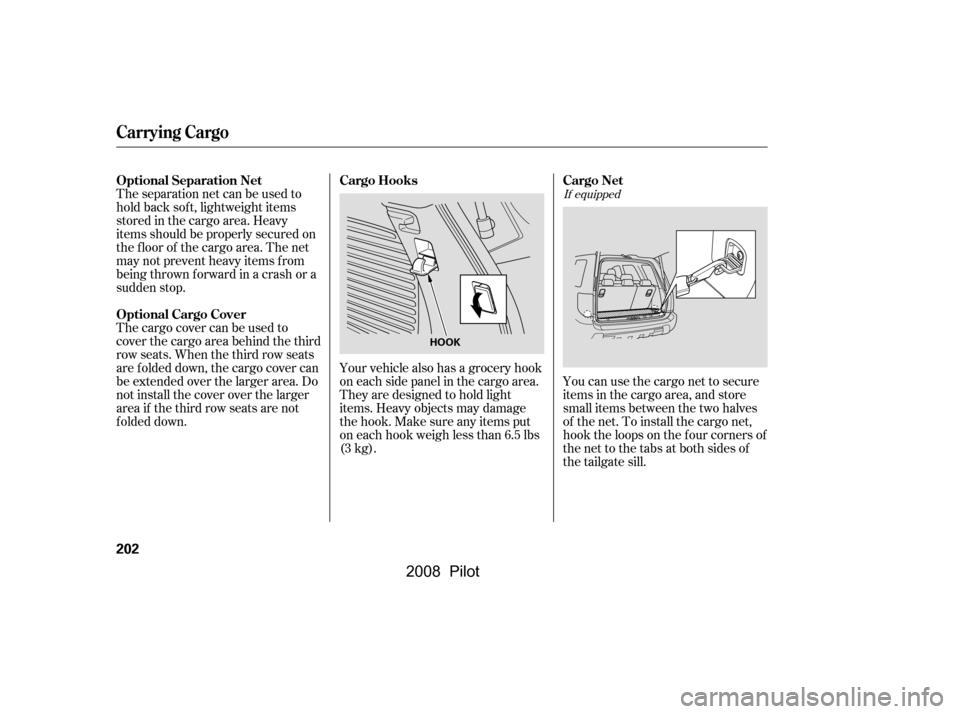
You can use the cargo net to secure
items in the cargo area, and store
small items between the two halves
of the net. To install the cargo net,
hook the loops on the f our corners of
the net to the tabs at both sides of
the tailgate sill.
Your vehicle also has a grocery hook
on each side panel in the cargo area.
They are designed to hold light
items. Heavy objects may damage
the hook. Make sure any items put
on each hook weigh less than 6.5 lbs
(3 kg).
Theseparationnetcanbeusedto
hold back sof t, lightweight items
stored in the cargo area. Heavy
items should be properly secured on
the f loor of the cargo area. The net
may not prevent heavy items f rom
being thrown f orward in a crash or a
sudden stop.
The cargo cover can be used to
cover the cargo area behind the third
row seats. When the third row seats
are folded down, the cargo cover can
be extended over the larger area. Do
not install the cover over the larger
area if the third row seats are not
f olded down.
Carrying Cargo
Cargo Net
Cargo Hooks
Optional Separation Net
Optional Cargo Cover
202
HOOK
�\f���—�\f���—�\f���y�
�
����\f����
�y���
�(���+�����\f�y�\f���\f���y
2008 Pilot
Page 224 of 329

Theweightthatthe
tongue of a f ully loaded trailer puts
on the hitch should be 5 to 10
percent of the total trailer weight for
boat trailers, and 8 to 15 percent of
total trailer weight for all other
trailers. (See page f or limits f or
your towing situation). Too much
tongue load reduces f ront-tire
traction and steering control. Too
little tongue load can make the
trailer unstable and cause it to sway.
Your vehicle has been designed to
tow a trailer, as well as carrying
passengers and their cargo. To
saf ely tow a trailer, you should
caref ully observe the load limits (see
page ), use the proper equipment,
and f ollow the guidelines in this
section.
Be sure to read the
sectiononpage
if you plan to tow of f paved
surf aces.
Towing a trailer that is too heavy can
seriously af f ect your vehicle’s
handling and perf ormance. It can
also damage the engine and
drivetrain.The maximum
allowable weight of the trailer and
everything in or on it depends on the
number of occupants in your vehicle
and the type of trailer being towed
(see page ).
199
223 223
230 Load Limits
Off-Highway
Driving GuidelinesTongue Load:
T ot al T railer Weight :
Towing a Trailer
220
Exceeding any load limit or
improperly loading your vehicle
and trailer can cause a crash in
which you can be seriously hurt
or killed.
Check the loading of your
vehicle and trailer carefully
beforestartingtodrive.
�\f���—�\f���—�\f���y�
�
�����������y���
�(���+�����\f�y�\f�������y
2008 Pilot
Page 225 of 329
The maximum allowable weight of
the vehicle, all occupants, all
accessories, all cargo, and the
tongue load is:The maximum allowable weight of
the vehicle axles is:
The maximum allowable weight of
the f ully loaded vehicle and trailer is
9,700 lbs (4,400 kg) with the proper
hitch and f luid coolers (see page
).
The GCWR must be reduced 2
percent f or every 1,000 f eet (305
meters) of elevation. 225
on the f ront axle
on the rear axle
on the f ront axle
on the rear axle
4WD models:
2WD models: 4WD models:
2WD models:
Towing a Trailer
Gross Vehicle Weight Rating
(GVWR): Gross Axle Weight Rating
(GA WR):Gross Combined Weight Rating
(GCWR):
Driving
221
5,950 lbs (2,700 kg)
5,840 lbs (2,650 kg)2,865 lbs (1,300 kg)
3,155 lbs (1,430 kg)
2,865 lbs (1,300 kg)
3,085 lbs (1,400 kg)
�\f���—�\f���—�\f���y�
�
�����������y���
�(���+�����\f�y�\f�������y
2008 Pilot
Page 226 of 329

Thebestwaytoconfirmthatall
loads are within limits is to check
them at a public scale.
For public scales in your area, check
your local phone book, or contact
your trailer dealer or rental agency
f or assistance.
To help ensure a saf e drive to a scale,
or if you cannot get to a public scale,
we recommend that you estimate
your total trailer weight and tongue
load as described.
Add the weight of your trailer (as
quoted by the manuf acturer) with
everything in or on the trailer. Then
check the tables on page to
make sure you do not exceed the
limit f or your conditions.Park the vehicle on level ground.
Measure f rom the ground to the
bottom of the trailer hitch.
Connect the f ully loaded trailer to
the hitch.
Measure again f rom the ground to
the same spot on the bottom of the
hitch.
Subtract the second measurement
from the first measurement, then
refer to the following table.
1½’’
2¼’’ 3’’
3¾’’ 150 lbs (68 kg)
250 lbs (114 kg)
350 lbs (160 kg)
450 lbs (205 kg)
If thedifferenceismorethan3¾
inch, you have too much load on the
tongue. Redistribute the load or
remove cargo as needed.
1.
2.
3.
4.
5.
223
Towing a Trailer
Estimating Loads If the
difference is: Estimated
tongue load is:
To Estimate the Total Trailer Weight To Estimate the Tongue Load
222
�\f���—�\f���—�\f���y�
�
�������\f���y���
�(���+�����\f�y�\f�������y
2008 Pilot
Page 227 of 329

Number ofOccupants 2
3
4
5
6
7
8
Number of Occupants 2
3
4
5
6
7
8 Equipped with transmission cooler and power steering f luid cooler.
T owing is Not Recommended
Equipped with transmission cooler and power steering f luid cooler.
T owing is Not Recommended
Maximum T otal T railer Weight
Maximum T otal T railer Weight
Maximum T ongue Load
Maximum T ongue Load
Towing a Trailer
Driving
223
Total Trailer Weight and Tongue Load Limits:
BOAT TRAILERS
OTHER TYPES OF TRAILERS
The corresponding weight limits assume occupants fill seats from the front of the vehicle to the back, each occupant weighs 150 lbs (70 kg) and each has 1 5 lbs (7 kg)
of luggage in the cargo area.
4,500 lbs (2,045 kg)
4,500 lbs (2,045 kg)
4,500 lbs (2,045 kg)
4,300 lbs (1,945 kg)
4,100 lbs (1,855 kg) 2,000 lbs (905 kg)
3,500 lbs (1,590 kg)
3,500 lbs (1,590 kg)
3,300 lbs (1,490 kg)
3,100 lbs (1,400 kg)
2,700 lbs (1,220 kg) 1,200 lbs (540 kg) 450 lbs (205 kg)
450 lbs (205 kg)
450 lbs (205 kg)
350 lbs (160 kg)
220 lbs (100 kg)
100 lbs (45 kg)
450 lbs (205 kg)
450 lbs (205 kg)
450 lbs (205 kg)
350 lbs (160 kg)
220 lbs (100 kg) 100 lbs (45 kg)
�\f���—�\f���—�\f���y�
�
�������
���y���
�(���+�����\f�y�\f�������y
2008 Pilot
Page 228 of 329
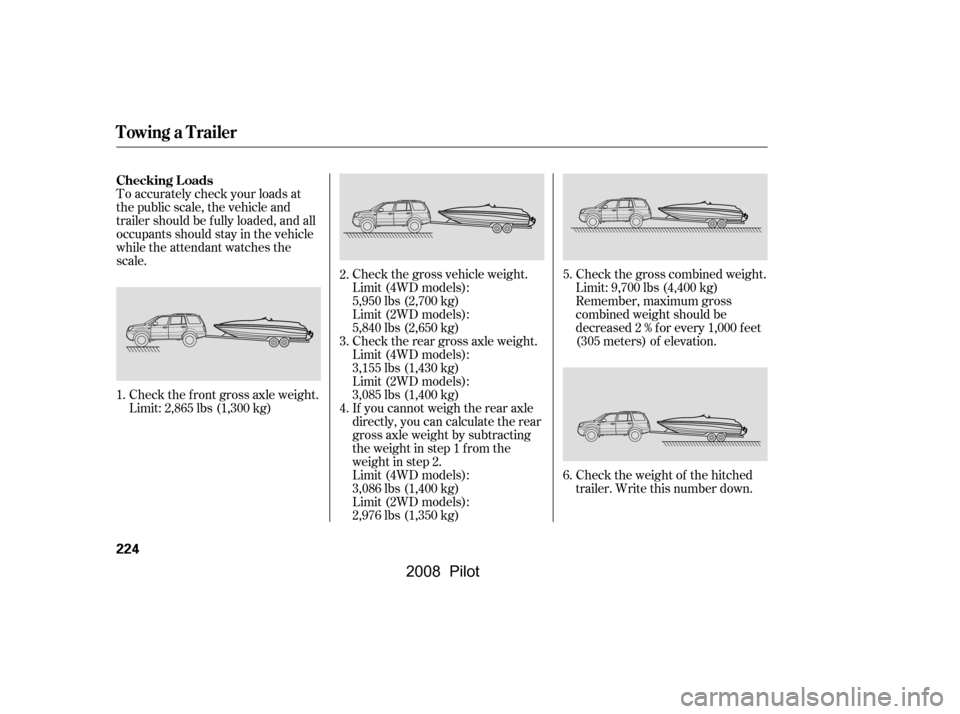
To accurately check your loads at
the public scale, the vehicle and
trailer should be f ully loaded, and all
occupants should stay in the vehicle
while the attendant watches the
scale.Check the f ront gross axle weight.
Limit: 2,865 lbs (1,300 kg) Check the gross combined weight.
Limit: 9,700 lbs (4,400 kg)
Remember, maximum gross
combined weight should be
decreased 2 % f or every 1,000 f eet
(305 meters) of elevation.
Check the weight of the hitched
trailer. Write this number down.
Check the gross vehicle weight.
Limit (4WD models):
5,950 lbs (2,700 kg)
Limit (2WD models):
5,840 lbs (2,650 kg)
Check the rear gross axle weight.
Limit (4WD models):
3,155 lbs (1,430 kg)
Limit (2WD models):
3,085 lbs (1,400 kg)
If you cannot weigh the rear axle
directly, you can calculate the rear
gross axle weight by subtracting
the weight in step 1 from the
weight in step 2.
Limit (4WD models):
3,086 lbs (1,400 kg)
Limit (2WD models):
2,976 lbs (1,350 kg)
1. 2.
3.
4.5.
6.
Towing a Trailer
Checking L oads
224
�\f���—�\f���—�\f���y�
�
�����������y���
�(���+�����\f�y�\f�������y
2008 Pilot