Page 369 of 524

�µ�µ�µ �µ
�µ �µ
�µ
Aggressive driving (hard
acceleration and braking)
Excessive idling, accelerating and
braking in stop-and-go traf f ic
Cold engine operation (engines
aremoreefficientwhenwarmed
up)
Driving with a heavy load or the
air conditioner running
Improperly inf lated tires
An under-inf lated tire increases
‘‘rolling resistance,’’ which reduces
f uel economy.
It puts a heavier
load on the engine, increasing f uel
consumption. In
particular, a build-up of snow or
mud on your vehicle’s underside
adds weight and rolling resistance.
Frequent cleaning helps your f uel
economy.
The f ollowing f actors can lower your
vehicle’s f uel economy:
A properly maintained vehicle
maximizes f uel economy. Poor
maintenance can signif icantly reduce
f uel economy. Always maintain your
vehicle according to the maintenance
messages displayed on the multi-
inf ormation display (see
on page ).
For example: Idling
results in 0 miles per gallon. If your vehicle has a
manual transmission, you can
boost your f uel economy by up
shif ting as early as possible. Aerodynamic drag has a big ef f ect
on f uel mileage at speeds above 45
mph (75 km/h). Reduce your
speed and you reduce the drag.
Trailers, car top carriers, roof
racks and bike racks are also big
contributors to increased drag.
Rapid
acceleration, abrupt cornering,
and hard braking increase fuel
consumption.
415
Fuel Economy Factors
Use the recommended viscosity
motor oil, displaying the A PI
Certif ication Seal (see page ).
Maintain proper tire inf lation
A void carrying excess weight in
your vehicle
K eep your vehicle clean
Improving Fuel Economy
Owner’s
Maintenance Checks Avoid excessive idling Always drive in the highest gear
possible Observe the speed limit
Drive moderately 418
Drive Ef f icient ly
Vehicle Maint enance
Fuel Economy
366
�����—�����—�����y���������������y���
�(�����������y�������
�y
2008 Odyssey
Page 374 of 524
�µ�·
�µ The resulting f igure equals the
available amount of cargo and
luggage load capacity. For
example, if the ‘‘XXX’’ amount
equals 1,400 lbs. and there will be
f ive 150 lb. passengers in your
vehicle, the amount of available
cargo and luggage load capacity is
650 lbs.
(1,400 750 (5 150) = 650 lbs.)
Determine the combined weight
of luggage and cargo being loaded
on the vehicle. That weight may
not saf ely exceed the available
cargo and luggage load capacity
calculated in Step 4.
If your vehicle will be towing a
trailer, load f rom your trailer will
be transf erred to your vehicle.
Consult this manual to determine
how this reduces the available
cargo and luggage load capacity of
your vehicle.
Subtract the combined weight of
the driver and passengers f rom
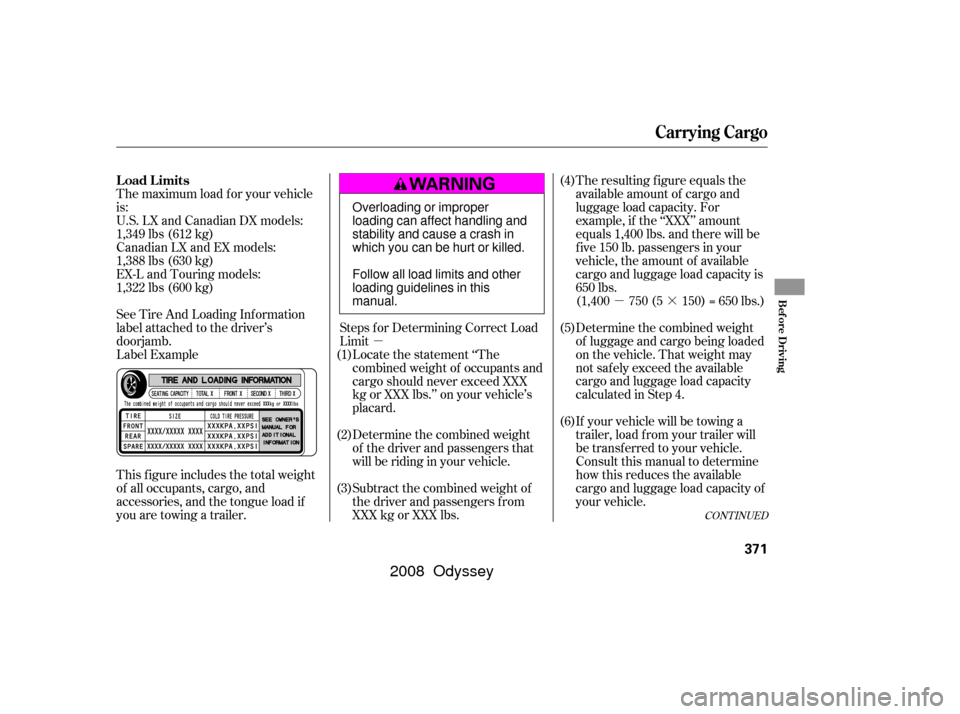
XXX kg or XXX lbs. Locate the statement ‘‘The
combined weight of occupants and
cargo should never exceed XXX
kg or XXX lbs.’’ on your vehicle’s
placard.
Steps f or Determining Correct Load
Limit
The maximum load f or your vehicle
is:
This f igure includes the total weight
of all occupants, cargo, and
accessories, and the tongue load if
you are towing a trailer. Label Example
Determine the combined weight
of the driver and passengers that
will be riding in your vehicle.
See Tire And Loading Inf ormation
label attached to the driver’s
doorjamb.
(1)
(2)
(3) (6) (5) (4)
Canadian LX and EX models:
1,388 lbs (630 kg)
EX-L and Touring models:
1,322 lbs (600 kg) U.S. LX and Canadian DX models:
1,349 lbs (612 kg)
CONT INUED
Load Limits
Carrying Cargo
Bef ore Driving
371
Overloading or improper
loading can affect handling and
stability and cause a crash in
which you can be hurt or killed.
Follow all load limits and other
loading guidelines in this
manual.
�����—�
�
�—�����y�
����
��������y���
�(�����������y���������y
2008 Odyssey
Page 375 of 524
In addition, the total weight of the
vehicle, all occupants, accessories,
cargo, and trailer tongue load must
not exceed the Gross Vehicle
Weight Rating (GVWR) or the Gross
Axle Weight Rating (GAWR). Both
areonalabelonthedriver’s
doorjamb.
MaxloadonEX-LandTouringmodelsisusedintheExamples. Example 1
Example 2
Example 3
Carrying Cargo
372
Passenger Weight
(150 lbs x 2 = 300 lbs)
Passenger Weight
(150 lbs x 4 = 600 lbs)
Passenger Weight
(150 lbs x 5 = 750 lbs)
Max Load (1,322 lbs)
Max Load (1,322 lbs)
Max Load (1,322 lbs) Cargo Weight
(1,022 lbs)
Cargo Weight
(722 lbs)
Cargo Weight
(572 lbs)
�����—�����—�����y���������������y���
�(�����������y���������y
2008 Odyssey
Page 377 of 524
The grocery bag hooks on the back
of the third row seats are designed
to hold plastic grocery bags
containing lightweight items. Heavy
objects may damage the hooks.
If you place items near the rear
windows, be sure they are below
the bottom of the windows. If
cargo is higher, it could interf ere
with proper operation of the side
curtain airbags.
If you carry any items on a roof
rack,besurethetotalweightof
the rack and the items does not
exceed 150 lb (68 kg).
If you use an accessory roof rack,
the roof rack weight limit may be
lower. Ref er to the inf ormation that
came with your roof rack.
Grocery Bag Hooks
Carrying Cargo
374
GROCERY BAG HOOKS
�����—�����—�����y�������������
�y���
�(�����������y���������y
2008 Odyssey
Page 399 of 524
Your vehicle has been designed
primarily to carry passengers and
their cargo. You can also use it to
tow a trailer if you caref ully observe
the load limits, use the proper
equipment, and f ollow the guidelines
in this section.The
maximum allowable weight of the
trailer and everything in or on it
depends on several f actors. See page f or the driving limits f or your
towing situation. Towing a load that
is too heavy can seriously af f ect your
vehicle’s handling and perf ormance.
It can also damage the engine and
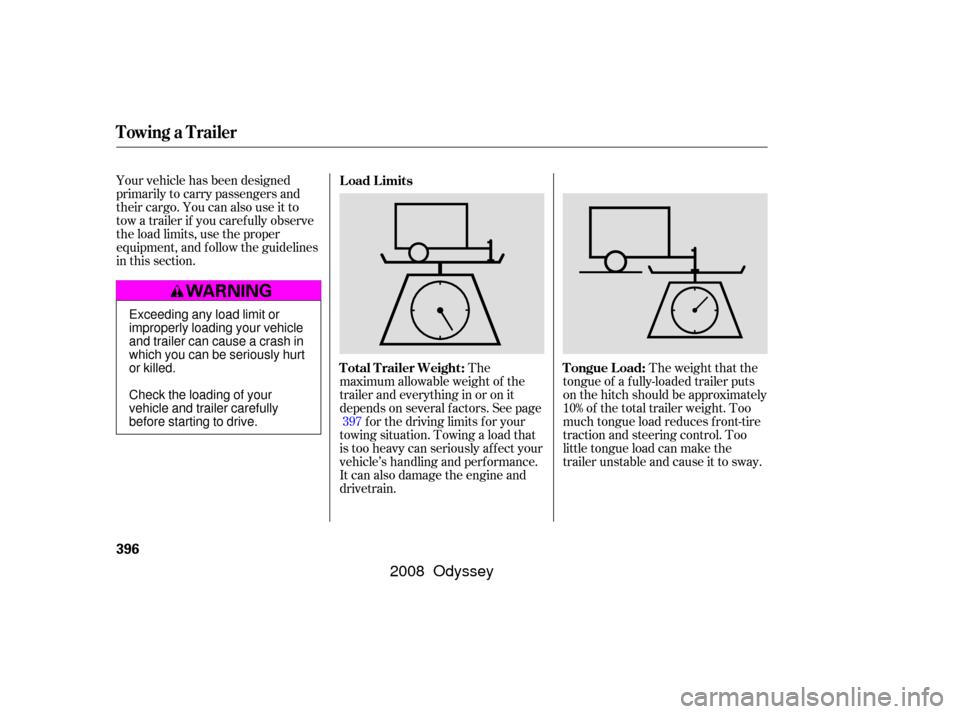
drivetrain. Theweightthatthe
tongue of a f ully-loaded trailer puts
on the hitch should be approximately
10% of the total trailer weight. Too
much tongue load reduces f ront-tire
traction and steering control. Too
little tongue load can make the
trailer unstable and cause it to sway.
397
Load Limits
T otal T railer Weight:
T ongue L oad:
Towing a Trailer
396
Exceeding any load limit or
improperly loading your vehicle
and trailer can cause a crash in
which you can be seriously hurt
or killed.
Check the loading of your
vehicle and trailer carefully
beforestartingtodrive.
�����—�����—�����y���������������y���
�(�����������y�������
�y
2008 Odyssey
Page 400 of 524
�Î
�Î�Î
�Î
�Î
�Î
�Î
�Î
�Î
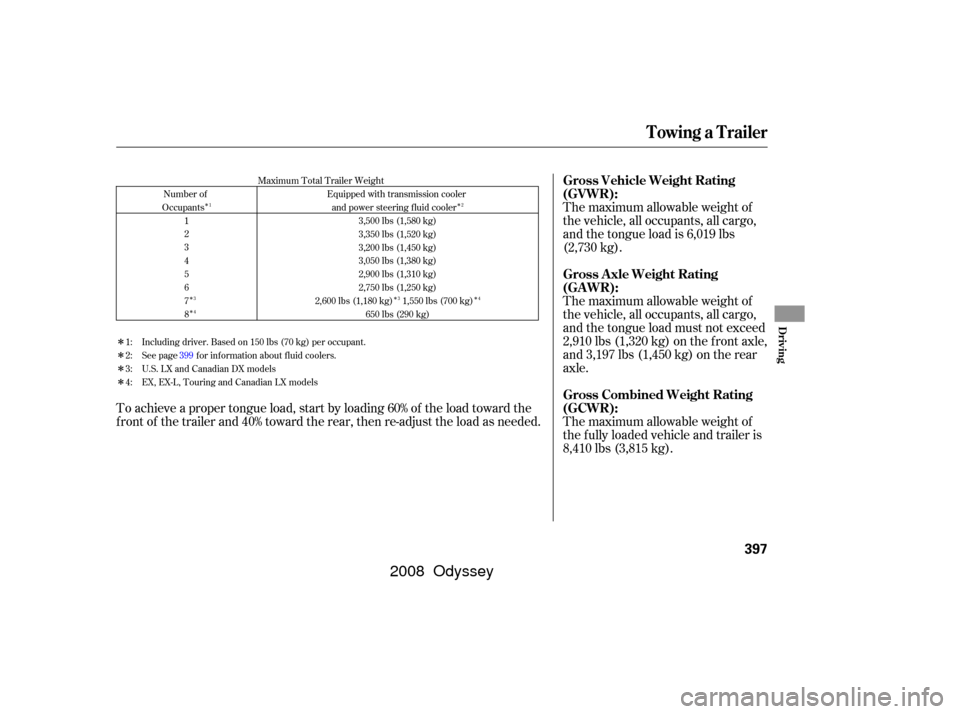
�ΠMaximum Total Trailer Weight
Equipped with transmission coolerand power steering fluid cooler 3,500 lbs (1,580 kg)
3,350 lbs (1,520 kg)
3,200 lbs (1,450 kg)
3,050 lbs (1,380 kg)
2,900 lbs (1,310 kg)
2,750 lbs (1,250 kg)
2,600 lbs (1,180 kg) 1,550 lbs (700 kg) 650 lbs (290 kg)
Including driver. Based on 150 lbs (70 kg) per occupant.
See page for information about fluid coolers. Number of
Occupants 1
2
3
4
5
6
7
8
1:
2:
3:
4: 399
U.S. LX and Canadian DX models
EX, EX-L, Touring and Canadian LX models
2
34
1
3
4
The maximum allowable weight of
the vehicle, all occupants, all cargo,
and the tongue load must not exceed
2,910 lbs (1,320 kg) on the f ront axle,
and 3,197 lbs (1,450 kg) on the rear
axle.
The maximum allowable weight of
the f ully loaded vehicle and trailer is
8,410 lbs (3,815 kg).
To achieve a proper tongue load, start by loading 60% of the load toward the
f ront of the trailer and 40% toward the rear, then re-adjust the load as needed. The maximum allowable weight of
the vehicle, all occupants, all cargo,
and the tongue load is 6,019 lbs
(2,730 kg).
Towing a Trailer
Gross Axle Weight Rating
(GA WR):
Gross Combined Weight Rating
(GCWR): Gross Vehicle Weight Rating
(GVWR):
Driving
397
�����—�
�
�—�����y�
����
��������y���
�(�����������y���������y
2008 Odyssey
Page 401 of 524

Thebestwaytoconfirmthatall
loads are within limits is to check
them at a public scale. For public
scales in your area, check your local
phone book, or contact your trailer
dealer or rental agency for
assistance.
If you cannot get to a public scale,
you can estimate the total trailer
weight by adding the weight of your
trailer (as quoted by the
manuf acturer) with everything in or
on the trailer.Towing generally requires a variety
of supplemental equipment,
depending on the size of your trailer,
how much load you are towing, and
where you tow. To ensure the best
quality, we recommend that you
purchase Honda equipment
whenever possible.
Discuss your needs with your trailer
sales or rental agency, and f ollow the
guidelines in this section. Also make
sure that all equipment is properly
installed and meets f ederal, state,
province, and local regulations.
If you normally pull the same load
each time you tow a trailer, you can
use a suitable scale or a special
tongue load gauge to check the
tongue load the f irst time you set up
a towing combination (a f ully loaded
vehicle and trailer), then recheck the
tongue load whenever the conditions
change.
Checking L oads T owing Equipment and
A ccessories
Towing a Trailer
398
�����—�����—�����y�������������
�y���
�(�����������y���������y
2008 Odyssey
Page 402 of 524

Any hitch used on your vehicle must
be properly bolted to the underbody,
using the six threaded holes
provided. A hitch and the required
f luid coolers designed especially f or
your Odyssey can be obtained f rom
your Honda dealer.
If the total trailer weight is more
than 1,850 lbs (840 kg), you must
also use a weight distributing hitch.
This device transf ers weight f rom
the vehicle’s rear wheels to the f ront
wheels, and to the trailer’s wheels.
Caref ully f ollow the hitch maker’s
instructions f or proper installation
and adjustment.Always use saf ety chains when you
tow a trailer. Make sure the chains
are secured to the trailer and hitch,
and that they cross under the tongue
and can catch the trailer if it
becomes unhitched. Leave enough
slack to allow the trailer to turn
corners easily, but do not let the
chains drag on the ground.
If the total trailer weight exceeds
2,000 lbs (900 kg), you should install
a sway control device to minimize
swaying that can occur in crosswinds
and in normal and emergency
driving maneuvers. Your trailer
maker can tell you what kind of sway
control you need and how to install it.
To help prevent overheating, a
transmission f luid cooler and a
power steering f luid cooler are
required f or trailer towing. These
coolers are available only f rom your
Honda dealer.
Hitches
Weight Distributing Hitch Saf et y Chains Sway Cont rol
T ransmission Fluid Cooler andPower St eering Fluid Cooler
Towing a Trailer
Driving
399
�����—�����—�����y���������������y���
�(�����������y���������y
2008 Odyssey