Page 25 of 524

All seat belts have an emergency
locking retractor. In normal driving,
the retractor lets you move f reely in
your seat while it keeps some
tension on the belt. During a collision
or sudden stop, the retractor
automatically locks the belt to help
restrain your body.
The seat belts in all positions except
the driver’s have a lockable retractor
that must be activated to secure a
child seat (see page ).
The lap/shoulder belt goes over
your shoulder, across your chest,
and across your hips.
To fasten the belt, insert the latch
plate into the buckle, then tug on the
belt to make sure the buckle is
latched (see page f or how to
properly position the belt).
If the indicator comes on or the
beeper sounds when the driver’s seat
belt is latched and there is no f ront
seat passenger and no items on the
front seat, something may be
interf ering with the monitoring
system. Look f or and remove:
To unlock the belt, press the red
PRESSbuttononthebuckle.Guide
the belt across your body so that it
retracts completely. Af ter exiting the
vehicle, be sure the belt is out of the
way and will not get closed in the
door.
Any items under the f ront
passenger’s seat.
Any object(s) hanging on the seat
or in the seat-back pocket.
If no obstructions are f ound, have
your vehicle checked by a dealer. Any objects, such as a f olded-down
second row seat, that is touching
the rear of the seat-back.
52
15
L ap/Shoulder Belt
Additional Inf ormation About Your Seat Belts
22
�����—�����—�����y���������������y���
�(�����������y���������y
2008 Odyssey
Page 26 of 524
CONT INUED
If the shoulder part of the belt is
pulled all the way out, the lockable
retractor will activate. The belt will
retract, but it will not allow the
passenger to move f reely.
To deactivate the lockable retractor,
unlatch the buckle and let the seat
belt fully retract. To refasten the
seat belt, pull it out only as f ar as
needed.For added protection, the f ront seat
belts are equipped with automatic
seat belt tensioners. When activated,
the tensioners immediately tighten
the belts to help hold the driver and
a f ront passenger in position.
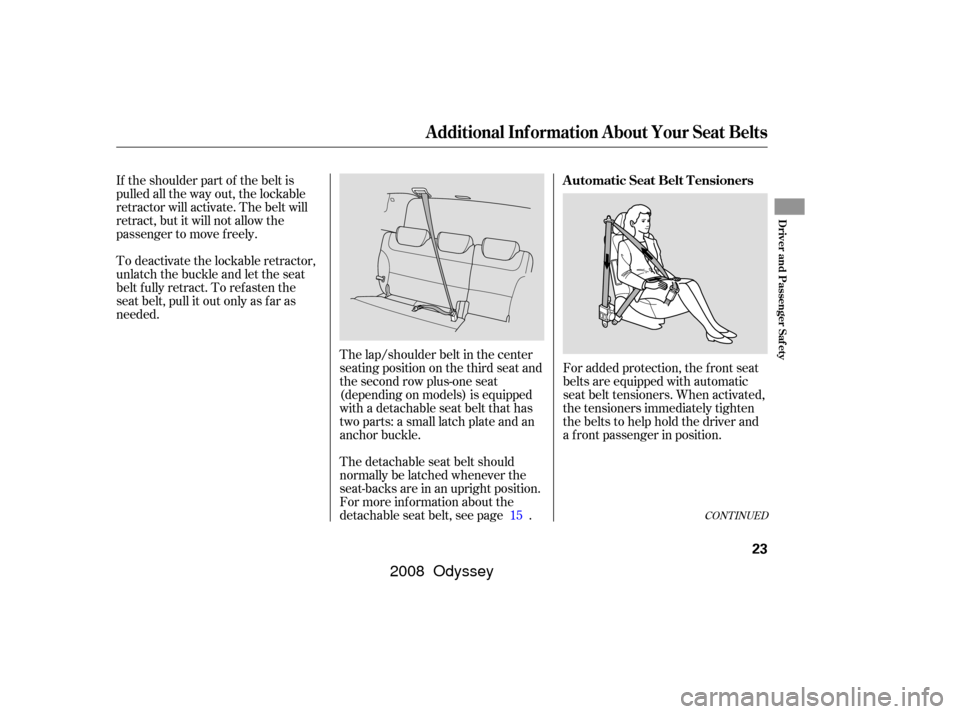
The lap/shoulder belt in the center
seating position on the third seat and
the second row plus-one seat
(depending on models) is equipped
with a detachable seat belt that has
two parts: a small latch plate and an
anchor buckle.
The detachable seat belt should
normally be latched whenever the
seat-backs are in an upright position.
For more inf ormation about the
detachable seat belt, see page .
15
Additional Inf ormation About Your Seat Belts
A utomatic Seat Belt T ensioners
Driver and Passenger Saf ety
23
�����—�����—�����y���������������y���
�(�����������y���������y
2008 Odyssey
Page 28 of 524
CONT INUED
A irbag System Components
Additional Inf ormation About Your Airbags
Driver and Passenger Saf ety
25
(8) Front Passenger’s Weight Sensors
(9) Front Impact Sensors
(10) Passenger Airbag Off Indicator
(11) Side Impact Sensors (1) Driver’s Front Airbag
(2) Passenger’s Front Airbag
(3) Control Unit
(4) Front Seat Belt Tensioners
(5) Side Airbags
(6) Side Curtain Airbags
(7) Driver’s Seat Position Sensor
(15) Supplemental Restraint System(SRS) Indicator
(12) Occupant Position Detection
System (OPDS) Sensors
(13) Front Passenger’s Weight Sensors/ OPDS Sensors Control Unit
(14) Rear Safing Sensor
(9) (2)
(15) (5)
(11)
(4) (11)
(6)
(11)
(14)
(11)
(1)
(3) (11) (4)
(7) (11) (8)
(5) (12)
(13)
(10)
�����—�����—�����y���������������y���
�(�����������y���������y
2008 Odyssey
Page 29 of 524

Your airbag system includes:Two SRS (supplemental restraint
system) f ront airbags. The driver’s
airbag is stored in the center of
the steering wheel; the f ront
passenger’sairbagisstoredinthe
dashboard. Both are marked ‘‘SRS
AIRBAG’’ (see page ).
Two side airbags, one f or the
driver and one f or a f ront
passenger. The airbags are stored
in the outer edges of the seat-
backs. Both are marked ‘‘SIDE
AIRBAG’’ (see page ). Two side curtain airbags, one f or
each side of the vehicle. The
airbags are stored in the ceiling,
above the side windows. The f ront
and rear pillars are marked ‘‘SIDE
CURTAIN AIRBAG’’ (see page
). Sensors that can detect whether
the driver’s seat belt and the f ront
passenger’s seat belt are latched
or unlatched (see page ).
A driver’s seat position sensor that
monitors the distance of the seat
from the front airbag. If the seat is
too f ar f orward, the airbag will
inf late with less f orce (see page
).
Weight sensors that monitor the
weight on the f ront passenger’s
seat. If the weight is about 65 lbs
(29 kg) or less (the weight of an
inf ant or small child), the
passenger’s f ront airbag will be
turned of f (see page ).
Automatic front seat belt
tensioners (see page ).
Sensors that can detect a
moderate to severe front impact,
side impact, or if your vehicle is
about to rollover.
Sensors that can detect whether a
child is in the passenger’s side
airbag path and signal the control
unit to turn the airbag of f (see
page ).
27
23
30
31 33
32 30
21
Additional Inf ormation About Your Airbags
26
�����—�����—�����y�����������
���y���
�(�����������y�������
�y
2008 Odyssey
Page 30 of 524

If you ever have a moderate to
severe f rontal collision, sensors will
detect the vehicle’s rapid
deceleration.
If the rate of deceleration is high
enough, the control unit will instantly
inf late the driver’s and f ront
passenger’s airbags, at the time and
with the f orce needed.
A rollover sensor that can detect if
your vehicle is about to roll over
and signal the control unit to
deploy both side curtain airbags
and f ront seat belt tensioners (see
page ).
A sophisticated electronic system
that continually monitors and
records inf ormation about the
sensors, the control unit, the
airbag activators, the seat belt
tensioners, and driver and f ront
passenger seat belt use when the
ignition switch is in the ON (II)
position.
An indicator on the instrument
panel that alerts you to a possible
problem with your airbags,
sensors, or seat belt tensioners
(see page ).
An indicator on the instrument
panel that alerts you that the
passenger’s side airbag has been
turned of f (see page ).
An indicator on the dashboard that
alerts you that the passenger’s
f ront airbag has been turned of f
(see page ).
Emergency backup power in case
your vehicle’s electrical system is
disconnected in a crash.
33
34 35
35
CONT INUED
How Your Front Airbags Work
Additional Inf ormation About Your Airbags
Driver and Passenger Saf ety
27
�����—�����—�����y�������������
�y���
�(�����������y���������y
2008 Odyssey
Page 31 of 524
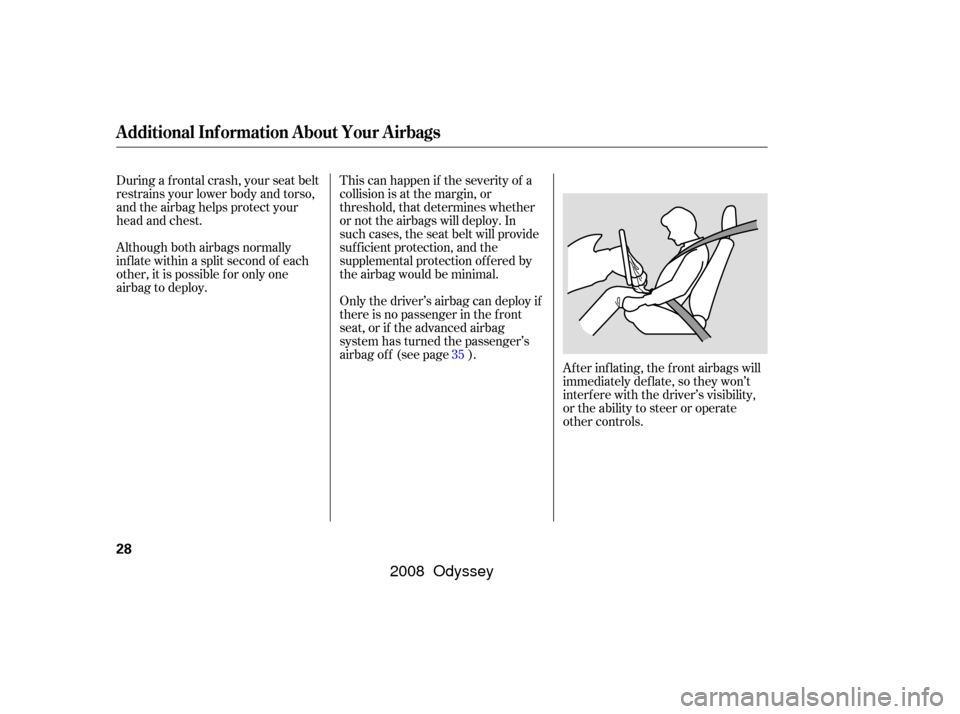
Af ter inf lating, the f ront airbags will
immediately def late, so they won’t
interf ere with the driver’s visibility,
or the ability to steer or operate
other controls.
During a f rontal crash, your seat belt
restrains your lower body and torso,
and the airbag helps protect your
head and chest.
Although both airbags normally
inf late within a split second of each
other, it is possible f or only one
airbag to deploy.
This can happen if the severity of a
collision is at the margin, or
threshold, that determines whether
or not the airbags will deploy. In
such cases, the seat belt will provide
suf f icient protection, and the
supplemental protection of f ered by
the airbag would be minimal.
Only the driver’s airbag can deploy if
there is no passenger in the f ront
seat, or if the advanced airbag
system has turned the passenger’s
airbag off (see page ).
35
Additional Inf ormation About Your Airbags
28
�����—�����—�����y���������������y���
�(�����������y���������y
2008 Odyssey
Page 32 of 524

Your f ront airbags are also dual-
threshold airbags. Airbags with this
f eature have two deployment
thresholds that depend on whether
sensors detect the occupant is
wearing a seat belt or not.
If the occupant’s belt is ,
the airbag will deploy at a slightly
lower threshold, because the
occupant would need extra
protection.
Your f ront airbags are dual-stage
airbags. This means they have two
inf lation stages that can be ignited
sequentially or simultaneously,
depending on crash severity.
In a crash, both stages
will ignite simultaneously to provide
the quickest and greatest protection.
In a crash, one stage will
ignite first, then the second stage
will ignite a split second later. This
provides longer airbag inf lation time
with a little less force.
The total time for inflation and
def lation is one-tenth of a second, so
f ast that most occupants are not
aware that the airbags deployed until
they see them lying in their laps.
After a crash, you may see what
looks like smoke. This is actually
powder f rom the airbag’s surf ace.
Although the powder is not harmf ul,
people with respiratory problems
mayexperiencesometemporary
discomf ort. If this occurs, get out of
the vehicle as soon as it is saf e to do
so.
If the occupant’s belt is , the
airbag will inf late at a slightly higher
threshold, when the airbag would be
needed to supplement the protection
provided by the seat belt.
CONT INUED
Dual-T hreshold A irbags
not lat ched
Dual-Stage A irbags
more severeless severe latched
Additional Inf ormation About Your Airbags
Driver and Passenger Saf ety
29
�����—�����—�����y���������������y���
�(�����������y���������y
2008 Odyssey
Page 33 of 524
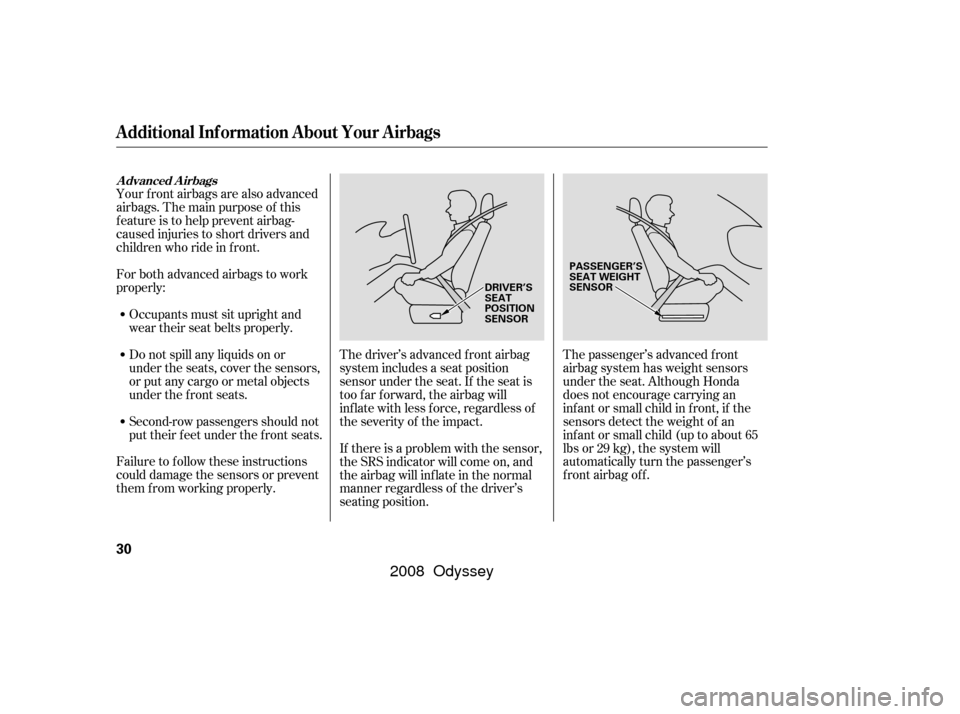
The driver’s advanced front airbag
system includes a seat position
sensor under the seat. If the seat is
too f ar f orward, the airbag will
inf late with less f orce, regardless of
the severity of the impact.
Your f ront airbags are also advanced
airbags. The main purpose of this
feature is to help prevent airbag-
caused injuries to short drivers and
children who ride in f ront.
For both advanced airbags to work
properly:
Occupants must sit upright and
wear their seat belts properly.
Do not spill any liquids on or
under the seats, cover the sensors,
or put any cargo or metal objects
under the f ront seats.
Failure to f ollow these instructions
could damage the sensors or prevent
them f rom working properly. If there is a problem with the sensor,
the SRS indicator will come on, and
the airbag will inf late in the normal
manner regardless of the driver’s
seating position.
Second-row passengers should not
put their f eet under the f ront seats. The passenger’s advanced f ront
airbag system has weight sensors
under the seat. Although Honda
does not encourage carrying an
inf ant or small child in f ront, if the
sensors detect the weight of an
inf ant or small child (up to about 65
lbs or 29 kg), the system will
automatically turn the passenger’s
front airbag off.
Additional Inf ormation About Your Airbags
Advanced Airbags
30
DRIVER’S
SEAT
POSITION
SENSOR
PASSENGER’S
SEAT WEIGHT
SENSOR
�����—�����—�����y���������������y���
�(�����������y���������y
2008 Odyssey
