Page 148 of 280
�Î
�Î
Raising your vehicle with a
non-Honda suspension kit can
af f ect the handling and stability.
Removing parts f rom your vehicle,
or replacing components, with
non-Honda components could
seriously af f ect your vehicle’s
handling, stability, and reliability.
Lowering the vehicle with a non-
Honda suspension kit that
signif icantly reduces ground
clearance can allow the
undercarriage to hit speed bumps
or other raised objects, which
could cause the airbags to deploy.
Herearesomeexamples:
Non-Honda wheels, because they
are a universal design, can cause
excessive stress on suspension
components and will not be
compatible with the tire pressure
monitoring system (TPMS) .
Larger or smaller wheels and tires
can interf ere with the operation of
your vehicle’s anti-lock brakes and
other systems.
Modif ying your steering wheel or
any other part of your vehicle’s
safety features can make the
systems inef f ective.
If you plan to modif y your vehicle,
consult your dealer. : If equipped
A ccessories and Modif ications
Modif ying Your Vehicle
Bef ore Driving
145
�\f���—�\f���—�����y���\f�������
���y���
�(�������
�\f�y�\f�
���\f�y
2008 Fit
Page 154 of 280
�Î�Î
�Î
This section gives you tips on
starting the engine under various
conditions, and how to operate the
manual and automatic transmissions.
It also includes important
information on parking your vehicle,
the braking system, and the tire
pressure monitoring system
(TPMS) .........................
Driving Guidelines .152
........................
Preparing to Drive .153
.......................
Starting the Engine .154
...................
Manual Transmission .155
..............
Automatic Transmission .157
Driving with the Paddle
.................
Shif ters (Sport only) .162
...........................................
Parking .166
.............................
Braking System .167
...............
Anti-lock Brakes (ABS) .168
Tire Pressure Monitoring
......................
System (TPMS) .170
...........................
Towing a Trailer .173
: If equipped
Driving
Driving
151
�\f���—�\f���—�����y���\f�������\f���y���
�(�������
�\f�y�\f�
�����y
2008 Fit
Page 157 of 280

Apply the parking brake.
In cold weather, turn of f all
electrical accessories to reduce
the drain on the battery.Without touching the accelerator
pedal, turn the ignition key to the
START (III) position. Do not hold
the key in the START (III)
position f or more than 15 seconds
at a time. If the engine does not
start right away, pause for at least
10 seconds bef ore trying again.
Make sure the shif t lever is in
Park. Press on the brake pedal.
Press the clutch pedal down all the
way. The START (III) position
does not f unction unless the clutch
pedal is pressed.
If the engine does not start within
15 seconds, or starts but stalls
right away, repeat step 4 with the
accelerator pedal pressed halfway
down. If the engine starts, release
pressure on the accelerator pedal
so the engine does not race.If the engine fails to start, press
the accelerator pedal all the way
down, and hold it there while
starting to clear flooding. If the
engine still does not start, return
to step 5.
1.
2.
3. 4.
5.6.
Manual transmission:
Automatic transmission:
Starting the Engine
154
T he immobilizer system protects your
vehicle f rom thef t. If an improperly-
coded key (or other device) is used, the
engine’s f uel system is disabled. For
more inf ormation, see page . The engine is harder to start in cold
weather. Also, the thinner air f ound at
altitudes above 8,000 f eet (2,400
meters) adds to this problem.
77
�\f���—�\f���—�����y���\f�����������y���
�(�������
�\f�y�\f�
�����y
2008 Fit
Page 158 of 280
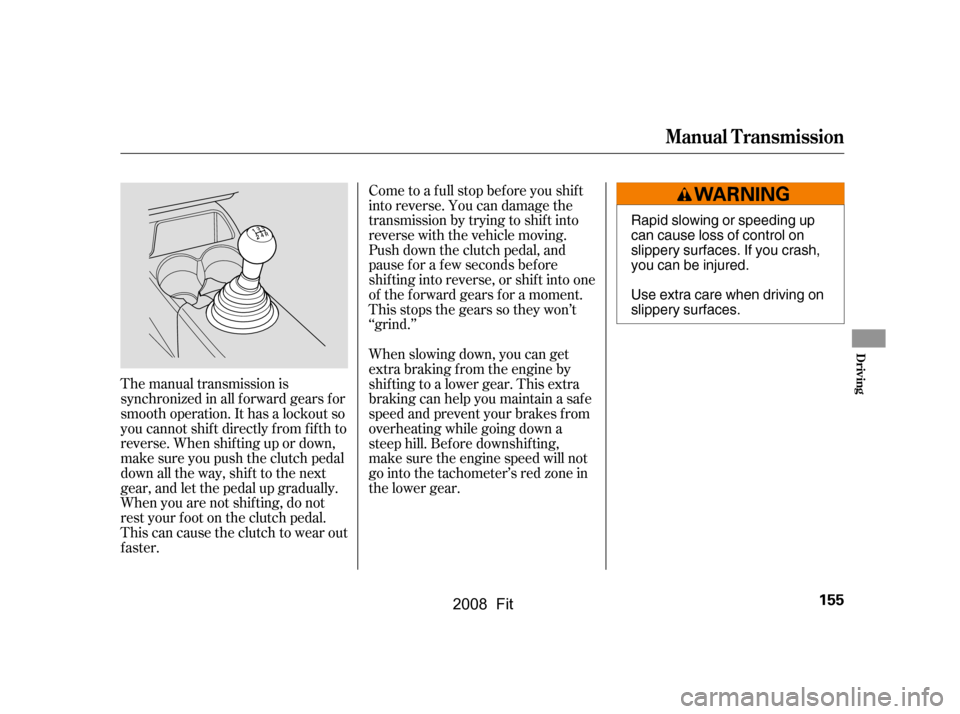
Come to a full stop before you shift
into reverse. You can damage the
transmission by trying to shift into
reverse with the vehicle moving.
Push down the clutch pedal, and
pause f or a f ew seconds bef ore
shif ting into reverse, or shif t into one
of the f orward gears f or a moment.
This stops the gears so they won’t
‘‘grind.’’
The manual transmission is
synchronized in all f orward gears f or
smooth operation. It has a lockout so
you cannot shift directly from fifth to
reverse. When shif ting up or down,
make sure you push the clutch pedal
down all the way, shift to the next
gear, and let the pedal up gradually.
When you are not shif ting, do not
rest your f oot on the clutch pedal.
This can cause the clutch to wear out
f aster. When slowing down, you can get
extra braking f rom the engine by
shifting to a lower gear. This extra
braking can help you maintain a safe
speed and prevent your brakes f rom
overheating while going down a
steep hill. Bef ore downshif ting,
make sure the engine speed will not
go into the tachometer’s red zone in
the lower gear.
Manual T ransmission
Driving
155
Rapid slowing or speeding up
can cause loss of control on
slippery surfaces. If you crash,
you can be injured.
Use extra care when driving on
slippery surfaces.
�\f���—�\f���—�����y���\f�����������y���
�(�������
�\f�y�\f�
���\f�y
2008 Fit
Page 160 of 280
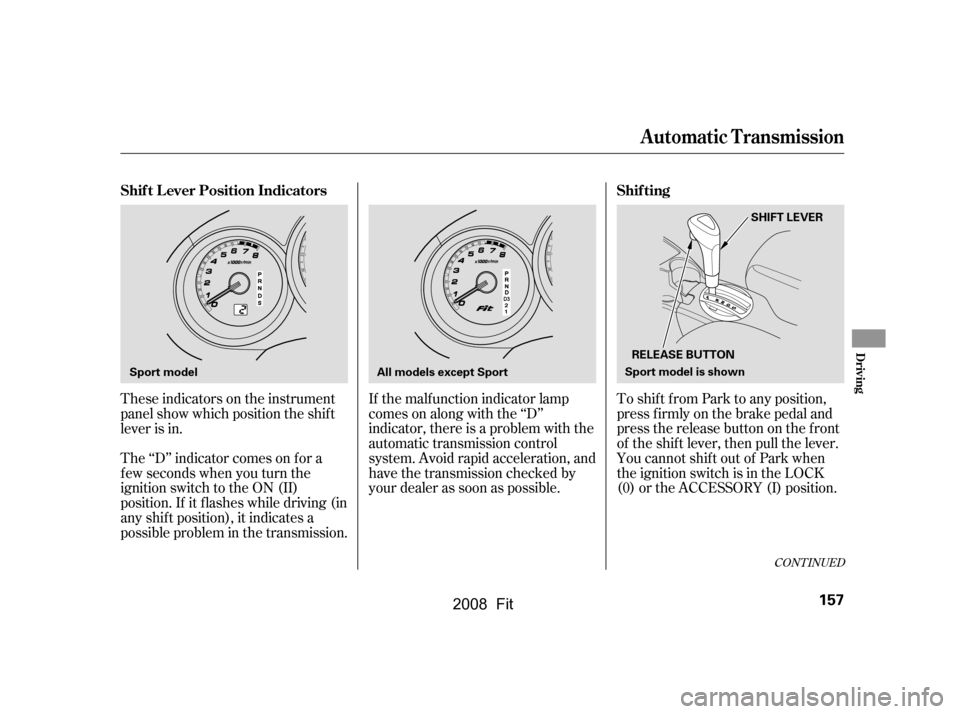
These indicators on the instrument
panel show which position the shif t
lever is in.
The ‘‘D’’ indicator comes on f or a
f ew seconds when you turn the
ignition switch to the ON (II)
position. If it f lashes while driving (in
any shif t position), it indicates a
possible problem in the transmission.If the malf unction indicator lamp
comes on along with the ‘‘D’’
indicator, there is a problem with the
automatic transmission control
system. Avoid rapid acceleration, and
have the transmission checked by
your dealer as soon as possible.
To shif t f rom Park to any position,
press firmly on the brake pedal and
pressthereleasebuttononthefront
of the shif t lever, then pull the lever.
YoucannotshiftoutofParkwhen
the ignition switch is in the LOCK
(0) or the ACCESSORY (I) position.
CONT INUED
Shif t L ever Position Indicators Shif ting
Automatic Transmission
Driving
157
SHIFT LEVER
RELEASE BUTTON
Sport model All models except Sport Sport model is shown
�\f���—�\f���—�����y���\f�����������y���
�(�������
�\f�y�\f�
�����y
2008 Fit
Page 161 of 280
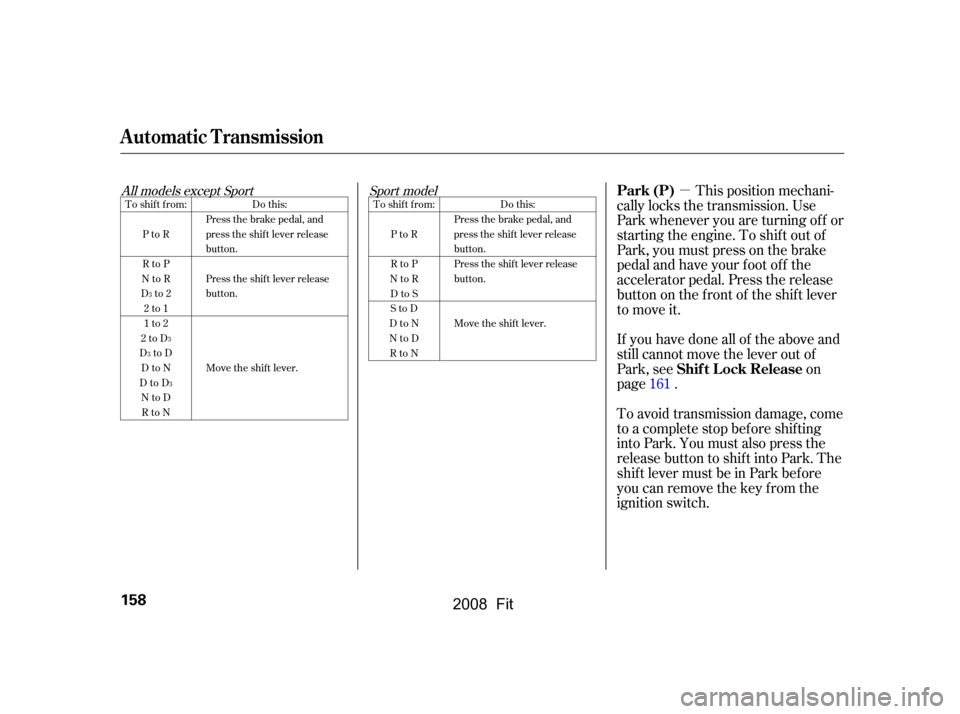
�µThis position mechani-
cally locks the transmission. Use
Park whenever you are turning of f or
starting the engine. To shif t out of
Park, you must press on the brake
pedal and have your f oot of f the
accelerator pedal. Press the release
buttononthefrontof theshiftlever
to move it.
If you have done all of the above and
still cannot move the lever out of
Park, see on
page .
To avoid transmission damage, come
to a complete stop bef ore shif ting
into Park. You must also press the
release button to shift into Park. The
shif t lever must be in Park bef ore
you can remove the key f rom the
ignition switch. 161To shift from:
PtoR
RtoP
NtoR DtoS
StoD
DtoN
NtoD RtoN Do this:
Press the brake pedal, and
press the shift lever release
button.
Press the shift lever release
button.
Move the shift lever.
Do this:
Press the brake pedal, and
press the shift lever release
button.
Press the shift lever release
button.
Move the shift lever.
To shift from:
PtoR
RtoP
NtoR
Dto2 2to1
1to2
2toD
DtoD DtoN
DtoD NtoDRtoN
3
3
3
3
All models except Sport Sport modelPark (P)
Shif t L ock Release
Automatic Transmission
158
�\f���—�\f���—�����y���\f�����������y���
�(�������
�\f�y�\f�
�����y
2008 Fit
Page 162 of 280
�µ
�µ �µ
�µ �µ
CONT INUED
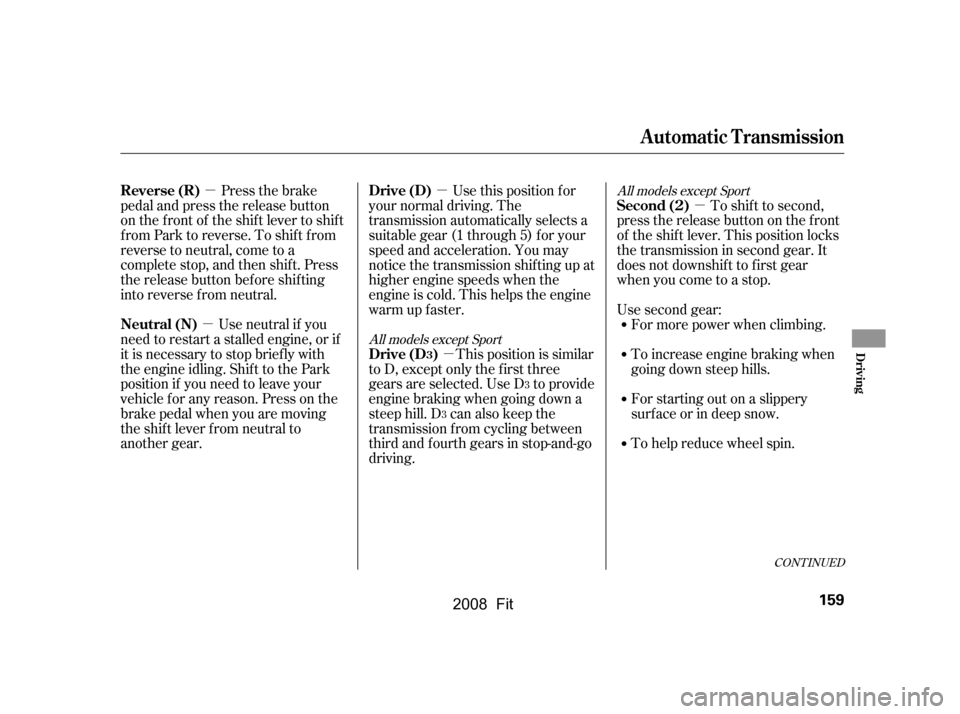
Press the brake
pedal and press the release button
on the f ront of the shif t lever to shif t
f rom Park to reverse. To shif t f rom
reverse to neutral, come to a
completestop,andthenshift.Press
the release button bef ore shif ting
into reverse f rom neutral.
Use neutral if you
need to restart a stalled engine, or if
it is necessary to stop brief ly with
the engine idling. Shif t to the Park
position if you need to leave your
vehicle for any reason. Press on the
brake pedal when you are moving
the shift lever from neutral to
another gear. Use this position f or
your normal driving. The
transmission automatically selects a
suitable gear (1 through 5) f or your
speed and acceleration. You may
notice the transmission shif ting up at
higher engine speeds when the
engine is cold. This helps the engine
warm up f aster.
This position is similar
to D, except only the first three
gears are selected. Use D to provide
engine braking when going down a
steep hill. D can also keep the
transmission f rom cycling between
third and f ourth gears in stop-and-go
driving. To shif t to second,
pressthereleasebuttononthefront
of the shif t lever. This position locks
the transmission in second gear. It
does not downshif t to f irst gear
when you come to a stop.
Use second gear:
For more power when climbing.
To help reduce wheel spin.
For starting out on a slippery
surf ace or in deep snow.
To increase engine braking when
going down steep hills.
3
3
All models except Sport All models except Sport
Automatic Transmission
Reverse (R)
Neutral (N)
Drive (D)
Drive (D )Second (2)
3Driving
159
�\f���—�\f���—�����y���\f�������\f�
�y���
�(�������
�\f�y�\f�
�����y
2008 Fit
Page 164 of 280
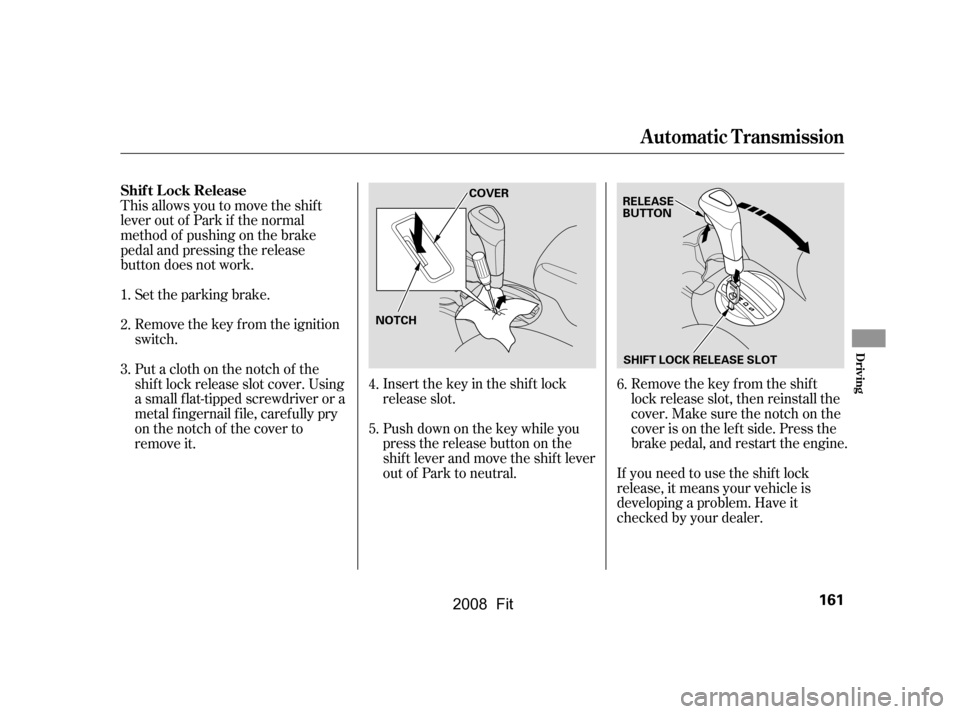
This allows you to move the shif t
lever out of Park if the normal
method of pushing on the brake
pedal and pressing the release
button does not work.Set the parking brake.
Remove the key from the ignition
switch.
Push down on the key while you
pressthereleasebuttononthe
shif t lever and move the shif t lever
out of Park to neutral.
Insert the key in the shift lock
release slot.Remove the key from the shift
lock release slot, then reinstall the
cover. Make sure the notch on the
cover is on the lef t side. Press the
brake pedal, and restart the engine.
If you need to use the shif t lock
release, it means your vehicle is
developing a problem. Have it
checked by your dealer.
Putaclothonthenotchof the
shif t lock release slot cover. Using
a small f lat-tipped screwdriver or a
metal f ingernail f ile, caref ully pry
on the notch of the cover to
remove it.
1.
2.
3.
4.
5.6.
Shif t L ock Release
Automatic Transmission
Driving
161
COVER
RELEASE
BUTTON
SHIFT LOCK RELEASE SLOT
NOTCH
�\f���—�\f���—�����y���\f�������
���y���
�(�������
�\f�y�\f�
�����y
2008 Fit