Page 325 of 413
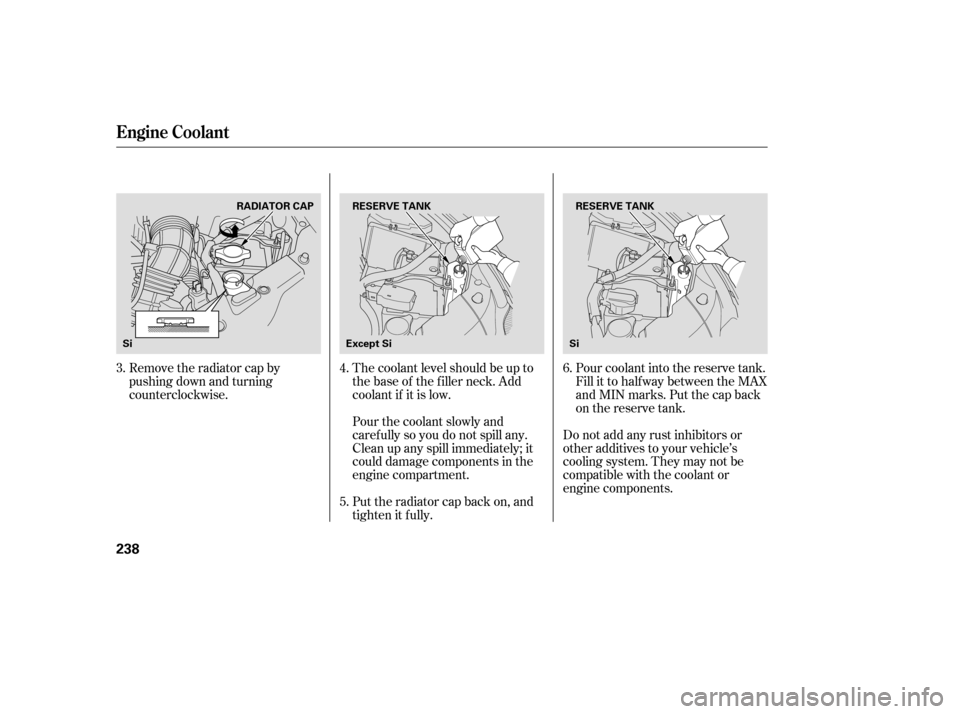
Pour coolant into the reserve tank.
Fill it to half way between the MAX
and MIN marks. Put the cap back
on the reserve tank.
Do not add any rust inhibitors or
other additives to your vehicle’s
cooling system. They may not be
compatible with the coolant or
engine components.
The coolant level should be up to
the base of the f iller neck. Add
coolant if it is low.
Pourthecoolantslowlyand
caref ully so you do not spill any.
Clean up any spill immediately; it
could damage components in the
engine compartment.
Put the radiator cap back on, and
tighten it fully.
Remove the radiator cap by
pushing down and turning
counterclockwise.
3.
4. 5.6.
Engine Coolant
238
RADIATOR CAP
RESERVE TANK
RESERVE TANK
Si Except SiSi
�����—�����—�����y���
��
��������y���
�(�#���������y���������y
Page 327 of 413
Check the f luid level with the engine
at normal operating temperature.If the level is below the lower
mark, add f luid into the dipstick
hole to bring it to the level
between the upper and lower
marks.
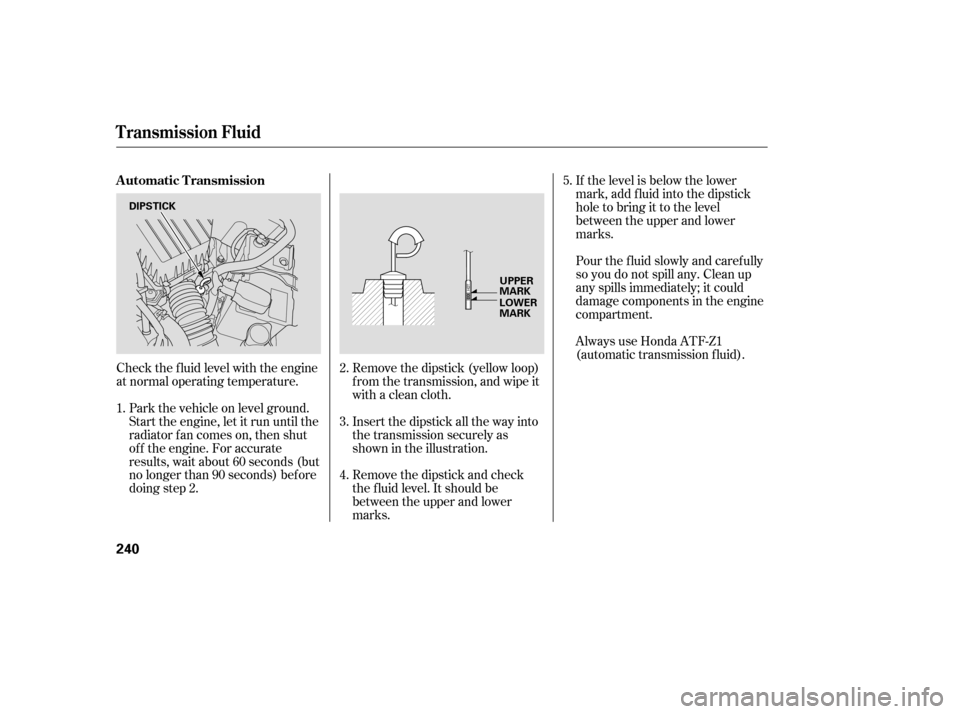
Remove the dipstick and check
the f luid level. It should be
between the upper and lower
marks.
Insert the dipstick all the way into
the transmission securely as
shown in the illustration.
Remove the dipstick (yellow loop)
f rom the transmission, and wipe it
with a clean cloth. Pour the f luid slowly and caref ully
so you do not spill any. Clean up
any spills immediately; it could
damage components in the engine
compartment.
Always use Honda ATF-Z1
(automatic transmission f luid).
Park the vehicle on level ground.
Start the engine, let it run until the
radiator f an comes on, then shut
of f the engine. For accurate
results, wait about 60 seconds (but
no longer than 90 seconds) bef ore
doing step 2. 3. 4. 5.
1. 2.
T ransmission Fluid
Automatic Transmission
240
DIPSTICK
LOWER
MARK
UPPER
MARK
�����—�����—�����y���
��
����
���y���
�(�#���������y���������y
Page 370 of 413

Put the radiator cap back on
tightly. Run the engine, and check
the temperature gauge. If it goes
back to the red mark, the engine
needs repair (seeon page ).
If you do not see steam or spray,
leave the engine running and
watch the temperature gauge. If
the high heat is due to overloading,
the engine should start to cool
down almost immediately. If it
does, wait until the temperature
gauge comes down to the midpoint,
then continue driving.
If the temperature gauge stays at
the red mark, turn of f the engine.
Look f or any obvious coolant leaks,
such as a split radiator hose.
Everything is still extremely hot,
so use caution. If you f ind a leak, it
must be repaired bef ore you
continue driving (see
on page ).
If you don’t f ind an obvious leak,
check the coolant level in the
radiator reserve tank (see page ). Add coolant if the level is
below the MIN mark. Start the engine, and set the
temperature control dial to
maximum heat. Add coolant to the
radiator up to the base of the f iller
neck. If you do not have the
proper coolant mixture available,
you can add plain water.
Remember to have the cooling
system drained and ref illed with
the proper mixture as soon as you
can.
If the temperature stays normal,
check the coolant level in the
radiator reserve tank. If it has
gone down, add coolant to the
MAX mark. Put the cap back on
tightly.
Using gloves or a large heavy
cloth, turn the radiator cap
counterclockwise, without pushing
down, to the f irst stop. Af ter the
pressure releases, push down on
the cap, and turn it until it comes
off.
If there was no coolant in the
reserve tank, you may need to add
coolant to the radiator. Let the
engine cool down until the reading
reaches the middle of the
temperature gauge or lower
bef ore checking the radiator.
7. 8. 9.
3. 4. 5. 6. 10. 11.
286
185 286
Emergency
Towing
Emergency
Towing
If theEngineOverheats
276
Removing the radiator cap
while the engine is hot can
cause the coolant to spray out,
seriously scalding you.
Always let the engine and
radiator cool down before
removing the radiator cap.
�����—�����—�����y���
��
��������y���
�(�#���������y�������
�y
Page 409 of 413

�Î..................................
Saf ety Belts . 8, 18
.........
Safety Defects, Reporting . 308
.................................
Saf ety Features . 7
...........................................
Airbags . 9
.......................................
Seat Belts . 8
.............
Saf ety Labels, Location of . 52
..............................
Saf ety Messages . iii
.....................................
Seat Belts . 8, 18
...............
Additional Information . 18
Automatic Seat Belt
...............................
Tensioners . 19
................
Lap/Shoulder Belt . 14, 19
........................
Maintenance . 20, 250
Reminder Light and
................................
Beeper . 18, 59
..............
Panel Brightness Control . 73
........................
Park Gear Position . 203
...........................................
Parking . 206
...............................
Parking Brake . 103
Parking Brake and Brake
.................
System Indicator . 59, 279
.................................
Parking Lights . 72
..
Parking Over Things that Burn . 302
........................
Playing a Disc . 124, 144
.........................
Playing a PC Card . 153
..................
Playing the Radio . 115, 132
.............................
PGM-FI System . 301
.........
Pregnancy, Using Seat Belts . 16
.........
Protecting Adults and Teens . 11
...
Additional Safety Precautions . 17
.....
Advice f or Pregnant Women . 16
........................
Protecting Children . 33
.....................
General Guidelines . 33
...........................
Protecting Inf ants . 38
...........
Protecting Larger Children . 47
.............
Protecting Small Children . 39 ...................
Radiator Overheating . 275
.............
Radio/CD Sound System . 114
Radio/CD/PC Card Sound
........................................
System . 132
...........................
Readiness Codes . 278
Rear Lights, Bulb
.......................
Replacement . 247-249
..........................
Rear Seat, Folding . 95
..........................
Rear View Mirror . 102
.................
Rear Window Def ogger . 74
...............
Reclining the Seat Backs . 91
.......
Recommended Shif t Speeds . 200
.............................
Reminder Lights . 59
................
Remote Audio Controls . 171
.......................
Remote Transmitter . 88
Replacement Inf ormation
..............
Dust and Pollen Filter . 250
................
Engine Oil and Filter . 234
..........................................
Fuses . 280
................................
Light Bulbs . 244
................
Maintenance Minder . 223
...........................................
Tires . 259
.............................
Wiper Blades . 251 Replacing Seat Belts Af ter a
............................................
Crash . 20
Reserve Tank, Engine ...............................
Coolant . 185, 236
...............................
Restraint, Child . 33
..................
Reverse Gear Position . 203
................................
Rotation, Tire . 258
Index
R
S
P
VI
�����—�
���—�����y�
�������������y���
�(�#���������y�������
�y