Page 371 of 413

Let the vehicle sit f or a minute.
Open the hood, and check the oil
level (see page ). An engine
very low on oil can lose pressure
during cornering and other driving
maneuvers.
If necessary, add oil to bring the
level back to the full mark on the
dipstick (see page ).
Start the engine, and watch the oil
pressure indicator. If it does not go
out within 10 seconds, turn of f the
engine. There is a mechanical
problem that needs to be repaired
bef ore you can continue driving
(see on page).
Saf ely pull of f the road, and shut
of f the engine. Turn on the hazard
warning lights.
This indicator should never come on
when the engine is running. If it
starts flashing or stays on, the oil
pressure has dropped very low or
lost pressure. Serious engine
damage is possible, and you should
take immediate action. If the charging system indicator
comes on brightly when the engine
is running, the battery is not being
charged.
Immediately turn of f all electrical
accessories. Try not to use other
electrically operated controls such as
the power windows. Keep the engine
running; starting the engine will
discharge the battery rapidly.
Go to a service station or garage
where you can get technical
assistance.
1. 2. 3. 4.
183
232
286 Emergency T owing
L ow Oil Pressure
Indicator
Charging System
Indicator
L ow Oil Pressure Indicator, Charging System Indicator
T aking Care of t he Unexpect ed
277
Running the engine with low oil
pressure can cause serious mechanical
damage almost immediately. Turn of f
the engine as soon as you can saf ely get
the vehicle stopped.
�����—�����—�����y���
��
��������y���
�(�#���������y���������y
Page 372 of 413

If the indicator comes on repeatedly,
even though it may turn of f as you
continue driving, have your vehicle
checked by the dealer as soon as
possible.
Your vehicle has certain ‘‘readiness
codes’’ that are part of the on-board
diagnostics f or the emissions
systems. In some states, part of the
emissions testing is to make sure
these codes are set. If they are not
set, the test cannot be completed.
If this indicator comes on
while driving, it means one
of the engine’s emissions control
systems may have a problem. Even
though you may f eel no dif f erence in
your vehicle’s perf ormance, it can
reduce your f uel economy and cause
increased emissions. Continued
operation may cause serious damage. If your vehicle’s battery has been
disconnected or gone dead, these
codes are erased. It can take several
days of driving under various
conditions to set the codes again.
If you have recently ref ueled your
vehicle, the indicator coming on
could be due to a loose or missing
f uel f ill cap. You will also see a
‘‘CHECK FUEL CAP’’ message on
the inf ormation display. Tighten the
cap until it clicks at least once.
Tightening the cap will not turn the
indicator of f immediately; it can take
several days of normal driving. To check if they are set, turn the
ignition switch to the ON (II)
position, without starting the engine.
The malf unction indicator lamp will
come on f or 20 seconds. If it then
goes of f , the readiness codes are set.
If it blinks f ive times, the readiness
codes are not set. If possible, do not
take your vehicle f or an emissions
test until the readiness codes are set.
Refer to for
more inf ormation (see page ).
303
Malf unct ion Indicat or L amp
Readiness Codes
Emissions T esting
278
If you keep driving with the
malf unction indicator lamp on, you can
damage your vehicle’s emissions
controls and engine. Those repairs may
not be covered by your vehicle’s
warranties.
�����—�����—�����y���
��
��������y���
�(�#���������y���������y
Page 380 of 413

�µ�µ
If your vehicle needs to be towed,
call a prof essional towing service or
organization. Never tow your vehicle
with just a rope or chain. It is very
dangerous.
The operator
loads your vehicle on the back of a
truck.
Therearetwowaystotowyour
vehicle: If , due to damage, your vehicle must
be towed with the f ront wheels on
the ground, do this:
Release the parking brake.
Shif t the transmission to neutral.
Leave the ignition switch in the
ACCESSORY (I) position so the
steering wheel does not lock.
The tow
truck uses two pivoting arms that go
under the f ront tires and lif t them of f
the ground. The rear tires remain on
the ground. With the f ront wheels on the ground,
do not tow the vehicle more than 50
miles (80 km), and keep the speed
below35mph(55km/h).
Start the engine.
Press on the brake pedal. Move
the shif t lever through all its
positions.
Leave the ignition switch in the
ACCESSORY (I) position so the
steering wheel does not lock.
Release the parking brake.
Turn of f the engine.
Shif t to D position f or 5 seconds,
then to N.
Manual transmission:
Automatic transmission:
Flat -bed Equipment
Wheel-lif t Equipment
T his is the best way to
transport your vehicle.
This is an acceptable
way to tow your vehicle.
Emergency T owing
286
Improper towing preparation will
damage the transmission. Follow the
above procedure exactly. If you cannot
shif t the transmission or start the
engine (automatic transmission), your
vehicle must be transported with the
f ront wheels of f the ground.
�����—�����—�����y���
�����������y���
�(�#���������y�������
�y
Page 383 of 413
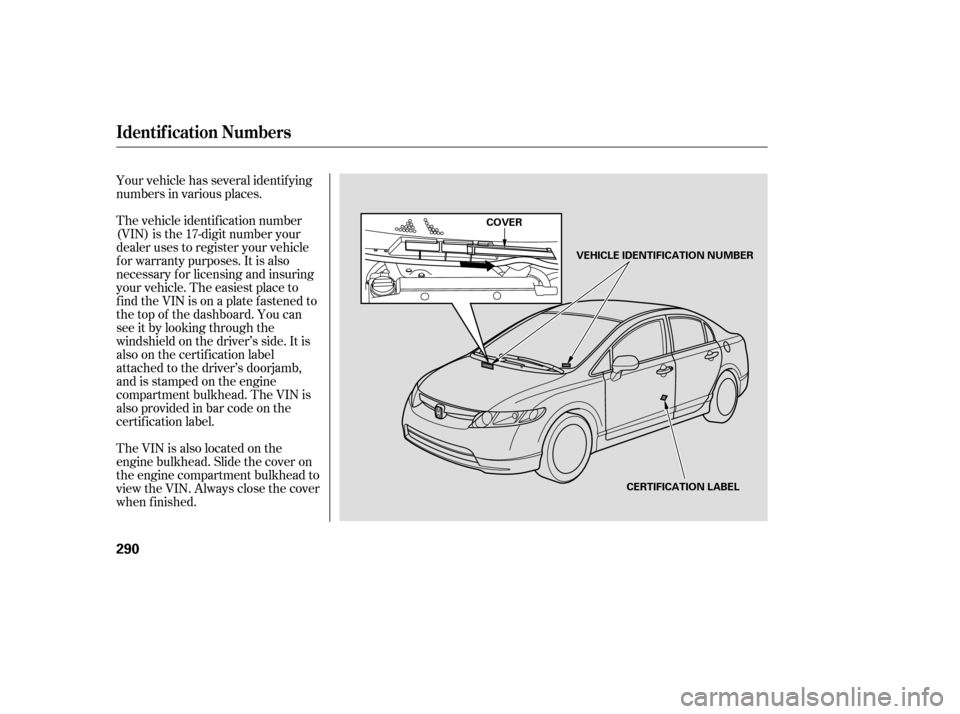
Your vehicle has several identif ying
numbers in various places.
The vehicle identif ication number
(VIN) is the 17-digit number your
dealer uses to register your vehicle
f or warranty purposes. It is also
necessary f or licensing and insuring
your vehicle. The easiest place to
find the VIN is on a plate fastened to
the top of the dashboard. You can
seeitbylookingthroughthe
windshield on the driver’s side. It is
also on the certification label
attached to the driver’s doorjamb,
and is stamped on the engine
compartment bulkhead. The VIN is
also provided in bar code on the
certif ication label.
The VIN is also located on the
engine bulkhead. Slide the cover on
the engine compartment bulkhead to
view the VIN. Always close the cover
when f inished.
Identif ication Numbers
290
CERTIFICATION LABEL
VEHICLE IDENTIFICATION NUMBER
COVER
�����—�����—�����y���
����
������y���
�(�#���������y���������y
Page 384 of 413
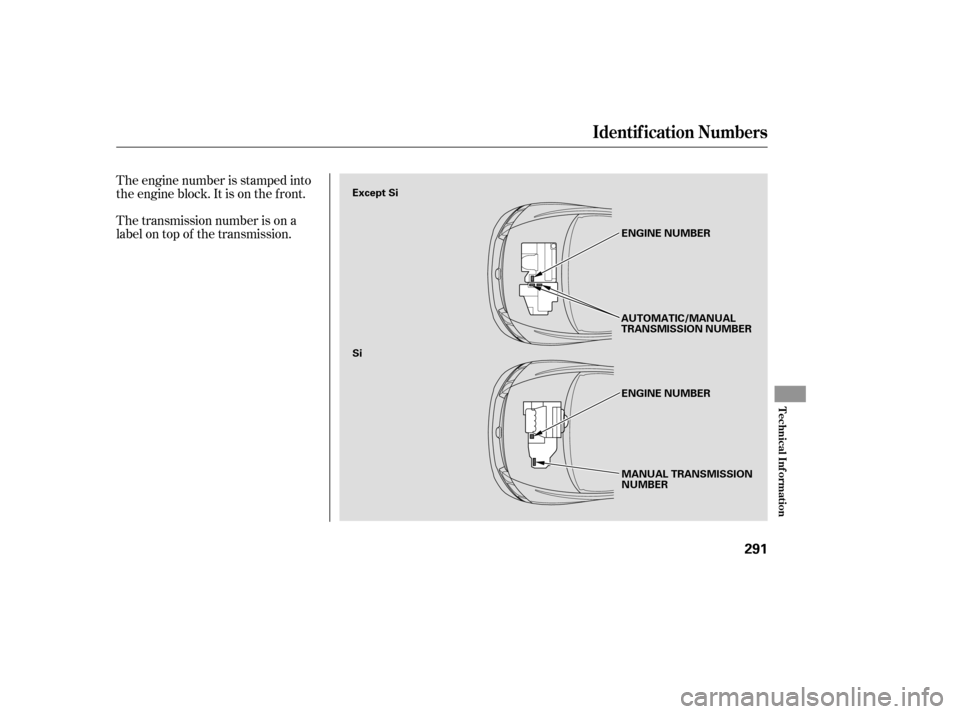
The engine number is stamped into
the engine block. It is on the f ront.
The transmission number is on a
label on top of the transmission.
Identif ication Numbers
T echnical Inf ormation
291
MANUAL TRANSMISSION
NUMBER
ENGINE NUMBER
ENGINE NUMBER
AUTOMATIC/MANUAL
TRANSMISSION NUMBER
Except Si Si
�����—�����—�����y���
����
������y���
�(�#���������y���������y
Page 385 of 413
�Î �Î�Î�Î
�Î �Î
�Î�Î �Î
�Î
�Î�Î
Specif ications
292
Dimensions
Weights Engine
Seating Capacities 176.7 in (4,489 mm)
69.0 in (1,752 mm)
56.5 in (1,435 mm)
106.3 in (2,700 mm)
59.0 in (1,499 mm)
59.9 in (1,522 mm)
Length
Width
Height
Wheelbase
Track
Gross vehicle weight rating See the certification label attached
to the driver’s doorjamb. Type
BorexStroke
Displacement
Compression ratio
Spark plugs
Spark plugsWater cooled 4-stroke
SOHC VTEC , DOHC i-VTEC
4-cylinder gasoline engine
3.19 x 3.44 in (81.0 x 87.3 mm)
3.39x3.39in(86x86mm) 110 cu-in (1,799 cm
)
122 cu-in (1,998 cm)
10.5 11.0
IZFR6K11S
NGK:
DENSO: SKJ20DR-M11S
IFR7G11KSSK22PR-M11S
Total
FrontRear 523
FrontRear
NGK:
DENSO:
1:2: Except SiSi
1 2 12
1 2
12 2
1
�����—�
���—�����y�
�������������y���
�(�#���������y���������y
Page 386 of 413

�µ�µ
�µ �µ�µ �µ �µ�µ�µ�µ�µ�µ�µ�µ�µ
�Î �Î �Î�Î�Î�Î �Î�Î�Î�Î�Î
�Î�Î�Î�Î�Î�Î�Î�Î�Î�Î
�Î
�Î
Specif ications
T echnical Inf ormation
293
Air Conditioning
Lights
Capacities
Refrigerant type
Charge quantity
Lubricant oil typeHFC-134a (R-134a)
14.1 15.9 oz (400 450 g)
SP-10
Headlights
Front turn signal/side marker/
Parking lights
Rear turn signal lights
Stop/Taillights
Rear side marker lights
Back-up lights
Taillights
High-mount brake light
License plate lights
Ceiling light
Spotlights
Trunk light 12 V 60 W (HB3)
12 V 51 W (HB4)
12 V 21/5 W
12 V 21 W
12 V 21/5 W
12 V 2 CP
12 V 21 W
12 V 3 CP
12 V 21 W
12 V 5 W
12 V 8 W
12 V 8 W
12 V 5 W
4.8 US qt (4.5
)
1.8 US qt (1.7
)
1.6 US qt (1.5
)
1.19 US gal (4.5
)
1.80 US gal (6.8
)
4.6 US qt (4.4
)
4.4 US qt (4.2
)
5.8 US qt (5.5
)
6.2 US qt (5.9
)
2.5 US qt (2.4)
1.40 US gal (5.3
)
1.77 US gal (6.7
)
2.6 US qt (2.5
)
1.7 US qt (1.6
)
1.5 US qt (1.4
)
1.37 US gal (5.2
)
1.72 US gal (6.5
)
3.9 US qt (3.7
)
3.7 US qt (3.5
)
4.8 US qt (4.5
)
13.2 US gal (50
)
Including the coolant in the reserve tank and that remaining in the
engine
Reserve tank capacity: 0.11 US gal (0.4
)
Excluding the oil remaining in the engine
Fuel tank
Engine
coolant
Engine oil Manual
transmission
fluid Automatic
transmission
fluid
Windshield
washer
reservoir
HighLow
A/T
M/T
A/T
M/T
Change Total
U.S. Vehicles
Canada
Vehicles Approx.
1: 2: 3:4: Except SiSi Change
Including filter
Without filter
Total
ChangeTotal
Change Total
13 34334
3434343434
2
3
�����—�
���—�����y�
�������������y���
�(�#���������y���������y
Page 394 of 413

�Î
�Î
The burning of gasoline in your
vehicle’s engine produces several by-
products. Some of these are carbon
monoxide (CO), oxides of nitrogen
(NOx), and hydrocarbons (HC).
Gasoline evaporating f rom the tank
also produces hydrocarbons. Con-
trolling the production of NOx, CO,
and HC is important to the environ-
ment. Under certain conditions of
sunlight and climate, NOx and HC
react to f orm photochemical ‘‘smog.’’
Carbon monoxide does not contri-
bute to smog creation, but it is a
poisonous gas. The United States Clean Air Act
sets standards f or automobile
emissions. It also requires that
automobile manufacturers explain to
owners how their emissions controls
workandwhattodotomaintain
them. This section summarizes how
the emissions controls work.
In Canada, Honda vehicles comply
with the Canadian emission
requirements, as specif ied in an
agreement with Environment
Canada, at the time they are
manuf actured.
Your vehicle has a positive
crankcase ventilation system. This
keeps gasses that build up in the
engine’s crankcase f rom going into
the atmosphere. The positive
crankcase ventilation valve routes
them from the crankcase back to the intake manif old. They are then
drawn into the engine and burned.
The onboard ref ueling vapor
recovery (ORVR) system captures
the f uel vapors during ref ueling. The
vapors are adsorbed in a canister
f illed with activated carbon. While
driving, the f uel vapors are drawn
into the engine and burned of f .
As gasoline evaporates in the f uel
tank, an evaporative emissions
control canister f illed with charcoal
adsorbs the vapor. It is stored in this
canister while the engine is of f . Af ter
the engine is started and warmed up,
the vapor is drawn into the engine
and burned during driving.
The Clean Air Act
Crankcase Emissions Control
System
Onboard Ref ueling Vapor
Recovery
Evaporative Emissions Control
System
Emissions Cont rols
300
�����—�����—�����y���
�����������y���
�(�#���������y���������y