2008 GMC SIERRA key
[x] Cancel search: keyPage 116 of 578

Starting the Engine
If your vehicle has the DURAMAX®Diesel engine, see
the DURAMAX®Diesel manual for more information.
To place the transmission in the proper gear:
Move your shift lever to PARK (P) or NEUTRAL (N).
Your engine will not start in any other position — this is
a safety feature. To restart when you are already
moving, use NEUTRAL (N) only.
Starting Procedure
1. With your foot off the accelerator pedal, turn the
ignition key to START. When the engine starts,
let go of the key. The idle speed will go down as
your engine gets warm. Do not race the engine
immediately after starting it. Operate the engine and
transmission gently to allow the oil to warm up
and lubricate all moving parts.
Your vehicle has a Computer-Controlled Cranking
System. This feature assists in starting the
engine and protects components. If the ignition key
is turned to the START position, and then
released when the engine begins cranking, the
engine will continue cranking for a few seconds or
until the vehicle starts. If the engine does not
start and the key is held in START for many
seconds, cranking will be stopped after 15 seconds
to prevent cranking motor damage. To preventgear damage, this system also prevents cranking if
the engine is already running. Engine cranking
can be stopped by turning the ignition switch to the
ACC/ACCESSORY or LOCK/OFF position.
Notice:Cranking the engine for long periods of
time, by returning the key to the START position
immediately after cranking has ended, can overheat
and damage the cranking motor, and drain the
battery. Wait at least 15 seconds between each try,
to let the cranking motor cool down.
2. If the engine does not start after 5-10 seconds,
especially in very cold weather (below 0°F or
−18°C), it could be ooded with too much gasoline.
Try pushing the accelerator pedal all the way to
the oor and holding it there as you hold the key in
START for up to a maximum of 15 seconds.
Wait at least 15 seconds between each try, to allow
the cranking motor to cool down. When the
engine starts, let go of the key and accelerator. If
the vehicle starts briey but then stops again, do the
same thing. This clears the extra gasoline from
the engine. Do not race the engine immediately
after starting it. Operate the engine and
transmission gently until the oil warms up and
lubricates all moving parts.
Notice:The engine is designed to work with the
electronics in your vehicle. If you add electrical parts
or accessories, you could change the way the engine
2-24
Page 120 of 578

Automatic Transmission Operation
If your vehicle is has an automatic transmission, it
has an electronic shift position indicator within
the instrument panel cluster. This display comes on
when the ignition key is turned to the ON/RUN position.
There are several different positions for the shift lever.
See “Range Selection Mode” later in this section.
PARK (P):This position locks your rear wheels. It is
the best position to use when you start the engine
because your vehicle cannot move easily. When parked
on a hill, especially when the vehicle has a heavy
load, you might notice an increase in the effort to shift
out of Park. See Torque Lock (Automatic Transmission)
underShifting Into PARK (P) on page 2-50for more
information.
Hydra-Matic
®4-Speed
Automatic Transmission
Allison Transmission®or Hydra-Matic®6-Speed
Automatic Transmission
2-28
Page 123 of 578

In some cases, this could appear to be a delayed shift,
however the transmission is operating normally.
Your vehicle’s transmission uses adaptive shift controls.
Adaptive shift controls continually compares key shift
parameters to pre-programmed ideal shifts stored in the
transmissions computer. The transmission constantly
makes adjustments to improve vehicle performance
according to how the vehicle is being used, such as with
a heavy load or when temperature changes. During this
adaptive shift control process, shifting might feel different
as the transmission determines the best settings.
When temperatures are very cold, the Allison
Transmission
®and Hydra-Matic®6-Speed
transmission’s gear shifting could be delayed providing
more stable shifts until the engine warms up. Shifts
could be more noticeable with a cold transmission. This
difference in shifting is normal.
MANUAL MODE (M):This position, is available on
vehicles with the Allison Transmission
®or Hydra-Matic®
6-Speed transmission. It lets drivers select the range
of gears appropriate for current driving conditions. If your
vehicle has this feature, see Range Select Mode
(Allison Transmission
®or Hydra-Matic®6-Speed
transmission) later in this section.THIRD (3):This position is also used for normal driving.
It reduces vehicle speed more than DRIVE (D) without
using the brakes. You might choose THIRD (3)
instead of DRIVE (D) when driving on hilly, winding
roads, when towing a trailer, so there is less shifting
between gears and when going down a steep hill.
SECOND (2):This position reduces vehicle speed even
more than THIRD (3) without using your brakes. You can
use SECOND (2) on hills. It can help control your speed
as you go down steep mountain roads, but then you
would also want to use the brakes off and on.
If you manually select SECOND (2) in an automatic
transmission, the transmission will start in second gear.
You can use this feature for reducing the speed of the
rear wheels when you are trying to start your vehicle from
a stop on slippery road surfaces.
FIRST (1):For the Hydra-Matic
®4-Speed transmission
this position reduces vehicle speed even more than
SECOND (2) without using the brakes. You can use it
on very steep hills, or in deep snow or mud. If the
shift lever is put in FIRST (1) while the vehicle is moving
forward, the transmission does not shift into rst gear
until the vehicle is going slowly enough.
2-31
Page 142 of 578
Shifting Into PARK (P)
{CAUTION:
It can be dangerous to get out of your vehicle
if the shift lever is not fully in PARK (P) with
the parking brake rmly set. Your vehicle can
roll. If you have left the engine running, the
vehicle can move suddenly. You or others
could be injured. To be sure your vehicle will
not move, even when you are on fairly level
ground, use the steps that follow. With
four-wheel drive, if your transfer case is in
NEUTRAL, your vehicle will be free to roll,
even if your shift lever is in PARK (P). So, be
sure the transfer case is in a drive gear — not
in NEUTRAL. If you are pulling a trailer, see
Towing a Trailer on page 4-55.
1. Hold the brake pedal down with your right foot and
set the parking brake.
SeeParking Brake on page 2-49for more
information.2. Move the shift lever into the PARK (P) position by
pulling the shift lever toward you and moving it up
as far as it will go.
3. Be sure the transfer case is in a drive gear — not
in NEUTRAL (N).
4. Turn the ignition key to LOCK/OFF.
5. Remove the key and take it with you. If you can
leave your vehicle with the ignition key in your
hand, your vehicle is in PARK (P).
Leaving Your Vehicle With the Engine
Running
{CAUTION:
It can be dangerous to leave your vehicle with
the engine running. Your vehicle could move
suddenly if the shift lever is not fully in
PARK (P) with the parking brake rmly set.
CAUTION: (Continued)
2-50
Page 144 of 578
Shifting Out of PARK (P)
This vehicle is equipped with an electronic shift lock
release system. The shift lock release is designed to:
Prevent ignition key removal unless the shift
lever is in PARK (P) with the shift lever button fully
released, and
Prevent movement of the shift lever out of
PARK (P), unless the ignition is in ON/RUN or
ACC/ACCESSORY and the regular brake pedal is
applied.
The shift lock release is always functional except in the
case of an uncharged or low voltage (less than
9 volt) battery.If your vehicle has an uncharged battery or a battery
with low voltage, try charging or jump starting the
battery. SeeJump Starting on page 5-46for more
information.
To shift out of PARK (P) use the following:
1. Apply the brake pedal.
2. Move the shift lever to the desired position.
If you still are unable to shift out of PARK (P):
1. Ease the pressure on the shift lever.
2. While holding down the brake pedal, press the shift
lever all the way into PARK (P).
3. Move the shift lever to the desired position.
If you are still having a problem shifting, then have your
vehicle serviced soon.
2-52
Page 157 of 578

When the System Does Not Seem to
Work Properly
The driver disables the system.
The parking brake pedal is depressed.
The ultrasonic sensors are not clean. Keep your
vehicle’s rear bumper free of mud, dirt, snow,
ice and slush. For cleaning instructions, see
Washing Your Vehicle on page 5-116.
A trailer was attached to your vehicle, or a bicycle
or an object was hanging out of your tailgate
during your last drive cycle, the red light may
illuminate in the rear display. Once the attached
object is removed, URPA will return to normal
operation.
A tow bar is attached to your vehicle.
The vehicle’s bumper is damaged. Take the vehicle
to your dealer/retailer to repair the system.
Other conditions may affect system performance,
such as vibrations from a jackhammer or the
compression of air brakes on a very large truck.
If the system is still disabled, after driving forward at
least 15 mph (25 km/h), take your vehicle to your
dealer/retailer.
OnStar®System
OnStar uses several innovative technologies and live
advisors to provide you with a wide range of safety,
security, information, and convenience services. If your
airbags deploy, the system is designed to make an
automatic call to OnStar Emergency advisors who can
request emergency services be sent to your location.
If you lock your keys in the vehicle, call OnStar at
1-888-4-ONSTAR and they can send a signal to unlock
your doors. If you need roadside assistance, press
the OnStar button and they can contact Roadside
Service for you.
OnStar service is provided to you subject to the OnStar
Terms and Conditions. You may cancel your OnStar
service at any time by contacting OnStar. A complete
OnStar Owner’s Guide and the OnStar Terms and
Conditions are included in the vehicle’s OnStar
2-65
Page 168 of 578
Center Console Storage
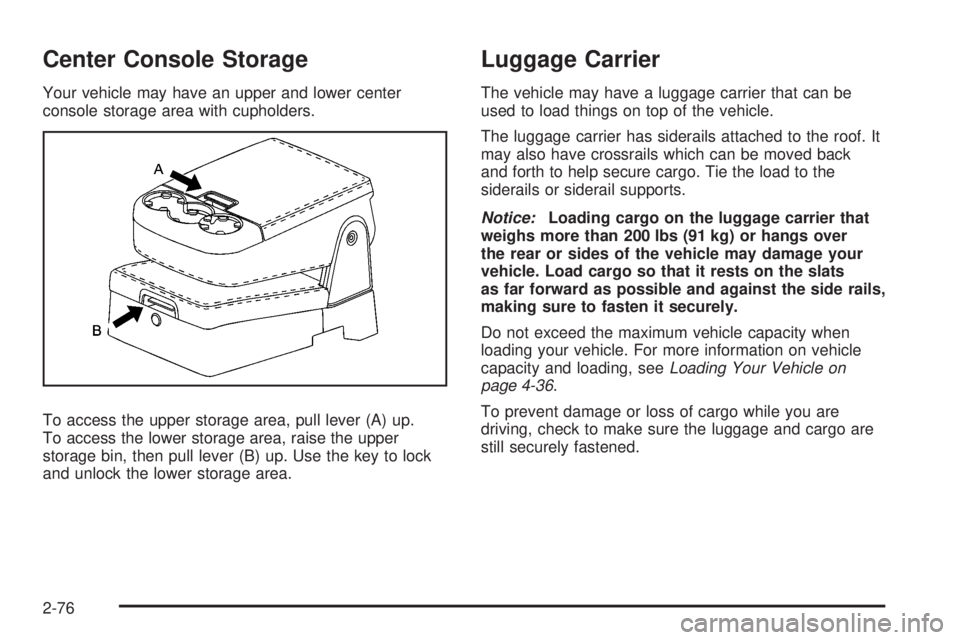
Your vehicle may have an upper and lower center
console storage area with cupholders.
To access the upper storage area, pull lever (A) up.
To access the lower storage area, raise the upper
storage bin, then pull lever (B) up. Use the key to lock
and unlock the lower storage area.
Luggage Carrier
The vehicle may have a luggage carrier that can be
used to load things on top of the vehicle.
The luggage carrier has siderails attached to the roof. It
may also have crossrails which can be moved back
and forth to help secure cargo. Tie the load to the
siderails or siderail supports.
Notice:Loading cargo on the luggage carrier that
weighs more than 200 lbs (91 kg) or hangs over
the rear or sides of the vehicle may damage your
vehicle. Load cargo so that it rests on the slats
as far forward as possible and against the side rails,
making sure to fasten it securely.
Do not exceed the maximum vehicle capacity when
loading your vehicle. For more information on vehicle
capacity and loading, seeLoading Your Vehicle on
page 4-36.
To prevent damage or loss of cargo while you are
driving, check to make sure the luggage and cargo are
still securely fastened.
2-76
Page 180 of 578
Hazard Warning Flashers
The hazard warning ashers warn others. They also let
police know you have a problem.
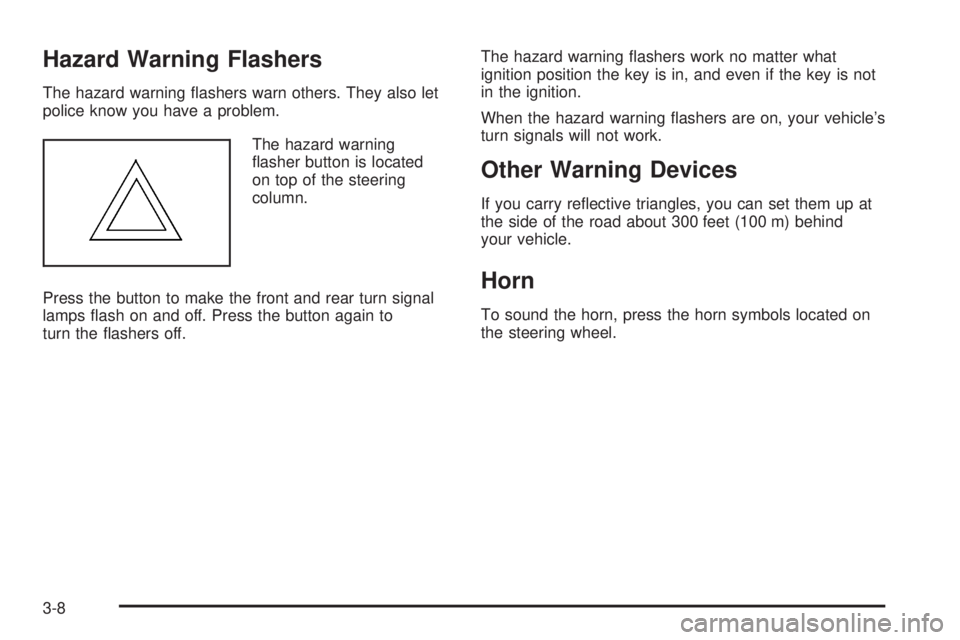
The hazard warning
asher button is located
on top of the steering
column.
Press the button to make the front and rear turn signal
lamps ash on and off. Press the button again to
turn the ashers off.The hazard warning ashers work no matter what
ignition position the key is in, and even if the key is not
in the ignition.
When the hazard warning ashers are on, your vehicle’s
turn signals will not work.
Other Warning Devices
If you carry reective triangles, you can set them up at
the side of the road about 300 feet (100 m) behind
your vehicle.
Horn
To sound the horn, press the horn symbols located on
the steering wheel.
3-8