Page 32 of 578
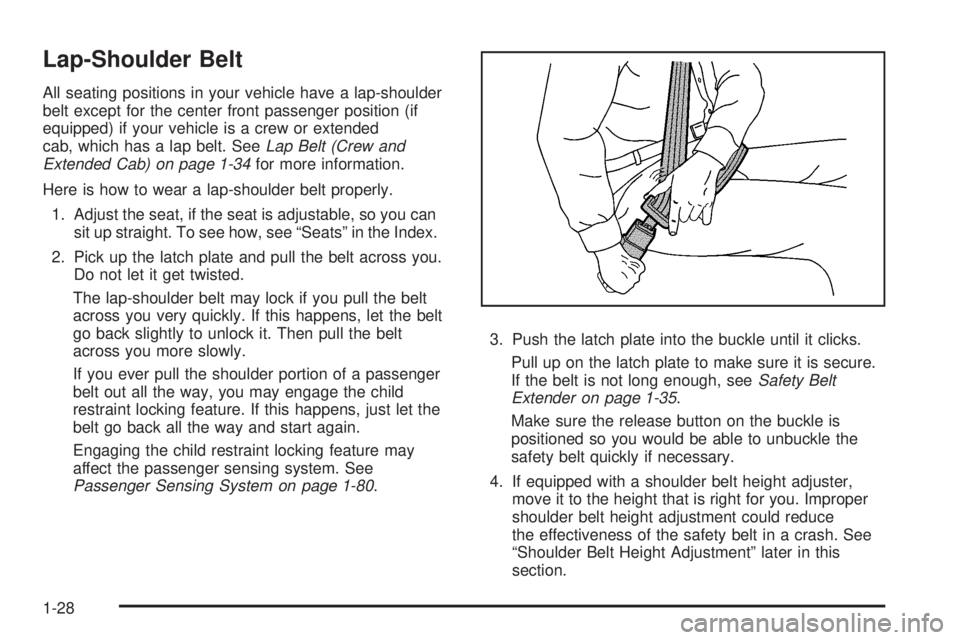
Lap-Shoulder Belt
All seating positions in your vehicle have a lap-shoulder
belt except for the center front passenger position (if
equipped) if your vehicle is a crew or extended
cab, which has a lap belt. SeeLap Belt (Crew and
Extended Cab) on page 1-34for more information.
Here is how to wear a lap-shoulder belt properly.
1. Adjust the seat, if the seat is adjustable, so you can
sit up straight. To see how, see “Seats” in the Index.
2. Pick up the latch plate and pull the belt across you.
Do not let it get twisted.
The lap-shoulder belt may lock if you pull the belt
across you very quickly. If this happens, let the belt
go back slightly to unlock it. Then pull the belt
across you more slowly.
If you ever pull the shoulder portion of a passenger
belt out all the way, you may engage the child
restraint locking feature. If this happens, just let the
belt go back all the way and start again.
Engaging the child restraint locking feature may
affect the passenger sensing system. See
Passenger Sensing System on page 1-80.3. Push the latch plate into the buckle until it clicks.
Pull up on the latch plate to make sure it is secure.
If the belt is not long enough, seeSafety Belt
Extender on page 1-35.
Make sure the release button on the buckle is
positioned so you would be able to unbuckle the
safety belt quickly if necessary.
4. If equipped with a shoulder belt height adjuster,
move it to the height that is right for you. Improper
shoulder belt height adjustment could reduce
the effectiveness of the safety belt in a crash. See
“Shoulder Belt Height Adjustment” later in this
section.
1-28
Page 34 of 578
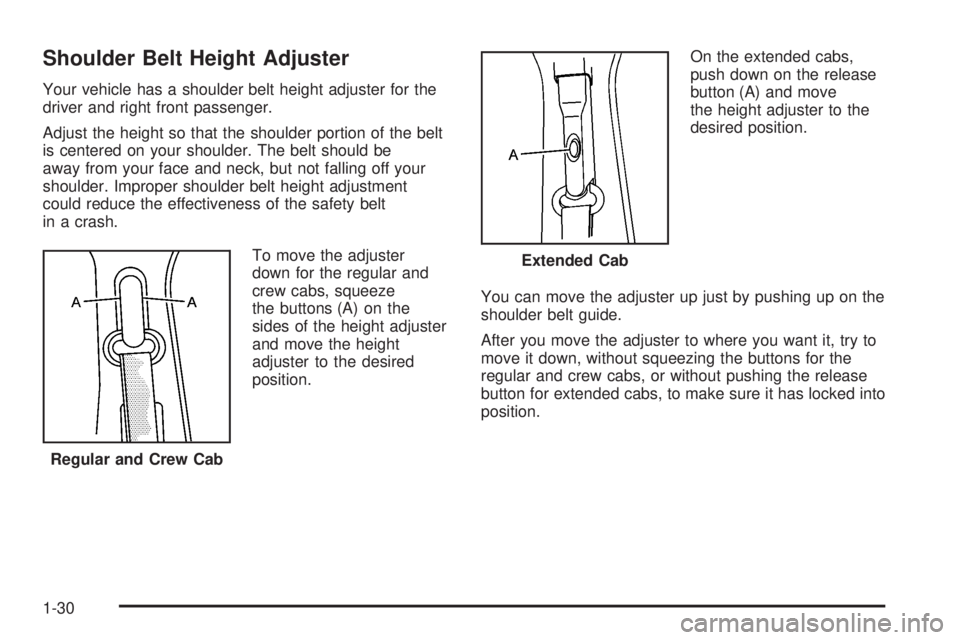
Shoulder Belt Height Adjuster
Your vehicle has a shoulder belt height adjuster for the
driver and right front passenger.
Adjust the height so that the shoulder portion of the belt
is centered on your shoulder. The belt should be
away from your face and neck, but not falling off your
shoulder. Improper shoulder belt height adjustment
could reduce the effectiveness of the safety belt
in a crash.
To move the adjuster
down for the regular and
crew cabs, squeeze
the buttons (A) on the
sides of the height adjuster
and move the height
adjuster to the desired
position.On the extended cabs,
push down on the release
button (A) and move
the height adjuster to the
desired position.
You can move the adjuster up just by pushing up on the
shoulder belt guide.
After you move the adjuster to where you want it, try to
move it down, without squeezing the buttons for the
regular and crew cabs, or without pushing the release
button for extended cabs, to make sure it has locked into
position.
Regular and Crew Cab
Extended Cab
1-30
Page 55 of 578
{CAUTION:
Children can be seriously injured or strangled
if a shoulder belt is wrapped around their neck
and the safety belt continues to tighten.
Secure any unused safety belts behind the
child restraint so children cannot reach them.
Pull the shoulder belt all the way out of the
retractor to set the lock, if your vehicle has
one, after the child restraint has been installed.
Be sure to follow the instructions of the child
restraint manufacturer.Notice:Contact between the child restraint LATCH
attachment parts and the vehicle’s safety belt
assembly may cause damage to these parts. Make
sure when securing unused safety belts behind
the child restraint that there is no contact between
the child restraint LATCH attachment parts and
the vehicle’s safety belt assembly.
Folding an empty rear seat with the safety belts
secured may cause damage to the safety belt or the
seat. When removing the child restraint, always
remember to return the safety belts to their normal,
stowed position before folding the rear seat.
1-51
Page 60 of 578
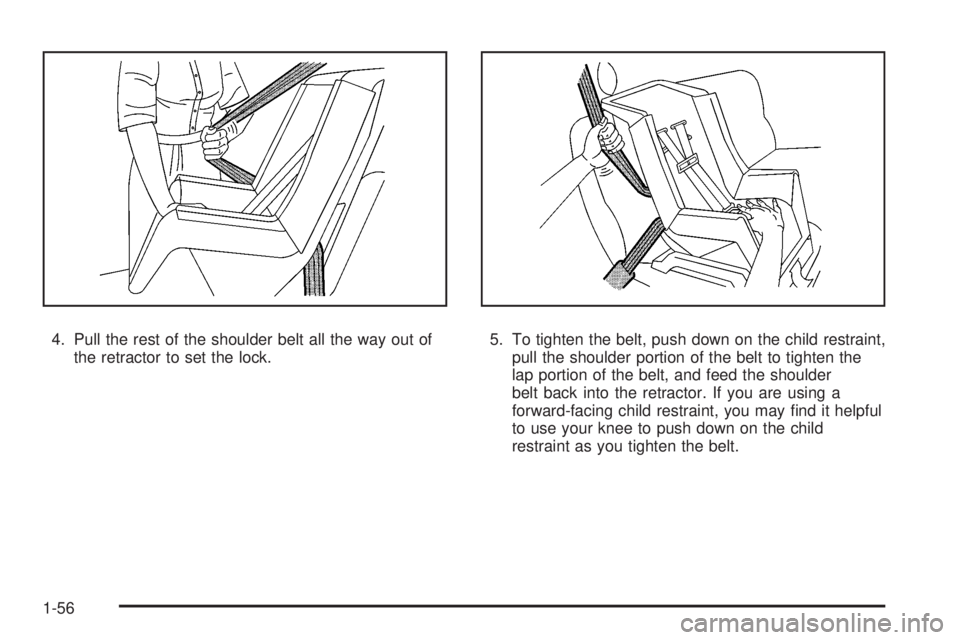
4. Pull the rest of the shoulder belt all the way out of
the retractor to set the lock.5. To tighten the belt, push down on the child restraint,
pull the shoulder portion of the belt to tighten the
lap portion of the belt, and feed the shoulder
belt back into the retractor. If you are using a
forward-facing child restraint, you may nd it helpful
to use your knee to push down on the child
restraint as you tighten the belt.
1-56
Page 64 of 578
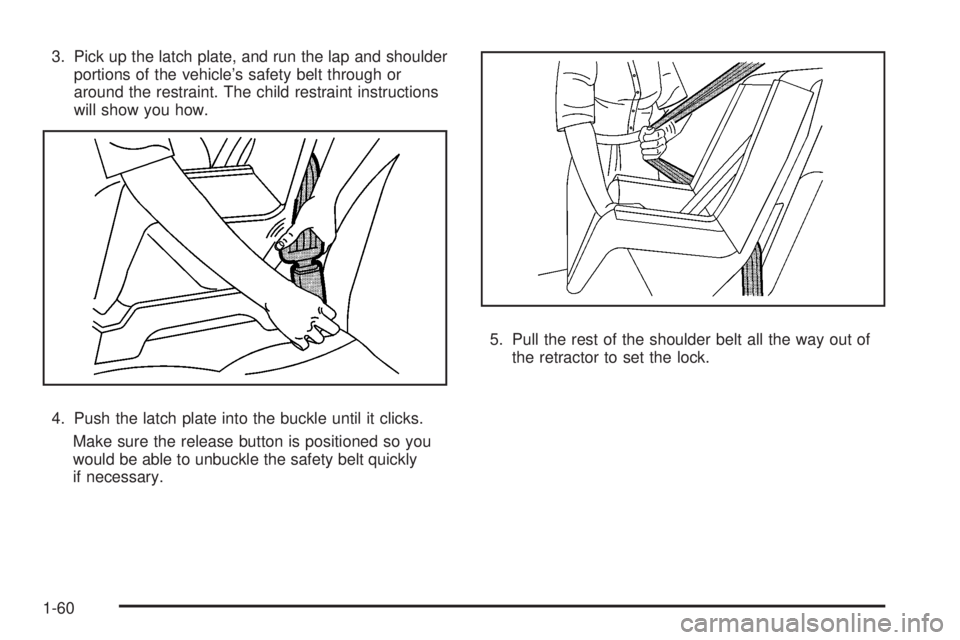
3. Pick up the latch plate, and run the lap and shoulder
portions of the vehicle’s safety belt through or
around the restraint. The child restraint instructions
will show you how.
4. Push the latch plate into the buckle until it clicks.
Make sure the release button is positioned so you
would be able to unbuckle the safety belt quickly
if necessary.5. Pull the rest of the shoulder belt all the way out of
the retractor to set the lock.
1-60
Page 68 of 578
5. Pull the rest of the shoulder belt all the way out of
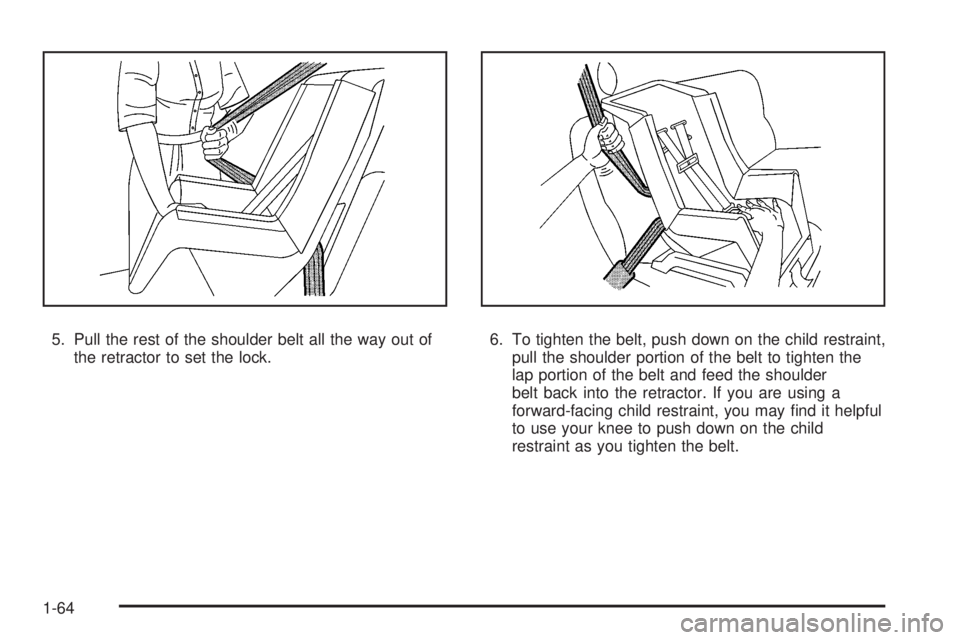
the retractor to set the lock.6. To tighten the belt, push down on the child restraint,
pull the shoulder portion of the belt to tighten the
lap portion of the belt and feed the shoulder
belt back into the retractor. If you are using a
forward-facing child restraint, you may nd it helpful
to use your knee to push down on the child
restraint as you tighten the belt.
1-64
Page 71 of 578
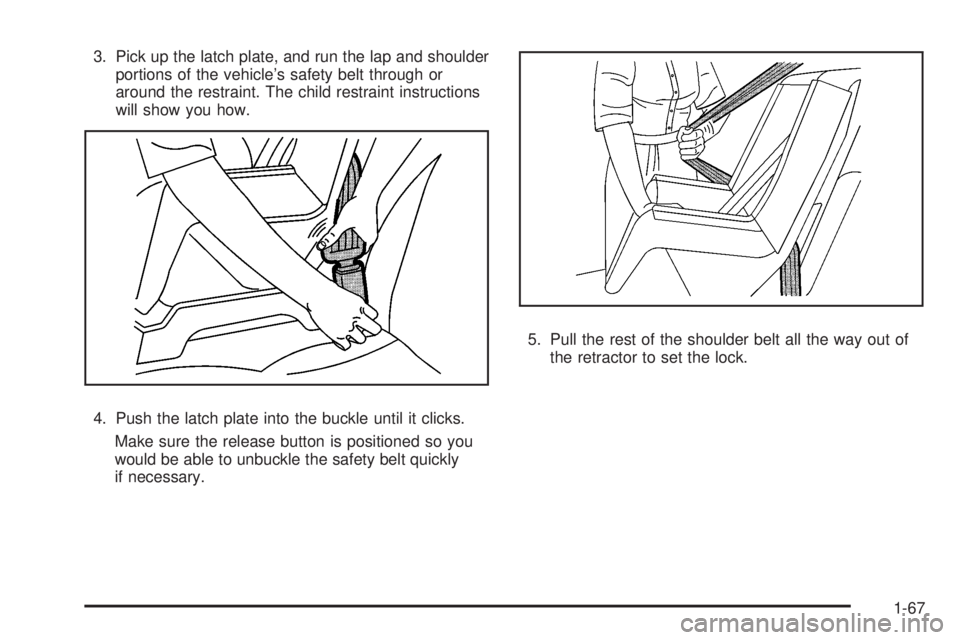
3. Pick up the latch plate, and run the lap and shoulder
portions of the vehicle’s safety belt through or
around the restraint. The child restraint instructions
will show you how.
4. Push the latch plate into the buckle until it clicks.
Make sure the release button is positioned so you
would be able to unbuckle the safety belt quickly
if necessary.5. Pull the rest of the shoulder belt all the way out of
the retractor to set the lock.
1-67
Page 76 of 578
If your vehicle has roof-rail airbags for the driver, right
front passenger, and second row outboard passengers,
they are in the ceiling above the side windows.
{CAUTION:
If something is between an occupant and an
airbag, the airbag might not inate properly or
it might force the object into that person
causing severe injury or even death. The path
of an inating airbag must be kept clear. Do
not put anything between an occupant and an
airbag, and do not attach or put anything on
the steering wheel hub or on or near any other
airbag covering.
If your vehicle has roof-rail airbags, never
secure anything to the roof of your vehicle by
routing the rope or tie down through any door
or window opening. If you do, the path of an
inating roof-rail airbag will be blocked. Driver Side shown, Passenger Side similar
1-72