2008 GMC ENVOY DENALI lock
[x] Cancel search: lockPage 86 of 468
Liftgate/Liftglass
{CAUTION:
It can be dangerous to drive with the liftgate or
liftglass open because carbon monoxide (CO)
gas can come into your vehicle. You cannot see
or smell CO. It can cause unconsciousness and
even death. If you must drive with the liftgate
open or if electrical wiring or other cable
connections must pass through the seal
between the body and the liftgate or liftglass:
Make sure all other windows are shut.
Turn the fan on your climate control system
to its highest speed and select the control
setting that will force outside air into your
vehicle. See “Climate Control System” in
the Index.
If you have air outlets on or under the
instrument panel, open them all the way.
SeeEngine Exhaust on page 2-37.
Liftgate Release
To unlock the liftgate, use the power door lock switch
or the remote keyless entry transmitter. SeeRemote
Keyless Entry (RKE) System Operation on page 2-5.
The liftglass will also unlock when the liftgate is
unlocked.
Press the button on the liftglass to open it. To open the
entire liftgate, lift the handle located in the center of
the liftgate. When the liftgate is opened, the liftglass
will lock after a short delay.
Emergency Release for Opening
Liftgate
1. Remove the trim plug, located on the inside of the
liftgate in the center, to expose the access hole in
the trim panel.
2. Use a tool to reach through the access hole in the
trim panel.
3. Pry the left release lever up to the unlock position.
Pry the right release lever up to unlatch the liftgate.
4. Reinstall the trim plug.
2-12
Page 88 of 468
Power Windows
{CAUTION:
Leaving children, helpless adults, or pets in a
vehicle with the windows closed is dangerous.
They can be overcome from extreme heat in
warm or hot weather and suffer permanent
injuries or even death from heat stroke.
Leaving children in a vehicle with the ignition
key is dangerous for many reasons, children
or others could be badly injured or even killed.
They could operate the power windows or
other controls or even make the vehicle move.
The windows will function with the keys in the
ignition and they could be seriously injured
or killed if caught in the path of a closing
window. Do not leave keys in a vehicle with
children.
When there are children in the rear seat
use the window lockout button to prevent
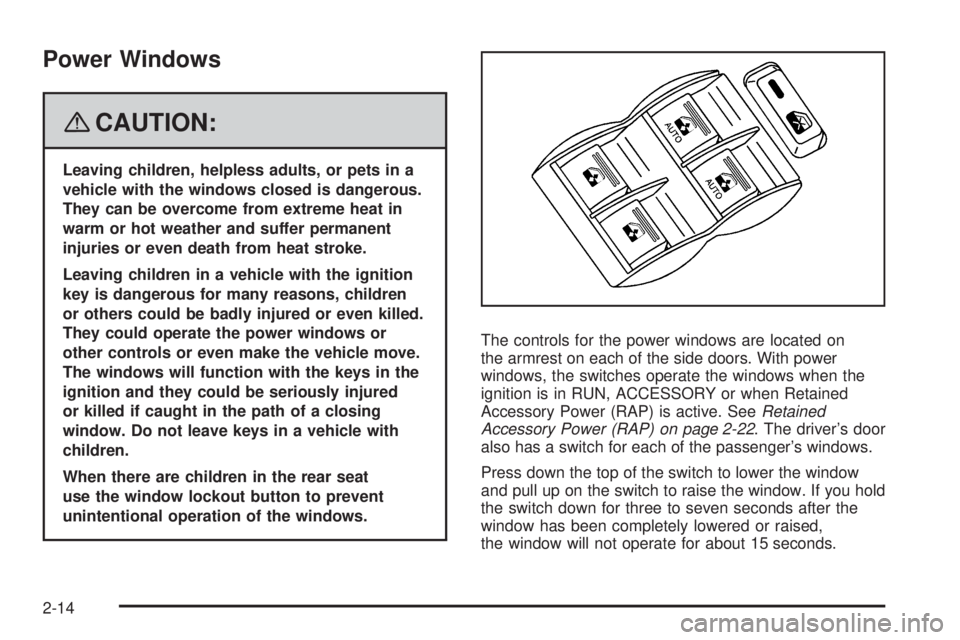
unintentional operation of the windows.The controls for the power windows are located on
the armrest on each of the side doors. With power
windows, the switches operate the windows when the
ignition is in RUN, ACCESSORY or when Retained
Accessory Power (RAP) is active. SeeRetained
Accessory Power (RAP) on page 2-22. The driver’s door
also has a switch for each of the passenger’s windows.
Press down the top of the switch to lower the window
and pull up on the switch to raise the window. If you hold
the switch down for three to seven seconds after the
window has been completely lowered or raised,
the window will not operate for about 15 seconds.
2-14
Page 89 of 468
Express-Down Window
AUTO (Express-down):The driver’s and front
passenger’s window switches have an express-down
feature that allows you to lower the window without
holding the switch down. Press down briey on the
driver’s or front passenger’s window switch labeled
AUTO to activate the express-down feature. Lightly tap
the switch to open the window slightly. The express-down
feature can be interrupted at any time by pressing the top
of the switch.
Window Lockout
o
(Lockout):Your vehicle has a lockout feature to
prevent passengers from operating the power windows.
The lockout switch is located in front of the window
switches on the driver’s door. A light in the lockout
switch will come on to show that the switch has been
activated. Press the lockout switch again to return
to normal operation.
Sun Visors
Sun Visors with Slide Rod
Your vehicle may have this feature. Pull the sun visor
down to block glare. Detach the sun visor from the center
mount and slide it along the rod from side-to-side to cover
the driver or passenger side of the front window. Swing
the sun visor to the side to cover the side window. It can
also be moved along the rod from side-to-side in this
position.
Sun Visors with Fixed Rod and Pull-out
Extension
Your vehicle may have this feature. Pull the sun visor
down to block glare. Pull the sun visor extender out
for additional coverage. Detach the sun visor from the
center mount and swing it to the side to cover the
side window.
Visor Vanity Mirror
Pull the sun visor down to expose the vanity mirror.
You may have to lift a cover to expose the mirror.
Lighted Visor Vanity Mirror
Your vehicle may have this feature. Pull the sun visor
down and lift the mirror cover to turn on the lamps.
The lamps will turn off when the cover is closed.
2-15
Page 90 of 468
Theft-Deterrent Systems
Vehicle theft is big business, especially in some cities.
Although your vehicle has a number of theft-deterrent
features, we know that nothing we put on it can make it
impossible to steal.
Content Theft-Deterrent
Your vehicle may have a content theft-deterrent alarm
system.
The security light is
located on the instrument
panel cluster.To operate the system:
1. Open the door.
2. Lock the door with the power door lock switch
or the Remote Keyless Entry (RKE) transmitter.
The security light should ash.
The system will not activate if the doors are locked
with the key or manual door lock.
3. Close all doors. The security light should turn off
after about 30 seconds. The alarm is not armed
until the security light turns off.
If a locked door is opened without the key or the RKE
transmitter, the alarm will go off. The headlamps
and parking lamps will ash for two minutes, and the
horn will sound for 30 seconds, then will turn off to save
the battery power.
To avoid setting off the alarm by accident:
Always lock the vehicle using the door keyafterthe
doors are closed.
Always unlock a door with a key, or use the RKE
transmitter. Unlocking a door any other way will
set off the alarm.
To turn off the alarm, press unlock on the RKE
transmitter or unlock any door with the key.
2-16
Page 91 of 468

Testing the Alarm
To test the alarm:
1. From inside the vehicle, lower the driver’s window
and open the driver’s door.
2. Activate the system by locking the doors with the
power door lock switch while the door is open, or
with the RKE transmitter.
3. Get out of the vehicle, close the door and wait for
the security light to go out.
4. Then reach in through the window, unlock the door
with the manual door lock and open the door.
This should set off the alarm.
When the alarm is set the power door unlock switch will
not work.
If the alarm does not sound when it should but the
headlamps ash, check to see if the horn works.
The horn fuse may be blown. To replace the fuse,
seeFuses and Circuit Breakers on page 5-110.
If the alarm does not sound or the headlamps do
not ash, the vehicle should be serviced by your
dealer/retailer.
Passlock®(U. S. Only)
Your vehicle has the Passlock®theft-deterrent system.
Passlock®is a passive theft-deterrent system that
enables fuel if the ignition lock cylinder is turned with a
valid key. If a correct key is not used or the ignition lock
cylinder has been tampered with, the fuel system is
disabled and the vehicle will not start.
During normal operation, the security light will turn off
about ve seconds after the key is turned to ON/RUN.
If the engine stalls and the security light ashes,
wait about 10 minutes until the light stops ashing before
trying to restart the engine. Remember to release the
key from START as soon as the engine starts.
If the engine does not start after three tries, the vehicle
needs service.
If the engine is running and the security light comes on,
you will be able to restart the engine if you turn the engine
off. However, your Passlock
®system is not working
properly and must be serviced by your dealer/retailer.
Your vehicle is not protected by Passlock
®at this time.
You may also want to check the fuse. SeeFuses and
Circuit Breakers on page 5-110. See your dealer/retailer
for service.
In an emergency, call the Roadside Assistance Center.
SeeRoadside Assistance Program on page 7-8.
Do not leave the key or device that disarms or
deactivates the theft deterrent system in the vehicle.
2-17
Page 93 of 468

When trying to start the vehicle, if the engine does not
start and the security light comes on, there may be
a problem with your theft-deterrent system. Turn
the ignition off and try again.
If the engine still does not start, and the key appears to
be undamaged, try another ignition key. At this time,
you may also want to check the fuse. SeeFuses
and Circuit Breakers on page 5-110. If the engine still
does not start with the other key, your vehicle needs
service. If your vehicle does start, the rst key may be
faulty. See your dealer/retailer who can service the
theft-deterrent system and have a new key made.
It is possible for the theft-deterrent system decoder to
learn the transponder value of a new or replacement
key. Up to 10 keys may be programmed for the vehicle.
The following procedure is for programming additional
keys only.Canadian Owners:If you lose or damage your keys,
only a dealer/retailer can service the theft-deterrent
system to have new keys made. To program additional
keys you will require two current driver’s keys.
To program a new key do the following:
1. Verify that the new key has PK3+ stamped on it.
2. Insert the current driver’s key in the ignition
and start the engine. If the engine will not start
see your dealer/retailer for service.
3. After the engine has started, turn the key to
LOCK/OFF, and remove the key.
4. Insert the second current driver’s key in the ignition
and start the engine within ten seconds of removing
the previous key. If the engine will not start see
your dealer/retailer for service.
2-19
Page 94 of 468
5. After the engine has started, turn the key to
LOCK/OFF, and remove the key. Insert the key
to be programmed and turn it to ON within
ten seconds of removing the previous key.
The security light will turn off once the key has
been programmed.
6. Repeat the Steps 1 through 5 if additional keys are
to be programmed.
If the security light comes on and stays on while driving,
you will be able to restart the engine if you turn it off.
The theft-deterrent system, however, is not working
properly and must be serviced by your dealer/retailer.
Your vehicle is not protected by the theft-deterrent
system at this time.
In an emergency, contact Roadside Assistance.
SeeRoadside Assistance Program on page 7-8.
Do not leave the key or device that disarms or
deactivates the theft deterrent system in the vehicle.Starting and Operating Your
Vehicle
New Vehicle Break-In
Notice:Your vehicle does not need an elaborate
break-in. But it will perform better in the long run if
you follow these guidelines:
Keep your speed at 55 mph (88 km/h) or less for
the rst 500 miles (805 km).
Do not drive at any one constant speed, fast or
slow, for the rst 500 miles (805 km). Do not
make full-throttle starts. Avoid downshifting
to brake or slow the vehicle.
Avoid making hard stops for the rst 200 miles
(322 km) or so. During this time the new brake
linings are not yet broken in. Hard stops with new
linings can mean premature wear and earlier
replacement. Follow this breaking-in guideline
every time you get new brake linings.
Do not tow a trailer during break-in. SeeTowing
a Trailer on page 4-45for the trailer towing
capabilities of your vehicle and more
information.
Following break-in, engine speed and load can be
gradually increased.
2-20
Page 95 of 468
Ignition Positions
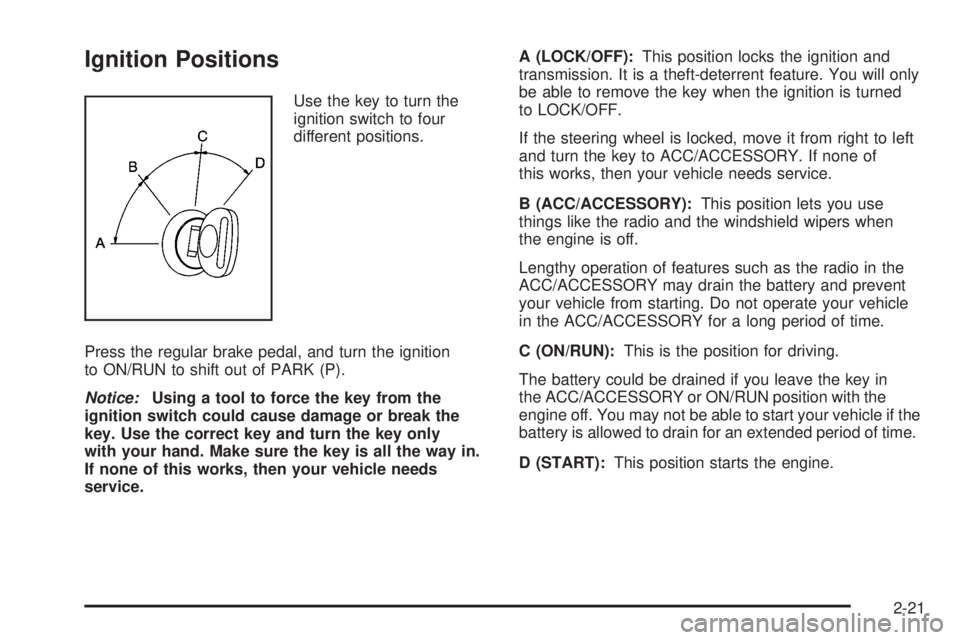
Use the key to turn the
ignition switch to four
different positions.
Press the regular brake pedal, and turn the ignition
to ON/RUN to shift out of PARK (P).
Notice:Using a tool to force the key from the
ignition switch could cause damage or break the
key. Use the correct key and turn the key only
with your hand. Make sure the key is all the way in.
If none of this works, then your vehicle needs
service.A (LOCK/OFF):This position locks the ignition and
transmission. It is a theft-deterrent feature. You will only
be able to remove the key when the ignition is turned
to LOCK/OFF.
If the steering wheel is locked, move it from right to left
and turn the key to ACC/ACCESSORY. If none of
this works, then your vehicle needs service.
B (ACC/ACCESSORY):This position lets you use
things like the radio and the windshield wipers when
the engine is off.
Lengthy operation of features such as the radio in the
ACC/ACCESSORY may drain the battery and prevent
your vehicle from starting. Do not operate your vehicle
in the ACC/ACCESSORY for a long period of time.
C (ON/RUN):This is the position for driving.
The battery could be drained if you leave the key in
the ACC/ACCESSORY or ON/RUN position with the
engine off. You may not be able to start your vehicle if the
battery is allowed to drain for an extended period of time.
D (START):This position starts the engine.
2-21