2008 FORD TAURUS change wheel
[x] Cancel search: change wheelPage 234 of 320

Once through water, always try the brakes. Wet brakes do not stop the
vehicle as effectively as dry brakes. Drying can be improved by moving
your vehicle slowly while applying light pressure on the brake pedal.
Be cautious of sudden changes in vehicle speed or direction when you
are driving in mud. Even AWD vehicles can lose traction in slick mud. As
when you are driving over sand, apply the accelerator slowly and avoid
spinning your wheels. If the vehicle does slide, steer in the direction of
the slide until you regain control of the vehicle.
If the transmission, AWD system components or axles are submerged in
water, their fluids should be checked and changed, if necessary.
Driving through deep water may damage the transmission.
If the front or rear axle is submerged in water, the axle lubricant and
PTU (Power Transfer Unit) lubricant should be checked and changed if
necessary.
After driving through mud, clean off residue stuck to rotating driveshafts
and tires. Excess mud stuck on tires and rotating driveshafts causes an
imbalance that could damage drive components.
“Tread Lightly” is an educational
program designed to increase public
awareness of land-use regulations
and responsibilities in our nations
wilderness areas. Ford Motor
Company joins the U.S. Forest Service and the Bureau of Land
Management in encouraging you to help preserve our national forest and
other public and private lands by “treading lightly.”
Driving on hilly or sloping terrain
Although natural obstacles may make it necessary to travel diagonally up
or down a hill or steep incline, you should always try to drive straight up
or straight down.Avoid driving crosswise or turning on steep
slopes or hills.A danger lies in losing traction, slipping sideways and
possibly rolling over. Whenever driving on a hill, determine beforehand
the route you will use. Do not drive over the crest of a hill without
seeing what conditions are on the other side. Do not drive in reverse
over a hill without the aid of an observer.
When climbing a steep slope or hill, start in a lower gear rather than
downshifting to a lower gear from a higher gear once the ascent has
started. This reduces strain on the engine and the possibility of stalling.
If you do stall out, Do not try to turnaround because you might roll over.
It is better to back down to a safe location.
2008 Taurus(tau)
Owners Guide (post-2002-fmt)
USA(fus)
Driving
234
Page 235 of 320
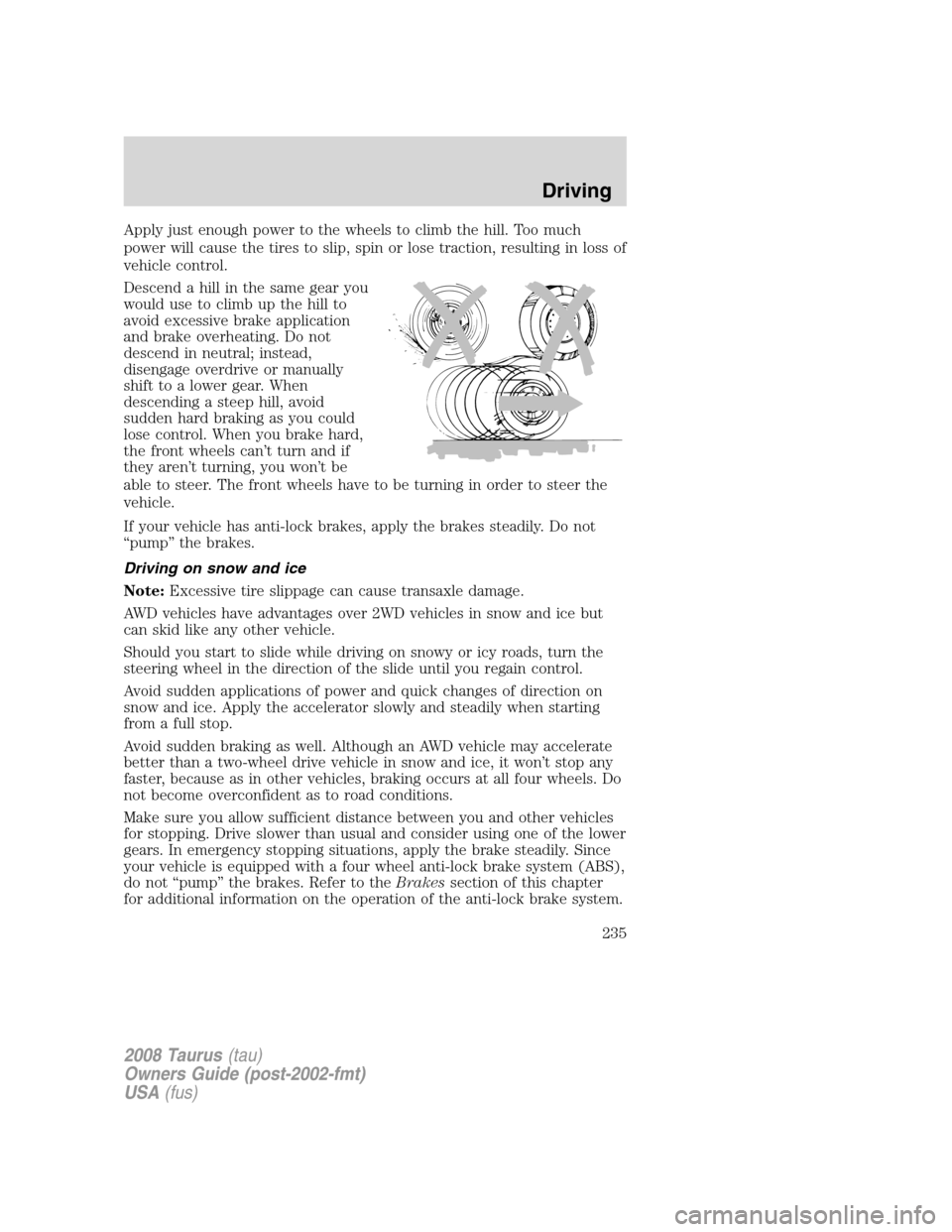
Apply just enough power to the wheels to climb the hill. Too much
power will cause the tires to slip, spin or lose traction, resulting in loss of
vehicle control.
Descend a hill in the same gear you
would use to climb up the hill to
avoid excessive brake application
and brake overheating. Do not
descend in neutral; instead,
disengage overdrive or manually
shift to a lower gear. When
descending a steep hill, avoid
sudden hard braking as you could
lose control. When you brake hard,
the front wheels can’t turn and if
they aren’t turning, you won’t be
able to steer. The front wheels have to be turning in order to steer the
vehicle.
If your vehicle has anti-lock brakes, apply the brakes steadily. Do not
“pump” the brakes.
Driving on snow and ice
Note:Excessive tire slippage can cause transaxle damage.
AWD vehicles have advantages over 2WD vehicles in snow and ice but
can skid like any other vehicle.
Should you start to slide while driving on snowy or icy roads, turn the
steering wheel in the direction of the slide until you regain control.
Avoid sudden applications of power and quick changes of direction on
snow and ice. Apply the accelerator slowly and steadily when starting
from a full stop.
Avoid sudden braking as well. Although an AWD vehicle may accelerate
better than a two-wheel drive vehicle in snow and ice, it won’t stop any
faster, because as in other vehicles, braking occurs at all four wheels. Do
not become overconfident as to road conditions.
Make sure you allow sufficient distance between you and other vehicles
for stopping. Drive slower than usual and consider using one of the lower
gears. In emergency stopping situations, apply the brake steadily. Since
your vehicle is equipped with a four wheel anti-lock brake system (ABS),
do not “pump” the brakes. Refer to theBrakessection of this chapter
for additional information on the operation of the anti-lock brake system.
2008 Taurus(tau)
Owners Guide (post-2002-fmt)
USA(fus)
Driving
235
Page 250 of 320

Removing the spare tire and jack
1. Lift the trunk cargo cover, and
remove the wing nut that secures
the spare tire by turning it
counterclockwise.
2. Lift and remove the spare tire
from the trunk.
3. Remove the second wing nut that
secures the jack retention bracket
by turning it counterclockwise,
remove the jack kit from the
vehicle.
4. Remove the jack and the wrench
from the felt bag. Fold down the
wrench socket to use to loosen the
lug nuts and to operate the jack.
Tire change procedure
When one of the front wheels is off the ground, the transaxle
alone will not prevent the vehicle from moving or slipping off the
jack, even if the vehicle is in P (Park).
To help prevent the vehicle from moving when you change a tire,
be sure to place the transaxle in P (Park), set the parking brake
and block (in both directions) the wheel that is diagonally opposite
(other side and end of the vehicle) to the tire being changed.
If the vehicle slips off the jack, you or someone else could be
seriously injured.
Do not attempt to change a tire on the side of the vehicle close
to moving traffic. Pull far enough off the road to avoid the
danger of being hit when operating the jack or changing the wheel.
2008 Taurus(tau)
Owners Guide (post-2002-fmt)
USA(fus)
Roadside Emergencies
250
Page 302 of 320

1. Start the engine and let it run
until it reaches normal operating
temperature (the engine coolant
temperature gauge indicator will be
near the center of the normal area
between H and C).
2. While the engine idles, turn the
steering wheel left and right several
times.
3. Turn the engine off.
4. Check the fluid level in the reservoir. It should be between the MIN
and MAX lines. Do not add fluid if the level is in this range.
5. If the fluid is low, add fluid in small amounts, continuously checking
the level until it reaches the range between the MIN and MAX lines. Be
sure to put the cap back on the reservoir. Refer toMaintenance
product specifications and capacitiesin this chapter for the proper
fluid type.
BRAKE FLUID
The fluid level will drop slowly as
the brakes wear, and will rise when
the brake components are replaced.
Fluid levels between the “MIN” and
“MAX” lines are within the normal
operating range; there is no need to
add fluid. If the fluid levels are
outside of the normal operating
range the performance of the
system could be compromised; seek
service from your authorized dealer
immediately.
TRANSAXLE FLUID
Checking automatic transaxle fluid
Refer to yourscheduled maintenance informationfor scheduled
intervals for fluid checks and changes.Your transaxle does not consume
fluid. However, the fluid level should be checked if the transaxle is not
working properly, i.e., if the transaxle slips or shifts slowly or if you
notice some sign of fluid leakage.
2008 Taurus(tau)
Owners Guide (post-2002-fmt)
USA(fus)
Maintenance and Specifications
302
Page 315 of 320

Cleaning your vehicle
engine compartment ..............272
instrument panel ....................274
interior .....................................274
plastic parts ............................273
washing ....................................270
waxing .....................................271
wheels ......................................271
wiper blades ............................273
Climate control (see Air
conditioning or Heating) ......73, 75
Clock ............................................91
Clock adjust
6-CD in dash .............................28
AM/FM/CD .................................21
Compass, electronic
set zone adjustment ...............109
Console
overhead ....................................91
Controls
power seat ...............................140
steering column ......................100
Coolant
checking and adding ..............286
refill capacities ................290, 307
specifications ..........................307
Cruise control
(see Speed control) ....................97
Cupholder(s) .............................145
Customer Assistance ................237
Ford Extended Service
Plan ..........................................266
Getting assistance outside
the U.S. and Canada ..............267
Getting roadside assistance ...237
Getting the service you
need .........................................262
Ordering additional
owner’s literature ...................268Utilizing the Mediation/
Arbitration Program ...............266
D
Daytime running lamps
(see Lamps) ................................81
Dipstick
automatic transmission
fluid ..........................................302
engine oil .................................281
Driving under special
conditions ..........................232, 234
sand .........................................233
snow and ice ...........................235
through water .................233, 236
DVD system .................................43
E
Electronic message center .......107
Emergencies, roadside
jump-starting ..........................254
Emission control system ..........299
Engine ........................................309
cleaning ...................................272
coolant .....................................286
idle speed control ...................284
lubrication specifications .......307
refill capacities ........................307
service points ..........................279
starting after a collision .........239
Engine block heater .................218
Engine oil ..................................281
change oil soon warning,
message center .......................281
checking and adding ..............281
dipstick ....................................281
filter, specifications ........283, 306
recommendations ...................283
2008 Taurus(tau)
Owners Guide (post-2002-fmt)
USA(fus)
Index
315