2008 FORD SUPER DUTY battery
[x] Cancel search: batteryPage 2 of 25

BLACKOUT LIGHTING (IF EQUIPPED)
If your vehicle is equipped with blackout lighting it will turn off all
interior and exterior lighting, regardless of ignition position or if any
doors are open.
The switch is mounted on the
instrument panel below the radio.
The courtesy/dome/exterior lights are deactivated when the vehicle is
turned off regardless of which position the blackout lighting switch is in;
these lights are activated when the vehicle’s ignition is turned to
on/auxiliary.
Note:Battery saver mode is enabled when the vehicle is turned off.
There is no delayed timer on this feature.
Note:Black-out lighting will conflict with U.S. Federal Motor Vehicle
Safety Standards (FMVSS). By selecting this option, the
customer/operator has and is exercising Governmental Privilege to
exempt vehicles from full FMVSS compliance.
When blackout lighting is enabled, it will turn off ALL interior
and exterior lights (i.e.headlamps, stop lamps, backup lamps,
interior warning lights, etc). Proceed with caution.
2008 F-250/350/450/550(f23)
Supplement
USA(fus)
Lights
2
Page 5 of 25
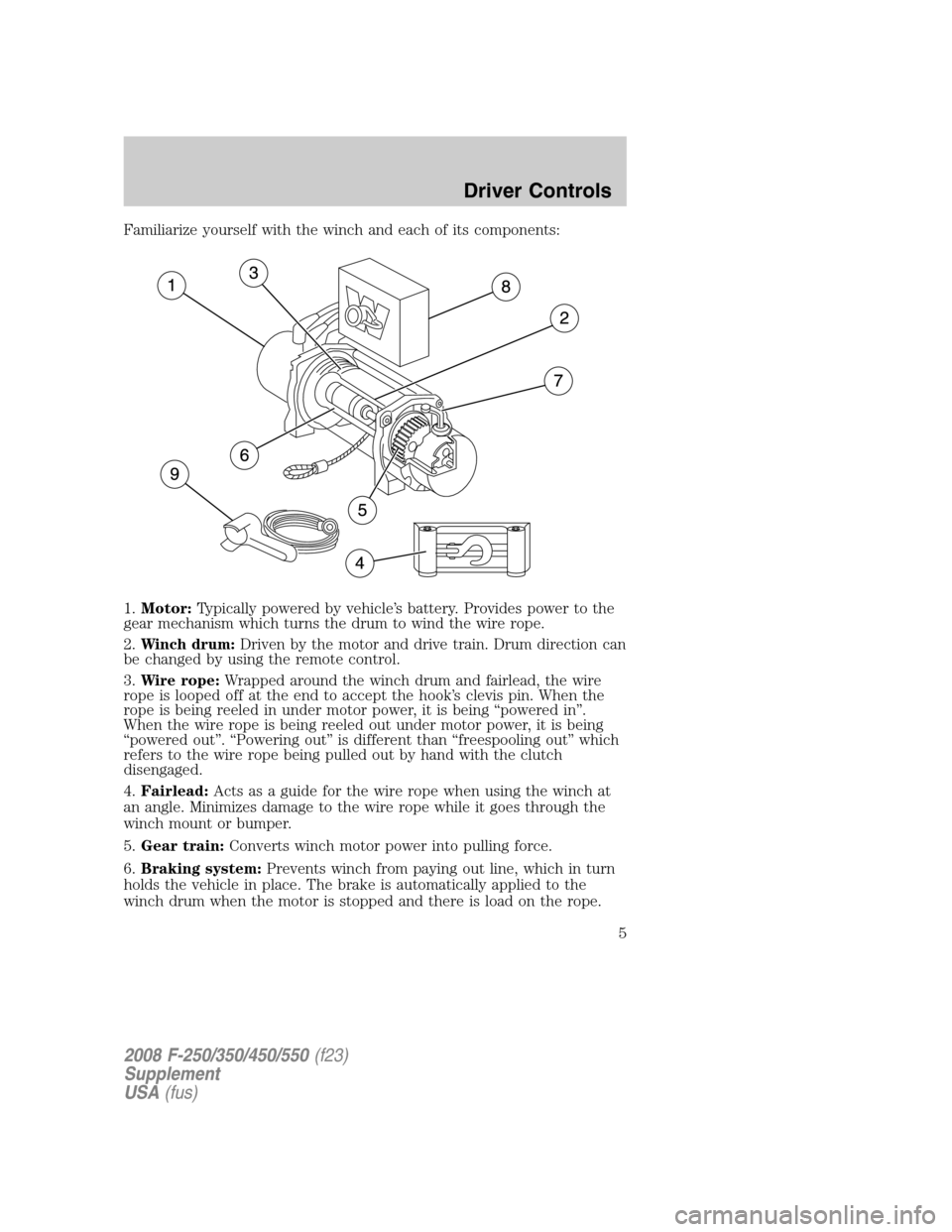
Familiarize yourself with the winch and each of its components:
1.Motor:Typically powered by vehicle’s battery. Provides power to the
gear mechanism which turns the drum to wind the wire rope.
2.Winch drum:Driven by the motor and drive train. Drum direction can
be changed by using the remote control.
3.Wire rope:Wrapped around the winch drum and fairlead, the wire
rope is looped off at the end to accept the hook’s clevis pin. When the
rope is being reeled in under motor power, it is being “powered in”.
When the wire rope is being reeled out under motor power, it is being
“powered out”. “Powering out” is different than “freespooling out” which
refers to the wire rope being pulled out by hand with the clutch
disengaged.
4.Fairlead:Acts as a guide for the wire rope when using the winch at
an angle. Minimizes damage to the wire rope while it goes through the
winch mount or bumper.
5.Gear train:Converts winch motor power into pulling force.
6.Braking system:Prevents winch from paying out line, which in turn
holds the vehicle in place. The brake is automatically applied to the
winch drum when the motor is stopped and there is load on the rope.
2008 F-250/350/450/550(f23)
Supplement
USA(fus)
Driver Controls
5
Page 8 of 25

•Backup parts:Extra items such as an extra clevis/D-shackle or a
remote control unit should be carried in case of emergency. For
severe and/or continuous winch use, you may want to consider
including an extra wire rope and winch hook.
•Toolbox items:Always bring along hand wrenches, screwdrivers,
pliers and tools to change wire rope.
•Jumper cables:It’s always a good idea to carry jumper cables in case
your battery becomes drained during a winching operation. Also, a
dual battery system and a battery isolator kit can be installed to
prevent draining the electrical source during winching operation.
A fully charged conventional automotive battery with a minimum of 650
cold cranking amp is recommended to obtain peak performance from
your winch. Make sure all electrical connections are clean and tight.
Winch operation
Before you pull
Make sure the new rope is stretched before its first use. Unspool the
wire rope, leaving five wraps on the drum. Apply at least 500 lbs.
(227 kg) of tension. This can be done by setting up an anchor point and
pulling your vehicle to it at a slightly inclined, flat surface and letting the
vehicle roll.
Before you use your winch, remember these key points:
1. Think safety at all times.
2. Always take your time to assess your situation and plan your pull
carefully.
3. Always take your time when using the winch.
4. Use the right equipment for your situation.
5. Always wear leather gloves and do not allow the wire rope to slide
through your hands.
6. You and only you should handle the wire rope and operate the remote
control switch.
7. Practice. Practice and practice the steps.
Choosing an anchor point
A secure anchor is critical to winching operations. The anchor must be
strong enough to hold while winching. Natural anchors include trees,
stumps and rocks. Hook the rope as low as possible. If no natural
anchors are available, when recovering another vehicle, your vehicle
2008 F-250/350/450/550(f23)
Supplement
USA(fus)
Driver Controls
8
Page 10 of 25
3. Point your forefinger down and draw circles in the air about waist
height to indicate feeding more wire from the winch.
4. Tells the driver to wind the winch in short, quick bursts. Open and
close the two fingertips until you want the winch to stop.
5. To signal to stop the winch, clench fist, palm to driver, held high
enough for the driver to see and other arm straight out at shoulder
height.
6. Cross palms together to tell the driver to apply the foot brake.
7. Tells driver to give the tires more drive force to assist the winch
process.
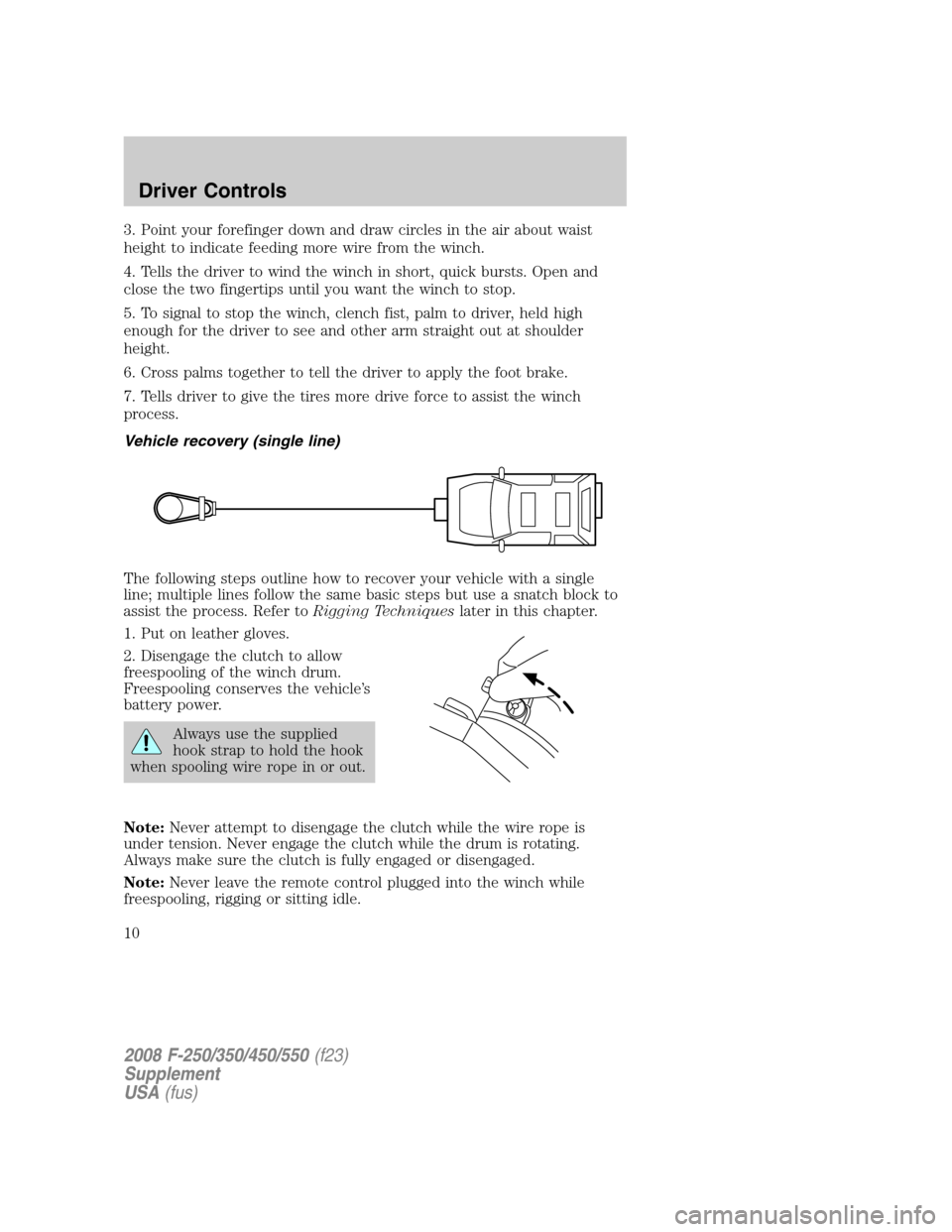
Vehicle recovery (single line)
The following steps outline how to recover your vehicle with a single
line; multiple lines follow the same basic steps but use a snatch block to
assist the process. Refer toRigging Techniqueslater in this chapter.
1. Put on leather gloves.
2. Disengage the clutch to allow
freespooling of the winch drum.
Freespooling conserves the vehicle’s
battery power.
Always use the supplied
hook strap to hold the hook
when spooling wire rope in or out.
Note:Never attempt to disengage the clutch while the wire rope is
under tension. Never engage the clutch while the drum is rotating.
Always make sure the clutch is fully engaged or disengaged.
Note:Never leave the remote control plugged into the winch while
freespooling, rigging or sitting idle.
2008 F-250/350/450/550(f23)
Supplement
USA(fus)
Driver Controls
10
Page 16 of 25

Triple line
Use the same techniques as a
double line.
Select a strong mounting location on your vehicle for the snatch block
and the clevis/D-shackle. Keep at a 90° angle between the winch and run
the wire rope to the first anchor point and through the snatch block.
Secure the rope back to the vehicle. Put the rope through the snatch
block and secure it with the clevis/D-shackle on the vehicle as close to
the winch as possible. Run the rope to the final anchor point.
Secure to the anchor point with a tree protector or choker chain. Attach the
clevis/D-shackle. Attach the clevis/D-shackle to the two ends of the protector/
chain, being careful not to overtighten (tighten and back off
12turn).
Secure the winch hook. While keeping the line near the ground, insert
the winch hook through the clevis/D-shackle. Check the anchor. Make
sure all connections are secured and free of debris before continuing
with the winching procedure.
Maintenance
•Inspect the wire rope before and after each winching operation. If the
wire rope has become kinked or frayed, it needs to be replaced. Be
sure to also inspect the winch hook and hook pin for signs of wear or
damage. Replace as necessary.
•
Keep winch, wire rope and switch control free from contaminants. Use a
clean rag or towel to remove any dirt and debris. If necessary, unwind the
winch completely (leaving a minimum of five wraps of rope on the drum)
and wipe it clean before rewinding it. Using a light oil on the rope and
winch hook can keep rust and corrosion from forming.
•Operating the winch for an extended period of time places an
additional load on your vehicle battery. Be sure to check and maintain
your battery and battery cables according to manufacturer guidelines.
Also, inspect the switch control and all electrical connections to be
certain they are clean and tight fitting.
•Inspect the remote control, if so equipped, for damage. Be sure to cap
the remote socket to prevent dirt and debris from entering the
connections. Store the remote control in a dry, protected area.
•No lubrication is required for the life of the winch.
2008 F-250/350/450/550(f23)
Supplement
USA(fus)
Driver Controls
16
Page 23 of 25
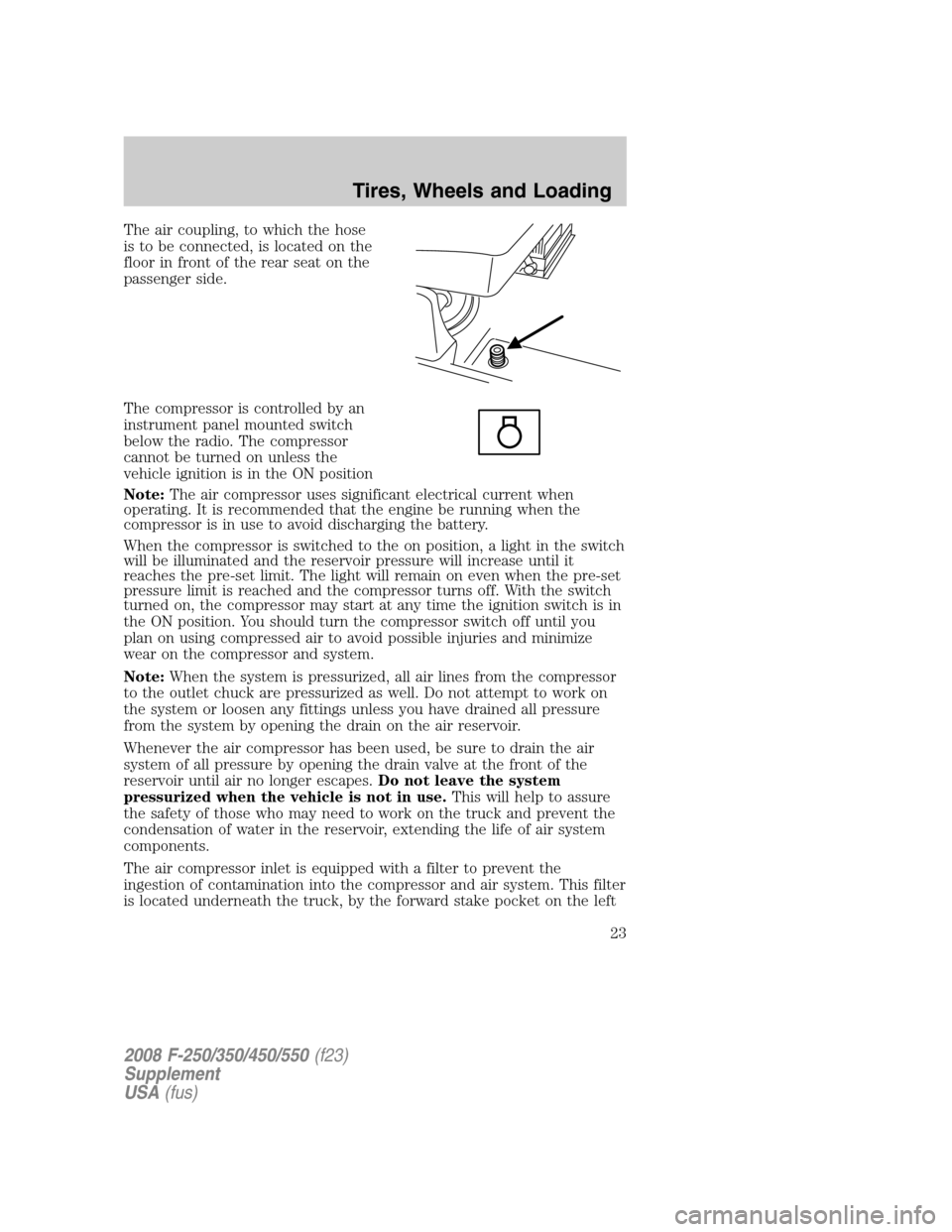
The air coupling, to which the hose
is to be connected, is located on the
floor in front of the rear seat on the
passenger side.
The compressor is controlled by an
instrument panel mounted switch
below the radio. The compressor
cannot be turned on unless the
vehicle ignition is in the ON position
Note:The air compressor uses significant electrical current when
operating. It is recommended that the engine be running when the
compressor is in use to avoid discharging the battery.
When the compressor is switched to the on position, a light in the switch
will be illuminated and the reservoir pressure will increase until it
reaches the pre-set limit. The light will remain on even when the pre-set
pressure limit is reached and the compressor turns off. With the switch
turned on, the compressor may start at any time the ignition switch is in
the ON position. You should turn the compressor switch off until you
plan on using compressed air to avoid possible injuries and minimize
wear on the compressor and system.
Note:When the system is pressurized, all air lines from the compressor
to the outlet chuck are pressurized as well. Do not attempt to work on
the system or loosen any fittings unless you have drained all pressure
from the system by opening the drain on the air reservoir.
Whenever the air compressor has been used, be sure to drain the air
system of all pressure by opening the drain valve at the front of the
reservoir until air no longer escapes.Do not leave the system
pressurized when the vehicle is not in use.This will help to assure
the safety of those who may need to work on the truck and prevent the
condensation of water in the reservoir, extending the life of air system
components.
The air compressor inlet is equipped with a filter to prevent the
ingestion of contamination into the compressor and air system. This filter
is located underneath the truck, by the forward stake pocket on the left
2008 F-250/350/450/550(f23)
Supplement
USA(fus)
Tires, Wheels and Loading
23