2008 FORD SUPER DUTY air filter
[x] Cancel search: air filterPage 29 of 96

F-Super Duty
1. Windshield washer fluid reservoir
2. Batteries
3. Air filter assembly and restriction gauge
4. Automatic transmission dipstick (if equipped)
5. Engine oil fill
6. Engine oil filter
7. Engine-mounted fuel filter assembly
8. Engine oil dipstick
9. Fuel coolant reservoir
10. Brake fluid reservoir
11. Power distribution box (behind engine coolant reservoir)
12. Engine coolant reservoir
13. Power steering fluid reservoir
2008 Econoline(eco)
Supplement
USA(fus)
Maintenance and Specifications
29
Page 32 of 96

components such as fuel tank, fuel lines, fuel pump, fuel sender and fuel
injectors. Concentrations greater than 5% can also cause fuel filter
restrictions that may result in a lack of power and or fuel pump and fuel
injector failure.
Biodiesel fuel is a product that has been converted from renewable fuel
sources, including vegetable oil, animal fat and cooking oil. Raw or
refined vegetable oil, animal fat, cooking oil or recycled greases should
not be used.
Do not use home heating oil, agricultural fuel or any diesel fuel
not intended for highway use. Damage to the fuel injection
system, engine and exhaust catalyst can occur if an improper fuel
is used. Do not add gasoline, gasohol or alcohol to diesel fuel.
This practice creates a serious fire hazard and engine
performance problems.
Fuel quality
It should not be necessary to add any aftermarket additives to your fuel
tank if you use a properly formulated diesel fuel that meets the ASTM D
975 industry specification. Aftermarket additives can damage the injector
system or engine. Repairs to correct the effects of using an aftermarket
product in your fuel may not be covered by your warranty.
Do not blend used engine oil with diesel fuel under any
circumstances.Blending used oil with the fuel will significantly increase
your vehicle’s exhaust emissions and reduce engine life due to increased
internal wear.
Many of the world’s automakers approved the World-wide Fuel Charter
that recommends diesel fuel specifications to provide improved
performance and emission control system protection for your vehicle.
Diesel fuel that meets the World-wide Fuel Charter should be used when
available. Ask your fuel supplier about fuel that meets the World-wide
Fuel Charter.
Diesel Fuel Conditioner
Additives that will improve fuel cetane numbers may be used to
verify/enhance fuel quality. Use Motorcraft Cetane Booster &
Performance Improver, PM-17-A (U.S.) / PM-17-B (Canada) or
equivalent. The customer warranty may be void from using additives that
do not meet or exceed Ford specifications.
Do not use alcohol based additives to correct fuel gelling. This may
result in damage to the fuel injectors/system. Use Motorcraft Anti-Gel &
Performance Improver, PM-18-A (U.S.) / PM-18-B (Canada) or
2008 Econoline(eco)
Supplement
USA(fus)
Maintenance and Specifications
32
Page 33 of 96
equivalent. The customer warranty may be void from using additives that
do not meet or exceed Ford specifications.
Fueling tips
If the engine fails to start in 30 seconds, turn the key to the OFF
position and wait 30 seconds before trying again.
Truck stops have pumps and nozzles designed for larger, heavy-duty
trucks. When refueling at truck stops: if the nozzle shuts off repeatedly
when refueling, wait 5–10 seconds; then use a slower rate of flow (don’t
depress the nozzle trigger as far).
If air is allowed to enter the fuel system (during fuel filter change or if
you run out of fuel) the engine will purge the trapped air as it runs. The
engine may run rough and produce white smoke while air is in the
system. This is normal and should correct itself in a short time.
An engine that suddenly becomes noisy or operates poorly after a fuel fill
could be using substandard fuel (i.e., high water content, low cetane
rating or gasoline in the fuel). Diesel fuel should be purchased from a
reputable station which sells a large amount of diesel fuel.
Care should be taken whenever diesel fuel is stored. Use only clean,
approved containers which will prevent the entry of dirt or water.
Diesel fuel must not be stored in a galvanized container. The fuel will
dissolve the zinc in a galvanized container. The zinc will then remain in
solution until it is run through the engine where it will be deposited in
the fuel injectors causing expensive-to-repair damage.
Diesel fuel dispensing nozzle fill rate
This truck is equipped with a fuel fill pipe which is able to accept fuel up
to 20 gallons per minute from an 1
18” fuel dispensing nozzle. Pumping
fuel at greater flow rates may result in premature nozzle shut-off or
spitback.
Fuel filler cap
When fueling your vehicle:
1. Turn the engine off.
2. Carefully turn the filler cap counterclockwise until it stops.
3. Pull to remove the cap from the fuel filler pipe.
4. To install the cap, align the tabs on the cap with the notches on the
filler pipe.
5. Turn the filler cap clockwise until a few clicks are heard.
2008 Econoline(eco)
Supplement
USA(fus)
Maintenance and Specifications
33
Page 36 of 96
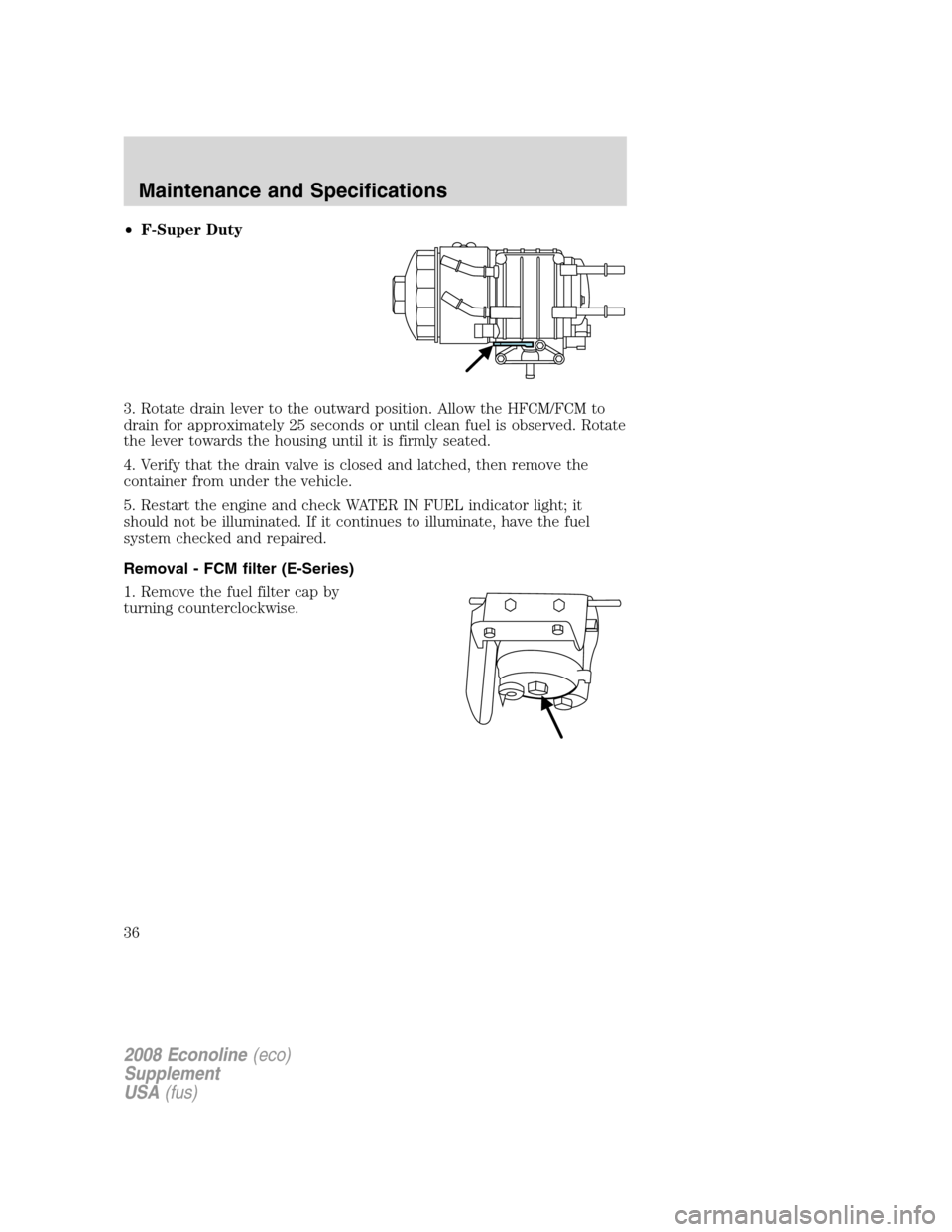
•F-Super Duty
3. Rotate drain lever to the outward position. Allow the HFCM/FCM to
drain for approximately 25 seconds or until clean fuel is observed. Rotate
the lever towards the housing until it is firmly seated.
4. Verify that the drain valve is closed and latched, then remove the
container from under the vehicle.
5. Restart the engine and check WATER IN FUEL indicator light; it
should not be illuminated. If it continues to illuminate, have the fuel
system checked and repaired.
Removal - FCM filter (E-Series)
1. Remove the fuel filter cap by
turning counterclockwise.
2008 Econoline(eco)
Supplement
USA(fus)
Maintenance and Specifications
36
Page 39 of 96
On E-Series vehicles:After replacing the fuel filter, the engine will
purge the trapped air as it runs. The engine may run roughly and smoke
until the air is completely eliminated.
On F-Super Duty vehicles:Turn the ignition key to ON for 30 seconds,
then turn it to OFF. Do this a total of six times in a row to purge any
trapped air from the fuel system.
Using a fuel which has more than average impurities may require
the fuel filter to be replaced more frequently than the service
interval specifies.
ENGINE OIL
Checking the engine oil level
Because it is normal to add some oil between oil changes, check your
engine oil level each time you stop for fuel. To check the engine oil level
consistently and accurately, the following procedure is recommended:
1. Have engine at normal operating temperature (at least into the
NORMAL range on the engine coolant temperature gauge).
2. Park the vehicle on a level surface, then turn off the engine and open
the hood.
3. Allow at least20 minutesafter engine shutdown to ensure that the
oil contained in the upper parts of the engine has returned to the oil
pan.
4. Protecting yourself from engine heat, pull out the dipstick, wipe it
clean and reinsert fully.
5. Read oil level on both sides of dipstick and use highest level (reading)
for the actual engine oil level.
6. Maintain the oil level between MIN and MAX or the ADD and
OPERATING RANGE on the dipstick by adding oil as required. The
distance from MIN to MAX or ADD to OPERATING RANGE on the
dipstick represents 2.0 quarts (1.9L). Do not overfill. If the oil level
exceeds MAX or OPERATING RANGE, oil consumption may result.
Engine oil specifications
To help achieve acceptable engine performance and durability, it is
important that only engine oils of good quality are used in your diesel
engine and it is changed at the recommended interval. For normal or
severe service, use Motorcraft oil or an equivalent oil conforming to Ford
specification WSS-M2C171–E or API service categories CJ-4 or CJ-4/SM.
2008 Econoline(eco)
Supplement
USA(fus)
Maintenance and Specifications
39
Page 43 of 96
AIR FILTER RESTRICTION GAUGE AND AIR FILTER
REPLACEMENT
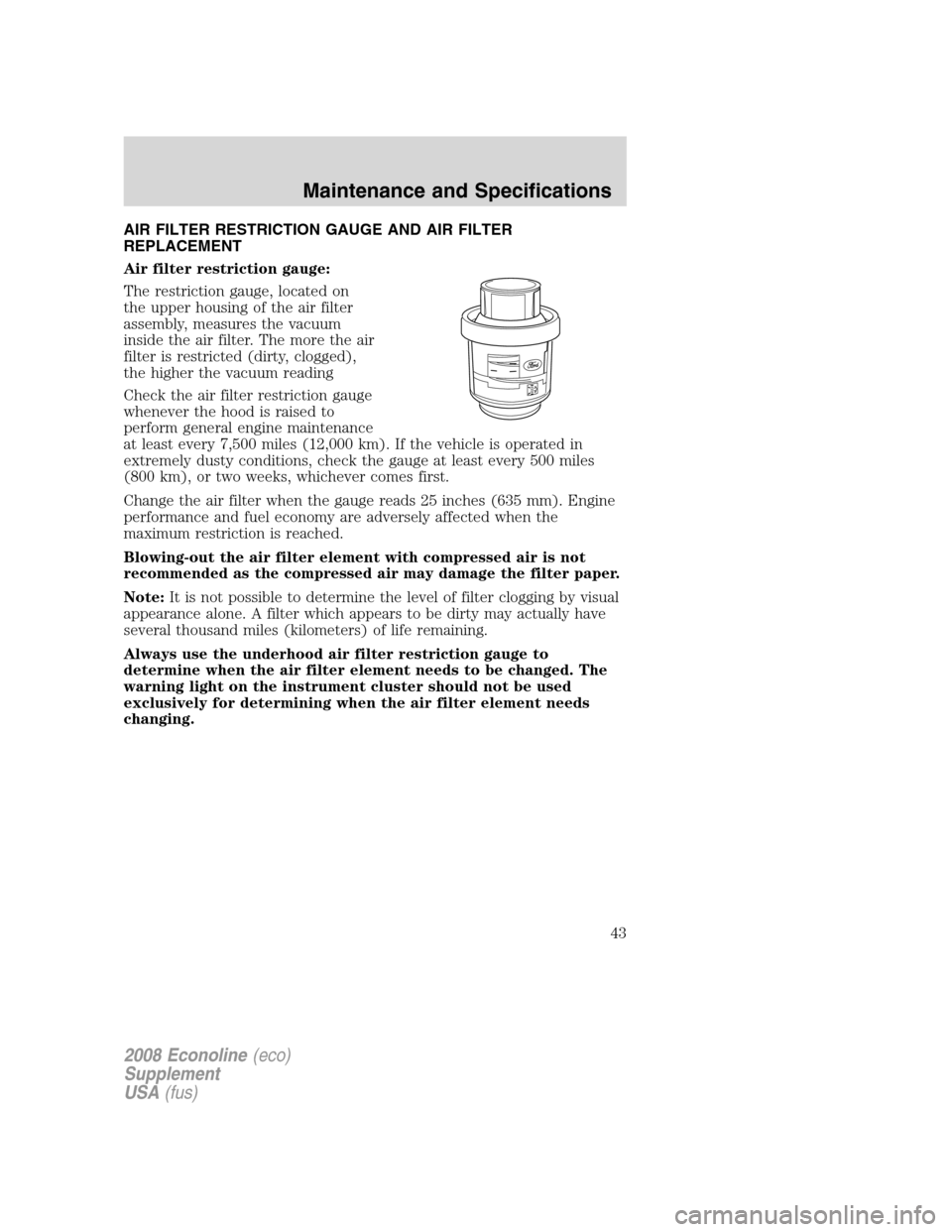
Air filter restriction gauge:
The restriction gauge, located on
the upper housing of the air filter
assembly, measures the vacuum
inside the air filter. The more the air
filter is restricted (dirty, clogged),
the higher the vacuum reading
Check the air filter restriction gauge
whenever the hood is raised to
perform general engine maintenance
at least every 7,500 miles (12,000 km). If the vehicle is operated in
extremely dusty conditions, check the gauge at least every 500 miles
(800 km), or two weeks, whichever comes first.
Change the air filter when the gauge reads 25 inches (635 mm). Engine
performance and fuel economy are adversely affected when the
maximum restriction is reached.
Blowing-out the air filter element with compressed air is not
recommended as the compressed air may damage the filter paper.
Note:It is not possible to determine the level of filter clogging by visual
appearance alone. A filter which appears to be dirty may actually have
several thousand miles (kilometers) of life remaining.
Always use the underhood air filter restriction gauge to
determine when the air filter element needs to be changed. The
warning light on the instrument cluster should not be used
exclusively for determining when the air filter element needs
changing.
2008 Econoline(eco)
Supplement
USA(fus)
Maintenance and Specifications
43
Page 44 of 96

After installation of the new filter
element, reset the gauge by pressing
the reset button on top of the
gauge.
Note:If the vehicle is operated in a
heavy snow storm, in blowing snow
or the vehicle is equipped with a
snowplow, the engine air filter
element may become partially
clogged with snow and/or ice. If this
occurs, the engine may experience a
significant reduction in power output. The vehicle may be driven under
these conditions for up to 200 miles (320 km) without damage to the
engine or related components.
At the earliest opportunity, clear all snow and ice from the air induction
system and reset the restriction gauge by pressing the button on the end
of the gauge. If the air filter restriction gauge vacuum reads above the
second line after clearing snow and/or ice, then replace the filter. Reset
filter restriction gauge after changing the air filter element.
The air filter warning message on the instrument cluster may be used, in
addition to the underhood restriction gauge, to monitor the condition of
the air filter element. Refer to theEngine air filterwarning light in this
chapter of the supplement.
Air filter replacement:
When replacing the air filter element, use the Motorcraft air filter
element listed inMotorcraft Part Numberslater in this chapter.
To reduce the risk of vehicle damage and/or personal burn
injuries do not start your engine with the air filter removed and
do not remove it while the engine is running.
Failure to use the correct air filter element may result in severe
engine damage.
•E-series air filter element:
1. Disconnect the hoses from the air filter outlet tube.
2008 Econoline(eco)
Supplement
USA(fus)
Maintenance and Specifications
44
Page 45 of 96
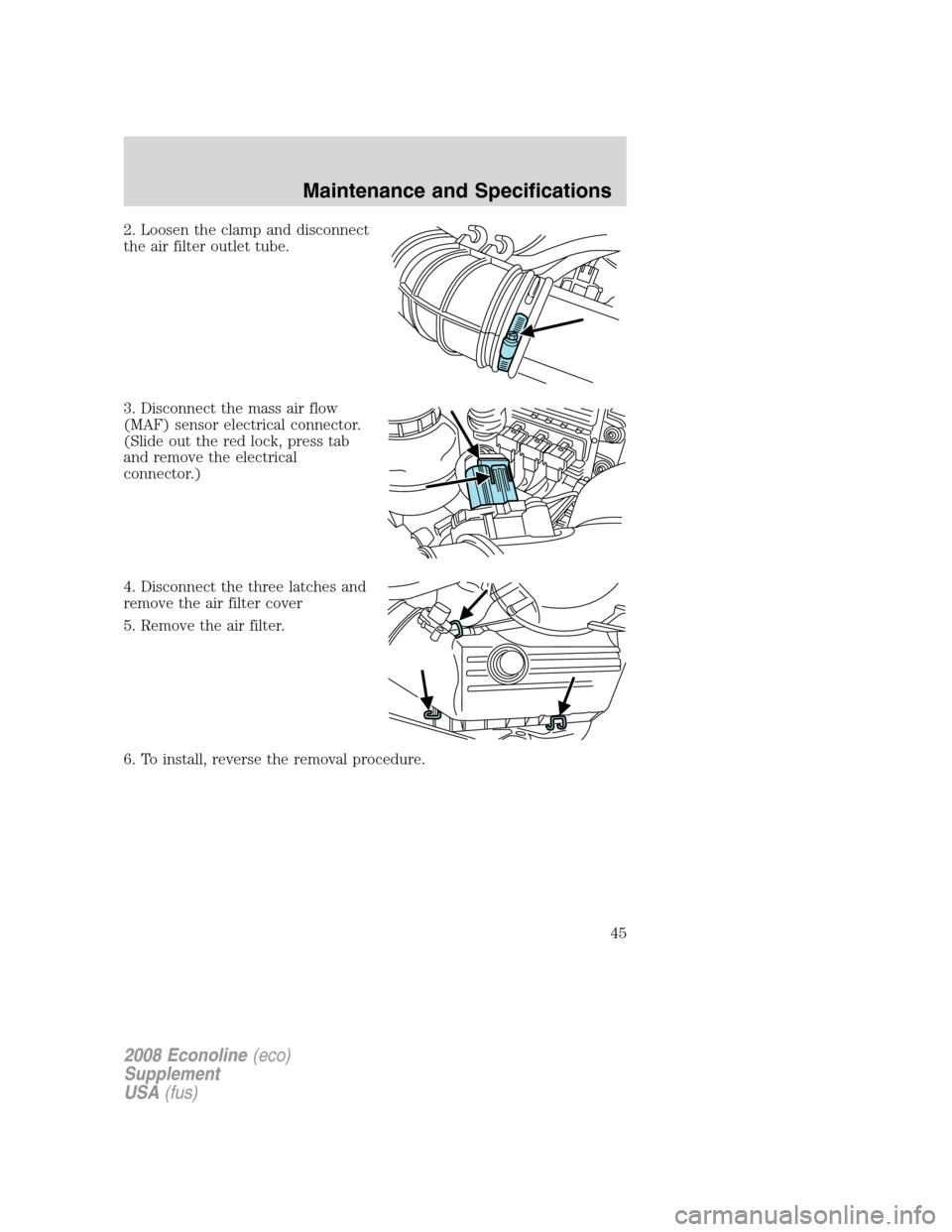
2. Loosen the clamp and disconnect
the air filter outlet tube.
3. Disconnect the mass air flow
(MAF) sensor electrical connector.
(Slide out the red lock, press tab
and remove the electrical
connector.)
4. Disconnect the three latches and
remove the air filter cover
5. Remove the air filter.
6. To install, reverse the removal procedure.
2008 Econoline(eco)
Supplement
USA(fus)
Maintenance and Specifications
45