Page 66 of 272

Anti-theft indicator
The anti-theft indicator is located in
the instrument cluster.
Vehicles equipped with the SecuriLock™ Passive Anti-theft system
behave as follows:
•When the ignition is in the 1(OFF/LOCK) position, the indicator will
flash once every 2 seconds for a total of 10 seconds to indicate the
SecuriLock™ system is functioning as a theft deterrent.
•When the ignition is in the 3 (ON) position, the indicator will glow for
3 seconds to indicate a programmed key has been validated and the
SecuriLock™ Passive Anti-theft system has enabled the engine.
Vehicles without the SecuriLock™ Passive Anti-theft system behave as
follows:
•When the ignition is in the 1 (OFF/LOCK) position, the indicator will
not flash.
•When the igniton is in the 3 (ON) position, the indicator will glow for
3 seconds to indicate the engine is enabled.
Replacement keys
If your keys are lost or stolen and you don’t have an extra coded key,
you will need to have your vehicle towed to an authorized dealer. The
key codes need to be erased from your vehicle and new coded keys will
need to be programmed.
Replacing coded keys can be very costly. Store an extra programmed key
away from the vehicle in a safe place to help prevent any
inconveniences. Please visit an authorized dealer to purchase additional
spare or replacement keys.
Programming spare keys
You can program your own coded keys to your vehicle. Please read and
understand the entire procedure before you begin.
Tips:
•A maximum of eight keys can be coded to your vehicle.
•Only use Securilock™ keys.
•You must have two previously programmed coded keys (keys that
already operate your vehicle’s engine) and the new unprogrammed
key(s) readily accessible.
2008 Ranger(ran)
Owners Guide (post-2002-fmt)
USA(fus)
Locks and Security
66
Page 67 of 272
•If no previously programmed coded keys are available, you must take
your vehicle to your authorized dealer to have the spare key(s)
programmed.
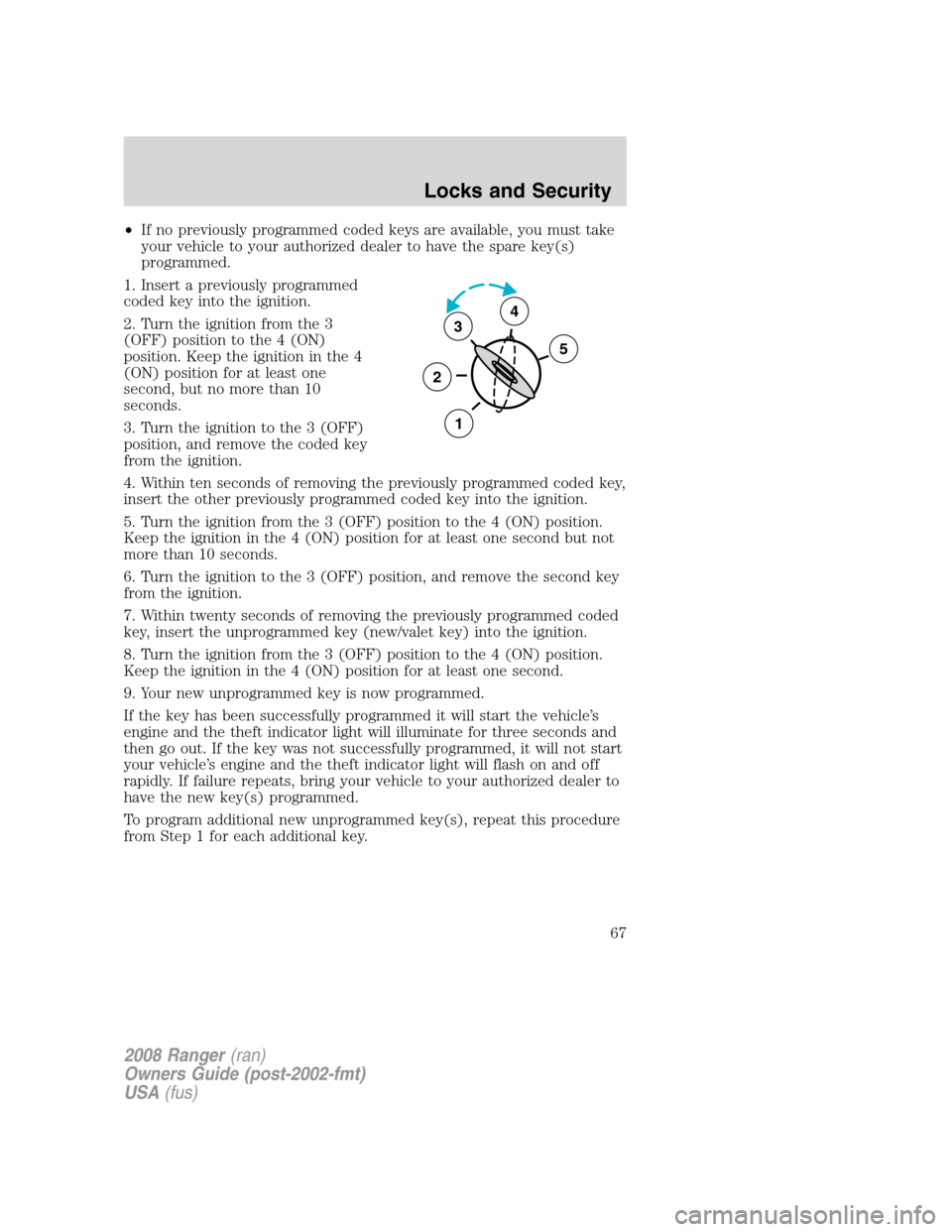
1. Insert a previously programmed
coded key into the ignition.
2. Turn the ignition from the 3
(OFF) position to the 4 (ON)
position. Keep the ignition in the 4
(ON) position for at least one
second, but no more than 10
seconds.
3. Turn the ignition to the 3 (OFF)
position, and remove the coded key
from the ignition.
4. Within ten seconds of removing the previously programmed coded key,
insert the other previously programmed coded key into the ignition.
5. Turn the ignition from the 3 (OFF) position to the 4 (ON) position.
Keep the ignition in the 4 (ON) position for at least one second but not
more than 10 seconds.
6. Turn the ignition to the 3 (OFF) position, and remove the second key
from the ignition.
7. Within twenty seconds of removing the previously programmed coded
key, insert the unprogrammed key (new/valet key) into the ignition.
8. Turn the ignition from the 3 (OFF) position to the 4 (ON) position.
Keep the ignition in the 4 (ON) position for at least one second.
9. Your new unprogrammed key is now programmed.
If the key has been successfully programmed it will start the vehicle’s
engine and the theft indicator light will illuminate for three seconds and
then go out. If the key was not successfully programmed, it will not start
your vehicle’s engine and the theft indicator light will flash on and off
rapidly. If failure repeats, bring your vehicle to your authorized dealer to
have the new key(s) programmed.
To program additional new unprogrammed key(s), repeat this procedure
from Step 1 for each additional key.
3
2
1
5
4
2008 Ranger(ran)
Owners Guide (post-2002-fmt)
USA(fus)
Locks and Security
67
Page 69 of 272
Lift the release bar to move seat
forward or backward. Ensure that
the seat is locked into place.
Pull lever located at the side of the
seat cushion up to adjust seatback.
60/40 seat (if equipped)
To gain access to the storage
compartment in your armrest (if
equipped), lift the latch to open lid.
The 60/40 seat cupholder (if
equipped) is detachable for
cleaning.
•Firmly grasp the bottom of the
cup holder and pull up.
To re-attach:
•Slide the cupholder over the two pins located on the front of the 60%
driver’s seat.
•Press down until it is firmly latched into place.
2008 Ranger(ran)
Owners Guide (post-2002-fmt)
USA(fus)
Seating and Safety Restraints
69
Page 70 of 272
Using the manual lumbar support (if equipped)
Turn the lumbar support control
clockwise to increase firmness.
Turn the lumbar support control
counterclockwise to increase
softness.
Passenger side rear access
Pull up on the recliner handle. The
seat will lean forward. Lift the
release bar to move the seat forward
to access the rear area of the cab.
To return seat to original position, slide the seat bottom back, then push
the seatback up to lock it in place. The seat will lock, and you will have
to use the release bar to move the seat back to the original position.
REAR SEATS
Center facing jump seat (2 door SuperCab) (if equipped)
To open, pull inboard and down on the seat strap.
To stow the seat, pull seat bottom back to the fully upright position.
Do not install a child seat in the center facing jump seats as
there are no child restraints recommended for use in this seating
position.
2008 Ranger(ran)
Owners Guide (post-2002-fmt)
USA(fus)
Seating and Safety Restraints
70
Page 77 of 272

Shorten and fasten the belt when
not in use.
For the rear jump seat, shorten and
fold the belt into the seat when not
in use.
Energy Management Feature
•This vehicle has a safety belt system with an energy management
feature at the front outboard seating positions to help further reduce
the risk of injury in the event of a head-on collision.
•This energy management system has a retractor assembly that is
designed to pay out webbing in a controlled manner. This feature is
designed to help reduce the belt force acting on the occupant’s chest.
The front outboard safety restraints in the vehicle are combination lap
and shoulder belts. The front passenger outboard safety belt has two
types of locking modes described below:
Vehicle sensitive mode
This is the normal retractor mode, which allows free shoulder belt length
adjustment to your movements and locking in response to vehicle
movement. For example, if the driver brakes suddenly or turns a corner
sharply, or the vehicle receives an impact of approximately 5 mph (8 km/h)
or more, the combination safety belts will lock to help reduce forward
movement of the driver and passengers.
Automatic locking mode
The automatic locking mode is not available on the driver safety belt.
In this mode, the shoulder belt is automatically pre-locked. The belt will
still retract to remove any slack in the shoulder belt. The automatic
locking mode is not available on the driver safety belt.
This mode should be usedany timea child safety seat is installed in a
passenger front seat. Refer toSafety restraints for childrenorSafety
seats for childrenlater in this chapter.
2008 Ranger(ran)
Owners Guide (post-2002-fmt)
USA(fus)
Seating and Safety Restraints
77
Page 78 of 272
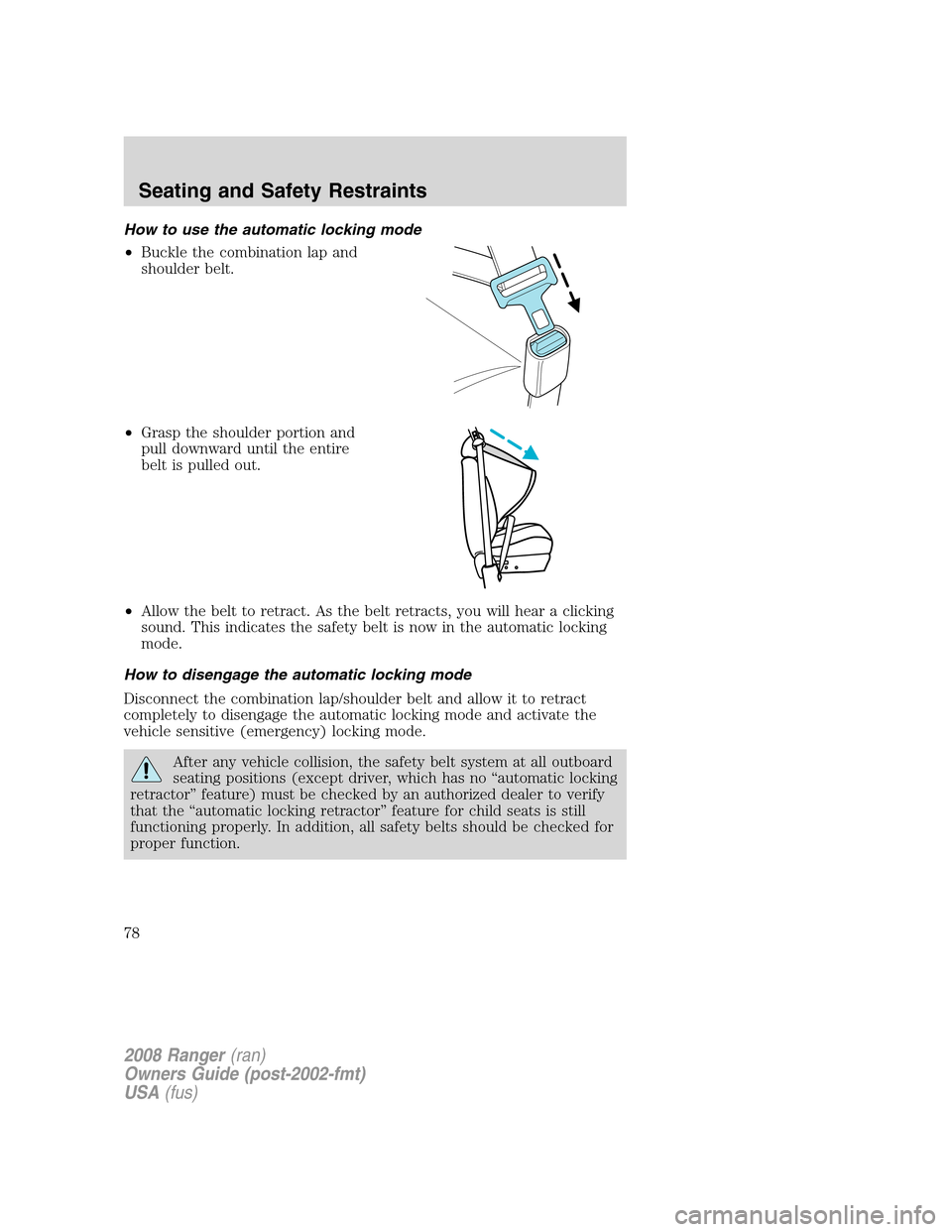
How to use the automatic locking mode
•Buckle the combination lap and
shoulder belt.
•Grasp the shoulder portion and
pull downward until the entire
belt is pulled out.
•Allow the belt to retract. As the belt retracts, you will hear a clicking
sound. This indicates the safety belt is now in the automatic locking
mode.
How to disengage the automatic locking mode
Disconnect the combination lap/shoulder belt and allow it to retract
completely to disengage the automatic locking mode and activate the
vehicle sensitive (emergency) locking mode.
After any vehicle collision, the safety belt system at all outboard
seating positions (except driver, which has no “automatic locking
retractor” feature) must be checked by an authorized dealer to verify
that the “automatic locking retractor” feature for child seats is still
functioning properly. In addition, all safety belts should be checked for
proper function.
2008 Ranger(ran)
Owners Guide (post-2002-fmt)
USA(fus)
Seating and Safety Restraints
78
Page 79 of 272

BELT AND RETRACTOR ASSEMBLY MUST BE REPLACED if
the safety belt assembly “automatic locking retractor” feature or
any other safety belt function is not operating properly when checked
authorized dealer.
Failure to replace the Belt and Retractor assembly could
increase the risk of injury in collisions.
Safety belt pretensioner
Your vehicle is equipped with safety belt pretensioners at the driver and
front outboard passenger seating positions.
The safety belt pretensioner is a device which removes excess webbing
from the safety belt system. The safety belt pretensioner uses the same
crash sensor system as the front airbag supplemental restraint system
(SRS). When the safety belt pretensioner deploys, webbing from the lap
and shoulder belt is tightened. Refer to theSafety belt maintenance
section in this chapter.
The driver and front passenger safety belt system (including
retractors, buckles and height adjusters) must be replaced if the
vehicle is involved in a collision that results in deployment of front
airbags and safety belt pretensioners.
Front safety belt height adjustment
Your vehicle has safety belt height adjustments for the driver and front
outboard passenger. Adjust the height of the shoulder belt so the belt
rests across the middle of your shoulder.
•Regular Cab and 4–door Super
Cab
2008 Ranger(ran)
Owners Guide (post-2002-fmt)
USA(fus)
Seating and Safety Restraints
79
Page 80 of 272

•2–door SuperCab
To lower the shoulder belt height, push the button and slide the height
adjuster down. To raise the height of the shoulder belt, push the button
and slide the height adjuster up. Pull down on the height adjuster to
make sure it is locked in place.
Position the safety belt height adjusters so that the belt rests
across the middle of your shoulder. Failure to adjust the safety
belt properly could reduce the effectiveness of the seat belt and
increase the risk of injury in a collision.
Safety belt extension assembly
If the safety belt is too short when fully extended, there is a 8 inch
(20 cm) safety belt extension assembly that can be added (part number
611C22). This assembly can be obtained from an authorized dealer.
Use only extensions manufactured by the same supplier as the safety
belt. Manufacturer identification is located at the end of the webbing on
the label. Also, use the safety belt extension only if the safety belt is too
short for you when fully extended.
Do not use extensions to change the fit of the shoulder belt
across the torso.
Safety belt maintenance
Inspect the safety belt systems periodically to make sure they work
properly and are not damaged. Inspect the safety belts to make sure
there are no nicks, tears or cuts. Replace if necessary. All safety belt
assemblies, including retractors, buckles, front safety belt buckle
assemblies, buckle support assemblies (slide bar-if equipped), shoulder
belt height adjusters (if equipped), shoulder belt guide on seatback (if
2008 Ranger(ran)
Owners Guide (post-2002-fmt)
USA(fus)
Seating and Safety Restraints
80

