Page 195 of 280

Auxiliary relay
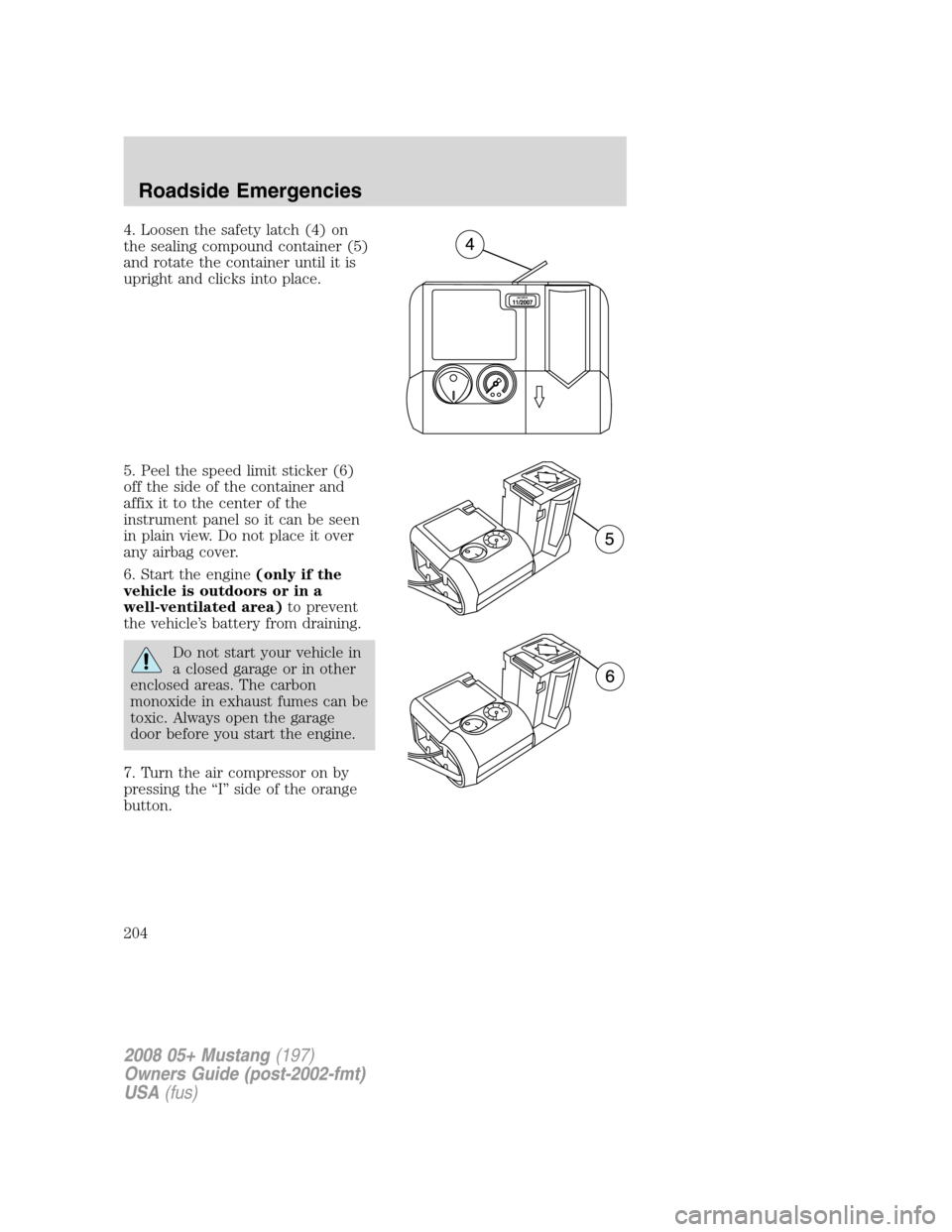
On heated seat equipped vehicles, there is a relay box located behind the
headlamp switch area containing two micro relays for the driver and
passenger heated seats.
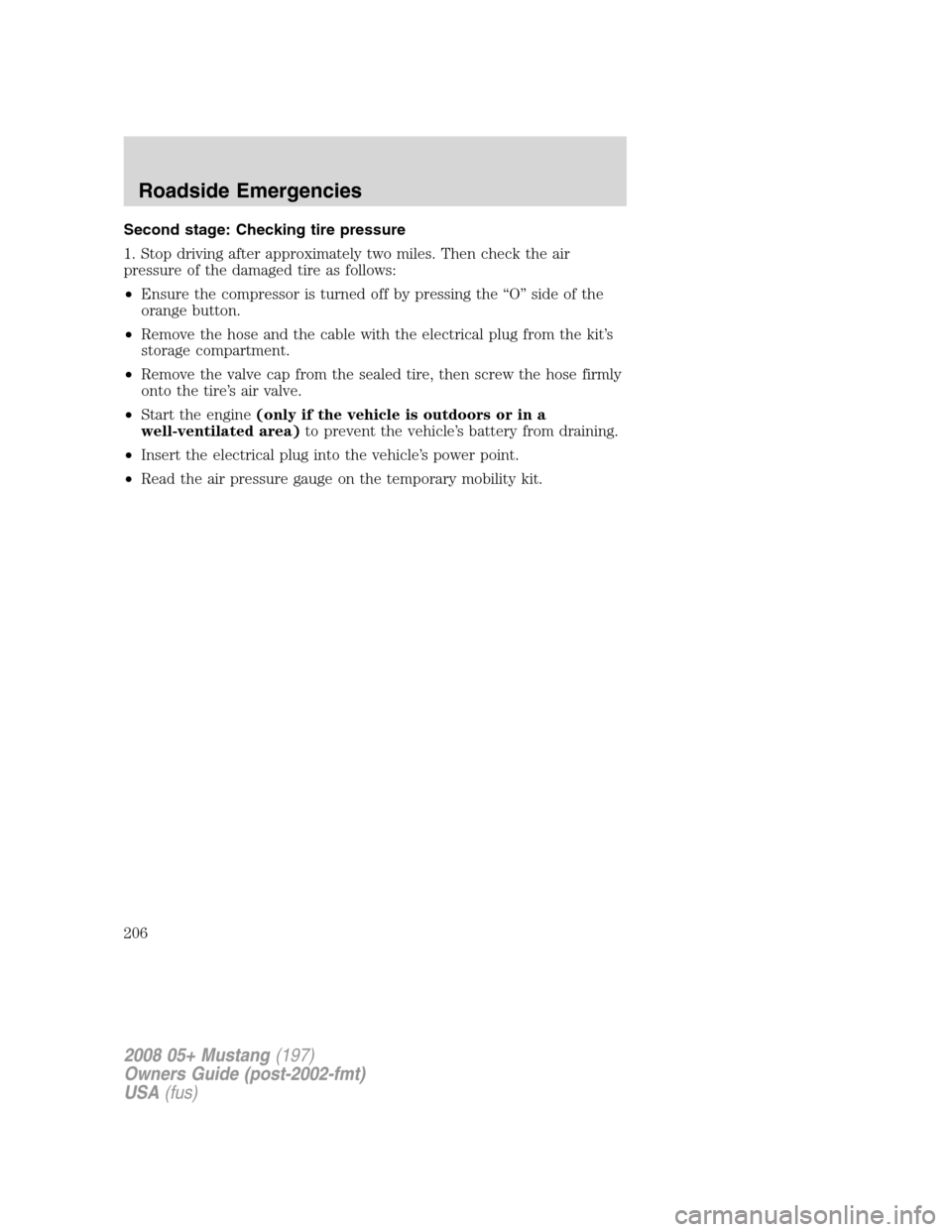
Auxiliary relay with HID headlamps
1. Left HID headlamp
2. Right HID headlamp
3. Not used
On vehicles equipped with HID headlamps, an auxiliary relay box is
located under the hood on the right hand side front of the engine
compartment. This auxiliary relay box contains the left front and right
front HID headlamp relays.
CHANGING A FLAT TIRE
If you get a flat tire while driving:
•do not brake heavily.
•gradually decrease the vehicle’s speed.
•hold the steering wheel firmly.
•slowly move to a safe place on the side of the road.
Your vehicle may be equipped with a conventional spare tire that is
different in one or more of the following: type, brand, size, speed rating
and tread design. If this is the case, this dissimilar spare tire is still rated
for your vehicle loads (GAWR and GVWR). This temporary spare tire is
not equipped with a Tire Pressure Monitor System (TPMS) sensor.
1
23
2008 05+ Mustang(197)
Owners Guide (post-2002-fmt)
USA(fus)
Roadside Emergencies
195
Page 198 of 280
When driving with the full-size dissimilar spare tire/wheel additional
caution should be given to:
•Towing a trailer
•Driving vehicles equipped with a camper body
•Driving vehicles with a load on the cargo rack
Drive cautiously when using a full-size dissimilar spare tire/wheel and
seek service as soon as possible.
Stopping and securing the vehicle
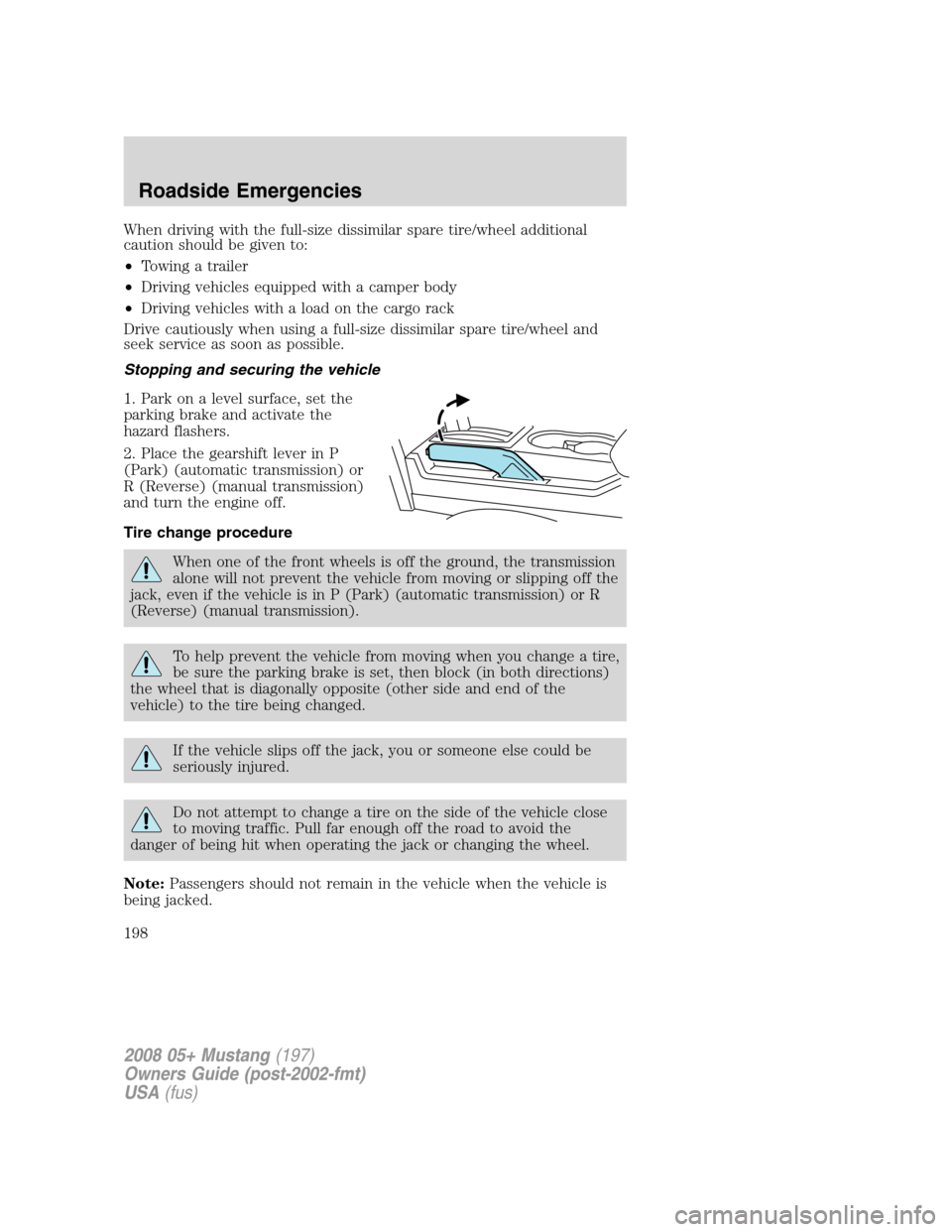
1. Park on a level surface, set the
parking brake and activate the
hazard flashers.
2. Place the gearshift lever in P
(Park) (automatic transmission) or
R (Reverse) (manual transmission)
and turn the engine off.
Tire change procedure
When one of the front wheels is off the ground, the transmission
alone will not prevent the vehicle from moving or slipping off the
jack, even if the vehicle is in P (Park) (automatic transmission) or R
(Reverse) (manual transmission).
To help prevent the vehicle from moving when you change a tire,
be sure the parking brake is set, then block (in both directions)
the wheel that is diagonally opposite (other side and end of the
vehicle) to the tire being changed.
If the vehicle slips off the jack, you or someone else could be
seriously injured.
Do not attempt to change a tire on the side of the vehicle close
to moving traffic. Pull far enough off the road to avoid the
danger of being hit when operating the jack or changing the wheel.
Note:Passengers should not remain in the vehicle when the vehicle is
being jacked.
2008 05+ Mustang(197)
Owners Guide (post-2002-fmt)
USA(fus)
Roadside Emergencies
198
Page 200 of 280

4. Put the jack in the jack notch
next to the tire you are changing.
Turn the jack handle clockwise until
the wheel is completely off the
ground.
Never use the rear differential
as a jacking point.
To lessen the risk of
personal injury, do not put
any part of your body under the
vehicle while changing a tire. Do
not start the engine when your
vehicle is on the jack. The jack is
only meant for changing the tire.
5. Remove the lug nuts with the lug wrench.
6. Replace the flat tire with the spare tire, making sure the valve stem is
facing outward. Reinstall lug nuts until the wheel is snug against the hub.
Do not fully tighten the lug nuts until the wheel has been lowered.
If you are using the temporary tire, the lug nut washers will not appear
to be flush with the rim. This is normal only when using the temporary
spare tire.
7. Lower the wheel by turning the jack handle counterclockwise.
8. Remove the jack and fully tighten
the lug nuts in the order shown.
Refer toWheel lug nut torque
specificationslater in this chapter
for the proper lug nut torque
specification.
9. Put flat tire, wheel ornament (if
equipped), jack and lug wrench
away. Make sure jack is fastened so
it does not rattle when you drive.
10. Unblock the wheels.
1
4 3
2 5
2008 05+ Mustang(197)
Owners Guide (post-2002-fmt)
USA(fus)
Roadside Emergencies
200
Page 202 of 280
•Do notdrive farther than 120 miles (193 km). Drive only to the
closest authorized dealer or tire dealer.
•Drive carefully and avoid abrupt steering maneuvers.
•Periodically monitor tire inflation pressure in the affected tire; if the
tire is losing pressure, have the vehicle towed.
•Read the information in theTips for use of the temporary mobility
kitsection to ensure safe operation of the temporary mobility kit and
your vehicle.
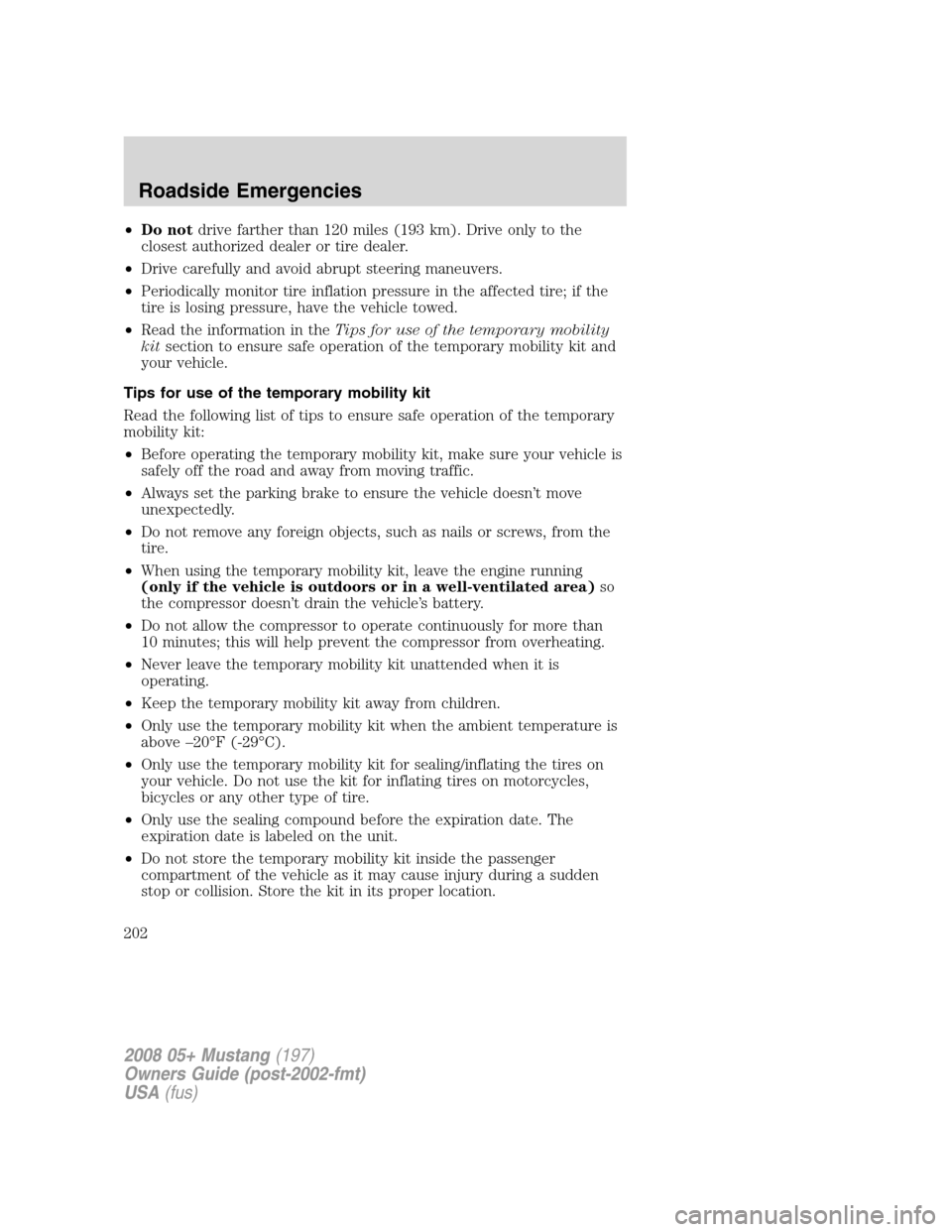
Tips for use of the temporary mobility kit
Read the following list of tips to ensure safe operation of the temporary
mobility kit:
•Before operating the temporary mobility kit, make sure your vehicle is
safely off the road and away from moving traffic.
•Always set the parking brake to ensure the vehicle doesn’t move
unexpectedly.
•Do not remove any foreign objects, such as nails or screws, from the
tire.
•When using the temporary mobility kit, leave the engine running
(only if the vehicle is outdoors or in a well-ventilated area)so
the compressor doesn’t drain the vehicle’s battery.
•Do not allow the compressor to operate continuously for more than
10 minutes; this will help prevent the compressor from overheating.
•Never leave the temporary mobility kit unattended when it is
operating.
•Keep the temporary mobility kit away from children.
•Only use the temporary mobility kit when the ambient temperature is
above –20°F (-29°C).
•Only use the temporary mobility kit for sealing/inflating the tires on
your vehicle. Do not use the kit for inflating tires on motorcycles,
bicycles or any other type of tire.
•Only use the sealing compound before the expiration date. The
expiration date is labeled on the unit.
•Do not store the temporary mobility kit inside the passenger
compartment of the vehicle as it may cause injury during a sudden
stop or collision. Store the kit in its proper location.
2008 05+ Mustang(197)
Owners Guide (post-2002-fmt)
USA(fus)
Roadside Emergencies
202
Page 204 of 280
4. Loosen the safety latch (4) on
the sealing compound container (5)
and rotate the container until it is
upright and clicks into place.
5. Peel the speed limit sticker (6)
off the side of the container and
affix it to the center of the
instrument panel so it can be seen
in plain view. Do not place it over
any airbag cover.
6. Start the engine(only if the
vehicle is outdoors or in a
well-ventilated area)to prevent
the vehicle’s battery from draining.
Do not start your vehicle in
a closed garage or in other
enclosed areas. The carbon
monoxide in exhaust fumes can be
toxic. Always open the garage
door before you start the engine.
7. Turn the air compressor on by
pressing the “I” side of the orange
button.
2008 05+ Mustang(197)
Owners Guide (post-2002-fmt)
USA(fus)
Roadside Emergencies
204
Page 206 of 280
Second stage: Checking tire pressure
1. Stop driving after approximately two miles. Then check the air
pressure of the damaged tire as follows:
•Ensure the compressor is turned off by pressing the “O” side of the
orange button.
•Remove the hose and the cable with the electrical plug from the kit’s
storage compartment.
•Remove the valve cap from the sealed tire, then screw the hose firmly
onto the tire’s air valve.
•Start the engine(only if the vehicle is outdoors or in a
well-ventilated area)to prevent the vehicle’s battery from draining.
•Insert the electrical plug into the vehicle’s power point.
•Read the air pressure gauge on the temporary mobility kit.
2008 05+ Mustang(197)
Owners Guide (post-2002-fmt)
USA(fus)
Roadside Emergencies
206
Page 208 of 280
What to do after the tire has been sealed
After using the temporary mobility kit to seal your tire, you will need to
replace the sealing compound and hose. Sealing compound and spare
parts can be obtained and replaced at an authorized dealer or tire dealer.
Empty sealing compound bottles may be disposed of at home; however,
liquid residue from the sealing compound should be disposed by your
authorized dealer or tire dealer, or in accordance with local waste
disposal regulations.
Note:After the sealing compound has been used, the maximum vehicle
speed is 50 mph (80 km/h) and the maximum driving distance is
120 miles (193 km). The sealed tire should be replaced immediately, or
at least within the 120 miles (200 km). After sealant use, the TPM (Tire
Pressure Monitoring) sensor located inside the wheel, must be replaced
by an authorized Ford dealer.
Note:If you experience any unusual vibration, ride disturbance or noise
while driving, reduce your speed until you can safely pull off to the side
of the road to call for roadside assistance.
You can check the tire pressure any time within the 120 miles (193 km)
by performing the following:
1. Ensure the compressor is turned off by pressing the “O” side of the
orange button.
2. Remove the hose and the cable with the electrical plug from the kit’s
storage compartment.
3. Remove the valve cap from the sealed tire, then screw the hose firmly
onto the tire’s air valve.
4. Insert the electrical plug into the vehicle’s power point.
5. Start the engine(only if the vehicle is outdoors or in a
well-ventilated area)to prevent the vehicle’s battery from draining.
6. Read the air pressure gauge on the temporary mobility kit.
If the tire pressure needs to be increased, operate the air compressor
and inflate the tire to the recommended pressure as indicated on the
label on the B-Pillar or the edge of the driver’s door.
2008 05+ Mustang(197)
Owners Guide (post-2002-fmt)
USA(fus)
Roadside Emergencies
208
Page 210 of 280

JUMP STARTING
The gases around the battery can explode if exposed to flames,
sparks, or lit cigarettes. An explosion could result in injury or
vehicle damage.
Batteries contain sulfuric acid which can burn skin, eyes and
clothing, if contacted.
Do not attempt to push-start your automatic transmission
vehicle. Automatic transmissions do not have push-start
capability. Attempting to push-start a vehicle with an automatic
transmission may cause transmission damage.
Preparing your vehicle
When the battery is disconnected or a new battery is installed, the
automatic transmission must relearn its shift strategy. As a result, the
transmission may have firm and/or soft shifts. This operation is
considered normal and will not affect function or durability of the
transmission. Over time, the adaptive learning process will fully update
transmission operation.
1.Use only a 12–volt supply to start your vehicle.
2. Do not disconnect the battery of the disabled vehicle as this could
damage the vehicle’s electrical system.
3. Park the booster vehicle close to the hood of the disabled vehicle
making sure the two vehiclesdo nottouch. Set the parking brake on
both vehicles and stay clear of the engine cooling fan and other moving
parts.
4. Check all battery terminals and remove any excessive corrosion before
you attach the battery cables. Ensure that vent caps are tight and level.
5. Turn the heater fan on in both vehicles to protect from any electrical
surges. Turn all other accessories off.
2008 05+ Mustang(197)
Owners Guide (post-2002-fmt)
USA(fus)
Roadside Emergencies
210