Page 159 of 256

•loose or worn steering components
•improper steering alignment
A high crown in the road or high crosswinds may also make the steering
seem to wander/pull.
AUTOMATIC TRANSMISSION OPERATION (IF EQUIPPED)
Brake-shift interlock
This vehicle is equipped with a brake-shift interlock feature that prevents
the gearshift lever from being moved from P (Park) when the ignition is
in the ON position unless the brake pedal is depressed.
If you cannot move the gearshift lever out of P (Park) with ignition in
the ON position and the brake pedal depressed:
1. Apply the parking brake, turn ignition key to LOCK, then remove the
key.
2. Insert a tool into the access hole
and depress the override; while the
override is depressed, move the
shift lever to neutral.
3. Start the vehicle.
If it is necessary to use the above procedure to move the gearshift lever,
it is possible that a fuse has blown or the vehicle’s brakelamps are not
operating properly. Refer toFuses and relaysin theRoadside
Emergencieschapter.
Do not drive your vehicle until you verify that the brakelamps
are working.
2008 Focus(foc)
Owners Guide (post-2002-fmt)
USA(fus)
Driving
159
Page 160 of 256
Always set the parking brake fully and make sure the gearshift is
latched in P (Park). Turn the ignition to the LOCK position and
remove the key whenever you leave your vehicle.
If the parking brake is fully released, but the brake warning lamp
remains illuminated, the brakes may not be working properly.
See your authorized dealer.
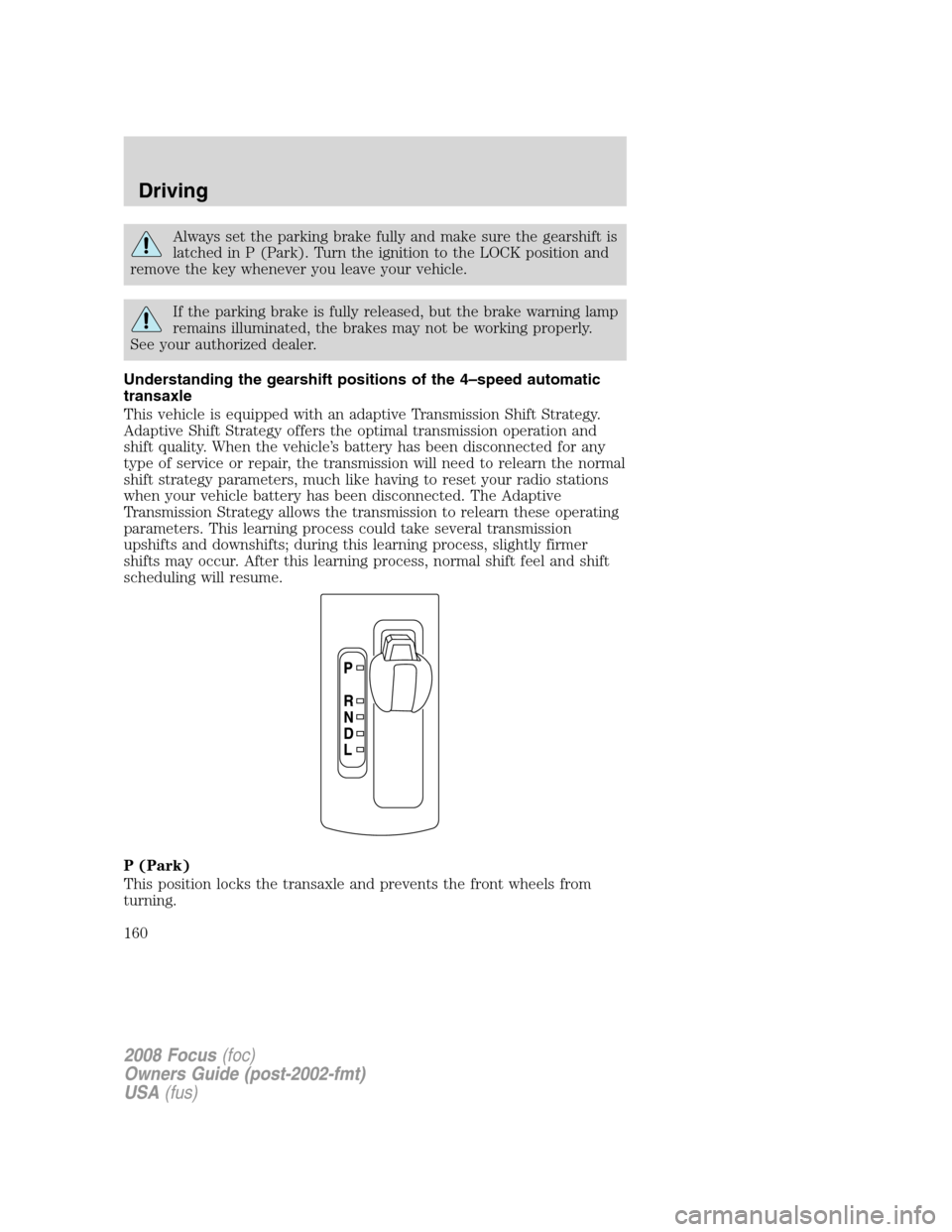
Understanding the gearshift positions of the 4–speed automatic
transaxle
This vehicle is equipped with an adaptive Transmission Shift Strategy.
Adaptive Shift Strategy offers the optimal transmission operation and
shift quality. When the vehicle’s battery has been disconnected for any
type of service or repair, the transmission will need to relearn the normal
shift strategy parameters, much like having to reset your radio stations
when your vehicle battery has been disconnected. The Adaptive
Transmission Strategy allows the transmission to relearn these operating
parameters. This learning process could take several transmission
upshifts and downshifts; during this learning process, slightly firmer
shifts may occur. After this learning process, normal shift feel and shift
scheduling will resume.
P (Park)
This position locks the transaxle and prevents the front wheels from
turning.
2008 Focus(foc)
Owners Guide (post-2002-fmt)
USA(fus)
Driving
160
Page 161 of 256
To put your vehicle in gear:
•Start the engine
•Depress the brake pedal
•Move the gearshift lever into the desired gear
To put your vehicle in P (Park):
•Come to a complete stop
•Move the gearshift lever and securely latch it in P (Park)
Always set the parking brake fully and make sure the gearshift is
latched in P (Park). Turn the ignition to the LOCK position and
remove the key whenever you leave your vehicle.
R (Reverse)
With the gearshift lever in R (Reverse), the vehicle will move backward.
Always come to a complete stop before shifting into and out of R
(Reverse).
N (Neutral)
With the gearshift lever in N (Neutral), the vehicle can be started and is
free to roll. Hold the brake pedal down while in this position.
D (Drive) with Overdrive
The normal driving position for the best fuel economy. Transaxle
operates in gears one through four.
2008 Focus(foc)
Owners Guide (post-2002-fmt)
USA(fus)
Driving
161
Page 163 of 256

If necessary, try turning the Traction Control™ system off. This will
allow the wheels to spin, which may help to free your stuck vehicle. For
more information, refer toTraction Control™in this chapter.
Do not rock the vehicle if the engine is not at normal operating
temperature or damage to the transmission may occur.
Do not rock the vehicle for more than a minute or damage to the
transmission and tires may occur, or the engine may overheat.
MANUAL TRANSMISSION OPERATION (IF EQUIPPED)
Using the clutch
The manual transaxle has a starter interlock that prevents cranking the
engine unless the clutch pedal is fully depressed.
To start the vehicle:
1. Make sure the parking brake is fully set.
2. Press the clutch pedal to the floor, then put the gearshift lever in the
neutral position.
3. Start the engine.
4. Press the brake pedal and move the gearshift lever to the desired
gear; 1 (First) or R (Reverse).
5. Release the parking brake, then slowly release the clutch pedal while
slowly pressing on the accelerator.
During each shift, the clutch pedal must be fully depressed to the floor.
Make sure the floor mat is properly positioned so it doesn’t interfere with
the full extension of the clutch pedal.
Failure to fully depress the clutch pedal to the floor may cause
increased shift efforts, prematurely wear transaxle components
or damage the transaxle.
Do not drive with your foot resting on the clutch pedal or use the
clutch pedal to hold your vehicle at a standstill while waiting on a
hill. These actions will reduce the life of the clutch.
135
24
R
2008 Focus(foc)
Owners Guide (post-2002-fmt)
USA(fus)
Driving
163
Page 164 of 256
Recommended shift speeds
Do not downshift into 1 (First) when your vehicle is moving
faster than 15 mph (24 km/h). This will damage the clutch.
Upshift according to the following chart:
Recommended upshifts (for best fuel economy) when
accelerating
5-speed manual transaxle
Shift from:
1 - 2 14 mph (23 km/h)
2 - 3 24 mph (39 km/h)
3 - 4 32 mph (51 km/h)
4 - 5 44 mph (71 km/h)
Reverse
Make sure that your vehicle is at a complete stop before you shift
into R (Reverse). Failure to do so may damage the transmission.
Hold the clutch pedal down and move the gearshift lever into the neutral
position. Wait at least three seconds before shifting into R (Reverse).
Note:The gearshift lever can only be moved into R (Reverse) by moving
it from left of 3 (Third) and 4 (Fourth) before shifting into R (Reverse).
This is a lockout feature that protects the transmission from accidentally
being shifted into R (Reverse) from 5 (Fifth).
If R (Reverse) is not fully engaged, press the clutch pedal down and
return the gearshift to the neutral position. Release the clutch pedal for
a moment, then press it down and shift to R (Reverse) again.
Parking your vehicle
1. Apply the brake and shift into the neutral position.
2. Fully apply the parking brake, then shift into 1 (First).
3. Turn the ignition off.
Do not park your vehicle in Neutral, it may move unexpectedly
and injure someone. Use 1 (First) gear and set the parking brake
fully.
2008 Focus(foc)
Owners Guide (post-2002-fmt)
USA(fus)
Driving
164
Page 177 of 256

•Use commercial car washing equipment
•Use snow chains on the end of the vehicle with the dissimilar spare
tire/wheel
The usage of a full-size dissimilar spare tire/wheel can lead to
impairment of the following:
•Handling, stability and braking performance
•Comfort and noise
•Ground clearance and parking at curbs
•Winter weather driving capability
•Wet weather driving capability
•All-Wheel driving capability (if applicable)
•Load leveling adjustment (if applicable)
When driving with the full-size dissimilar spare tire/wheel additional
caution should be given to:
•Towing a trailer
•Driving vehicles equipped with a camper body
•Driving vehicles with a load on the cargo rack
Drive cautiously when using a full-size dissimilar spare tire/wheel and
seek service as soon as possible.
Stopping and securing the vehicle
1. Park on a level surface, set the
parking brake and activate the
hazard flashers.
2. Place the gearshift lever in P (Park) (automatic transmission) or R
(Reverse) (manual transmission) and turn the engine off.
2008 Focus(foc)
Owners Guide (post-2002-fmt)
USA(fus)
Roadside Emergencies
177
Page 178 of 256

Tire change procedure
When one of the front wheels is off the ground, the transaxle
alone will not prevent the vehicle from moving or slipping off the
jack, even if the vehicle is in P (Park) (automatic transaxle) or R
(Reverse) (manual transaxle).
To help prevent the vehicle from moving when you change a tire,
be sure the parking brake is set, then block (in both directions)
the wheel that is diagonally opposite (other side and end of the
vehicle) to the tire being changed.
If the vehicle slips off the jack, you or someone else could be
seriously injured.
Do not attempt to change a tire on the side of the vehicle close
to moving traffic. Pull far enough off the road to avoid the
danger of being hit when operating the jack or changing the wheel.
1. Remove the spare tire and jack by
turning their tie-down bolts
counterclockwise. The lug wrench is
located in a bag next to, or on top
of, the spare tire.
2. Block the diagonally opposite
wheel.
2008 Focus(foc)
Owners Guide (post-2002-fmt)
USA(fus)
Roadside Emergencies
178
Page 182 of 256

General information
Failure to follow these guidelines could result in an increased
risk of loss of vehicle control, injury or death.
Do not attempt to repair punctures larger than
14inch (6.4 mm) or
damage to the tire’s sidewall. The tire may not completely seal.
Note:Do not use the temporary mobility kit if a tire has become
severely damaged by driving the vehicle with a tire that has insufficient
air pressure. Only punctured areas located within the tire tread can be
sealed with the temporary mobility kit.
Loss of air pressure may adversely affect tire performance. For this
reason:
•Do notdrive the vehicle above 50 mph (80 km/h).
•Do notdrive further than 120 miles (200 km/h). Drive only to the
closest Ford Motor Company authorized dealer or tire repair shop to
have your tire inspected.
•Drive carefully and avoid abrupt steering maneuvers.
•Periodically monitor tire inflation pressure in the affected tire; if the
tire is losing pressure, have the vehicle towed.
•Read the information in theTips for use of the temporary mobility
kitsection to ensure safe operation of the temporary mobility kit and
your vehicle.
Tips for use of the temporary mobility kit
Read the following list of tips to ensure safe operation of the temporary
mobility kit:
•Before operating the temporary mobility kit, make sure your vehicle is
safely off the road and away from moving traffic. Turn on the hazard
lights.
•Always set the parking brake to ensure the vehicle doesn’t move
unexpectedly.
•Do not remove any foreign objects, such as nails or screws, from the
tire.
•When using the temporary mobility kit, leave the engine running
(only if the vehicle is outdoors or in a well-ventilated area)so
the compressor doesn’t drain the vehicle’s battery.
•Do not allow the compressor to operate continuously for more than 15
minutes; this will help prevent the compressor from overheating.
2008 Focus(foc)
Owners Guide (post-2002-fmt)
USA(fus)
Roadside Emergencies
182
