2008 FORD F750 light
[x] Cancel search: lightPage 178 of 273
Using low sulfur (16-500 ppm) or high sulfur (greater than
500 ppm) diesel fuel in a diesel engine designed to use only
Ultra Low Sulfur Diesel fuel increases the likelihood of engine oil
dilution with fuel which may lead to major engine damage.
Using low sulfur (16-500 ppm) or high sulfur (greater than
500 ppm) diesel fuel in a diesel engine designed to use only
Ultra Low Sulfur Diesel fuel will cause certain emission components to
malfunction which may also cause the Service Engine Soon (
SERVICE
ENGINE
SOON)
light to illuminate indicating an emissions-related concern.
Do not mix diesel fuel with gasoline, gasohol or alcohol. This
could cause an explosion resulting in personal injury.
Do not use starting fluid such as ether or gasoline. Such fluids
can cause immediate explosive damage to the engine and
possible personal injury.
Fuel quality
It should not be necessary to add any aftermarket additives to your fuel
tank if you use a properly formulated diesel fuel that meets ASTM D 975
specification. Aftermarket additives can damage the injector system or
engine. Repairs to correct the effects of using an aftermarket product in
your fuel may not be covered by your warranty.
Do not blend used engine oil with diesel fuel under any
circumstances.Blending used oil with the fuel will significantly increase
your vehicle’s exhaust emissions and reduce engine life due to increased
internal wear.
Many of the world’s automakers approved the World-wide Fuel Charter
that recommends diesel fuel specifications to provide improved
performance and emission control system protection for your vehicle.
Diesel fuel that meet the World-wide Fuel Charter should be used when
available. Ask your fuel supplier about fuel that meet the World-Wide
Fuel Charter.
2008 F-650/750(f67)
Supplement
USA(fus)
Maintenance and Specifications
177
Page 180 of 273

Essentials of good fuel economy
Measuring techniques
Your best source of information about actual fuel economy is you, the
driver. You must gather information as accurately and consistently as
possible. Fuel expense, frequency of fill-ups or fuel gauge readings are
NOT accurate as a measure of fuel economy. We do not recommend
taking fuel economy measurements during the first 1,000 miles
(1,600 km) of driving (engine break-in period). You will get a more
accurate measurement after 2,000–3,000 miles (3,000–5,000 km).
The advertised fuel capacity of the fuel tank(s) on your vehicle is equal
to the rated refill capacity of the fuel tank(s) as listed inFuel tanksin
this chapter. The advertised capacity is the amount of the Indicated
Capacity and the Empty Reserve combined. Indicated Capacity is the
difference in the amount of fuel in a full tank and a tank when the fuel
gauge indicates empty. Empty Reserve is the small amount of usable fuel
remaining in the fuel tank after the fuel gauge indicates empty.
The amount of Empty Reserve varies and should not be relied
upon to increase driving range. When refueling your vehicle after
the fuel gauge indicates empty, you might not be able to refuel
the full amount of the advertised capacity of the fuel tank due to
the empty reserve still present in the tank.
Filling the tank
For consistent results:
•Use the same fill rate setting (low - medium - high) each time during
filling.
•Allow three automatic click-offs when filling.
•Always use fuel of a known quality, preferably a national brand.
•Have the vehicle loading and distribution the same every time.
•When refueling a vehicle equipped with dual fuel tanks, if the two
tanks are not filled equally, the fuel gauge reading may fluctuate
slightly until the fuel level between the two tanks balance out and
become equal.
Your results will be most accurate if your filling method is consistent.
Note:For vehicles equipped with dual fuel tanks, engine performance
may degrade if fuel is not added to both tanks when refueling.
2008 F-650/750(f67)
Supplement
USA(fus)
Maintenance and Specifications
179
Page 183 of 273

Diesel particulate filter regeneration (Cummins engine only)
Under most operating conditions, DPF regeneration will be transparent
to the operator. A small increase in engine/turbo sound-level is normal
during filter regeneration. If, however, your engine is operated for
extended periods of time under one of the following conditions, operator
assistance may be required to facilitate the filter regeneration process:
•Vehicle is operated in stop-and-go traffic and/or maintains low speeds
as in a city/delivery driving
•Engine is started and shut-off frequently
•Vehicle payload is relatively light
•Vehicle is regularly operated in cold ambient temperatures (i.e. below
0°F [-18°C])
Diesel Particulate Filter Four–Level Loading Chart
Level/Lamp status Filter status Requested action
Level 1
DPF lamp solidRegeneration required. Drive on highway at
highway speedsOR
started “parked
regeneration” to
prevent loss of engine
performance. Level 2
DPF lamp flashingNearly full. Engine
performance is limited.
Level 3
DPF lamp flashing +
Service Engine Soon
lamp solidFull. Engine is
increasingly limited.Perform “parked
regeneration” to
prevent loss of engine
performance.
Level 4
Stop Engine lamp
solidOver full. Engine
performance is highly
limited. Continued
operation may result
in irreparable damage
to the filter.Pull vehicle safely off
roadway, turn on
hazard flashers and
shut down engine as
soon as possible. Seek
service immediately.
2008 F-650/750(f67)
Supplement
USA(fus)
Maintenance and Specifications
182
Page 185 of 273

When these steps are performed successfully in the order outlined above,
the DPF lamp will begin flashing at a rate of once every 10 seconds. The
engine speed may also increase slightly. To allow parked regeneration to
continue uninterrupted:
1. The vehicle must remain parked
2. The transmission must remain in P (Park) or N (Neutral) (as
previously described in Step 2).
3. The accelerator pedal, service brake pedal, and clutch pedal (if
equipped) must not be depressed
4. The parking brake must remain set
On average (depending on filter level and other factors), the process will
take 20–30 minutes to complete. The DPF lamp will turn off when the
process is complete. Repeat Steps 1–5, if parked regeneration is
interrupted.
To discontinue parked regeneration (Cummins engine only)
Depress any of the floor pedals to discontinue parked regeneration.
Diesel particulate filter maintenance and service
The DPF is designed to retain a relatively large amount of residual ash
and provide many miles and hours of maintenance-free operation. At
some point, generally beyond 150,000 miles (240,000 km) or 5,000 hours
of operation (whichever comes first), the DPF will require professional
cleaning to remove the accumulated ash
The exact number of miles or hours of operation will vary greatly
depending upon vehicle/engine loading and operating conditions, ash
content of the engine oil, and quality of the diesel fuel used in your
truck. Adhering to your engine manufacturer’s recommended oil and fuel
specifications will maximize the miles and hours of operation before a
DPF professional cleaning is required. Refer to your engine
manufacturer’s owner’s manual for more details regarding recommended
maintenance and service of your DPF.
Exhaust outlet assembly
The normal operating temperature of the exhaust system is very
high. Never work around or attempt to repair any part of the
exhaust system until it has cooled. Failure to follow these instructions
may result in personal injury.
2008 F-650/750(f67)
Supplement
USA(fus)
Maintenance and Specifications
184
Page 194 of 273

such as the fuel sender, cranking motor, alternator and feed-through
studs should be cleaned and re-coated with a lubricant sealing grease
such as Motorcraft Silicone Brake Caliper Grease and Dielectic
Compound XG-3, or equivalent. This should include the ground cable
connector for batteries, engine and cab as well as the jump starting stud.
Accessory feed connections
Vehicle electrical systems are complex and often include electronic
components such as engine and transmission controls, instrument panels,
ABS, etc. While most systems operate on battery voltage (12 volts),
some systems can be as high as 90 volts or as low as five volts. Refer to
the Electrical Circuit Diagram Manuals, available from your vehicle’s
manufacturer, to ensure that any additional body lights and accessories
are connected to circuits that are both appropriate and not overloaded.
No modification should be made to any vehicle control system without
first contacting your dealer.
SUSPENSION INSPECTION
Note:Do not adjust air suspension height to any setting other than the
specified setting. Altering the height setting will change the driveline
angle and may result in unwarrantable component damage, such as
transmission component damage.
Verify drive axle air suspension height and height control valve
performance at engine lube oil change intervals.
Periodically:
•Check condition of spring leaves for evidence of fatigue, bending or
breakage.
•Check condition of suspension mounting brackets and bushings.
•Check that torque rod mounting fasteners are tight.
•Check to be sure the suspension alignment is maintained at all times.
•Check U-bolts after the chassis has been operating under load for
1,000 miles (1,600 km) or six months, whichever comes first, the
U-Bolt nuts must be re-torqued. The U-Bolt nuts thereafter must be
re-torqued every 36,000 miles (58,000 km). The U-Bolt and nut
threads and seats should be cleaned and lubricated to ensure a “like
new” condition when re-torquing.
Note:See theU-Bolt Nut Torquechart later in this section.
2008 F-650/750(f67)
Supplement
USA(fus)
Maintenance and Specifications
193
Page 198 of 273

When installing wheel balance weights, they must be mounted on the
dome-side of the wheel only. Failure to do so may result in loss of wheel
weight and/or damage to brakes or wheels.
Important:Remember to replace the wheel air valves when the road
tires are replaced at the end of their useful life.
Oil lubricated front wheel bearings
During normal vehicle duty cycle, the lube and air inside the hub/wheel
cavity expands and if not vented, causes pressure build-up that could
cause accelerated seal wear.
There are two venting methods:
•a slit or small hole in the rubber check vent or
•the window
You can use either of these methods to prevent pressure build-up.
Normal maintenance
Over a period of time, if not routinely cleaned, a slight film of oil can
collect dirt around the rubber fill plug and face, which could appear to
be a leak. Routine cleaning ensures that the lube level can be easily
observed through the clear window as intended. In situations where the
window is clean on the outside but discolored on the inside, the lube
level may be checked by inserting a finger through the rubber check
vent hole.
The specified lube level for a clear window type hubcaps is from the
minimum line to + 5/16 inch above the minimum line.
If the lube level should suddenly drop dramatically below the minimum
level, see theWorkshop Manualfor diagnostic procedure.
Installation, tightening and alignment
When installing wheels, be certain that the threads on studs and nuts are
clean to permit correct torque. The mounting surfaces of rims, wheels,
spacer rings and clamps must be free of dirt, rust, lubricants or damage.
Use a wire brush to clean the mounting contact surfaces. Do not use
lubricant on threads.
After the rim or wheel has been properly tightened, it should be checked
for alignment. Rotate the wheel with a piece of chalk attached to a
steady, firm surface, and placed to just barely clear the outside surface of
the tire bead seat. This procedure will point out the high spot. A high
spot does not necessarily mean that the lug nuts have been unevenly
tightened. This condition or misalignment could be caused by a bent
wheel.
2008 F-650/750(f67)
Supplement
USA(fus)
Maintenance and Specifications
197
Page 200 of 273
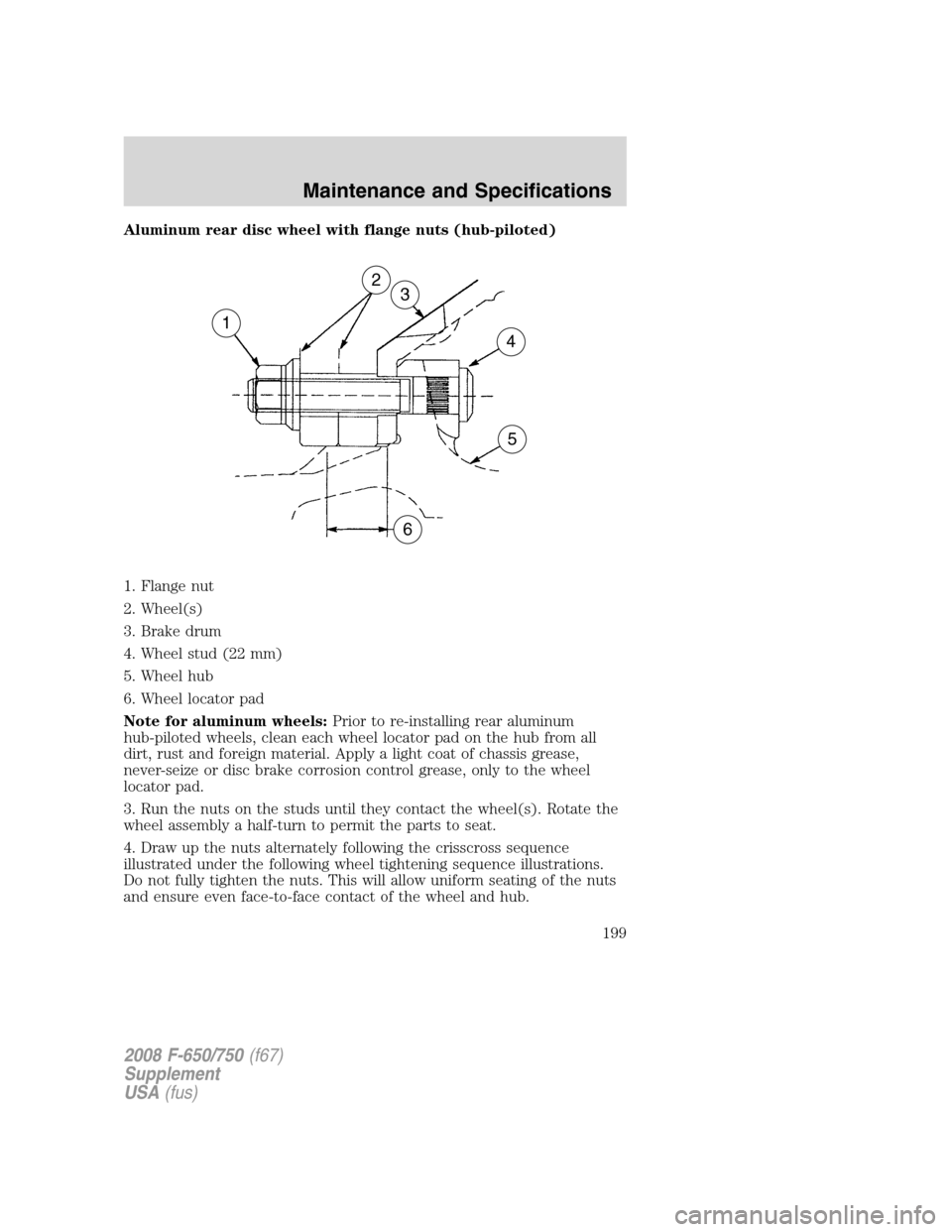
Aluminum rear disc wheel with flange nuts (hub-piloted)
1. Flange nut
2. Wheel(s)
3. Brake drum
4. Wheel stud (22 mm)
5. Wheel hub
6. Wheel locator pad
Note for aluminum wheels:Prior to re-installing rear aluminum
hub-piloted wheels, clean each wheel locator pad on the hub from all
dirt, rust and foreign material. Apply a light coat of chassis grease,
never-seize or disc brake corrosion control grease, only to the wheel
locator pad.
3. Run the nuts on the studs until they contact the wheel(s). Rotate the
wheel assembly a half-turn to permit the parts to seat.
4. Draw up the nuts alternately following the crisscross sequence
illustrated under the following wheel tightening sequence illustrations.
Do not fully tighten the nuts. This will allow uniform seating of the nuts
and ensure even face-to-face contact of the wheel and hub.
1
6
5
4
32
2008 F-650/750(f67)
Supplement
USA(fus)
Maintenance and Specifications
199
Page 202 of 273
Use only the same type and style wheels and mounting hardware
to replace original parts. Failure to do so may result in an
assembly that looks fine, but does not fit together properly. This could
possibly cause wheel or fastener failures which could result in property
damage, personal injury or death.
Note:Do not attempt to mix stud-piloted wheels or fasteners with
hub-piloted wheels or fasteners.
Note:Do not change from aluminum wheels to steel wheels or
vice-versa without changing the mounting hardware required or, with
flange-nut mounting systems, changing the hub and stud assembly.
WHEEL NUT TORQUE
Size Nut mountingTorque
Ft. lb. N•m
22 mm Flange 450–500 610–678
Note:Do not use lubrication on dry threads. Where excessive corrosion
exists, a light coat of lubricant on the first three threads of the stud bolt
is permitted. Keep lubricant away from:
•Hex nut and rim clamp contact surfaces.
•Cap nut ball face and ball seat on the disc wheel.
•Flange nut washer surface and flat on the disc wheel.
TIRE INFORMATION
Inflation
Always maintain your tires in good condition. Frequently check
and maintain correct inflation pressures as specified by tire
manufacturers. Inspect periodically for abnormal wear patterns and
repair/replace cut or broken tire casing. Always use experienced,
trained personnel with proper equipment and correct procedures to
mount or remove tires and wheels. Failure to adhere to these warnings
could result in wheel or tire malfunction, damage to your vehicle,
personal injury, or death.
2008 F-650/750(f67)
Supplement
USA(fus)
Maintenance and Specifications
201