2008 FORD F650 service schedule
[x] Cancel search: service schedulePage 189 of 273
BRAKE FLUID
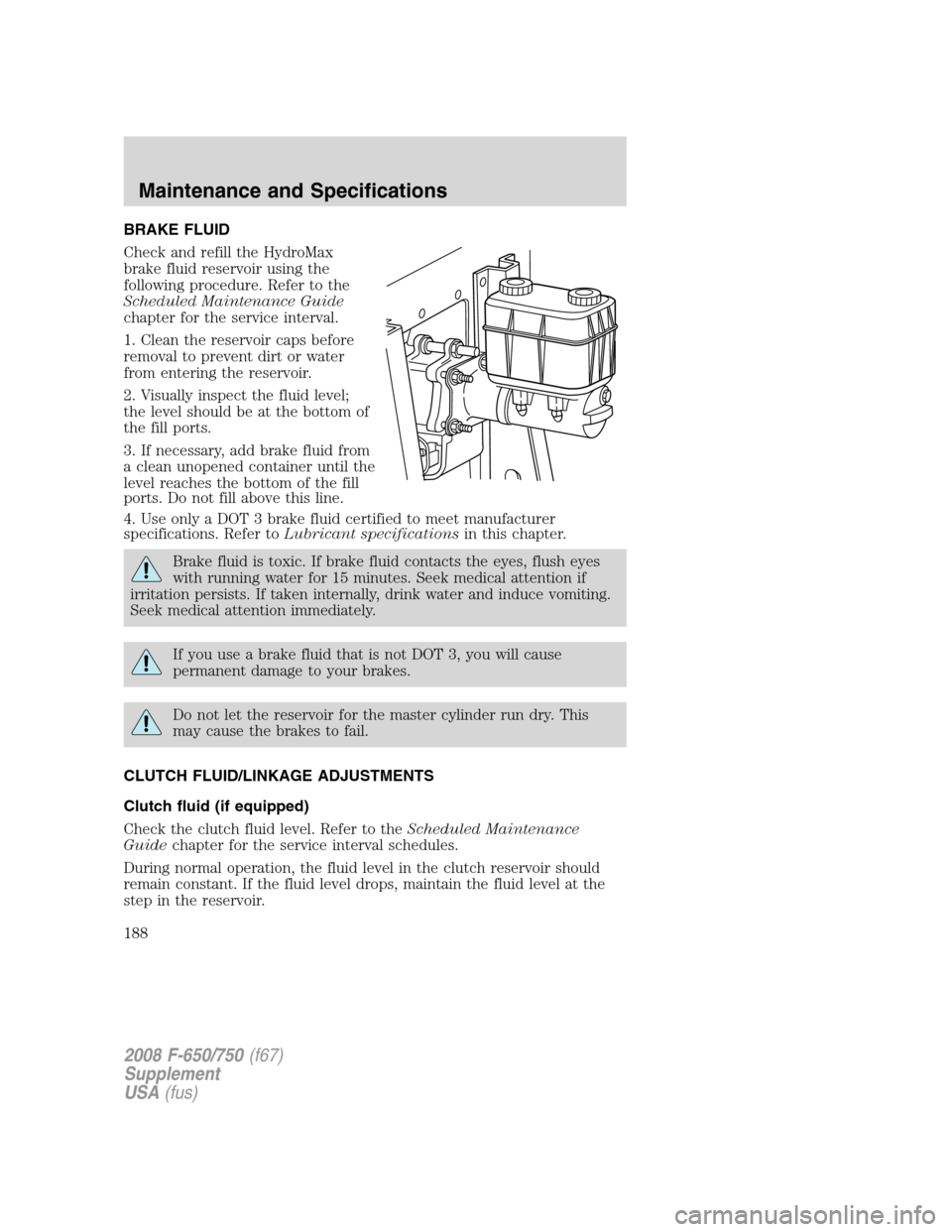
Check and refill the HydroMax
brake fluid reservoir using the
following procedure. Refer to the
Scheduled Maintenance Guide
chapter for the service interval.
1. Clean the reservoir caps before
removal to prevent dirt or water
from entering the reservoir.
2. Visually inspect the fluid level;
the level should be at the bottom of
the fill ports.
3. If necessary, add brake fluid from
a clean unopened container until the
level reaches the bottom of the fill
ports. Do not fill above this line.
4. Use only a DOT 3 brake fluid certified to meet manufacturer
specifications. Refer toLubricant specificationsin this chapter.
Brake fluid is toxic. If brake fluid contacts the eyes, flush eyes
with running water for 15 minutes. Seek medical attention if
irritation persists. If taken internally, drink water and induce vomiting.
Seek medical attention immediately.
If you use a brake fluid that is not DOT 3, you will cause
permanent damage to your brakes.
Do not let the reservoir for the master cylinder run dry. This
may cause the brakes to fail.
CLUTCH FLUID/LINKAGE ADJUSTMENTS
Clutch fluid (if equipped)
Check the clutch fluid level. Refer to theScheduled Maintenance
Guidechapter for the service interval schedules.
During normal operation, the fluid level in the clutch reservoir should
remain constant. If the fluid level drops, maintain the fluid level at the
step in the reservoir.
2008 F-650/750(f67)
Supplement
USA(fus)
Maintenance and Specifications
188
Page 190 of 273
Use only a DOT 3 brake fluid designed to meet manufacturer
specifications. Refer toLubricant specificationsin this chapter.
Carefully read cautionary information on product label. For
MEDICAL EMERGENCY INFORMATION, contact a physician or
Poison Control Center immediately; on Ford-Motorcraft products call:
1-800-959-3673 (FORD). Failure to follow these instructions may result
in personal injury.
1. Set the parking brake, shift into 1
(First) and turn the engine off.
2. Open the hood.
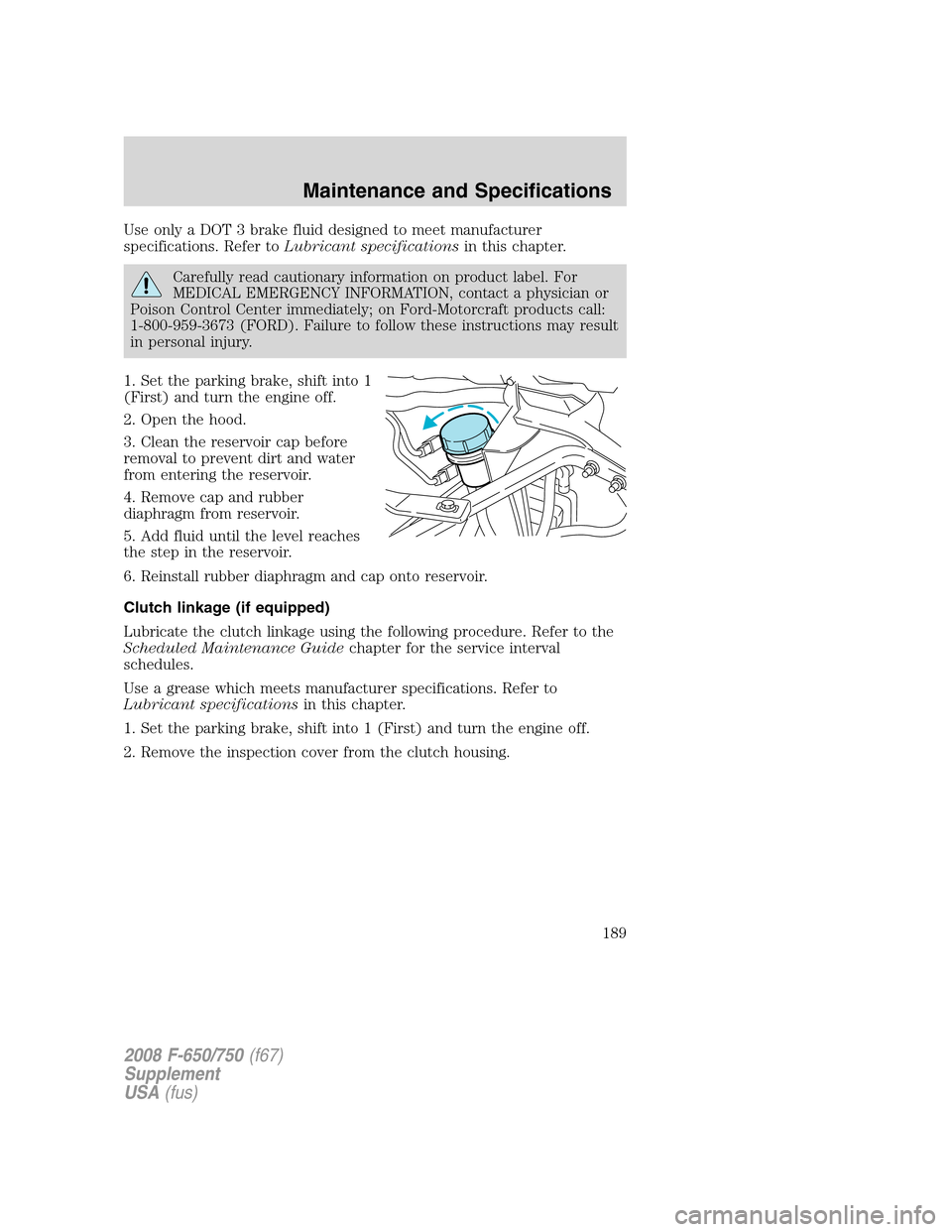
3. Clean the reservoir cap before
removal to prevent dirt and water
from entering the reservoir.
4. Remove cap and rubber
diaphragm from reservoir.
5. Add fluid until the level reaches
the step in the reservoir.
6. Reinstall rubber diaphragm and cap onto reservoir.
Clutch linkage (if equipped)
Lubricate the clutch linkage using the following procedure. Refer to the
Scheduled Maintenance Guidechapter for the service interval
schedules.
Use a grease which meets manufacturer specifications. Refer to
Lubricant specificationsin this chapter.
1. Set the parking brake, shift into 1 (First) and turn the engine off.
2. Remove the inspection cover from the clutch housing.
2008 F-650/750(f67)
Supplement
USA(fus)
Maintenance and Specifications
189
Page 192 of 273

3. With the parking brake engaged and your foot on the brake pedal,
start the engine and move the gearshift lever through all of the gear
ranges. Allow sufficient time for each gear to engage.
4. Place the gearshift lever in N (Neutral) or P (Park) and leave the
engine running.
5. Remove the dipstick, wiping it clean with a clean, dry lint free rag.
6. Install the dipstick making sure it is fully seated in the filler tube.
7. Remove the dipstick and inspect the fluid level.
If you must add transmission fluid, make sure the correct type of fluid is
being used. The type of fluid used is indicated in your Allison Automatic
Transmission Operator’s Manual.
Fluid levels above the safe range may result in transmission failure; an
overfill condition of transmission fluid may cause shift and/or
engagement concerns and/or possible damage.
Use of a non-approved automatic transmission fluid may cause
internal transmission component damage.
Manual transmission fluid
Refer to theScheduled Maintenance Guidechapter for transmission
fluid level checks and fluid change intervals.
Your manual transmission may be filled with an optional synthetic fluid
which allows the use of extended service intervals. A tag on the filler
plug will identify the use of the synthetic fluid.
Use only fluid that meets manufacturer specifications (refer to
Lubricant specificationsin this chapter.
Use of a non-approved transmission fluid may cause internal
transmission component damage.
Check your transmission fluid level using the following procedure:
1. Park the vehicle on level ground.
2. Set the parking brake and shift into 1 (First) and turn the engine off.
3. Clean any dirt from around the filler plug.
4. Remove the filler plug and inspect the fluid level.
5. The fluid level should be up to the bottom of the filler plug opening.
6. If necessary, add enough fluid through the filler plug opening so that
the fluid level is at the bottom of the opening.
7. Clean and install the filler plug securely.
2008 F-650/750(f67)
Supplement
USA(fus)
Maintenance and Specifications
191
Page 228 of 273

GENERAL MAINTENANCE INFORMATION
The general maintenance services listed in this section are required
because they are considered essential to the life and performance of
your vehicle. Refer to the “Daily Owner Checks” chart for important
maintenance items.
Ford Motor Company recommends you perform the owner maintenance
services listed in this section. These services are matters of day-to-day
care that are important to the proper operation of your vehicle. In
addition to the conditions described in owner maintenance, be alert for
any unusual noise, vibration or other indication that your vehicle may
need service and attend to it promptly.
Your vehicle is very sophisticated and built with multiple complex
performance systems. Every manufacturer develops these systems using
different specifications and performance features. That’s why it’s
important to rely upon your Ford dealership to properly diagnose and
repair your vehicle.
Use only recommended fuels, lubricants, fluids and service parts
conforming to Ford specifications. Motorcraft parts are designed and
built for best performance in your vehicle. Using these parts for
replacement is your assurance that Ford-Built quality stays in your
vehicle.
Non-Ford approved chemicals or additives are not required for factory
recommended maintenance. In fact, Ford Motor Company recommends
against the use of such additive products unless specifically
recommended by Ford for a particular application.
SCHEDULED MAINTENANCE
Ford Motor Company has recommended maintenance intervals for
various parts and component systems based upon engineering testing.
Ford Motor Company relies upon this testing to determine the most
appropriate mileage for replacement of oils and fluids to protect your
vehicle at the lowest overall cost to you and recommends against
maintenance schedules that deviate from the scheduled maintenance
information.
The maintenance or replacement of the emission control devices (or
systems) in your new Ford Motor Company vehicle (or engine) may be
performed at your expense. These services may be performed by any
automotive repair establishment or individual using automotive parts
equivalent to those with which your vehicle or engine was originally
equipped. If any parts other than Ford, Motorcraft, or Ford authorized,
2008 F-650/750(f67)
Supplement
USA(fus)
Scheduled Maintenance Guide
227
Page 229 of 273
remanufactured parts are used for maintenance replacements (or for the
service) of components effecting the emission control, the owner should
be ensured that such parts are warranted by their manufacturer to be
equivalent to genuine Ford Motor Company Parts in performance and
durability. Please consult your warranty information booklet for complete
warranty information.
Authorized dealer maintenance
Your authorized dealer specializes in knowing all about Ford Motor
Company vehicles rather than knowing a little about all makes.
There are Ford or Ford of Canada dealer service shops ready to serve
you wherever you drive in the U.S. or Canada. They stock Ford and
Motorcraft parts, and Ford Chemicals and lubricants. You can be
confident that these meet the same exacting design and quality
standards as those used to build the vehicle originally. Dealer Service
Technicians have available training in the latest product developments
and service techniques.
Oils, Fluids and Flushing
In many cases, fluid discoloration is a normal operating characteristic of
the chemical compound and in itself does not demonstrate that a fluid
needs to be changed. Oils and fluids identified in theScheduled
Maintenance Guidechapter should be changed at the specified interval
or in conjunction with a repair. Flushing is a viable way to change fluid
for many vehicle sub-systems during scheduled maintenance and should
only be done using the same fluid required to finish the maintenance
procedure, or a Ford approved flushing chemical.
OWNER MAINTENANCE
You can do much of the maintenance your vehicle requires yourself, if
you have the time and a reasonable amount of mechanical ability. If you
prefer to have this work done professionally, your authorized dealer
stands ready to help you.
All mechanical components and attachments are important in that they
could affect the performance of vital components and systems. If
replacement becomes necessary, they must be replaced with parts having
the same part number or with equivalent parts. Torque values of the
attaching parts must be used as specified during any reassembly
procedure to ensure proper retention.
2008 F-650/750(f67)
Supplement
USA(fus)
Scheduled Maintenance Guide
228
Page 230 of 273

FACTORY AUTHORIZED SYSTEMS CHECKS
In the event that your vehicle experiences a component related concern,
please contact your Ford dealership. The Ford Motor Company Trained
Technicians who work at Ford dealerships are specifically trained to
understand your vehicle.
A proper repair begins with a thorough system check. A Factory
Authorized Systems Check can ONLY be found at a Ford dealership. In
some circumstances, the technician may need to request your
authorization to perform additional operations to determine the final
diagnosis. The technician’s goal is to ensure that your vehicle is fixed
right the first time, at the best value to you.
The following list represents several of the Factory Authorized Systems
Checks available at a participating Ford dealers:
•Air Conditioning
•Check Engine Light
•All Wheel Drive and 4x4
•Automatic Transmission
•Engine Cooling and Cabin Heating
•Steering and Suspension
•Charge/Start/Battery
•Wheel Alignment
•Anti-Lock Brake System
EMISSIONS CONTROL SYSTEM
To ensure the emissions control systems operate effectively, you should
have the services listed in the maintenance schedule performed at the
specified time and mileage/km intervals. You should avoid running out of
fuel or turning off the ignition while the vehicle is in motion, especially
at high speeds.
Because of high engine compartment and exhaust system
temperatures resulting from emissions equipment, do not park,
idle or operate your vehicle in dry grass or other dry ground cover
where the possibility of ground fire exists.
Do not make unauthorized modifications to the engine or vehicle.
Modifications causing increased amounts of unburned fuel to reach the
exhaust system can significantly increase the temperature of the engine
compartment and/or the exhaust system.
2008 F-650/750(f67)
Supplement
USA(fus)
Scheduled Maintenance Guide
229
Page 233 of 273
MAINTENANCE
Instructions for maintenance and service of the noise control system
have been included in the required maintenance services and in the
general maintenance section. To further help minimize noise emissions
degradation throughout the life of the vehicle, Ford Motor Company
recommends that this vehicle should be operated in the manner
described within this Owner Guide. Caution should be exercised by the
owner when installing replacement parts to be sure that a tampering act
(as outlined above) is not committed. Note any inspection and service
performed in the Maintenance Record.
EMISSIONS INFORMATION LABEL
Emissions information appears on the Important Engine Information
decal located on or near the engine.
SCHEDULED MAINTENANCE SERVICES
Maintenance service adjustments must conform to specifications
contained in this manual, and those shown on the Important Engine
Information decal. The following services are to be performed at
scheduled intervals because they are considered essential to the life and
performance of your vehicle. Ford recommends that you perform
maintenance on all designated items to achieve best vehicle operation.
Maintenance intervals are provided for three types of general vehicle
environments: On-Highway, City and Severe Service. In all applications,
the actual interval is determined by monitoring kilometers (miles) and
time and when the engine is due for an oil change. When the engine oil
change is required prior to the truck lubrication interval, it is
recommended that the lubrication be performed at the same time in
order to reduce your vehicle’s time out of service.
•On-Highway:60,000 miles (96,000 km) or more annually.
•City:60,000 miles (96,000 km) or less annually.
•Severe Service:20,000 miles (32,000 km) or less annually on/off
road in dirty conditions.
Scheduled maintenance beyond 100,000 miles (160,000 km) should be
continued as before 100,000 miles (160,000 km).
2008 F-650/750(f67)
Supplement
USA(fus)
Scheduled Maintenance Guide
232
Page 234 of 273
AIR BRAKE ADJUSTMENT
Failure to maintain proper air brake adjustment can result in
reduction or loss of braking ability.
Air brake inspection and adjustment or repairs should be performed by a
qualified service technician in accordance with the instructions in the
service manual.
Cam brakes - automatic slack adjusters
Inspect standard air brakes equipped with automatic slack adjusters for
proper brake adjustment as perscheduled maintenance information.
However, more frequent inspection is required if your vehicle’s brakes
are subjected to heavy use or adverse operating conditions such as:
•Frequent brake applications while fully loaded.
•Operation on hilly or mountainous terrain.
•Frequent operation on dirt, gravel or mud.
Some aftermarket brake linings also require more frequent inspections.
Do not manually adjust the automatic slack adjusters to correct
excessive pushrod stroke as it may result in reduced brake
effectiveness and a vehicle crash. Excessive pushrod stroke indicates
that a problem exists with the automatic adjuster, with the installation
of the adjuster, or with foundation brake components that manual
adjustment will not remedy. Seek service from a qualified facility for
excessive pushrod stroke.
2008 F-650/750(f67)
Supplement
USA(fus)
Scheduled Maintenance Guide
233