2008 FORD F150 ignition
[x] Cancel search: ignitionPage 304 of 400

Fuse/Relay
LocationFuse Amp
RatingPassenger Compartment Fuse
Panel Description
F33 15A* Shift solenoid, CMS #12 and #22,
Ignition coils
F34 15A* PCM power, IMRC (4.2L)
F35 20A* Instrument cluster high beam
indicator, High beam headlamps,
DRL disable relay
F36 10A* Trailer tow right turn/stop lamps
37 20A* Rear power point
38 25A* Subwoofer power
39 — Not used
40 20A* Low beam headlamps, DRL
41 — Not used
42 10A* Trailer tow left turn/stop lamps
F101 30A** Starter solenoid
F102 20A** Ignition switch feed
F103 20A** ABS valves
F104 — Not used
F105 30A** Electric trailer brakes
F106 30A** Trailer tow battery charge
F107 30A** Power door locks (BSM)
F108 30A** Passenger power seat
F109 30A** Driver power seat, Adjustable
pedals, Memory module (pedals,
seats)
F110 20A** Cigar lighter, Diagnostic connector
power
F111 30A** 4x4 motor relays
F112 40A** ABS pump power
F113 30A** Wipers and washer pump
F114 40A** Heated backlite, Heated mirror
power
F115 20A** Moonroof
2008 F-150(f12)
Owners Guide (post-2002-fmt)
USA(fus)
Roadside Emergencies
304
Page 309 of 400
When driving with the full-size dissimilar spare tire/wheel additional
caution should be given to:
•Towing a trailer
•Driving vehicles equipped with a camper body
•Driving vehicles with a load on the cargo rack
Drive cautiously when using a full-size dissimilar spare tire/wheel and
seek service as soon as possible.
Location of the spare tire and tools
The spare tire and tools for your vehicle are stowed in the following
locations:
Tool Location
Spare tire Under the vehicle, just forward of
the rear bumper
Jack, jack handle and lug nut
wrenchRegular Cab: Behind the interior
trim on the passenger side of the
cab
SuperCrew and SuperCab: Under
the rear seat on the passenger side
The wing nut must be removed and the jack screw turned
counterclockwise to release pressure before the jack can be removed
from the holder.
Removing the spare tire
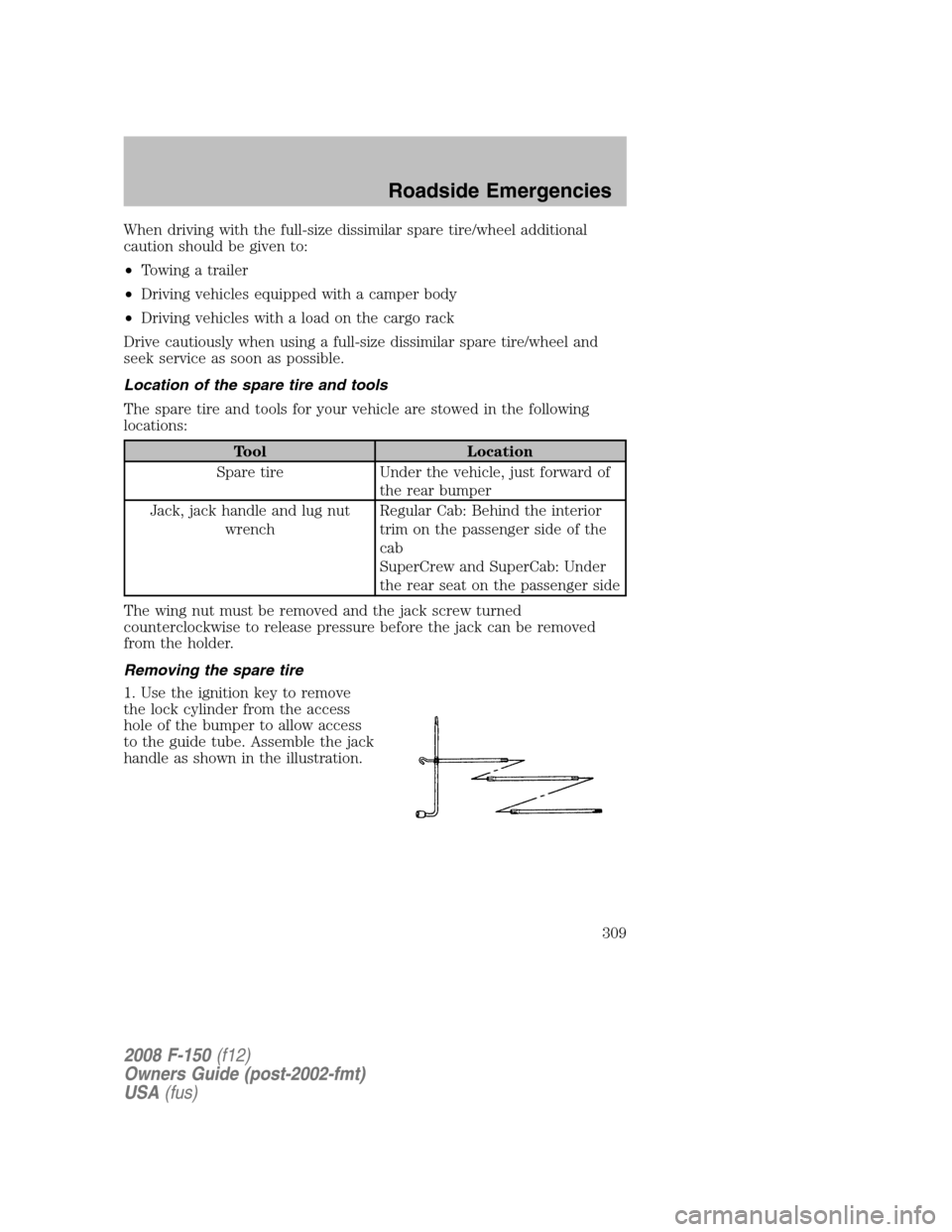
1. Use the ignition key to remove
the lock cylinder from the access
hole of the bumper to allow access
to the guide tube. Assemble the jack
handle as shown in the illustration.
2008 F-150(f12)
Owners Guide (post-2002-fmt)
USA(fus)
Roadside Emergencies
309
Page 364 of 400
Unleaded Gasoline engines
If you are experiencing starting, rough idle or hesitation driveability
problems during a cold start, try a different brand of “Regular” unleaded
gasoline. “Premium” unleaded gasoline is not recommended because it
may cause these problems to become more pronounced. If the problems
persist, see your authorized dealer.
FFV engine (if equipped)
To identify if your vehicle is an FFV, it may be equipped with a yellow
fuel cap with the writing “E85/Gasoline”, or check if there is a label on
the fuel filler door, or check your VIN. When checking the VIN, look for
the engine type identifier (8th character). If your vehicle is an FFV, then
the character will be labeled as a “V”.
It is best not to alternate repeatedly between gasoline and E
85. If you do
switch fuels, it is recommended that you add as much fuel as
possible—at least half a tank. Do not add less than five gallons (18.9 L)
when refueling. You should drive the vehicle immediately after refueling
for at least five miles (8 km) to allow the vehicle to adapt to the change
in ethanol concentration.
If you operate your vehicle 50% or more of the time on ethanol, you
should follow a different maintenance schedule. In addition to this it is
also recommended to fill the fuel tank with regular unleaded gasoline
once every 3,000 miles (4,828 km). Seescheduled maintenance
informationfor more information.
Running out of fuel
Avoid running out of fuel because this situation may have an adverse
effect on powertrain components.
If you have run out of fuel:
•You may need to cycle the ignition from OFF to ON several times after
refueling to allow the fuel system to pump the fuel from the tank to
the engine. On restarting, cranking time will take a few seconds longer
than normal.
•Normally, adding 1 gallon (3.8L) of fuel is enough to restart the
engine. If the vehicle is out of fuel and on a steep grade, more than
1 gallon (3.8L) may be required.
•TheService engine soon
indicator may come on. For more
information on theService engine soon
indicator, refer to
Warning lights and chimesin theInstrument Clusterchapter.
2008 F-150(f12)
Owners Guide (post-2002-fmt)
USA(fus)
Maintenance and Specifications
364
Page 365 of 400
ESSENTIALS OF GOOD FUEL ECONOMY
Measuring techniques
Your best source of information about actual fuel economy is you, the
driver. You must gather information as accurately and consistently as
possible. Fuel expense, frequency of fill-ups or fuel gauge readings are
NOT accurate as a measure of fuel economy. We do not recommend
taking fuel economy measurements during the first 1,000 miles (1,600 km)
of driving (engine break-in period). You will get a more accurate
measurement after 2,000 miles–3,000 miles (3,000 km–5,000 km).
Filling the tank
The advertised fuel capacity of the fuel tank on your vehicle is equal to
the rated refill capacity of the fuel tank as listed in theMaintenance
product specifications and capacitiessection of this chapter.
The advertised capacity is the amount of the indicated capacity and the
empty reserve combined. Indicated capacity is the difference in the
amount of fuel in a full tank and a tank when the fuel gauge indicates
empty. Empty reserve is the small amount of fuel remaining in the fuel
tank after the fuel gauge indicates empty.
The amount of usable fuel in the empty reserve varies and should
not be relied upon to increase driving range. When refueling your
vehicle after the fuel gauge indicates empty, you might not be
able to refuel the full amount of the advertised capacity of the
fuel tank due to the empty reserve still present in the tank.
For consistent results when filling the fuel tank:
•Turn the engine/ignition switch to the off position prior to refueling,
an error in the reading may result if the engine is left running.
•Use the same filling rate setting (low — medium — high) each time
the tank is filled.
•Allow no more than three automatic click-offs when filling.
•Always use fuel with the recommended octane rating.
•Use a known quality gasoline, preferably a national brand.
•Use the same side of the same pump and have the vehicle facing the
same direction each time you fill up.
•Have the vehicle loading and distribution the same every time.
Your results will be most accurate if your filling method is consistent.
Calculating fuel economy
1. Fill the fuel tank completely and record the initial odometer reading
(in miles or kilometers).
2008 F-150(f12)
Owners Guide (post-2002-fmt)
USA(fus)
Maintenance and Specifications
365
Page 368 of 400
The EPA window sticker should be your guide for the fuel economy
comparisons with other vehicles.
It is important to note the box in the lower left corner of the window
sticker. These numbers represent the Range of MPG (L/100 km)
expected on the vehicle under optimum conditions. Your fuel economy
may vary depending upon the method of operation and conditions.
EMISSION CONTROL SYSTEM
Your vehicle is equipped with various emission control components and a
catalytic converter which will enable your vehicle to comply with
applicable exhaust emission standards. To make sure that the catalytic
converter and other emission control components continue to work
properly:
•Use only the specified fuel listed.
•Avoid running out of fuel.
•Do not turn off the ignition while your vehicle is moving, especially at
high speeds.
•Have the items listed inscheduled maintenance information
performed according to the specified schedule.
The scheduled maintenance items listed inscheduled maintenance
informationare essential to the life and performance of your vehicle
and to its emissions system.
If other than Ford, Motorcraft or Ford-authorized parts are used for
maintenance replacements or for service of components affecting
emission control, such non-Ford parts should be equivalent to genuine
Ford Motor Company parts in performance and durability.
Do not park, idle, or drive your vehicle in dry grass or other dry
ground cover. The emission system heats up the engine
compartment and exhaust system, which can start a fire.
Illumination of theService engine soon
indicator, charging system
warning light or the temperature warning light, fluid leaks, strange odors,
smoke or loss of engine power could indicate that the emission control
system is not working properly.
An improperly operating or damaged exhaust system may allow exhaust
to enter the vehicle. Have a damaged or improperly operating exhaust
system inspected and repaired immediately.
2008 F-150(f12)
Owners Guide (post-2002-fmt)
USA(fus)
Maintenance and Specifications
368
Page 370 of 400
detected by the OBD-II may not have symptoms that are apparent,
continued driving with theService engine soon
indicator on can
result in increased emissions, lower fuel economy, reduced engine and
transmission smoothness, and lead to more costly repairs.
Readiness for Inspection/Maintenance (I/M) testing
Some state/provincial and local governments may have
Inspection/Maintenance (I/M) programs to inspect the emission control
equipment on your vehicle. Failure to pass this inspection could prevent
you from getting a vehicle registration. Your vehicle may not pass the I/M
test if theService engine soon
indicator is on or not working
properly (bulb is burned out), or if the OBD-II system has determined
that some of the emission control systems have not been properly
checked. In this case, the vehicle is considered not ready for I/M testing.
If theService engine soon
indicator is on or the bulb does not
work, the vehicle may need to be serviced. Refer to the On board
diagnostics (OBD-II) description in this chapter.
If the vehicle’s engine or transmission has just been serviced, or the
battery has recently run down or been replaced, the OBD-II system may
indicate that the vehicle is not ready for I/M testing. To determine if the
vehicle is ready for I/M testing, turn the ignition key to the ON position
for 15 seconds without cranking the engine. If theService engine
soon
indicator blinks eight times, it means that the vehicle is not
ready for I/M testing; if theService engine soon
indicator stays on
solid, it means that the vehicle is ready for I/M testing.
The OBD-II system is designed to check the emission control system
during normal driving. A complete check may take several days. If the
vehicle is not ready for I/M testing, the following driving cycle consisting
of mixed city and highway driving may be performed:
15 minutes of steady driving on an expressway/highway followed by 20
minutes of stop-and-go driving with at least four 30-second idle periods.
Allow the vehicle to sit for at least eight hours without starting the
engine. Then, start the engine and complete the above driving cycle. The
engine must warm up to its normal operating temperature. Once started,
do not turn off the engine until the above driving cycle is complete. If
the vehicle is still not ready for I/M testing, the above driving cycle will
have to be repeated.
POWER STEERING FLUID
Check the power steering fluid. Refer to thescheduled maintenance
informationfor the service interval schedules.
2008 F-150(f12)
Owners Guide (post-2002-fmt)
USA(fus)
Maintenance and Specifications
370
Page 385 of 400
ENGINE DATA
Engine 4.2L V6 engine 4.6L V8 engine 5.4L V8 engine
Cubic inches 256 281 330
Required fuel87 octane 87 octane 87 octane or
Ethanol (E85)
2
Firing order 1-4-2-5-3-6 1-3-7-2-6-5-4-8 1-3-7-2-6-5-4-8
Ignition system EDIS Coil on plug Coil on plug
Spark plug gap0.052–0.056 inch
(1.32–1.42mm)0.052–0.056 inch
(1.32–1.42mm)0.040–0.050 inch
(1.02–1.28mm)
1
Compression
ratio9.3:1 9.37:1 9.85:1
1The 5.4L 3V spark plug gap can’t be adjusted.
25.4L 3V FFV engines only.
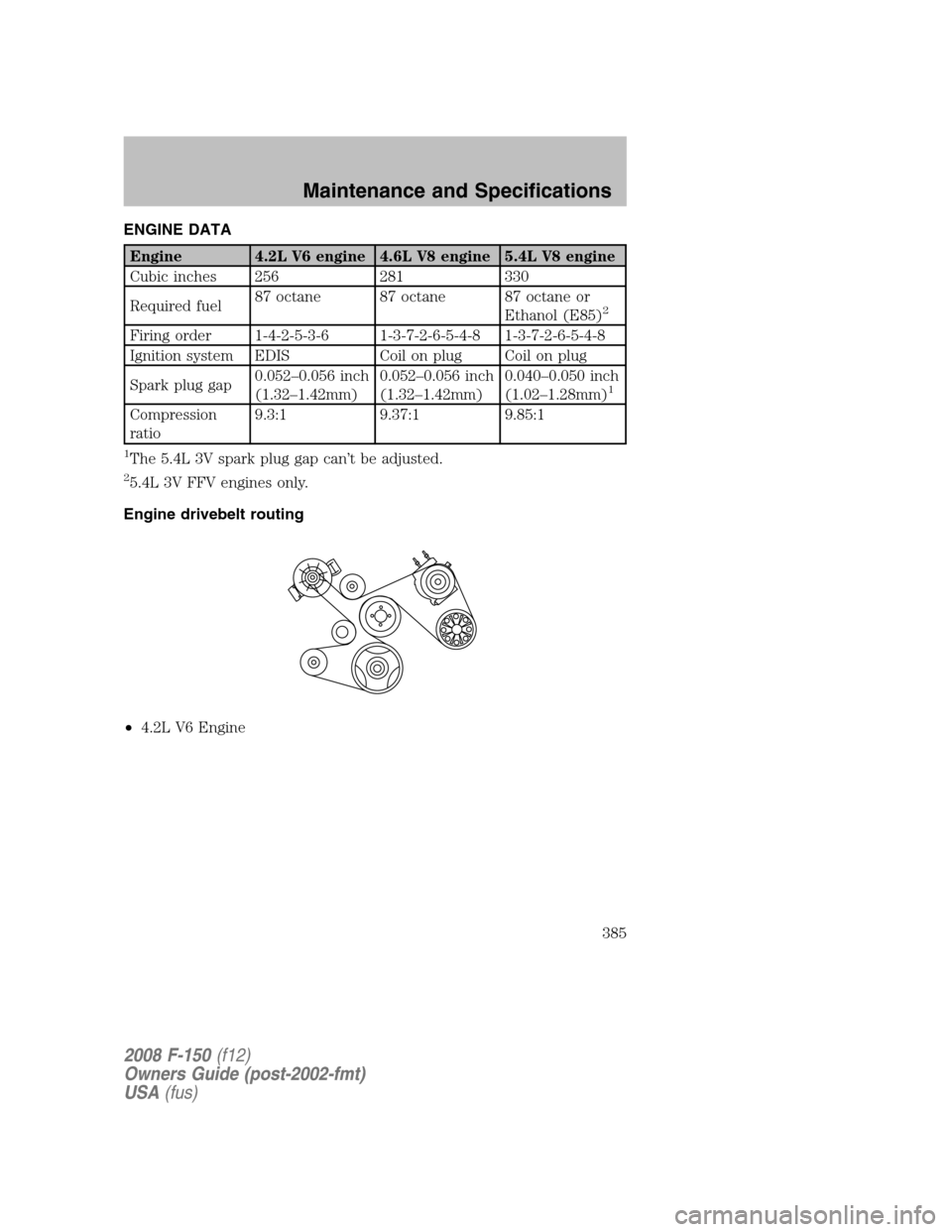
Engine drivebelt routing
•4.2L V6 Engine
2008 F-150(f12)
Owners Guide (post-2002-fmt)
USA(fus)
Maintenance and Specifications
385
Page 394 of 400

heating and air conditioning
system ...........................82, 85, 87
Homelink wireless control
system ........................................120
Hood ..........................................340
How to get going ........................23
I
Ignition ...............................258, 385
Illuminated visor mirror ...........103
Infant seats
(see Safety seats) .....................196
Inspection/maintenance (I/M)
testing ........................................370
Instrument panel
cleaning ...........................333–334
cluster ........................................12
lighting up panel and
interior .......................................93
J
Jack ............................................307
positioning ...............................307
storage .....................................307
Jump-starting your vehicle ......315
K
Keyless entry system ...............153
autolock ...................................145
keypad .....................................153
locking and unlocking doors ..154
programming entry code .......154
Keys ...................................144, 156
positions of the ignition .........258L
Lamps
autolamp system .......................91
bulb replacement
specifications chart ..................97
daytime running light ...............92
fog lamps ...................................92
headlamps .................................91
headlamps, flash to pass ..........92
instrument panel, dimming .....93
interior lamps .....................95–96
replacing bulbs .................98, 101
Lane change indicator
(see Turn signal) ........................95
Lights, warning and indicator ....12
anti-lock brakes (ABS) ..........265
Load limits .................................237
Loading instructions .................243
Locks
autolock ...................................145
childproof ................................146
doors ........................................144
Lubricant specifications ...........381
Lug nuts ....................................314
Lumbar support, seats .....159–160
M
Manual transmission .................275
reverse .....................................277
Message center .........................125
english/metric button .............129
system check button ..............129
warning messages ...................130
Mirrors ...............................111–112
automatic dimming rearview
mirror ......................................112
fold away .................................113
2008 F-150(f12)
Owners Guide (post-2002-fmt)
USA(fus)
Index
394