2008 FORD F SERIES MOTORHOME AND COMMERCIAL CHASSIS wheel alignment
[x] Cancel search: wheel alignmentPage 32 of 130
•Do not run over curbs or hit the tire against a curb when parking
WARNING:If your vehicle is stuck in snow, mud, sand, etc.,do
notrapidly spin the tires; spinning the tires can tear the tire and
cause an explosion. A tire can explode in as little as three to five
seconds.
WARNING:Do not spin the wheels at over 35 mph (56 km/h).
The tires may fail and injure a passenger or bystander.
Highway hazards
No matter how carefully you drive there’s always the possibility that you
may eventually have a flat tire on the highway. Drive slowly to the
closest safe area out of traffic. This may further damage the flat tire, but
your safety is more important.
If you feel a sudden vibration or ride disturbance while driving, or you
suspect your tire or vehicle has been damaged, immediately reduce your
speed. Drive with caution until you can safely pull off the road. Stop and
inspect the tires for damage. If a tire is under-inflated or damaged,
deflate it, remove wheel and replace it with your spare tire and wheel. If
you cannot detect a cause, have the vehicle towed to the nearest repair
facility or tire dealer to have the vehicle inspected.
Tire and wheel alignment
A bad jolt from hitting a curb or pothole can cause the front end of your
vehicle to become misaligned or cause damage to your tires. If your
vehicle seems to pull to one side when you’re driving, the wheels may be
out of alignment. Have an authorized dealer check the wheel alignment
periodically.
Wheel misalignment in the front or the rear can cause uneven and rapid
treadwear of your tires and should be corrected by an authorized dealer.
Front wheel drive (FWD) vehicles and those with an independent rear
suspension (if equipped) may require alignment of all four wheels.
The tires should also be balanced periodically. An unbalanced tire and
wheel assembly may result in irregular tire wear.
Tire rotation
Rotating your tires at the recommended interval (as indicated in the
scheduled maintenance informationthat comes with your vehicle) will
help your tires wear more evenly, providing better tire performance and
longer tire life.
2008 Motorhome(mot)
Supplement
USA(fus)
Tires, Wheels and Loading
32
Page 33 of 130
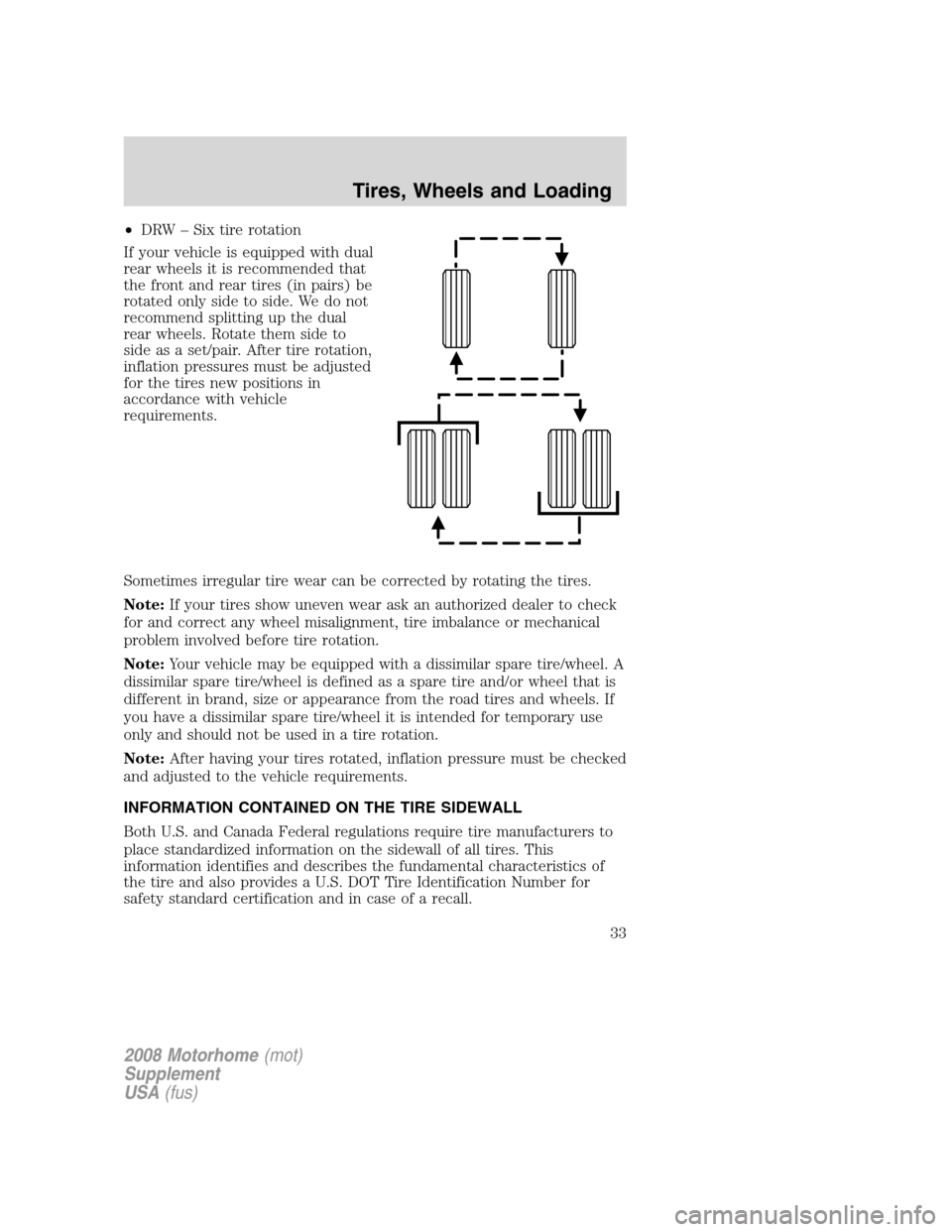
•DRW – Six tire rotation
If your vehicle is equipped with dual
rear wheels it is recommended that
the front and rear tires (in pairs) be
rotated only side to side. We do not
recommend splitting up the dual
rear wheels. Rotate them side to
side as a set/pair. After tire rotation,
inflation pressures must be adjusted
for the tires new positions in
accordance with vehicle
requirements.
Sometimes irregular tire wear can be corrected by rotating the tires.
Note:If your tires show uneven wear ask an authorized dealer to check
for and correct any wheel misalignment, tire imbalance or mechanical
problem involved before tire rotation.
Note:Your vehicle may be equipped with a dissimilar spare tire/wheel. A
dissimilar spare tire/wheel is defined as a spare tire and/or wheel that is
different in brand, size or appearance from the road tires and wheels. If
you have a dissimilar spare tire/wheel it is intended for temporary use
only and should not be used in a tire rotation.
Note:After having your tires rotated, inflation pressure must be checked
and adjusted to the vehicle requirements.
INFORMATION CONTAINED ON THE TIRE SIDEWALL
Both U.S. and Canada Federal regulations require tire manufacturers to
place standardized information on the sidewall of all tires. This
information identifies and describes the fundamental characteristics of
the tire and also provides a U.S. DOT Tire Identification Number for
safety standard certification and in case of a recall.
2008 Motorhome(mot)
Supplement
USA(fus)
Tires, Wheels and Loading
33
Page 108 of 130
•Resting your foot on the brake pedal while driving may reduce fuel
economy.
•Combine errands and minimize stop-and-go driving.
Maintenance
•Keep tires properly inflated and use only recommended size.
•Operating a vehicle with the wheels out of alignment will reduce fuel
economy.
•Use recommended engine oil. Refer toMaintenance product
specifications and capacitiesin this chapter.
•Perform all regularly scheduled maintenance items. Follow the
recommended maintenance schedule and owner maintenance checks
found inscheduled maintenance information.
Conditions
•Heavily loading a vehicle or towing a trailer may reduce fuel economy
at any speed.
•Carrying unnecessary weight may reduce fuel economy (approximately
1 mpg [0.4 km/L] is lost for every 400 lb [180 kg] of weight carried).
•Adding certain accessories to your vehicle (for example bug
deflectors, rollbars/light bars, running boards, ski/luggage racks) may
reduce fuel economy.
•Using fuel blended with alcohol may lower fuel economy.
•Fuel economy may decrease with lower temperatures during the first
8–10 miles (12–16 km) of driving.
•Driving on flat terrain offers improved fuel economy as compared to
driving on hilly terrain.
•Transmissions give their best fuel economy when operated in the top
cruise gear and with steady pressure on the gas pedal.
•Close windows for high speed driving.
EPA fuel economy estimates
Every new vehicle should have a window sticker containing EPA fuel
economy estimates. Contact your authorized dealer if the window sticker
is not supplied with your vehicle. The EPA fuel economy estimates
should be your guide for the fuel economy comparisons with other
vehicles. Your fuel economy may vary depending upon the method of
operation and conditions.
2008 Motorhome(mot)
Supplement
USA(fus)
Maintenance and Specifications
108
Page 128 of 130
headlamps, flash to pass ..........17
instrument panel, dimming .....17
Lights, warning and indicator ......8
anti-lock brakes (ABS) ............53
Load limits ...................................39
Loading instructions ...................43
Lubricant specifications ...........121
Lug nuts ......................................75
M
Message center ...........................11
Motorcraft parts ................101, 120
O
Octane rating ............................104
Oil (see Engine oil) ....................91
Overdrive .....................................19
P
Parking brake ..............................54
Parts (see Motorcraft parts) ....120
Power distribution box
(see Fuses) .................................66
Power steering
fluid, checking and adding ....112
fluid, refill capacity ................121
fluid, specifications .................121
R
Relays ....................................62, 69
Roadside assistance ....................61
S
Safety defects, reporting ......86–87Servicing your vehicle ................89
Spark plugs,
specifications .....................120, 124
Special notice ................................4
Specification chart,
lubricants ...................................121
Speed control ..............................19
Starting your vehicle ............48–50
jump starting ............................75
Steering wheel
tilting .........................................18
T
Tilt steering wheel ......................18
Tires .......................................22–23
alignment ..................................32
care ............................................28
changing ....................................71
checking the pressure ..............27
inflating .....................................24
replacing ..............................30, 73
rotating ......................................32
safety practices .........................31
sidewall information .................33
snow tires and chains ..............38
spare tire ...................................69
terminology ...............................23
tire grades .................................23
treadwear ............................22, 29
Towing .........................................44
trailer towing ............................44
wrecker ......................................80
Transmission ...............................55
automatic operation .................19
brake-shift interlock (BSI) ......55
fluid, checking and adding
(automatic) .............................115
fluid, refill capacities ..............121
2008 Motorhome(mot)
Supplement
USA(fus)
Index
128