Page 71 of 130
•Use snow chains on the end of the vehicle with the dissimilar spare
tire/wheel
The usage of a full-size dissimilar spare tire/wheel can lead to
impairment of the following:
•Handling, stability and braking performance
•Comfort and noise
•Ground clearance and parking at curbs
•Winter weather driving capability
•Wet weather driving capability
•All-Wheel driving capability (if applicable)
•Load leveling adjustment (if applicable)
When driving with the full-size dissimilar spare tire/wheel additional
caution should be given to:
•Towing a trailer
•Driving vehicles equipped with a camper body
•Driving vehicles with a load on the cargo rack
Drive cautiously when using a full-size dissimilar spare tire/wheel and
seek service as soon as possible.
Stopping and securing the vehicle
1. Park on a level surface.
2. Activate the warning flashers.
3. Place the gearshift in P (Park).
2008 Motorhome(mot)
Supplement
USA(fus)
Roadside Emergencies
71
Page 80 of 130
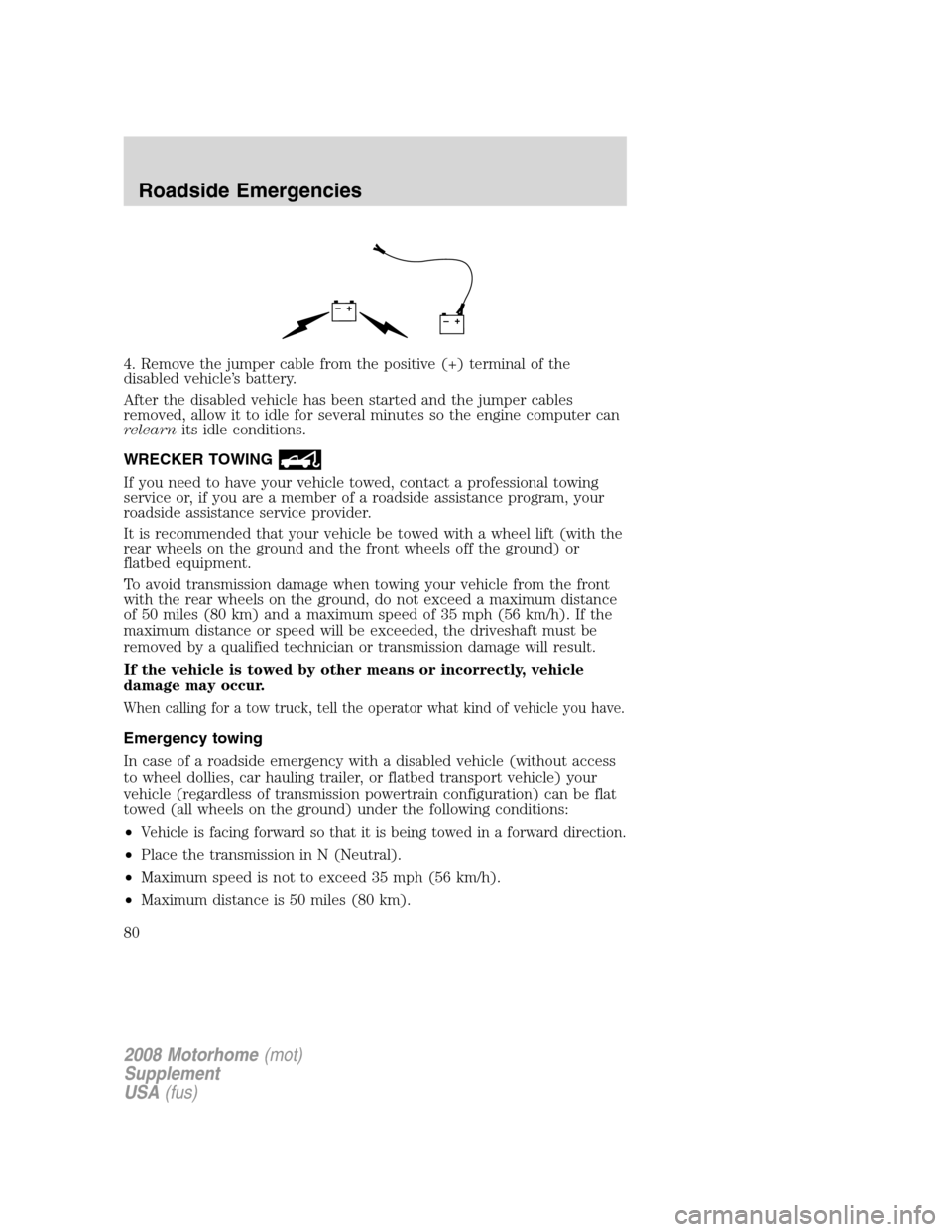
4. Remove the jumper cable from the positive (+) terminal of the
disabled vehicle’s battery.
After the disabled vehicle has been started and the jumper cables
removed, allow it to idle for several minutes so the engine computer can
relearnits idle conditions.
WRECKER TOWING
If you need to have your vehicle towed, contact a professional towing
service or, if you are a member of a roadside assistance program, your
roadside assistance service provider.
It is recommended that your vehicle be towed with a wheel lift (with the
rear wheels on the ground and the front wheels off the ground) or
flatbed equipment.
To avoid transmission damage when towing your vehicle from the front
with the rear wheels on the ground, do not exceed a maximum distance
of 50 miles (80 km) and a maximum speed of 35 mph (56 km/h). If the
maximum distance or speed will be exceeded, the driveshaft must be
removed by a qualified technician or transmission damage will result.
If the vehicle is towed by other means or incorrectly, vehicle
damage may occur.
When calling for a tow truck, tell the operator what kind of vehicle you have.
Emergency towing
In case of a roadside emergency with a disabled vehicle (without access
to wheel dollies, car hauling trailer, or flatbed transport vehicle) your
vehicle (regardless of transmission powertrain configuration) can be flat
towed (all wheels on the ground) under the following conditions:
•
Vehicle is facing forward so that it is being towed in a forward direction.
•Place the transmission in N (Neutral).
•Maximum speed is not to exceed 35 mph (56 km/h).
•Maximum distance is 50 miles (80 km).
+–+–
2008 Motorhome(mot)
Supplement
USA(fus)
Roadside Emergencies
80
Page 108 of 130
•Resting your foot on the brake pedal while driving may reduce fuel
economy.
•Combine errands and minimize stop-and-go driving.
Maintenance
•Keep tires properly inflated and use only recommended size.
•Operating a vehicle with the wheels out of alignment will reduce fuel
economy.
•Use recommended engine oil. Refer toMaintenance product
specifications and capacitiesin this chapter.
•Perform all regularly scheduled maintenance items. Follow the
recommended maintenance schedule and owner maintenance checks
found inscheduled maintenance information.
Conditions
•Heavily loading a vehicle or towing a trailer may reduce fuel economy
at any speed.
•Carrying unnecessary weight may reduce fuel economy (approximately
1 mpg [0.4 km/L] is lost for every 400 lb [180 kg] of weight carried).
•Adding certain accessories to your vehicle (for example bug
deflectors, rollbars/light bars, running boards, ski/luggage racks) may
reduce fuel economy.
•Using fuel blended with alcohol may lower fuel economy.
•Fuel economy may decrease with lower temperatures during the first
8–10 miles (12–16 km) of driving.
•Driving on flat terrain offers improved fuel economy as compared to
driving on hilly terrain.
•Transmissions give their best fuel economy when operated in the top
cruise gear and with steady pressure on the gas pedal.
•Close windows for high speed driving.
EPA fuel economy estimates
Every new vehicle should have a window sticker containing EPA fuel
economy estimates. Contact your authorized dealer if the window sticker
is not supplied with your vehicle. The EPA fuel economy estimates
should be your guide for the fuel economy comparisons with other
vehicles. Your fuel economy may vary depending upon the method of
operation and conditions.
2008 Motorhome(mot)
Supplement
USA(fus)
Maintenance and Specifications
108
Page 115 of 130
Parking Brake Fluid
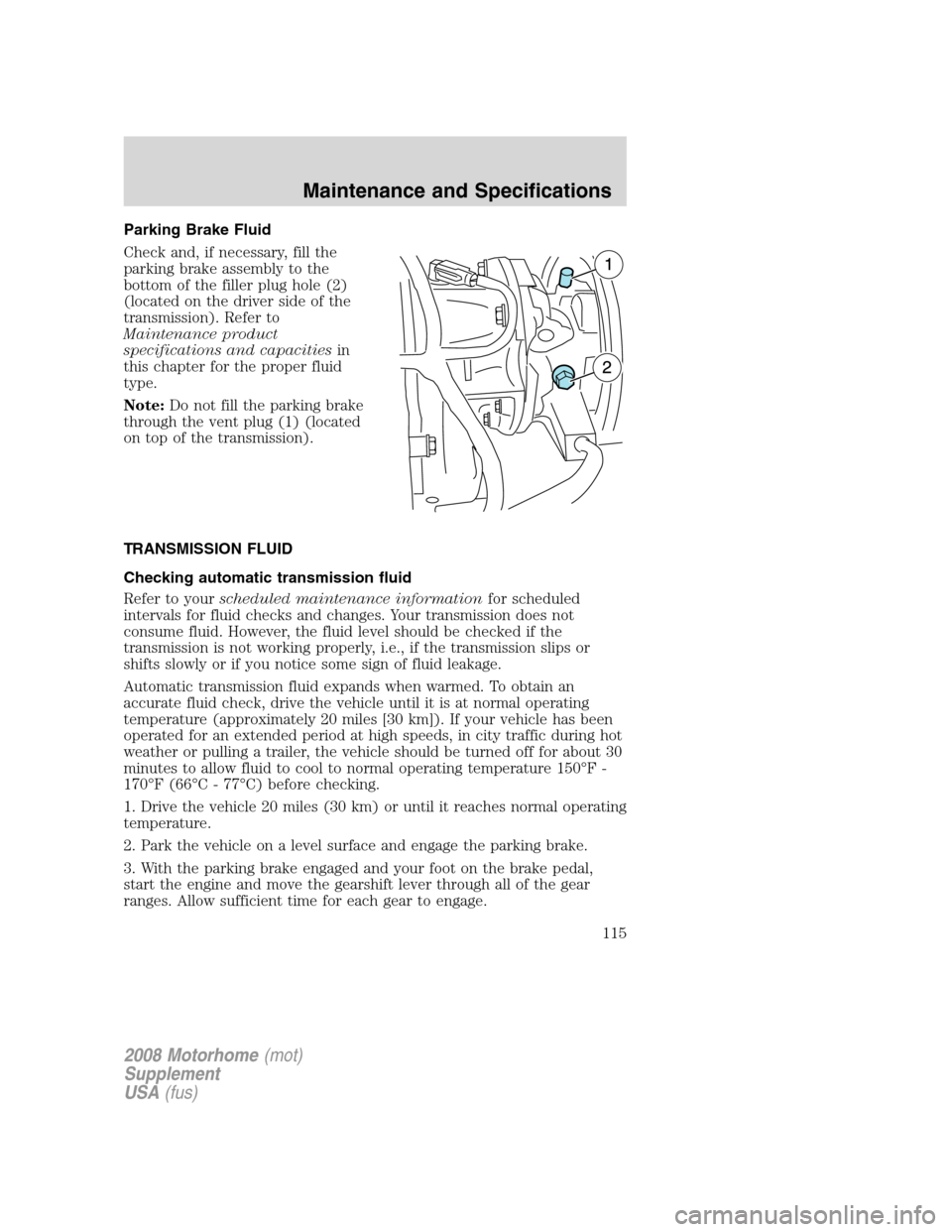
Check and, if necessary, fill the
parking brake assembly to the
bottom of the filler plug hole (2)
(located on the driver side of the
transmission). Refer to
Maintenance product
specifications and capacitiesin
this chapter for the proper fluid
type.
Note:Do not fill the parking brake
through the vent plug (1) (located
on top of the transmission).
TRANSMISSION FLUID
Checking automatic transmission fluid
Refer to yourscheduled maintenance informationfor scheduled
intervals for fluid checks and changes. Your transmission does not
consume fluid. However, the fluid level should be checked if the
transmission is not working properly, i.e., if the transmission slips or
shifts slowly or if you notice some sign of fluid leakage.
Automatic transmission fluid expands when warmed. To obtain an
accurate fluid check, drive the vehicle until it is at normal operating
temperature (approximately 20 miles [30 km]). If your vehicle has been
operated for an extended period at high speeds, in city traffic during hot
weather or pulling a trailer, the vehicle should be turned off for about 30
minutes to allow fluid to cool to normal operating temperature 150°F -
170°F (66°C - 77°C) before checking.
1. Drive the vehicle 20 miles (30 km) or until it reaches normal operating
temperature.
2. Park the vehicle on a level surface and engage the parking brake.
3. With the parking brake engaged and your foot on the brake pedal,
start the engine and move the gearshift lever through all of the gear
ranges. Allow sufficient time for each gear to engage.
2008 Motorhome(mot)
Supplement
USA(fus)
Maintenance and Specifications
115
Page 128 of 130
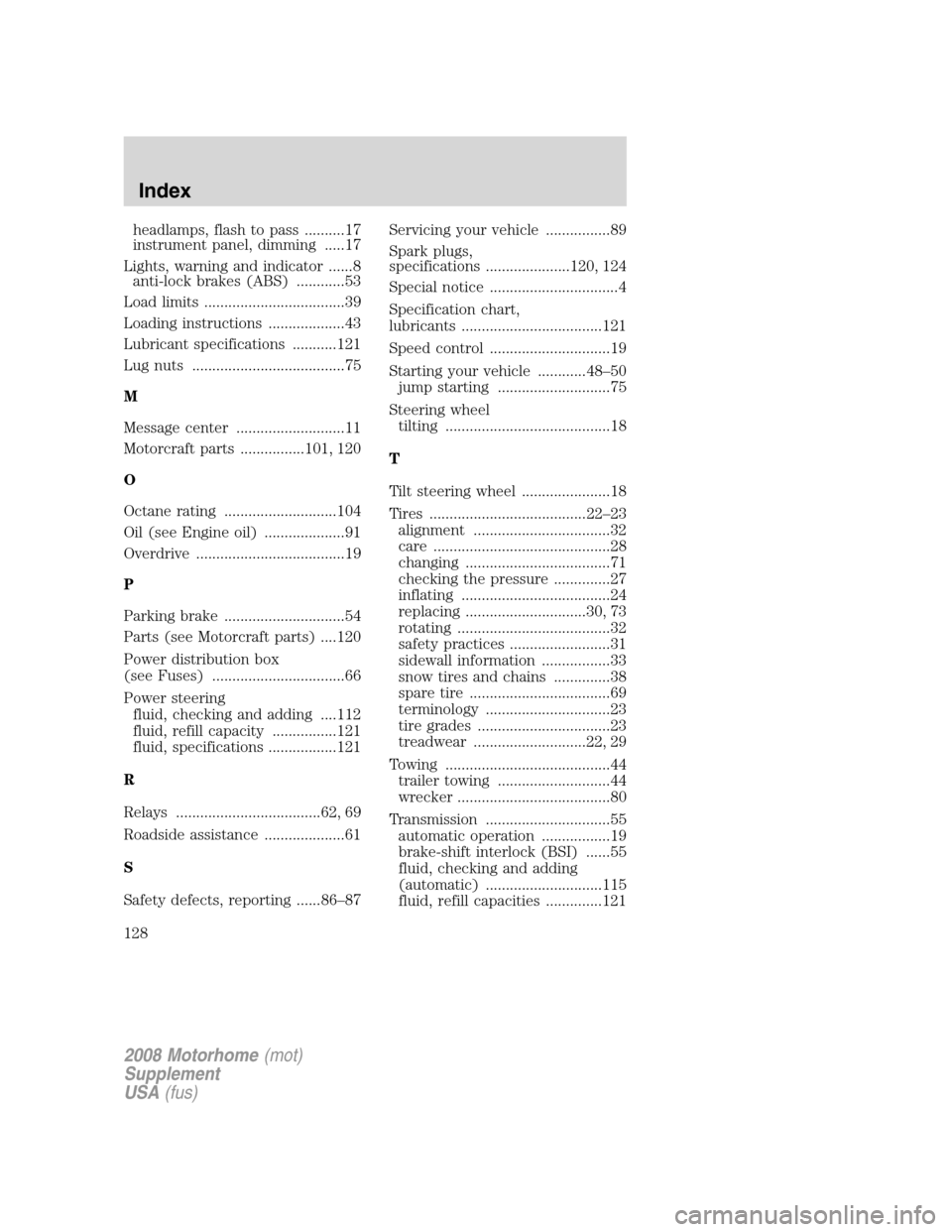
headlamps, flash to pass ..........17
instrument panel, dimming .....17
Lights, warning and indicator ......8
anti-lock brakes (ABS) ............53
Load limits ...................................39
Loading instructions ...................43
Lubricant specifications ...........121
Lug nuts ......................................75
M
Message center ...........................11
Motorcraft parts ................101, 120
O
Octane rating ............................104
Oil (see Engine oil) ....................91
Overdrive .....................................19
P
Parking brake ..............................54
Parts (see Motorcraft parts) ....120
Power distribution box
(see Fuses) .................................66
Power steering
fluid, checking and adding ....112
fluid, refill capacity ................121
fluid, specifications .................121
R
Relays ....................................62, 69
Roadside assistance ....................61
S
Safety defects, reporting ......86–87Servicing your vehicle ................89
Spark plugs,
specifications .....................120, 124
Special notice ................................4
Specification chart,
lubricants ...................................121
Speed control ..............................19
Starting your vehicle ............48–50
jump starting ............................75
Steering wheel
tilting .........................................18
T
Tilt steering wheel ......................18
Tires .......................................22–23
alignment ..................................32
care ............................................28
changing ....................................71
checking the pressure ..............27
inflating .....................................24
replacing ..............................30, 73
rotating ......................................32
safety practices .........................31
sidewall information .................33
snow tires and chains ..............38
spare tire ...................................69
terminology ...............................23
tire grades .................................23
treadwear ............................22, 29
Towing .........................................44
trailer towing ............................44
wrecker ......................................80
Transmission ...............................55
automatic operation .................19
brake-shift interlock (BSI) ......55
fluid, checking and adding
(automatic) .............................115
fluid, refill capacities ..............121
2008 Motorhome(mot)
Supplement
USA(fus)
Index
128
Page:
< prev 1-8 9-16 17-24