Page 45 of 130
Preparing to tow
Use the proper equipment for towing a trailer and make sure it is
properly attached to your vehicle. See your authorized dealer or a
reliable trailer dealer if you require assistance.
Hitches
You must distribute the load in your trailer so that 10–15% of the total
weight of the trailer is on the tongue.
Weight distributing hitch
When hooking up a trailer using a load equalizing hitch, always use the
following procedure:
1. Park the unloaded vehicle on a level surface. With the ignition on and
all doors closed, allow the vehicle to stand for several minutes so that it
can level.
2. Measure the height of a reference point on the front and rear bumpers
at the center of the vehicle.
3. Attach the trailer to the vehicle and adjust the hitch equalizers so that
the front bumper height is within
12” (13 mm) of the reference point.
After proper adjustment, the rear bumper should be no higher than in
Step 2.
Note:Adjusting a weight distributing hitch so the rear bumper of the
vehicle is higher than it was unloaded will defeat the function of the
weight distributing hitch and may cause unpredictable handling.
Safety chains
Always connect the trailer’s safety chains to the frame or hook retainers
of the vehicle hitch. To connect the trailer’s safety chains, cross the
chains under the trailer tongue and allow slack for turning corners.
If you use a rental trailer, follow the instructions that the rental agency
gives to you.
Do not attach safety chains to the bumper.
Trailer brakes
Electric brakes and manual, automatic or surge-type brakes are safe if
installed properly and adjusted to the manufacturer’s specifications. The
trailer brakes must meet local and Federal regulations.
2008 Motorhome(mot)
Supplement
USA(fus)
Tires, Wheels and Loading
45
Page 47 of 130
•If you are driving down a long or steep hill, shift to a lower gear. Do
not apply the brakes continuously, as they may overheat and become
less effective.
•The trailer tongue weight should be 10–15% of the loaded trailer
weight.
•If you will be towing a trailer frequently in hot weather, hilly
conditions, at GCWR, or any combination of these factors, consider
refilling your rear axle with synthetic gear lube if not already so
equipped. Refer to theMaintenance and Specificationschapter for
the lubricant specification. Remember that regardless of the rear axle
lube used, do not tow a trailer for the first 1,000 miles (1,600 km) of a
new vehicle, and that the first 500 miles (800 km) of towing be done
at no faster than 70 mph (113 km/h) with no full throttle starts.
•After you have traveled 50 miles (80 km), thoroughly check your
hitch, electrical connections and trailer wheel lug nuts.
•To aid in engine/transmission cooling and A/C efficiency during hot
weather while stopped in traffic, place the gearshift lever in P (Park).
•Vehicles with trailers should not be parked on a grade. If you must
park on a grade, place wheel chocks under the trailer’s wheels.
2008 Motorhome(mot)
Supplement
USA(fus)
Tires, Wheels and Loading
47
Page 108 of 130
•Resting your foot on the brake pedal while driving may reduce fuel
economy.
•Combine errands and minimize stop-and-go driving.
Maintenance
•Keep tires properly inflated and use only recommended size.
•Operating a vehicle with the wheels out of alignment will reduce fuel
economy.
•Use recommended engine oil. Refer toMaintenance product
specifications and capacitiesin this chapter.
•Perform all regularly scheduled maintenance items. Follow the
recommended maintenance schedule and owner maintenance checks
found inscheduled maintenance information.
Conditions
•Heavily loading a vehicle or towing a trailer may reduce fuel economy
at any speed.
•Carrying unnecessary weight may reduce fuel economy (approximately
1 mpg [0.4 km/L] is lost for every 400 lb [180 kg] of weight carried).
•Adding certain accessories to your vehicle (for example bug
deflectors, rollbars/light bars, running boards, ski/luggage racks) may
reduce fuel economy.
•Using fuel blended with alcohol may lower fuel economy.
•Fuel economy may decrease with lower temperatures during the first
8–10 miles (12–16 km) of driving.
•Driving on flat terrain offers improved fuel economy as compared to
driving on hilly terrain.
•Transmissions give their best fuel economy when operated in the top
cruise gear and with steady pressure on the gas pedal.
•Close windows for high speed driving.
EPA fuel economy estimates
Every new vehicle should have a window sticker containing EPA fuel
economy estimates. Contact your authorized dealer if the window sticker
is not supplied with your vehicle. The EPA fuel economy estimates
should be your guide for the fuel economy comparisons with other
vehicles. Your fuel economy may vary depending upon the method of
operation and conditions.
2008 Motorhome(mot)
Supplement
USA(fus)
Maintenance and Specifications
108
Page 109 of 130
Note:Vehicles over 8,500 GVW (Gross Vehicle Weight) will not have fuel
economy information printed on the EPA window sticker.
EMISSION CONTROL SYSTEM
Your vehicle is equipped with various emission control components and a
catalytic converter which will enable your vehicle to comply with
applicable exhaust emission standards. To make sure that the catalytic
converter and other emission control components continue to work
properly:
•Use only the specified fuel listed.
•Avoid running out of fuel.
•Do not turn off the ignition while your vehicle is moving, especially at
high speeds.
•Have the items listed inscheduled maintenance information
performed according to the specified schedule.
The scheduled maintenance items listed inscheduled maintenance
informationare essential to the life and performance of your vehicle
and to its emissions system.
If other than Ford, Motorcraft or Ford-authorized parts are used for
maintenance replacements or for service of components affecting
emission control, such non-Ford parts should be equivalent to genuine
Ford Motor Company parts in performance and durability.
WARNING:Do not park, idle, or drive your vehicle in dry grass
or other dry ground cover. The emission system heats up the
engine compartment and exhaust system, which can start a fire.
Illumination of theService engine soonlight, charging system warning
light or the temperature warning light, fluid leaks, strange odors, smoke
or loss of engine power, could indicate that the emission control system
is not working properly.
An improperly operating or damaged exhaust system may allow exhaust
to enter the vehicle. Have a damaged or improperly operating exhaust
system inspected and repaired immediately.
WARNING:Exhaust leaks may result in entry of harmful and
potentially lethal fumes into the passenger compartment.
Do not make any unauthorized changes to your vehicle or engine. By
law, vehicle owners and anyone who manufactures, repairs, services,
2008 Motorhome(mot)
Supplement
USA(fus)
Maintenance and Specifications
109
Page 113 of 130
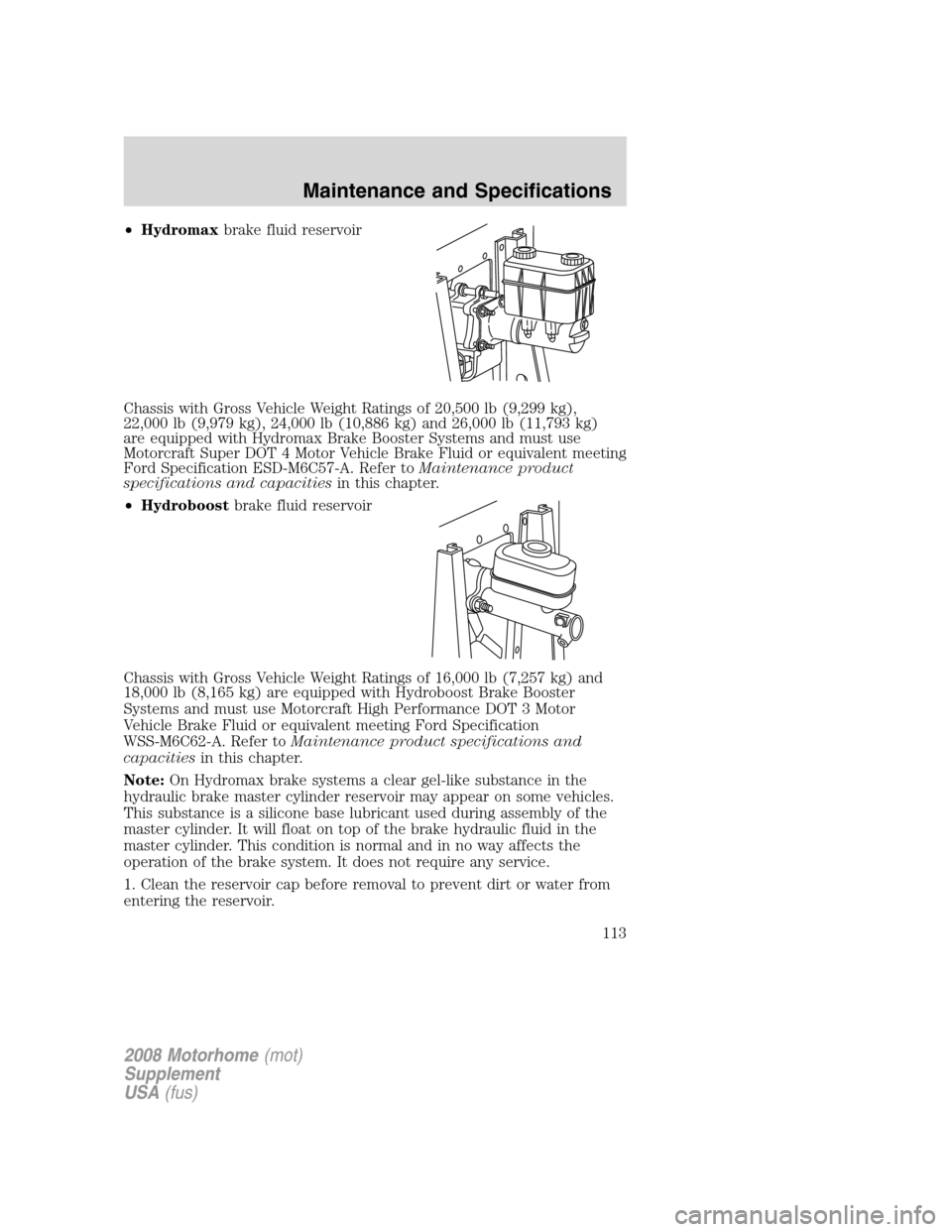
•Hydromaxbrake fluid reservoir
Chassis with Gross Vehicle Weight Ratings of 20,500 lb (9,299 kg),
22,000 lb (9,979 kg), 24,000 lb (10,886 kg) and 26,000 lb (11,793 kg)
are equipped with Hydromax Brake Booster Systems and must use
Motorcraft Super DOT 4 Motor Vehicle Brake Fluid or equivalent meeting
Ford Specification ESD-M6C57-A. Refer toMaintenance product
specifications and capacitiesin this chapter.
•Hydroboostbrake fluid reservoir
Chassis with Gross Vehicle Weight Ratings of 16,000 lb (7,257 kg) and
18,000 lb (8,165 kg) are equipped with Hydroboost Brake Booster
Systems and must use Motorcraft High Performance DOT 3 Motor
Vehicle Brake Fluid or equivalent meeting Ford Specification
WSS-M6C62-A. Refer toMaintenance product specifications and
capacitiesin this chapter.
Note:On Hydromax brake systems a clear gel-like substance in the
hydraulic brake master cylinder reservoir may appear on some vehicles.
This substance is a silicone base lubricant used during assembly of the
master cylinder. It will float on top of the brake hydraulic fluid in the
master cylinder. This condition is normal and in no way affects the
operation of the brake system. It does not require any service.
1. Clean the reservoir cap before removal to prevent dirt or water from
entering the reservoir.
2008 Motorhome(mot)
Supplement
USA(fus)
Maintenance and Specifications
113
Page 121 of 130
MAINTENANCE PRODUCT SPECIFICATIONS AND CAPACITIES
Item Capacity Ford Part NameFord Part Number /
Ford Specification
Brake fluid-Hydroboost
brake booster
system—Chassis with
Gross Vehicle Weight
Ratings of 16,000 lb
(7,257 kg) and 18,000 lb
(8,165 kg)
Between MIN and
MAX on reservoirMotorcraft High
Performance DOT 3
Motor Vehicle Brake
FluidPM-1-C /
WSS-M6C65-A1
Brake fluid-Hydromax
brake booster
system—Chassis with
Gross Vehicle Weight
Ratings of 20,500 lb
(9,299 kg), 22,000 lb
(9,979 kg), 24,000 lb
(10,886 kg) and 26,000
lb (11793 kg)Super DOT 4 Motor
Vehicle Brake FluidYS4Z-19542-AA /
WSS-M6C65-A2
Engine coolant30.6 quarts
(29.0L)
1
Motorcraft Premium Gold
Engine Coolant with
bittering agent
(yellow-colored)
2
VC-7-B /
WSS-M97B51-A1
Cooling system stop
leak pellets—Motorcraft Cooling
System Stop Leak PelletsVC-6 /
WSS-M99B37-B6
2008 Motorhome(mot)
Supplement
USA(fus)
Maintenance and Specifications
121