Page 364 of 392
Your vehicle was not designed to use fuel or fuel additives with metallic
compounds, including manganese-based additives. Studies indicate that
these additives can cause your vehicle’s emission control system to
deteriorate more rapidly.
Repairs to correct the effects of using a fuel for which your vehicle was
not designed may not be covered by your warranty.
Octane recommendations
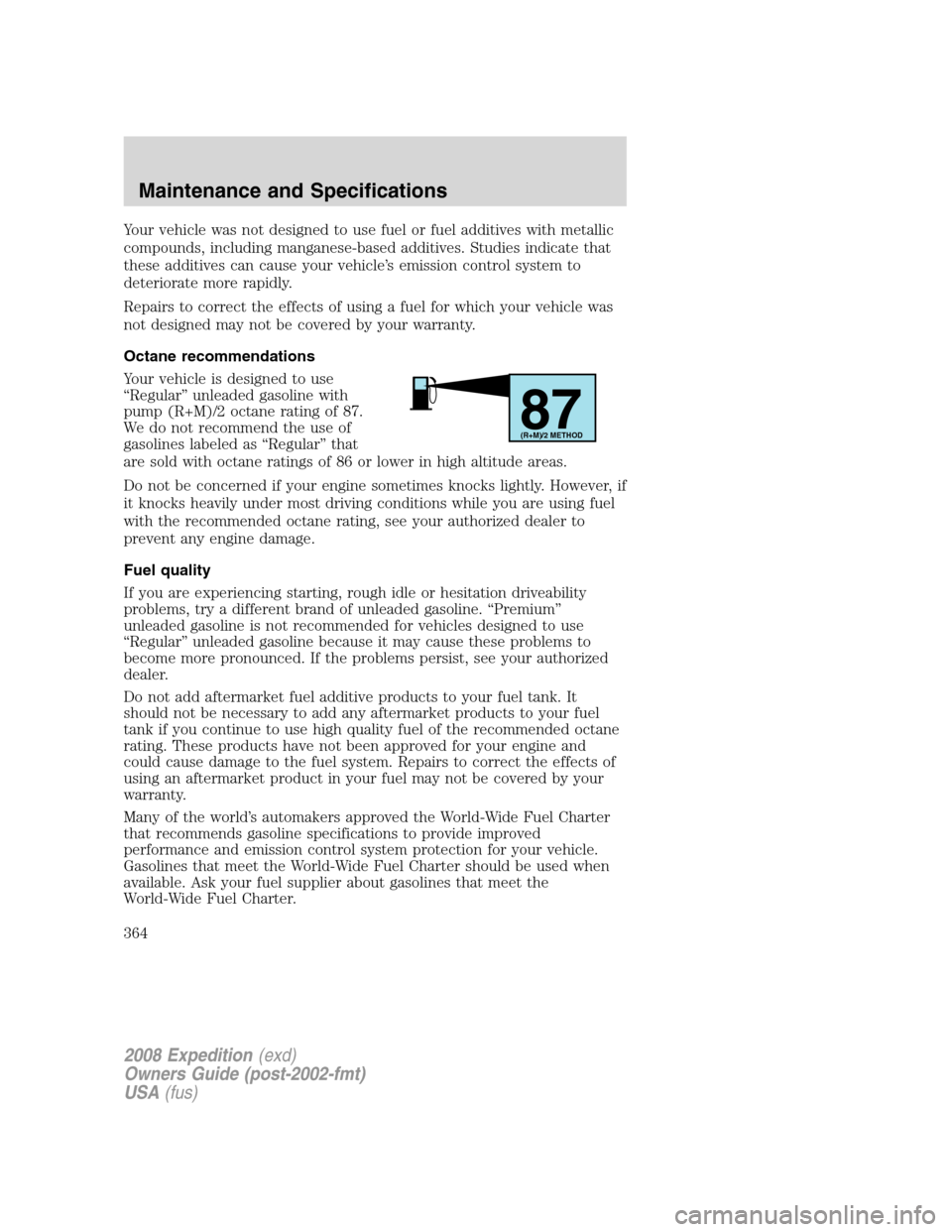
Your vehicle is designed to use
“Regular” unleaded gasoline with
pump (R+M)/2 octane rating of 87.
We do not recommend the use of
gasolines labeled as “Regular” that
are sold with octane ratings of 86 or lower in high altitude areas.
Do not be concerned if your engine sometimes knocks lightly. However, if
it knocks heavily under most driving conditions while you are using fuel
with the recommended octane rating, see your authorized dealer to
prevent any engine damage.
Fuel quality
If you are experiencing starting, rough idle or hesitation driveability
problems, try a different brand of unleaded gasoline. “Premium”
unleaded gasoline is not recommended for vehicles designed to use
“Regular” unleaded gasoline because it may cause these problems to
become more pronounced. If the problems persist, see your authorized
dealer.
Do not add aftermarket fuel additive products to your fuel tank. It
should not be necessary to add any aftermarket products to your fuel
tank if you continue to use high quality fuel of the recommended octane
rating. These products have not been approved for your engine and
could cause damage to the fuel system. Repairs to correct the effects of
using an aftermarket product in your fuel may not be covered by your
warranty.
Many of the world’s automakers approved the World-Wide Fuel Charter
that recommends gasoline specifications to provide improved
performance and emission control system protection for your vehicle.
Gasolines that meet the World-Wide Fuel Charter should be used when
available. Ask your fuel supplier about gasolines that meet the
World-Wide Fuel Charter.
87(R+M)/2 METHOD
2008 Expedition(exd)
Owners Guide (post-2002-fmt)
USA(fus)
Maintenance and Specifications
364
Page 367 of 392
economy under current driving conditions. Additionally, keeping records
during summer and winter will show how temperature impacts fuel
economy. In general, lower temperatures give lower fuel economy.
Driving style — good driving and fuel economy habits
Give consideration to the lists that follow and you may be able to change
a number of variables and improve your fuel economy.
Habits
•Smooth, moderate operation can yield up to 10% savings in fuel.
•Steady speeds without stopping will usually give the best fuel
economy.
•Idling for long periods of time (greater than one minute) may waste
fuel.
•Anticipate stopping; slowing down may eliminate the need to stop.
•Sudden or hard accelerations may reduce fuel economy.
•Slow down gradually.
•Driving at reasonable speeds (traveling at 55 mph [88 km/h] uses 15%
less fuel than traveling at 65 mph [105 km/h]).
•Revving the engine before turning it off may reduce fuel economy.
•Using the air conditioner or defroster may reduce fuel economy.
•You may want to turn off the speed control in hilly terrain if
unnecessary shifting between the top gears occurs. Unnecessary
shifting of this type could result in reduced fuel economy.
•Warming up a vehicle on cold mornings is not required and may
reduce fuel economy.
•Resting your foot on the brake pedal while driving may reduce fuel
economy.
•Combine errands and minimize stop-and-go driving.
Maintenance
•Keep tires properly inflated and use only recommended size.
•Operating a vehicle with the wheels out of alignment will reduce fuel
economy.
•Use recommended engine oil. Refer toMaintenance product
specifications and capacitiesin this chapter.
•Perform all regularly scheduled maintenance items. Follow the
recommended maintenance schedule and owner maintenance checks
found inscheduled maintenance information.
2008 Expedition(exd)
Owners Guide (post-2002-fmt)
USA(fus)
Maintenance and Specifications
367
Page 386 of 392
change oil soon warning,
message center .......................349
checking and adding ..............349
dipstick ....................................349
filter, specifications ........351, 375
recommendations ...................351
refill capacities ........................376
specifications ..........................376
Event data recording ....................7
Exhaust fumes ..........................268
F
Fail safe cooling ........................358
Family entertainment system ....48
Floor mats .................................145
Fluid capacities .........................376
Foglamps .....................................87
Four-Wheel Drive vehicles .......290
control trac .............................290
description ..............................291
driving off road .......................293
indicator light .........................290
preparing to drive your
vehicle .....................................279
Fuel ............................................360
calculating fuel
economy ..................123, 135, 365
cap ...........................................362
capacity ...................................376
choosing the right fuel ...........363
comparisons with EPA fuel
economy estimates .................368
detergent in fuel .....................365
filling your vehicle with
fuel ...........................360, 362, 365
filter, specifications ........360, 375
fuel pump shut-off switch .....302
improving fuel economy ........365
octane rating ...................364, 379quality ......................................364
running out of fuel .................365
safety information relating to
automotive fuels .....................360
Fuses ..................................303–304
G
Gas cap (see Fuel cap) ............362
Gas mileage
(see Fuel economy) .................365
Gauges .........................................17
H
Hazard flashers .........................301
Headlamps ...................................87
aiming ........................................89
autolamp system .......................87
bulb specifications ....................92
daytime running lights .............88
flash to pass ..............................88
high beam .................................88
replacing bulbs .........................93
turning on and off ....................87
Heating
heating and air
conditioning system ...........76–77
Homelink wireless control
system ........................................118
Hood ..........................................345
How to get going ........................20
I
Ignition ...............................265, 379
Illuminated visor mirror ...........100
Infant seats
(see Safety seats) .....................216
2008 Expedition(exd)
Owners Guide (post-2002-fmt)
USA(fus)
Index
386