2008 FORD EXPEDITION steering wheel
[x] Cancel search: steering wheelPage 298 of 392
Apply just enough power to the wheels to climb the hill. Too much
power will cause the tires to slip, spin or lose traction, resulting in loss of
vehicle control.
Descend a hill in the same gear you
would use to climb up the hill to
avoid excessive brake application
and brake overheating. Do not
descend in neutral; instead,
disengage overdrive or manually
shift to a lower gear. When
descending a steep hill, avoid
sudden hard braking as you could
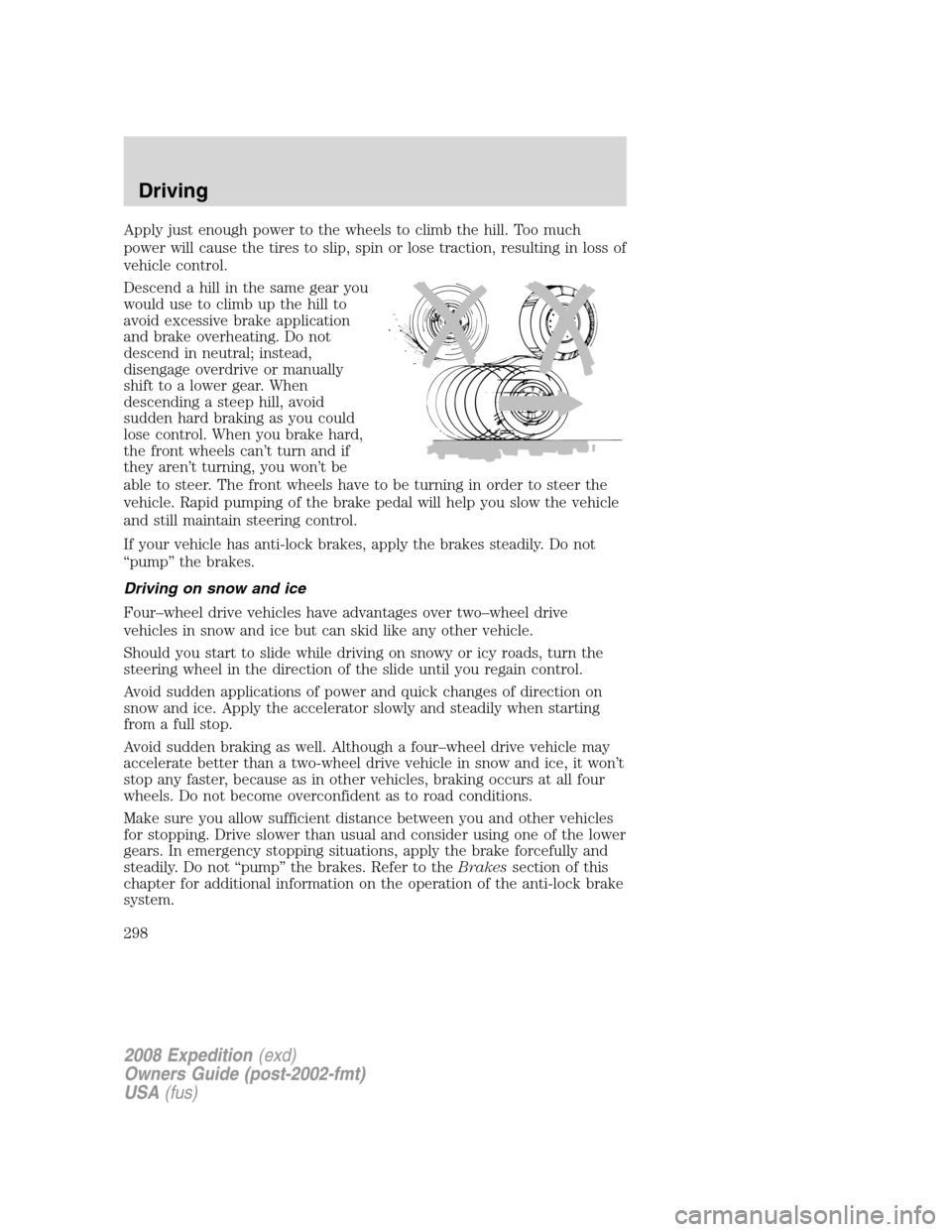
lose control. When you brake hard,
the front wheels can’t turn and if
they aren’t turning, you won’t be
able to steer. The front wheels have to be turning in order to steer the
vehicle. Rapid pumping of the brake pedal will help you slow the vehicle
and still maintain steering control.
If your vehicle has anti-lock brakes, apply the brakes steadily. Do not
“pump” the brakes.
Driving on snow and ice
Four–wheel drive vehicles have advantages over two–wheel drive
vehicles in snow and ice but can skid like any other vehicle.
Should you start to slide while driving on snowy or icy roads, turn the
steering wheel in the direction of the slide until you regain control.
Avoid sudden applications of power and quick changes of direction on
snow and ice. Apply the accelerator slowly and steadily when starting
from a full stop.
Avoid sudden braking as well. Although a four–wheel drive vehicle may
accelerate better than a two-wheel drive vehicle in snow and ice, it won’t
stop any faster, because as in other vehicles, braking occurs at all four
wheels. Do not become overconfident as to road conditions.
Make sure you allow sufficient distance between you and other vehicles
for stopping. Drive slower than usual and consider using one of the lower
gears. In emergency stopping situations, apply the brake forcefully and
steadily. Do not “pump” the brakes. Refer to theBrakessection of this
chapter for additional information on the operation of the anti-lock brake
system.
2008 Expedition(exd)
Owners Guide (post-2002-fmt)
USA(fus)
Driving
298
Page 299 of 392
Maintenance and Modifications
The suspension and steering systems on your vehicle have been designed
and tested to provide predictable performance whether loaded or empty
and durable load carrying capability. For this reason, Ford Motor
Company strongly recommends that you do not make modifications such
as adding or removing parts (such as lift kits or stabilizer bars) or by
using replacement parts not equivalent to the original factory equipment.
Any modifications to a vehicle that raise the center of gravity can make
it more likely the vehicle will roll over as a result of a loss of control.
Ford Motor Company recommends that caution be used with any vehicle
equipped with a high load or device (such as ladder racks or pickup box
cover).
Failure to maintain your vehicle properly may void the warranty, increase
your repair cost, reduce vehicle performance and operational capabilities
and adversely affect driver and passenger safety. Frequent inspection of
vehicle chassis components is recommended if the vehicle is subjected to
heavy off-road usage.
DRIVING THROUGH WATER
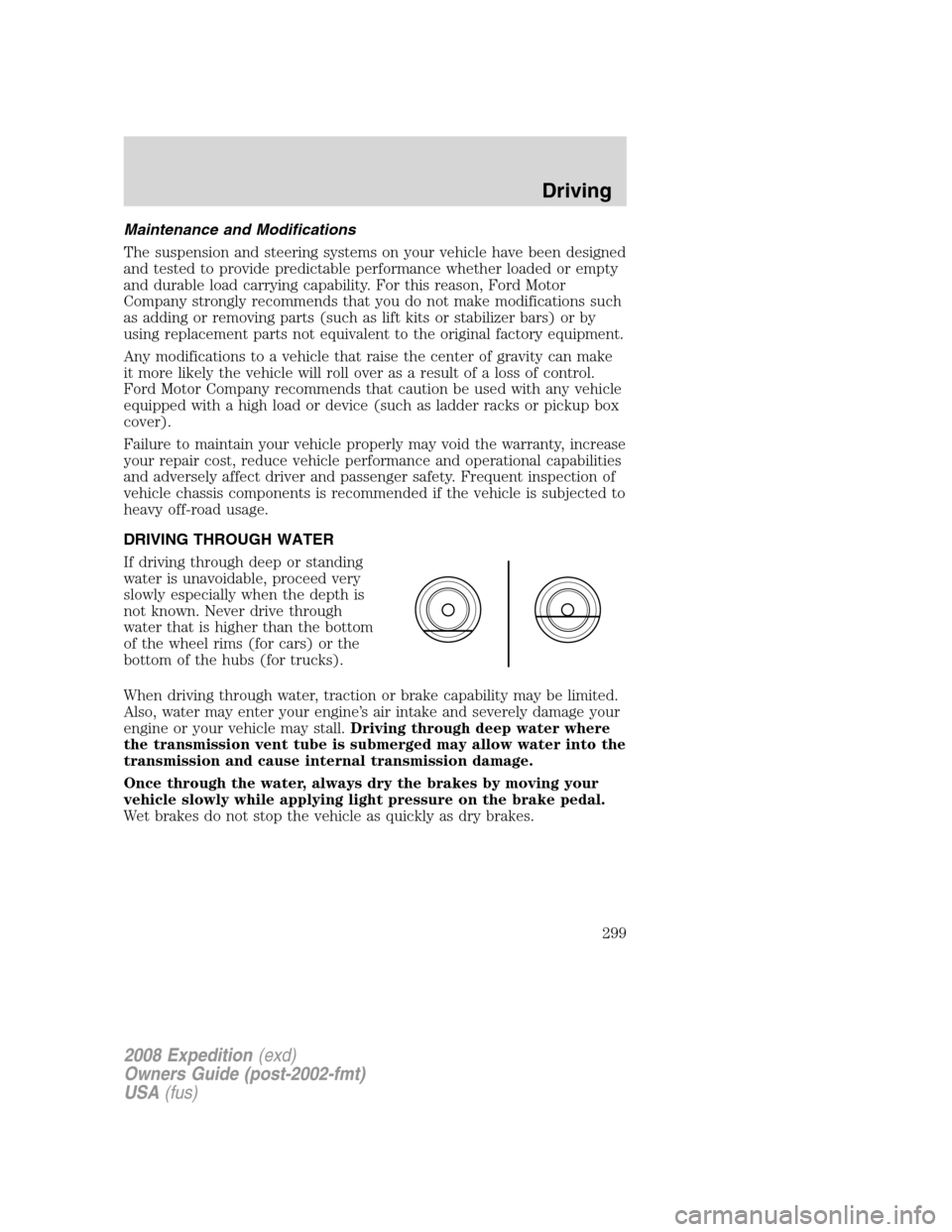
If driving through deep or standing
water is unavoidable, proceed very
slowly especially when the depth is
not known. Never drive through
water that is higher than the bottom
of the wheel rims (for cars) or the
bottom of the hubs (for trucks).
When driving through water, traction or brake capability may be limited.
Also, water may enter your engine’s air intake and severely damage your
engine or your vehicle may stall.Driving through deep water where
the transmission vent tube is submerged may allow water into the
transmission and cause internal transmission damage.
Once through the water, always dry the brakes by moving your
vehicle slowly while applying light pressure on the brake pedal.
Wet brakes do not stop the vehicle as quickly as dry brakes.
2008 Expedition(exd)
Owners Guide (post-2002-fmt)
USA(fus)
Driving
299
Page 310 of 392
Fuse/Relay
LocationFuse
Amp
RatingPower Distribution Box Description
65 10A* Air suspension logic
66 — Not used
67 10A* Blower coil
68 — Not used
69 30A* Run/Start – passenger compartment fuse
panel
70 20A* PCM (sensors) – EFC, A/C clutch coil
71 5A* Fuel coil, ISP-R
72 20A* PCM (ignition coils)
73 5A* Transmission ignition
74 20A* PCM (sensors) – HEGO/CMS, MAFS, EVMV,
CMCV, Speed deactivation switch, VCT
75 5A* 4x4 Integrated Wheel Ends (IWE) solenoid
76 20A* PCM – VPWR
77 10A* ABS logic, Heated PCV
* Mini Fuses ** Cartridge Fuses
CHANGING THE TIRES
If you get a flat tire while driving, do not apply the brake heavily.
Instead, gradually decrease your speed. Hold the steering wheel firmly
and slowly move to a safe place on the side of the road.
Note:The tire pressure monitoring system (TPMS) indicator light will
illuminate when the spare tire is in use. To restore the full functionality
of the monitoring system, all road wheels equipped with tire pressure
monitoring sensors must be mounted on the vehicle.
Have a flat serviced by an authorized dealer in order to prevent damage
to the TPMS sensors, refer toTire Pressure Monitoring System
(TPMS)in theTires, Wheels and Loadingchapter. Replace the spare
tire with a road tire as soon as possible.
The use of tire sealants may damage your Tire Pressure
Monitoring System and should not be used.
2008 Expedition(exd)
Owners Guide (post-2002-fmt)
USA(fus)
Roadside Emergencies
310
Page 339 of 392
•The wiper blades can be cleaned with isopropyl (rubbing) alcohol or
Motorcraft Premium Windshield Washer Concentrate (ZC-32-A),
available from your authorized dealer. This washer fluid contains
special solution in addition to alcohol which helps to remove the hot
wax deposited on the wiper blade and windshield from automated car
wash facilities. Be sure to replace wiper blades when they appear
worn or do not function properly.
•Do not use abrasives, as they may cause scratches.
•Do not use fuel, kerosene, or paint thinner to clean any parts.
If you cannot remove those streaks after cleaning with the glass cleaner
or if the wipers chatter and move in a jerky motion, clean the outer
surface of the windshield and the wiper blades using a sponge or soft
cloth with a neutral detergent or mild-abrasive cleaning solution. After
cleaning, rinse the windshield and wiper blades with clean water. The
windshield is clean if beads do not form when you rinse the windshield
with water.
Do not use sharp objects, such as a razor blade, to clean the
inside of the rear window or to remove decals, as it may cause
damage to the rear window defroster’s heated grid lines.
INSTRUMENT PANEL/INTERIOR TRIM AND CLUSTER LENS
Clean the instrument panel, interior trim areas and cluster lens with a
clean and damp white cotton cloth, then with a clean and dry white
cotton cloth; you may also use Motorcraft Dash & Vinyl Cleaner
(ZC-38-A) on the instrument panel and interior trim areas.
•Avoid cleaners or polishes that increase the gloss of the upper portion
of the instrument panel. The dull finish in this area helps protect the
driver from undesirable windshield reflection.
•Be certain to wash or wipe your hands clean if you have been in
contact with certain products such as insect repellent and suntan
lotion in order to avoid possible damage to the interior painted
surfaces.
•Do not use household or glass cleaners as these may damage the
finish of the instrument panel, interior trim and cluster lens.
Do not use chemical solvents or strong detergents when cleaning
the steering wheel or instrument panel to avoid contamination of
the airbag system.
If a staining liquid like coffee/juice has been spilled on the instrument
panel or on interior trim surfaces, clean as follows:
2008 Expedition(exd)
Owners Guide (post-2002-fmt)
USA(fus)
Cleaning
339
Page 371 of 392
If the vehicle’s engine or transmission has just been serviced, or the
battery has recently run down or been replaced, the OBD-II system may
indicate that the vehicle is not ready for I/M testing. To determine if the
vehicle is ready for I/M testing, turn the ignition key to the ON position
for 15 seconds without cranking the engine. If the
indicator blinks
eight times, it means that the vehicle is not ready for I/M testing; if
the
indicator stays on solid, it means that the vehicle is ready for
I/M testing.
The OBD-II system is designed to check the emission control system
during normal driving. A complete check may take several days. If the
vehicle is not ready for I/M testing, the following driving cycle consisting
of mixed city and highway driving may be performed:
15 minutes of steady driving on an expressway/highway followed by 20
minutes of stop-and-go driving with at least four 30-second idle periods.
Allow the vehicle to sit for at least eight hours without starting the
engine. Then, start the engine and complete the above driving cycle. The
engine must warm up to its normal operating temperature. Once started,
do not turn off the engine until the above driving cycle is complete. If
the vehicle is still not ready for I/M testing, the above driving cycle will
have to be repeated.
POWER STEERING FLUID
Check the power steering fluid. Refer to thescheduled maintenance
informationfor the service interval schedules.
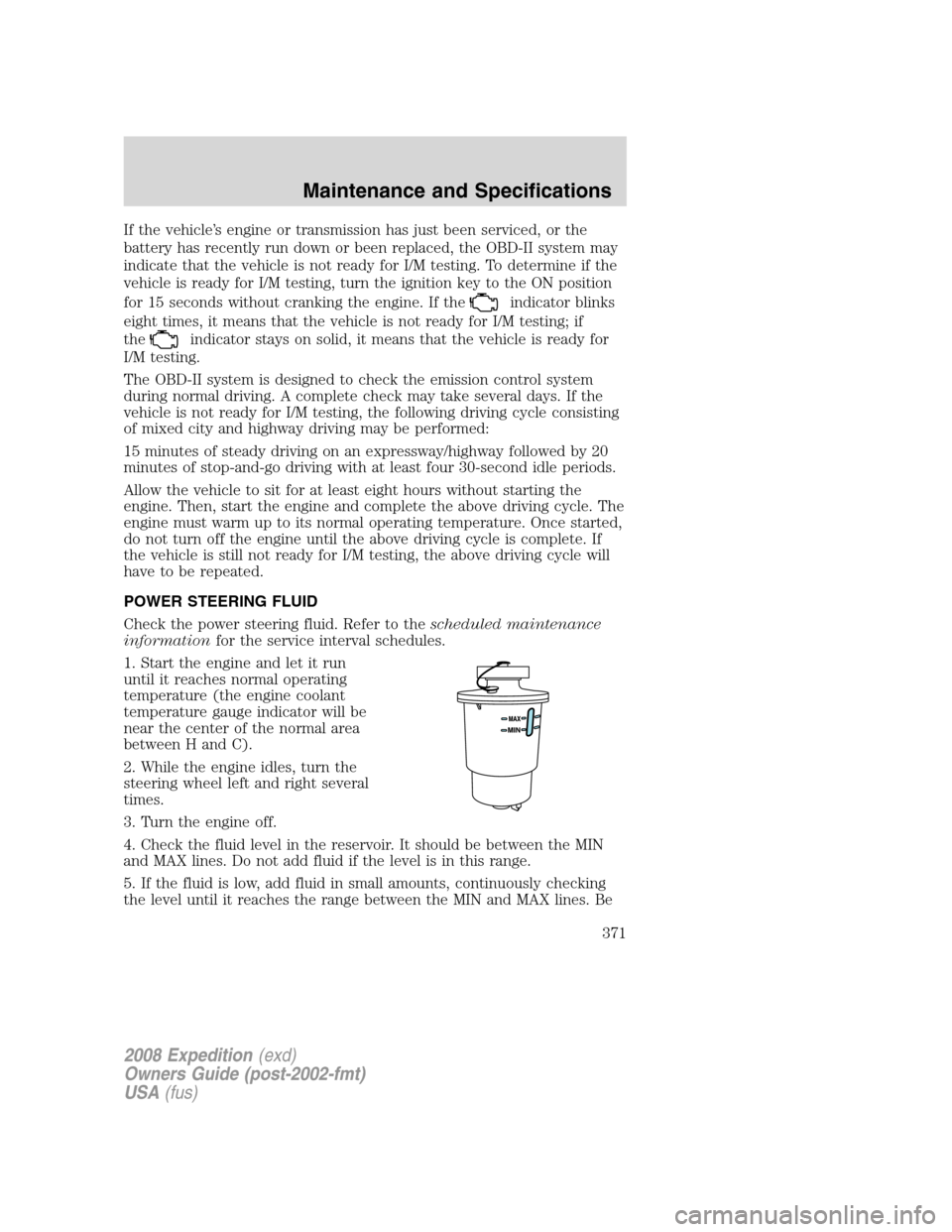
1. Start the engine and let it run
until it reaches normal operating
temperature (the engine coolant
temperature gauge indicator will be
near the center of the normal area
between H and C).
2. While the engine idles, turn the
steering wheel left and right several
times.
3. Turn the engine off.
4. Check the fluid level in the reservoir. It should be between the MIN
and MAX lines. Do not add fluid if the level is in this range.
5. If the fluid is low, add fluid in small amounts, continuously checking
the level until it reaches the range between the MIN and MAX lines. Be
2008 Expedition(exd)
Owners Guide (post-2002-fmt)
USA(fus)
Maintenance and Specifications
371
Page 385 of 392
in rear seat ......................217, 220
Child safety seats - booster
seats ...........................................213
Cleaning your vehicle
engine compartment ..............337
instrument panel ....................339
interior .....................................340
plastic parts ............................338
washing ....................................335
waxing .....................................336
wheels ......................................337
wiper blades ............................338
Clock adjust
6-CD in dash .............................33
AM/FM/CD .................................26
Compass, electronic ..................124
calibration ...............................125
set zone adjustment .......124, 134
Console ......................................102
overhead ..........................101–102
Controls
power seat ...............................174
steering column ......................115
Coolant
checking and adding ..............354
refill capacities ................358, 376
specifications ..........................376
Cruise control
(see Speed control) ..................112
Customer Assistance ................300
Ford Extended Service
Plan ..........................................332
Getting assistance outside the
U.S. and Canada .....................333
Getting roadside assistance ...300
Getting the service you
need .........................................328
Ordering additional owner’s
literature .................................334Utilizing the
Mediation/Arbitration
Program ...................................332
D
Daytime running lamps
(see Lamps) ................................88
Defrost
rear window ..............................86
Dipstick
automatic transmission
fluid ..........................................372
engine oil .................................349
Driving under special
conditions ..................285, 294, 297
sand .........................................296
snow and ice ...........................298
through water .................296, 299
DVD system .................................48
E
Electronic message
center .................................122, 132
Emergencies, roadside
jump-starting ..........................319
Emission control system ..........368
Engine ........................................379
cleaning ...................................337
coolant .....................................354
fail-safe cooling .......................358
idle speed control ...................352
lubrication specifications .......376
refill capacities ........................376
service points ..........................346
starting after a collision .........302
Engine block heater .................268
Engine oil ..................................349
2008 Expedition(exd)
Owners Guide (post-2002-fmt)
USA(fus)
Index
385
Page 389 of 392

Setting the clock
AM/FM single CD .....................26
AM/FM/In-dash 6 CD ................33
Snowplowing .................................8
Spark plugs,
specifications .....................375, 379
Special notice
utility-type vehicles ....................8
Specification chart,
lubricants ...................................376
Speed control ............................112
Stability system .........................273
Starting your vehicle ........265–267
jump starting ..........................319
Steering wheel
controls ....................................115
tilting .......................................100
T
Tilt steering wheel ....................100
Tire Pressure Monitoring
System (TPMS)
Driving .....................................296
Tires, Wheels and Loading ....245
Warning Displays ......12, 129, 141
Tires ...........................230–231, 310
alignment ................................238
care ..........................................234
changing ..........................310, 314
checking the pressure ............234
inflating ...................................232
label .........................................244
replacing ..................................236
rotating ....................................238
safety practices .......................237
sidewall information ...............239
snow tires and chains ............250
spare tire .................................311terminology .............................231
tire grades ...............................231
treadwear ........................230, 235
Towing .......................................256
recreational towing .................264
trailer towing ..........................256
wrecker ....................................326
Transmission .............................280
brake-shift interlock
(BSI) ................................280–281
fluid, checking and adding
(automatic) .............................372
fluid, refill capacities ..............376
lubricant specifications ..........376
Trunk .................................158–159
Turn signal ..................................90
V
Vehicle Identification Number
(VIN) ..........................................380
Vehicle loading ..........................250
Ventilating your vehicle ...........268
W
Warning lights (see Lights) .......12
Washer fluid ..............................347
Water, Driving through .............299
Windows
power .......................................105
rear wiper/washer ...................100
Windshield washer fluid and
wipers ..........................................99
checking and adding fluid .....347
liftgate reservoir .....................347
replacing wiper blades ...........348
Wrecker towing .........................326
2008 Expedition(exd)
Owners Guide (post-2002-fmt)
USA(fus)
Index
389