2008 FORD EDGE ECU
[x] Cancel search: ECUPage 148 of 336
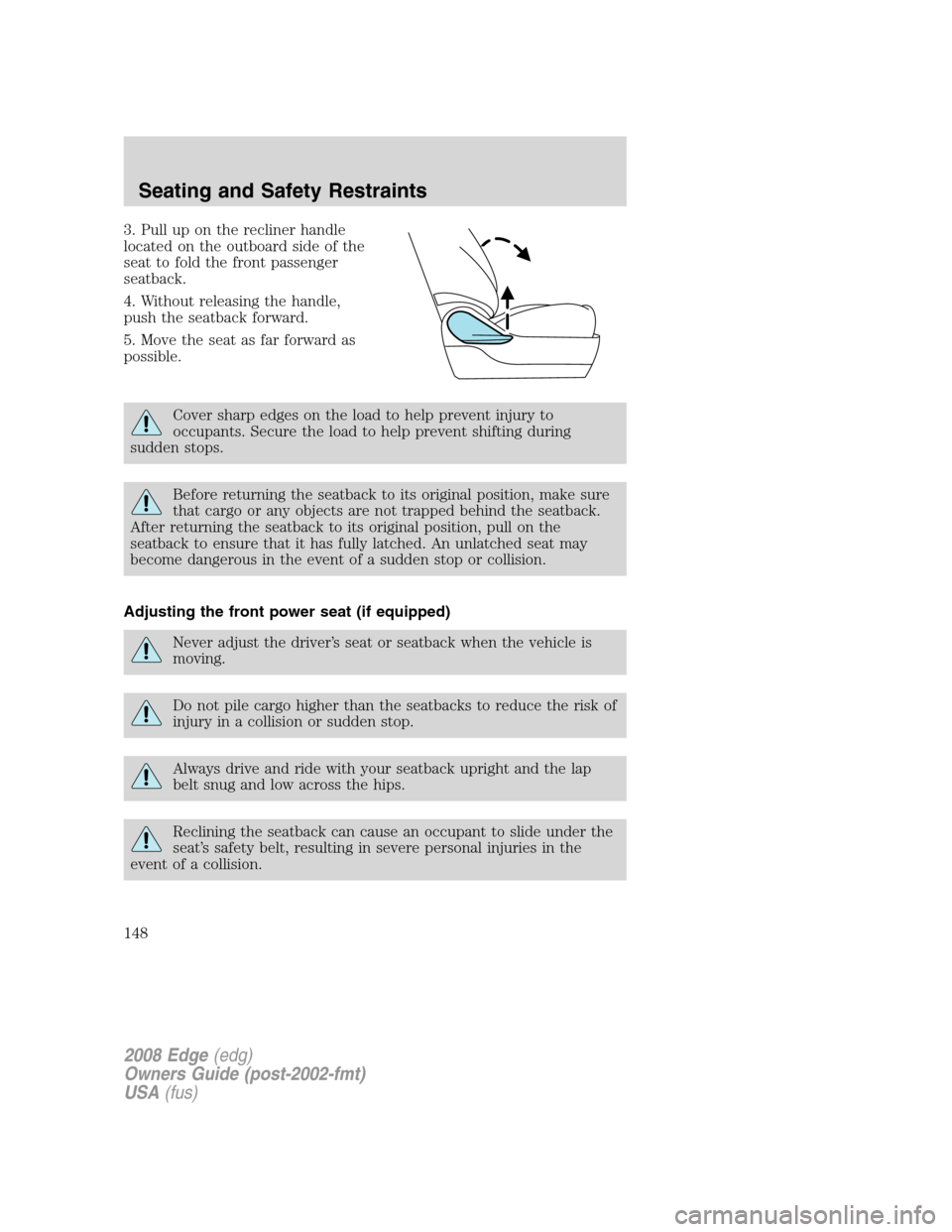
3. Pull up on the recliner handle
located on the outboard side of the
seat to fold the front passenger
seatback.
4. Without releasing the handle,
push the seatback forward.
5. Move the seat as far forward as
possible.
Cover sharp edges on the load to help prevent injury to
occupants. Secure the load to help prevent shifting during
sudden stops.
Before returning the seatback to its original position, make sure
that cargo or any objects are not trapped behind the seatback.
After returning the seatback to its original position, pull on the
seatback to ensure that it has fully latched. An unlatched seat may
become dangerous in the event of a sudden stop or collision.
Adjusting the front power seat (if equipped)
Never adjust the driver’s seat or seatback when the vehicle is
moving.
Do not pile cargo higher than the seatbacks to reduce the risk of
injury in a collision or sudden stop.
Always drive and ride with your seatback upright and the lap
belt snug and low across the hips.
Reclining the seatback can cause an occupant to slide under the
seat’s safety belt, resulting in severe personal injuries in the
event of a collision.
2008 Edge(edg)
Owners Guide (post-2002-fmt)
USA(fus)
Seating and Safety Restraints
148
Page 150 of 336

Memory seat and mirrors (if equipped)
This system allows automatic
positioning of the driver seat and
outside rearview mirrors, to two
programmable positions.
The memory seat control is located
on the driver door.
•To program position one, move
the driver seat and exterior
mirrors to the desired positions
using the associated controls.
Press the SET control. The SET control light will briefly illuminate.
While the light is illuminated, press control 1.
•To program position two, repeat the previous procedure using control
2.
A position can only be recalled when the transmission gearshift is in Park
(automatic transmission). A memory seat position may be programmed
at any time.
The memory seat positions are also recalled when you press your remote
entry transmitter UNLOCK control and the transmitter is programmed to
a memory seat position or when you enter a valid customer code 1 or 2
on the keypad.
To program the memory seat to remote entry transmitter, refer to
Remote entry systemin theLocks and Security chapter..
Note: The seat will not travel to its final position if the key is not
in the ignition and the easy entry feature is enabled.
Easy-entry/easy-exit feature (if equipped)
This feature automatically moves the driver’s seat rearward 2 inches
(5 cm) when:
•the transmission is in N (Neutral) or P (Park)
•the key is removed from the ignition cylinder
The seat will move forward (to the original position) when:
•the transmission is in N (Neutral) or P (Park)
•the key is placed in the ignition cylinder
2008 Edge(edg)
Owners Guide (post-2002-fmt)
USA(fus)
Seating and Safety Restraints
150
Page 160 of 336
Each seating position in your vehicle has a specific safety belt
assembly which is made up of one buckle and one tongue that
are designed to be used as a pair. 1) Use the shoulder belt on the
outside shoulder only. Never wear the shoulder belt under the arm. 2)
Never swing the safety belt around your neck over the inside shoulder.
3) Never use a single belt for more than one person.
Always transport children 12 years old and under in the back
seat and always properly use appropriate child restraints.
Combination lap and shoulder belts
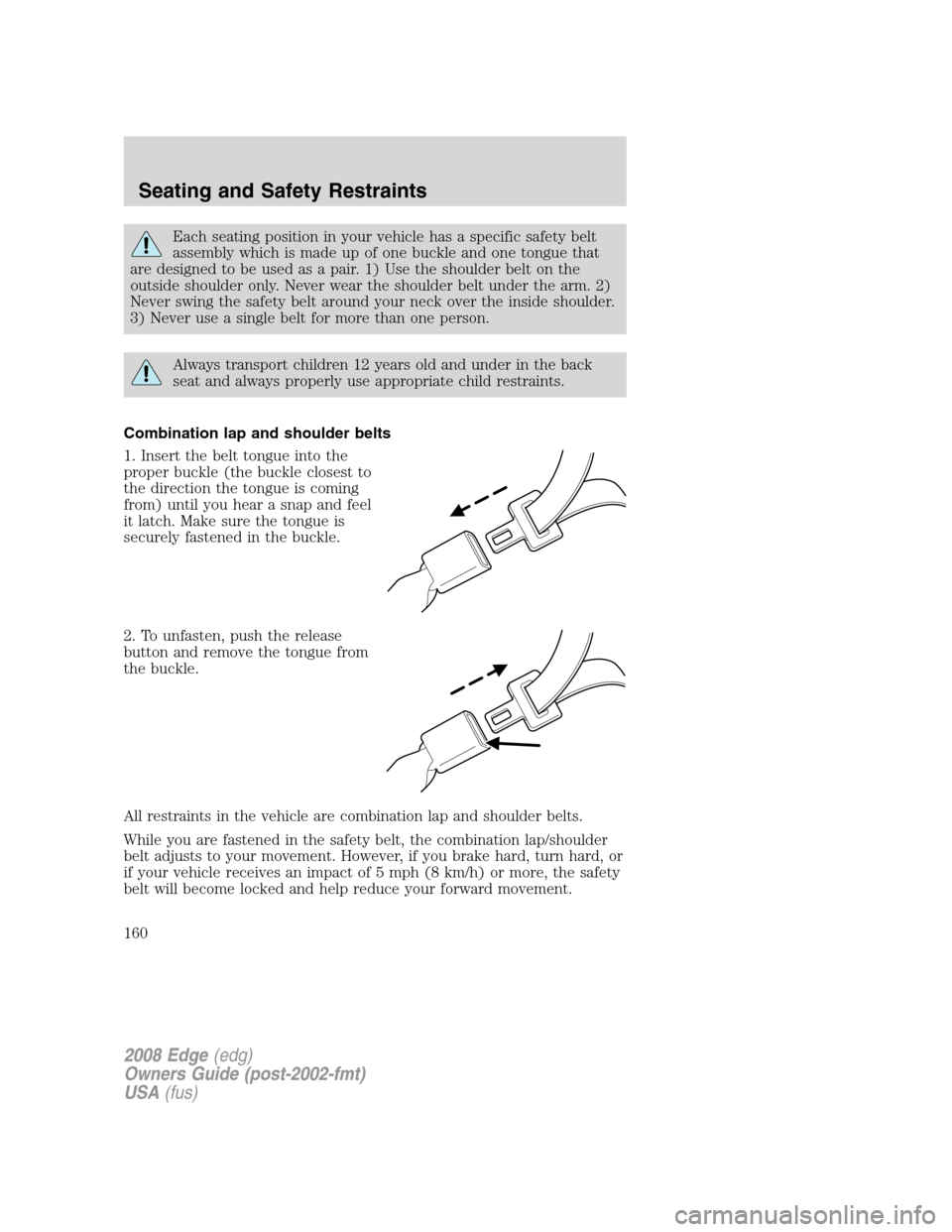
1. Insert the belt tongue into the
proper buckle (the buckle closest to
the direction the tongue is coming
from) until you hear a snap and feel
it latch. Make sure the tongue is
securely fastened in the buckle.
2. To unfasten, push the release
button and remove the tongue from
the buckle.
All restraints in the vehicle are combination lap and shoulder belts.
While you are fastened in the safety belt, the combination lap/shoulder
belt adjusts to your movement. However, if you brake hard, turn hard, or
if your vehicle receives an impact of 5 mph (8 km/h) or more, the safety
belt will become locked and help reduce your forward movement.
2008 Edge(edg)
Owners Guide (post-2002-fmt)
USA(fus)
Seating and Safety Restraints
160
Page 179 of 336

In case there is a problem with the
front passenger sensing system, the
airbag readiness light in the
instrument cluster will stay lit.
If the airbag readiness light is lit, do the following:
The driver and/or adult passengers should check for any objects that
may be lodged underneath the front passenger seat or cargo interfering
with the seat.
If objects are lodged and/or cargo is interfering with the seat; please take
the following steps to remove the obstruction:
•Pull the vehicle over.
•Turn the vehicle off.
•Driver and/or adult passengers should check for any objects lodged
underneath the front passenger seat or cargo interfering with the seat.
•Remove the obstruction(s) (if found).
•Restart the vehicle.
•Wait at least 2 minutes and verify that the airbag readiness light is no
longer illuminated
•If the airbag readiness light remains illuminated, this may or may/not
be a problem due to the front passenger sensing system.
DO NOT attempt to repair or service the system; take your vehicle
immediately to an authorized dealer.
If it is necessary to modify an advanced front airbag system to
accommodate a person with disabilities, contact the Ford Customer
Relationship Center at the phone number shown in theCustomer
Assistancesection of thisOwner’s Guide.
Any alteration/modification to the front passenger seat may
affect the performance of the front passenger sensing system.
Determining if the system is operational
The supplemental restraint system uses a warning indicator light in the
instrument cluster or a back-up tone to indicate the condition of the
system. Refer to theWarning lights and chimessection in the
Instrument Clusterchapter. Routine maintenance of the airbag is not
required.
2008 Edge(edg)
Owners Guide (post-2002-fmt)
USA(fus)
Seating and Safety Restraints
179
Page 190 of 336

SAFETY SEATS FOR CHILDREN
Child and infant or child safety seats
Use a safety seat that is recommended for the size and weight of the
child. Carefully follow all of the manufacturer’s instructions with the
safety seat you put in your vehicle. If you do not install and use the
safety seat properly, the child may be injured in a sudden stop or
collision.
When installing a child safety seat:
•Review and follow the information
presented in theAirbag
Supplemental Restraint System
section in this chapter.
•Use the correct safety belt buckle
for that seating position.
•Insert the belt tongue into the
proper buckle until you hear a
snap and feel it latch. Make sure
the tongue is securely fastened in
the buckle.
•Keep the buckle release button pointing up and away from the safety
seat, with the tongue between the child seat and the release button,
to prevent accidental unbuckling.
•Place seat back in upright position.
•Put the safety belt in the automatic locking mode. Refer toAutomatic
locking mode.
•LATCH lower anchors are recommended for use by children up to
48 lb (22 kg) in a child restraint. Top tether anchors can be used for
children up to 60 lb (27 kg) in a child restraint, and to provide upper
torso restraint for children up to 80 lb (36 kg) using an upper torso
harness and a belt-positioning booster.
Ford Motor Company recommends the use of a child safety seat having a
top tether strap. Install the child safety seat in a seating position with
LATCH and tether anchors. For more information on top tether straps
and anchors, refer toAttaching safety seats with tether strapsin this
chapter. For more information of LATCH anchors refer toAttaching
safety seats with LATCH (Lower Anchors and Tethers for Children)
attachmentsin this chapter.
2008 Edge(edg)
Owners Guide (post-2002-fmt)
USA(fus)
Seating and Safety Restraints
190
Page 192 of 336
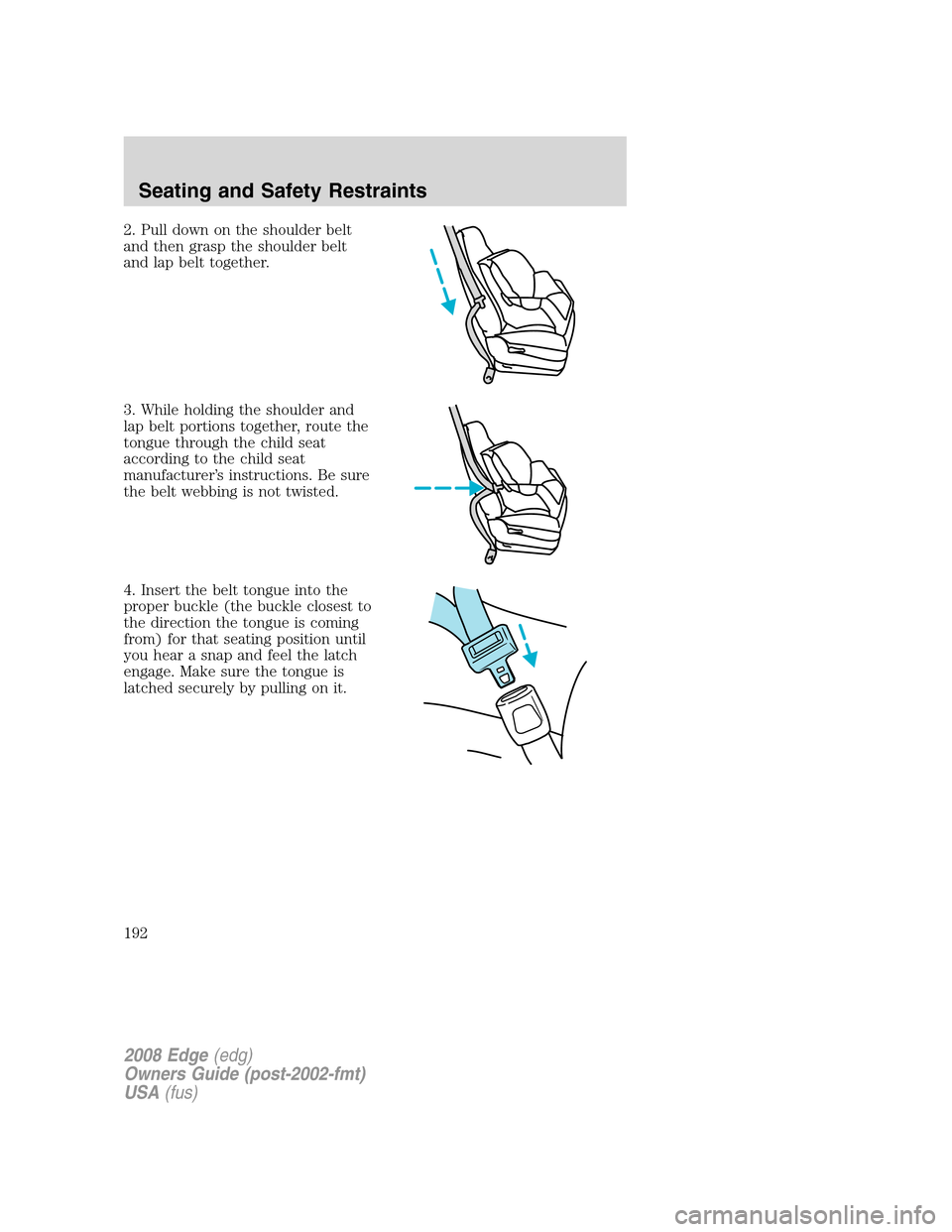
2. Pull down on the shoulder belt
and then grasp the shoulder belt
and lap belt together.
3. While holding the shoulder and
lap belt portions together, route the
tongue through the child seat
according to the child seat
manufacturer’s instructions. Be sure
the belt webbing is not twisted.
4. Insert the belt tongue into the
proper buckle (the buckle closest to
the direction the tongue is coming
from) for that seating position until
you hear a snap and feel the latch
engage. Make sure the tongue is
latched securely by pulling on it.
2008 Edge(edg)
Owners Guide (post-2002-fmt)
USA(fus)
Seating and Safety Restraints
192
Page 193 of 336

5. To put the retractor in the
automatic locking mode, grasp the
shoulder portion of the belt and pull
downward until all of the belt is
pulled out and a click is heard.
6. Allow the belt to retract. The belt will click as it retracts to indicate it
is in the automatic locking mode.
7. Pull the lap belt portion across
the child seat toward the buckle and
pull up on the shoulder belt while
pushing down with your knee on the
child seat.
8. Allow the safety belt to retract to
remove any slack in the belt.
9. Before placing the child in the
seat, forcibly move the seat forward
and back to make sure the seat is
securely held in place. To check
this, grab the seat at the belt path
and attempt to move it side to side
and forward. There should be no
more than one inch of movement for
proper installation.
10. Try to pull the belt out of the retractor to make sure the retractor is
in the automatic locking mode (you should not be able to pull more belt
out). If the retractor is not locked, unbuckle the belt and repeat Steps 2
through 9.
Check to make sure the child seat is properly secured before each use.
2008 Edge(edg)
Owners Guide (post-2002-fmt)
USA(fus)
Seating and Safety Restraints
193
Page 217 of 336

When your temporary spare tire is installed
When one of your road tires needs to be replaced with the temporary spare,
the TPMS system will continue to identify an issue to remind you that the
damaged road wheel/tire needs to be repaired and put back on your vehicle.
To restore the full functionality of the Tire Pressure Monitoring System,
have the damaged road wheel/tire repaired and remounted on your
vehicle. For additional information, refer toChanging tires with TPMS
in this section.
When you believe your system is not operating properly
The main function of the Tire Pressure Monitoring System is to warn you
when your tires need air. It can also warn you in the event the system is no
longer capable of functioning as intended. Please refer to the following
chart for information concerning your Tire Pressure Monitoring System:
Low Tire
Pressure
Warning LightPossible
causeCustomer Action Required
Solid Warning
LightTire(s)
under-inflated1. Check your tire pressure to ensure
tires are properly inflated; refer to
Inflating your tiresin this chapter.
2. After inflating your tires to the
manufacturer’s recommended
inflation pressure as shown on the
Tire Label (located on the edge of
driver’s door or the B-Pillar), the
vehicle must be driven for at least
two minutes over 20 mph (32 km/h)
before the light will turn OFF.
Spare tire in
useYour temporary spare tire is in use.
Repair the damaged road wheel/tire
and reinstall it on the vehicle to
restore system functionality. For a
description on how the system
functions, refer toWhen your
temporary spare tire is installedin
this section.
TPMS
malfunctionIf your tires are properly inflated and
your spare tire is not in use and the
light remains ON, have the system
inspected by your authorized dealer.
2008 Edge(edg)
Owners Guide (post-2002-fmt)
USA(fus)
Tires, Wheels and Loading
217