2008 FORD C MAX tyre pressure
[x] Cancel search: tyre pressurePage 224 of 278

Downloaded from www.Manualslib.com manuals search engine 17.Immediately drive approximatelythree kilometres (two miles) sothat the sealant can seal thedamaged area.
Note:When pumping in the sealantthrough the tyre valve, the pressuremay rise up to 6 bar (87 psi) but willdrop again after about 30 seconds.
WARNING
If you experience heavyvibrations, unsteady steeringbehaviour or noises while driving,reduce your speed and drive withcaution to a place where it is safe foryou to stop the vehicle. Recheck thetyre and its pressure. If the tyrepressure is less than 1.3 bar (19 psi)or if there are any cracks, bumps orsimilar damage visible, do notcontinue driving with this tyre.
Checking the tyre pressure
1.Stop the vehicle after drivingapproximately three kilometres(two miles). Check, and wherenecessary, adjust the pressure ofthe damaged tyre.
2.Attach the kit and read the tyrepressure from the pressure gaugeF.
3.If the pressure of the sealant-filledtyre is 1.3 bar (19 psi) or more,adjust it to the specified pressure.See Technical specifications(page 224).
4.Follow the inflation procedureonce again to top up the tyre.
5.Check the tyre pressure againfrom the pressure gauge F. If thetyre pressure is too high, deflatethe tyre to the specified pressureusing the pressure relief valve B.
6.Once you have inflated the tyre toits correct tyre pressure, movethe compressor switch H toposition 0, remove the powerplug G from the socket, unscrewthe hose C, fasten the valve capand replace the protective cap A.
7.Leave the sealant bottle K in thebottle holder E and store the kitaway safely in its original location.
8.Drive to the nearest tyre specialistto get the damaged tyre replaced.Before the tyre is removed fromthe rim, inform your tyre dealerthat the tyre contains sealant.Renew the kit as soon as possibleafter it has been used once.
Note:Remember that emergencyroadside tyre repair kits only providetemporary mobility. Regulationsconcerning tyre repair after usage oftyre repair kit may differ from countryto country. You should consult a tyrespecialist for advice.
WARNING
Before driving, make sure thetyre is adjusted to therecommended inflation pressure.See Technical specifications(page 224). Monitor the tyre pressureuntil the sealed tyre is replaced.
222
Wheels and tyres
Page 225 of 278
Downloaded from www.Manualslib.com manuals search engine Empty sealant bottles can bedisposed of together with normalhousehold waste. Return remains ofsealant to your dealer or dispose ofit in compliance with local wastedisposal regulations.
TYRE CARE
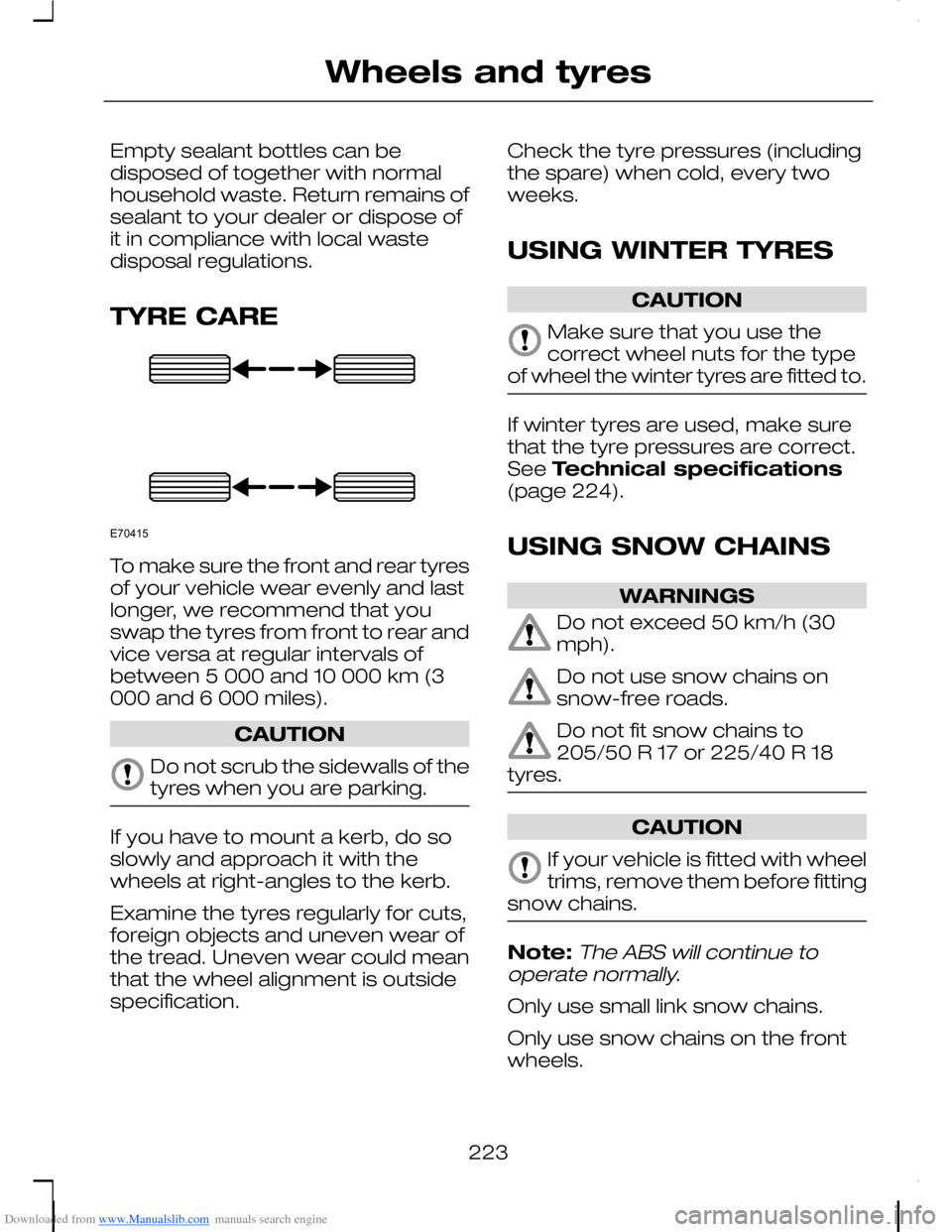
To make sure the front and rear tyresof your vehicle wear evenly and lastlonger, we recommend that youswap the tyres from front to rear andvice versa at regular intervals ofbetween 5 000 and 10 000 km (3000 and 6 000 miles).
CAUTION
Do not scrub the sidewalls of thetyres when you are parking.
If you have to mount a kerb, do soslowly and approach it with thewheels at right-angles to the kerb.
Examine the tyres regularly for cuts,foreign objects and uneven wear ofthe tread. Uneven wear could meanthat the wheel alignment is outsidespecification.
Check the tyre pressures (includingthe spare) when cold, every twoweeks.
USING WINTER TYRES
CAUTION
Make sure that you use thecorrect wheel nuts for the typeof wheel the winter tyres are fitted to.
If winter tyres are used, make surethat the tyre pressures are correct.See Technical specifications(page 224).
USING SNOW CHAINS
WARNINGS
Do not exceed 50 km/h (30mph).
Do not use snow chains onsnow-free roads.
Do not fit snow chains to205/50 R 17 or 225/40 R 18tyres.
CAUTION
If your vehicle is fitted with wheeltrims, remove them before fittingsnow chains.
Note:The ABS will continue tooperate normally.
Only use small link snow chains.
Only use snow chains on the frontwheels.
223
Wheels and tyresE70415
Page 226 of 278

Downloaded from www.Manualslib.com manuals search engine Vehicles with stabilitycontrol (ESP)
Vehicles with stability control (ESP)may exhibit some unusual drivingcharacteristics which can be avoidedby switching the system off. SeeStability control (page 160).
TECHNICAL SPECIFICATIONS
Wheel nut torque
130 NmSteel wheel nuts
130 NmFive spoke steel wheel nuts
130 NmAlloy wheel nuts
Up to 160 km/h (100 mph)
Tyre pressures
Full loadNormal load
Tyre sizeVariantRearFrontRearFront
bar(lbf/in²)bar(lbf/in²)bar(lbf/in²)bar(lbf/in²)
4.24.24.24.2T125/85 R162
All - temporaryspare tyre - 80km/h (50 mph)MAX
2.82.42.32.1195/65 R 15All
2.82.42.32.3225/40 R 18All
2.82.42.32.1205/55 R 16Vehicles with apetrol engine
2.82.42.32.1205/50 R 17Vehicles with apetrol engine
2.82.42.32.3205/55 R 16Vehicles with adiesel engine
224
Wheels and tyres
Page 227 of 278

Downloaded from www.Manualslib.com manuals search engine Full loadNormal load
Tyre sizeVariantRearFrontRearFront
bar(lbf/in²)bar(lbf/in²)bar(lbf/in²)bar(lbf/in²)
2.82.42.32.3205/50 R 17Vehicles with adiesel engine
Continuous speed in excess of 160 km/h (100 mph)
Tyre pressures
Full loadNormal load
Tyre sizeVariantRearFrontRearFront
bar(lbf/in²)bar(lbf/in²)bar(lbf/in²)bar(lbf/in²)
3.02.62.32.3195/65 R 15All
3.02.62.32.5225/40 R 18All
3.02.62.32.3205/55 R 16Vehicles with apetrol engine
3.02.62.32.3205/50 R 17Vehicles with apetrol engine
3.02.62.32.5205/55 R 16Vehicles with adiesel engine
3.02.62.32.5205/50 R 17Vehicles with adiesel engine
225
Wheels and tyres
Page 274 of 278

Downloaded from www.Manualslib.com manuals search engine Telephone controls......................234Ending or rejecting calls...................234Remote control.................................234
Telephone setup...........................231Bond another Bluetooth phone......233Making a phone an active phone....232Phonebook........................................232Phonebook categories....................232Placing your phone in the cradle.....231Requirements for cradleconnection......................................231
Telephone.......................................231General information...........................231
TelephoneSee: Using the telephone.......................See: Using the telephone.......................
Toll reader.......................................139Towing a trailer...............................169Steep gradients..................................169
Towing points.................................185Front towing eye................................185Rear towing eye.................................186
Towing the vehicle on fourwheels...........................................186All vehicles...........................................186Vehicles with automatictransmission....................................187
Towing.............................................169Transmission..................................154Type approvals..............................255Alarm....................................................261Engine immobiliser............................259Passive key........................................259Remote control.................................255
Tyre care........................................223Tyre repair kit..................................217Checking the tyre pressure.............222General information...........................217Inflating the tyre..................................218Using the tyre repair kit.....................218
TyresSee: Wheels and tyres.......................211
U
Using booster cables...................209To connect the booster cables......209To start the engine.............................210
Using cruise control......................164Cancelling the set speed..................165Changing the set speed...................164Resuming the set speed..................165Setting a speed..................................164Switching cruise control off..............165Switching cruise control on..............164
Using seat belts duringpregnancy......................................33Using snow chains.......................223Vehicles with stability control(ESP)................................................224
Using stability control.....................161Using the parking aid....................162Manoeuvring with the parkingaid.....................................................163Switching the parking aid on andoff......................................................162
Using the telephone............................Changing the active phone.............240Debonding a bonded phone...........240Handling an incoming call................239Handling a second incoming call.....239Making a call......................................238
Using voice control.......................242System operation..............................242
Using winter tyres.........................223
V
Vehicle battery..............................209Vehicle care...................................207Vehicle identification number(VIN)..............................................226Vehicle identification plate...........226Vehicle identification.....................226Vehicle recovery............................185
272
Index
Page 275 of 278

Downloaded from www.Manualslib.com manuals search engine VentilationSee: Climate control..........................107
VentsSee: Air vents......................................107
VINSee: Vehicle identification number(VIN).................................................226
Voice control............................57, 241Principle of operation........................241
W
Warning lamps and indicators......90ABS warning lamp...............................90Airbag warning lamp...........................90Brake system and ABS warninglamps..................................................91Brake system warning lamp..............90Cruise control indicator.......................91Direction indicator................................91Doors open warning lamp..................91Engine systems fault warninglamp....................................................91Engine warning lamp...........................91Front fog lamp indicator......................91Frost warning lamp..............................92Glow plug indicator.............................92Headlamp indicator.............................92Ignition warning lamp..........................92Low fuel level warning lamp...............92Main beam indicator...........................92Maximum engine RPM warninglamp...................................................92Message indicator...............................92Oil pressure warning lamp.................93Power steering warning lamp...........93Rear fog lamp indicator......................93Seat belt reminder...............................93Stability control (ESP) indicator..........93
Warning triangle.............................174Washer fluid check.......................203Washers
See: Wipers and washers..................59
WashingSee: Cleaning the exterior...............207
Wheels and tyres...........................211General information............................211Technical specifications...................224
Windows and mirrors.....................84Windscreen washers......................61Windscreen wipers.........................59Automatic wiper system.....................61Autowipers...........................................59Intermittent wipe..................................59
Winter tyresSee: Using winter tyres....................223
Wipers and washers.......................59
273
Index