2008 FIAT CROMA time
[x] Cancel search: timePage 105 of 258

104
SAFETY
DEVICES
CORRECT USE
OF THE CAR
WARNING
LIGHTS AND
MESSAGES
IN AN
EMERGENCY
CAR
MAINTENANCE
TECHNICAL
SPECIFICATIONS
INDEX
DASHBOARD
AND CONTROLS
DIESEL ENGINES
If the outside temperature is very low, the
diesel thickens due to the formation of
paraffins and could clog the diesel fuel fil-
ter.
In order to avoid these problems, differ-
ent types of diesel are distributed ac-
cording to the season: summer type, win-
ter type arctic type (mountains/cold ar-
eas).
If refuelling with diesel fuel not suitable for
the current temperature, mix diesel fuel
with TUTELA DIESEL ART additive in the
proportions stated on the can, putting first
the antifreeze in the tank and then the
diesel fuel.
Refuel with local diesel fuel if the car is
used/parked in the mountains or in cold
areas for a long period. In this event you
are recommended to keep an amount of
fuel higher than 50% in the tank.The car must only be filled
with diesel fuel for motor ve-
hicles, in compliance with Eu-
ropean Standard EN590. The
use of other products or mixtures may
irreparably damage the engine with in-
validation of the warranty due to the
damage caused. In the event of acci-
dentally filling with another type of fu-
el, do not start the engine and empty
the tank. If the engine has been run
even for only a very short time, in ad-
dition to the tank, it is also necessary
to drain out the whole fuel circuit.
REFUELLING
To guarantee full tank filling, carry out two
refuelling operations after the first click of
the fuel delivery gun. Avoid further top-
ping up operations that could cause dam-
ages to the fuel system.
AT THE FILLING
STATION
PETROL ENGINES
Use only unleaded petrol.
To prevent errors, the diameter of the fu-
el tank filler is too small to introduce a lead
petrol pump filler. Use petrol with a rat-
ed octane number (R.O.N.) not lower
than 95.
IMPORTANT An inefficient catalyst leads
to harmful exhaust emissions, thus con-
tributing to air pollution.
IMPORTANT Never use leaded petrol,
even in small amount or in an emergency,
as this would damage the catalyst beyond
repair.
070-106 Croma TRW GB 29-05-2008 8:57 Pagina 104
Page 107 of 258

106
SAFETY
DEVICES
CORRECT USE
OF THE CAR
WARNING
LIGHTS AND
MESSAGES
IN AN
EMERGENCY
CAR
MAINTENANCE
TECHNICAL
SPECIFICATIONS
INDEX
DASHBOARD
AND CONTROLS
DIESEL PARTICULATE FILTER
(DPF)
The Diesel Particulate Filter is a mechan-
ical filter, integral with the exhaust system,
that physically traps particulates present
in the exhaust gases of Diesel engines.
The diesel particular filter has been adopt-
ed to eliminate almost totally particulates
in compliance with current / future law
regulations.
During normal use of the car, the engine
control unit records a set of data (e.g.:
travel time, type of route, temperatures,
etc.) and it will then calculate how much
particulates has been trapped by the filter.
Since this filter physically traps particulates,
it shall be cleaned (reclaimed) at regular
intervals by burning carbon particles.
Reclaiming procedure is controlled auto-
matically by the engine control unit ac-
cording to the filter conditions and the
conditions of use of the car.During reclaiming the following phenom-
ena could take place: idling slight increase,
fan activation, slight smoke increase, high
exhaust temperatures. These situations
shall not be considered as faults and they
do not affect car performance and envi-
ronment.
If the dedicated message is displayed, re-
fer to section “Warning lights and mes-
sages”.
During normal service the
diesel particulate filter (DPF)
reaches high temperatures. Do not
therefore park the car over inflam-
mable materials (grass, dry leaves,
pine needles, etc.): fire hazard.
WARNING
During normal service the
catalyst reaches high tem-
peratures. Do not therefore park the
car over inflammable materials (grass,
dry leaves, pine needles, etc.): fire
hazard.
WARNING
070-106 Croma TRW GB 29-05-2008 8:57 Pagina 106
Page 109 of 258

108
CORRECT USE
OF THE CAR
WARNING
LIGHTS AND
MESSAGES
IN AN
EMERGENCY
CAR
MAINTENANCE
TECHNICAL
SPECIFICATIONS
INDEX
DASHBOARD
AND CONTROLS
SAFETY
DEVICES
SEAT BELTS
USING THE SEAT BELTS
The belt should be worn keeping the chest
straight and rested against the seat back.
To fasten the seat belts, take hold the
tongue A-fig. 1and insert it into the buck-
le B-fig. 1, until hearing the locking click.
At removal, if it jams, let it rewind for a
short stretch, then pull it out again with-
out jerking.
To unfasten the seat belts, press button
C-fig. 1. Guide the seat belt with your
hand while it is rewinding, to prevent it
from twisting.
Through the reel, the belt automatically
adapts to the body of the passenger wear-
ing it, allowing freedom of movement.When the car is parked on a steep slope
the reel mechanism may block; this is nor-
mal. The reel mechanism prevents the
webbing coming out when it is jerked or
if the car brakes sharply, in a collision or
when cornering at high speed.
The rear seat is fitted with inertial seat belts
with three anchor points and reel fig. 2.Rear seat belts shall be worn as shown in
the figure.
IMPORTANT When using side and cen-
tral seat belts at the same time, fasten first
the side seat belt and then the central one.
fig. 1F0L0119mfig. 2F0L0120m
Never press button C when
travelling.
WARNING
107-126 Croma TRW GB 28-05-2008 16:32 Pagina 108
Page 111 of 258

110
CORRECT USE
OF THE CAR
WARNING
LIGHTS AND
MESSAGES
IN AN
EMERGENCY
CAR
MAINTENANCE
TECHNICAL
SPECIFICATIONS
INDEX
DASHBOARD
AND CONTROLS
SAFETY
DEVICES
PRETENSIONERS
To increase the efficiency of the seat belts,
the car is fitted with front and rear pre-
tensioners (where provided). These de-
vices, in the event of a violent crash,
rewind the seat belts a few centimetres.
In this way they ensure that the seat belt
adheres perfectly to the wearer before the
restraining action begins.
Front pretensioners activation is indicat-
ed by buckle withdrawal downwards.
Rear pretensioners (where provided) ac-
tivation is indicated by seat belt retractor
locking; the seat belt cannot be drawn
back up when guiding it manually.
IMPORTANT To obtain the highest de-
gree of protection from the action of the
pretensioning device, wear the seat belt
keeping it firmly close to the chest and
pelvis.
Pretensioner activation may produce a
small amount of smoke. This smoke is in
no way toxic and presents no fire hazard.The pretensioner does not require any
maintenance or greasing.
Anything that modifies its original condi-
tions invalidates its efficiency.
If due to unusual natural events (floods,
seas storm, etc.) the device has been af-
fected by water and mud, it must neces-
sarily be replaced.
LOAD LIMITERS
To increase passenger’s safety, the front
and rear (where provided) seat belt reels
contain a load limiter which allows con-
trolled sag in such a way as to dose the
force acting on the chest and shoulders
during the belt restraining action in case
of front crash.The pretensioner can only
be used once. After a colli-
sion that has triggered it, have it re-
placed at a Fiat Dealership. Preten-
sioner validity is written on the label
set on the door contour sheet metal.
Pretensioners should be replaced at
Fiat Dealership as this date ap-
proaches.
WARNING
Operations which lead to
knocks, vibrations or localised
heating (over 100°C for a
maximum of 6 hours) in the
area around the pretensioners may
cause damage or trigger them. These
devices are not affected by vibrations
caused by irregularities of the road sur-
face or low obstacles such as kerbs, etc.
Contact a Fiat Dealership for any as-
sistance.
107-126 Croma TRW GB 28-05-2008 16:32 Pagina 110
Page 112 of 258

111
CORRECT USE
OF THE CAR
WARNING
LIGHTS AND
MESSAGES
IN AN
EMERGENCY
CAR
MAINTENANCE
TECHNICAL
SPECIFICATIONS
IINDEX
DASHBOARD
AND CONTROLS
SAFETY
DEVICES
GENERAL INSTRUCTIONS FOR
USING THE SEAT BELTS
The driver must comply with (and have
the car occupants follow) all the local le-
gal regulations concerning the use of seat
belts. Always fasten the seat belts before
starting.
Seat belts are also to be worn by expec-
tant mothers: the risk of injury in the case
of accident is greatly reduced for them and
the unborn child if they are wearing a seat
belt.
Of course they must position the lower
part of the belt very low down so that it
passes under the abdomen (as illustrated
in fig. 4).
fig. 4F0L0060mfig. 5F0L0061mfig. 6F0L0062m
The belt should not be twist-
ed. The upper part should
pass over the shoulder and cross the
chest diagonally. The lower part
should adhere to the pelvis and not
the abdomen of the passenger. Do
not use any objects (pegs, stoppers,
etc.) to keep the belts away from the
body.
WARNING
For maximum safety, keep
the back of your seat up-
right, lean back into it and make sure
the seat belt fits closely across your
chest and hips. Make sure that the
seat belts of the front and rear pas-
sengers are fastened at all times! You
increase the risk of serious injury or
death in a collision if you travel with
the belts unfastened.
WARNING
Under no circumstances
should the components of
the seat belts and pretensioners be
tampered with or removed. Any op-
eration should be carried out by qual-
ified and authorised personnel. Al-
ways contact a Fiat Dealership.
WARNING
107-126 Croma TRW GB 28-05-2008 16:32 Pagina 111
Page 113 of 258

112
CORRECT USE
OF THE CAR
WARNING
LIGHTS AND
MESSAGES
IN AN
EMERGENCY
CAR
MAINTENANCE
TECHNICAL
SPECIFICATIONS
INDEX
DASHBOARD
AND CONTROLS
SAFETY
DEVICES
HOW TO KEEP THE SEAT
BELTS ALWAYS IN EFFICIENT
CONDITIONS
❒Always use the belt with the tape taut
and never twisted; make sure that it is
free to run without impediments.
❒After a serious accident, replace the
belt being worn at that time, even if
it does not appear damaged. Always
replace the seat belts if pretensioners
have been activated.
❒To clean the belts, wash by hand with
neutral soap, rinse and leave to dry in
the shade. Never use strong deter-
gents, bleach or dyes or other chem-
ical substance that might weaken the
fibres.
❒Prevent the reels from getting wet:
their correct operation is only guar-
anteed if water does not get inside.
❒Replace the seat belt when showing
significant wear or cut signs.
CARRYING CHILDREN
SAFELY
For optimal protection in the event of a
crash, all passengers must be seated and
wearing adequate restraint systems.
This is even more important for children.
This prescription is compulsory in all EC
countries according to EC Directive
2003/20/EC.
Compared with adults, their head is pro-
portionally larger and heavier than the rest
of the body, while the muscles and bone
structure are not completely developed.
Therefore, correct restraint systems are
necessary, other than adult seat belts. The
results of research on the best child re-
straint systems are contained in the Euro-
pean Standard EEC-R44. This Standard en-
forces the use of restraint systems classi-
fied in five groups:
Group 0 - 0-10 kg in weight
Group 0+ - 0-13 kg in weight
Group 1 9-18 kg in weight
Group 2 15-25 kg in weight
Group 3 22-36 kg in weight
If the belt has been subject-
ed to heavy stress, for ex-
ample after and accident, it should be
changed completely together with
the anchors, anchor fastening screws
and the pretensioners. In fact, even if
the belt has no visible defects, it could
have lost its resilience.
WARNING
Never travel with a child sit-
ting on the passenger’s lap
with a single belt to protect them
both. Do not fasten other objects to
the body.
WARNING
107-126 Croma TRW GB 28-05-2008 16:32 Pagina 112
Page 118 of 258

117
CORRECT USE
OF THE CAR
WARNING
LIGHTS AND
MESSAGES
IN AN
EMERGENCY
CAR
MAINTENANCE
TECHNICAL
SPECIFICATIONS
IINDEX
DASHBOARD
AND CONTROLS
SAFETY
DEVICES
PRESETTING FOR
MOUNTING THE
“UNIVERSAL ISOFIX”
CHILD RESTRAINT
SYSTEM
This car is preset for mounting the Uni-
versal Isofix child restraint system, a new
European standardised system for carry-
ing children safely.
Fig. 11shows a child restraint system by
way of example.
The Universal Isofix child’s seat covers
weight group: 1.
Due to its different anchoring system, the
Universal Isofix child’s seat shall be an-
chored to the proper lower metal rings
A-fig. 12, set between rear seat back and
cushion. The upper belt (provided with
the child’s seat) shall be then secured to
ring B-fig. 13set on rear seat backrest.
It is possible to mount at the same time
both the traditional restraint system and
the “Universal Isofix” one.
Remember that in case of Universal Isofix
child’s seat, you can only use all those
seats approved with the marking ECE
R44/03 “Universal Isofix”.
At Lineaccessori Fiat is available the “Uni-
versal Isofix” “Duo Plus” child’s seat.For any further installation/use detail, re-
fer to the “Instructions Manual” that must
be provided by the child restraint system
Manufacturer.
fig. 11F0L0318m
fig. 12F0L0121m
Mount the child restraint
system only with the car sta-
tionary. The Isofix child restraint sys-
tem is properly anchored to the
mounting brackets when clicks are
heard. In any case, keep to the in-
stallation instructions that must be
provided by the child restraint system
Manufacturer.
WARNING
fig. 13F0L0122m
107-126 Croma TRW GB 28-05-2008 16:32 Pagina 117
Page 134 of 258
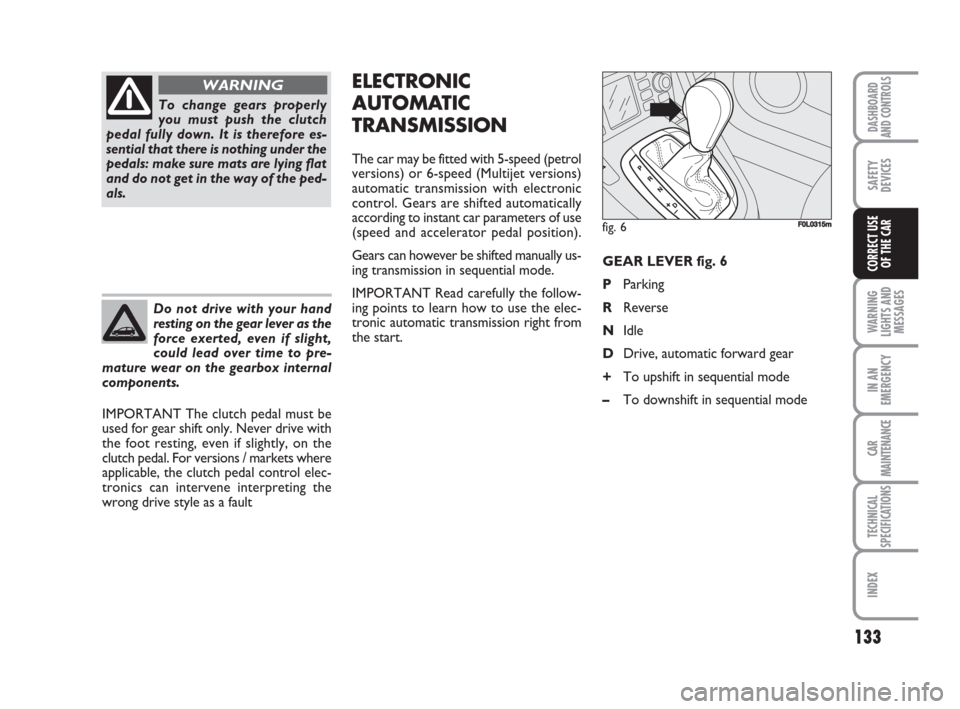
ELECTRONIC
AUTOMATIC
TRANSMISSION
The car may be fitted with 5-speed (petrol
versions) or 6-speed (Multijet versions)
automatic transmission with electronic
control. Gears are shifted automatically
according to instant car parameters of use
(speed and accelerator pedal position).
Gears can however be shifted manually us-
ing transmission in sequential mode.
IMPORTANT Read carefully the follow-
ing points to learn how to use the elec-
tronic automatic transmission right from
the start.GEAR LEVER fig. 6
PParking
RReverse
NIdle
DDrive, automatic forward gear
+To upshift in sequential mode
–To downshift in sequential mode
133
WARNING
LIGHTS AND
MESSAGES
IN AN
EMERGENCY
CAR
MAINTENANCE
TECHNICAL
SPECIFICATIONS
INDEX
DASHBOARD
AND CONTROLS
SAFETY
DEVICES
CORRECT USE
OF THE CAR
To change gears properly
you must push the clutch
pedal fully down. It is therefore es-
sential that there is nothing under the
pedals: make sure mats are lying flat
and do not get in the way of the ped-
als.
WARNING
Do not drive with your hand
resting on the gear lever as the
force exerted, even if slight,
could lead over time to pre-
mature wear on the gearbox internal
components.
IMPORTANT The clutch pedal must be
used for gear shift only. Never drive with
the foot resting, even if slightly, on the
clutch pedal. For versions / markets where
applicable, the clutch pedal control elec-
tronics can intervene interpreting the
wrong drive style as a fault
fig. 6FF0L0315m
127-144 Croma TRW GB 28-05-2008 16:32 Pagina 133