Page 211 of 303
Battery Save Feature
The Battery Save feature conserves battery power when
storing the vehicle. It allows for up to 3 months of storage
time without losing radio and engine controller memory.
Using this feature is an alternative to disconnecting the
battery.
NOTE:This vehicle is designed to sit in storage with a
fully charged battery for up to 30 days. If you plan to
store the vehicle longer than 30 days, we recommend
doing one of the following:
²Disconnect the battery.
²Use the battery charger.
²Put the vehicle into Battery Save mode (3-month
charge).
To Activate the Battery Save Feature:
1. Insert the key into the ignition switch.2. Cycle the ignition switch from OFF/LOCK to ACC
four times. Leave the switch in the OFF/LOCK position
after the fourth cycle.
3. Push the driver's Power Door Lock switch in the UP
direction. A single chime will sound and the horn will
chirp to indicate that the process has begun.
Ignition Key Positions
210 MAINTAINING YOUR VEHICLE
Page 212 of 303

4. Remove the key from the ignition switch and exit the
vehicle. The Battery Save Feature will be enabled 45
seconds after all doors are closed.
NOTE:
²Turning the ignition switch to the ON/RUN position
at any time will cancel activation of the Battery Save
Feature.
²The remote keyless entry and the exterior passenger
door handle will not work when the Battery Save
feature is enabled. Enter the vehicle by using the key to
unlock the door manually and by using the exterior
driver door handle to open the door.
²The Vehicle Security Alarm is disabled when the
Battery Save Feature is enabled. Therefore, the vehicle
is not protected when the Battery Save Feature is
enabled.
²The exterior and interior lighting functions will not
work when the Battery Save Feature is enabled.
To Deactivate the Battery Save Feature:
1. Press the exterior driver's door handle once to wake
up the vehicle. Then, press the handle again to open the
door.
NOTE:If the door does not open (vehicle is armed),
press the remote keyless entry unlock button to unlock
the vehicle.
2. Insert the key into the ignition switch.
3. Turn the ignition switch to the ON/RUN position. The
Battery Save Feature will turn off.
NOTE:If the ignition switch is NOT turned to ON/
RUN position, the Battery Save Feature will be enabled
45 seconds after the driver's door is closed.
MAINTAINING YOUR VEHICLE 211
7
Page 216 of 303

Lubrication
The tie rod ends are lubricated for life. No periodic
lubrication is required.
Body Lubrication
Locks and all body pivot points, including seat tracks,
doors hinges, trunk/liftgate hinges, and hood hinges,
should be lubricated periodically to assure quiet, easy
operation and to protect against rust and wear. Prior to
the application of any lubricant, the parts concerned
should be wiped clean to remove dust and grit; after
lubricating excess oil and grease should be removed.
Particular attention should also be given to hood latching
components to insure proper function. When performing
other underhood services, the hood latch, release mecha-
nism, and safety catch should be cleaned and lubricated.
The external lock cylinders should be lubricated twice a
year, preferably in the fall and spring. Apply a smallamount of a high quality lubricant, such as MopartLock
Cylinder Lubricant or equivalent directly into the lock
cylinder.
Body Mechanism Lubrication
Body and other operating mechanisms and linkages
should be inspected, cleaned, and lubricated, as required
to maintain ease of operation and to provide protection
against rust and wear.
Before the application of any lubricant, the parts con-
cerned should be wiped clean to remove dust and grit;
after lubricating, excess oil or grease should be removed.
Hood Latch
When performing other underhood services, the hood
latch release mechanism and safety catch should be
inspected, cleaned, and lubricated.
It is important to maintain proper lubrication to insure
that the hood mechanisms work properly and safely.
MAINTAINING YOUR VEHICLE 215
7
Page 217 of 303

Multi-Purpose Lubricant NLGI Grade 2 or equivalent
should be applied sparingly to all pivot and sliding
contact areas.
Other Body Mechanisms
The following body mechanisms should be inspected
and, if necessary, all pivot and sliding contact areas of
these components should be lubricated with a smooth
white body lubricant such as MopartSpray White Lube
or equivalent:
²Hood hinge
²D/ lid hinge
²Fuel door hinge
²Lock cylinders
²Parking brake mechanism
²Trunk/liftgate latches
²Ash tray
Points That Should Not Be Lubricated
There are many points that should not be lubricated;
some because they are permanently lubricated; some
because lubricants will be detrimental to the operating
characteristics; and some because lubricants will cause
component failures.
In particular, do not lubricate rubber bushings, since this
not only will cause them to fail, but will destroy their
necessary frictional characteristics.
Parts that should not be lubricated are as follows:
²Generator bearings
²Drive belt
²Accessory drive belt idler pulley
²Idler arm assembly
²Front wheel bearing
216 MAINTAINING YOUR VEHICLE
Page 235 of 303
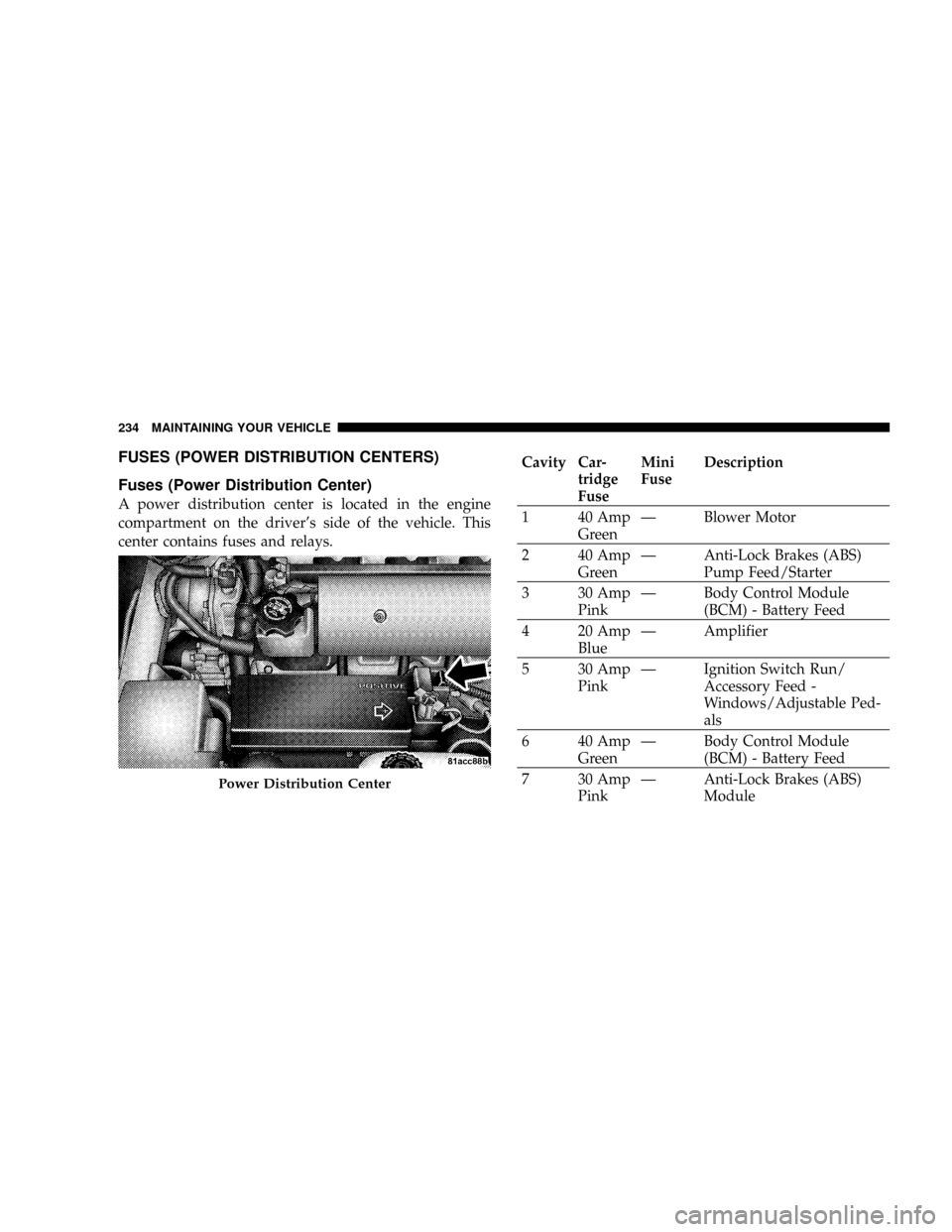
FUSES (POWER DISTRIBUTION CENTERS)
Fuses (Power Distribution Center)
A power distribution center is located in the engine
compartment on the driver's side of the vehicle. This
center contains fuses and relays.
Cavity Car-
tridge
FuseMini
FuseDescription
1 40 Amp
GreenÐ Blower Motor
2 40 Amp
GreenÐ Anti-Lock Brakes (ABS)
Pump Feed/Starter
3 30 Amp
PinkÐ Body Control Module
(BCM) - Battery Feed
4 20 Amp
BlueÐ Amplifier
5 30 Amp
PinkÐ Ignition Switch Run/
Accessory Feed -
Windows/Adjustable Ped-
als
6 40 Amp
GreenÐ Body Control Module
(BCM) - Battery Feed
7 30 Amp
PinkÐ Anti-Lock Brakes (ABS)
Module
Power Distribution Center
234 MAINTAINING YOUR VEHICLE
Page 239 of 303

VEHICLE STORAGE
We recommend that you follow these guidelines for
storing your vehicle for extended periods.
²Fill the fuel tank. This will prevent water condensation
inside the tank. If you plan to store your vehicle more
than 2 months, add an anti-oxidant fuel stabilizer to
the fuel tank.
²Change the oil to remove any corrosive combustion
related acids in the crankcase.
²Check that the radiator coolant level of protection is to
at least -20ÉF (-29ÉC).
²Make sure that all tires are inflated to the optimum
pressure. (See page 158 for more information.)
²Wash and wax the vehicle to protect the finish.
²Store the vehicle in a dry, well-ventilated location.
²Move the wiper blades away from the windshield.
²Block the wheels. Do not apply the Parking Brake.
²Cut blocks of plywood about the same size of the tires.
Cover each block with indoor/outdoor carpeting and
place them between the tires and concrete. This will
prevent tire flat spotting.
²For long-term storage, remove the tires and put the
vehicle up on blocks. Stack the tires on plywood and
cover with a tarp to prevent flat spotting.
²If the vehicle will be subjected to freezing tempera-
tures, either remove the battery and store it in a dry,
well ventilated area or connect a trickle charger (1.5
Amp) with automatic shutdown / overcharge protec-
tion to the battery. However, do not leave the trickle
charger hooked up to the battery without being
plugged in to a 110 volt AC outlet, as this will result in
further drain on the vehicle's battery. If the vehicle is
not going to be driven in the next 3 weeks, perform the
battery recharge procedure in the Service Manual.
238 MAINTAINING YOUR VEHICLE
Page 243 of 303
BULB REPLACEMENT
Auxiliary High Beam Headlight, Front Park/Turn
Signal Light, Front Side Marker Light
1. Remove the push pin from the upper outer corner of
the splash shield and remove the splash shield.2. Turn the appropriate bulb and socket assembly
counter-clockwise, and then pull it out of the headlight
assembly.
1 Ð Front Side Marker Light
2 Ð Front Park/Turn Signal Light
3 Ð Low/High Beam HID Headlight
4 Ð Auxiliary High Beam Headlight
5 Ð Headlight Adjustment Ð Aim Up & Down 242 MAINTAINING YOUR VEHICLE
Page 244 of 303

3. Pull the bulb out of the socket assembly.
4. Push the replacement bulb into the socket assembly.
5. Reinstall the bulb and socket assembly into the head-
light assembly, and then turn it clockwise.
6. Install the splash shield and push pin.
High Intensity Discharge Headlights (HID)
The headlights are a type of high voltage discharge tube.
High voltage can remain in the circuit even with the
headlight switch off and the key removed.Because of
this, you should not attempt to service a headlight bulb
yourself. If a headlight bulb fails, take your vehicle to
an authorized dealer for service.
WARNING!
A transient high tension occurs at the bulb sockets of
High Intensity Discharge (HID) headlights when the
headlight switch is turned ON. It may cause serious
electrical shock or electrocution if not serviced prop-
erly. See your authorized dealer for service.
NOTE:
²When the High Intensity Discharge Headlights (HID)
are turned on, there is a blue hue to the lights. This
diminishes and becomes more white after approxi-
mately 10 seconds as the system charges.
²If High Intensity Discharge (HID) lights are not work-
ing, cycle the headlight switch 4 times to see if it will
restrike.
MAINTAINING YOUR VEHICLE 243
7