Page 133 of 303
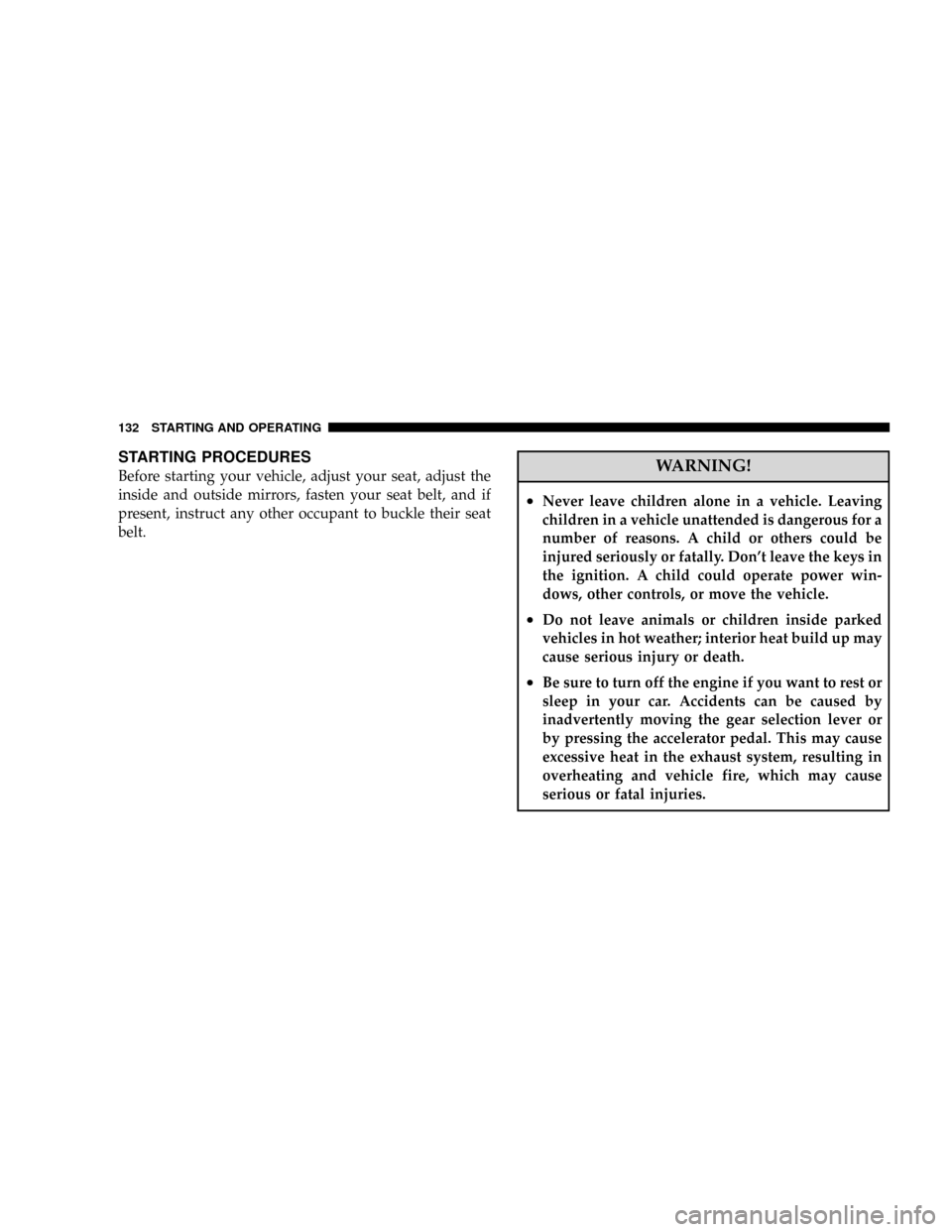
STARTING PROCEDURES
Before starting your vehicle, adjust your seat, adjust the
inside and outside mirrors, fasten your seat belt, and if
present, instruct any other occupant to buckle their seat
belt.WARNING!
²Never leave children alone in a vehicle. Leaving
children in a vehicle unattended is dangerous for a
number of reasons. A child or others could be
injured seriously or fatally. Don't leave the keys in
the ignition. A child could operate power win-
dows, other controls, or move the vehicle.
²Do not leave animals or children inside parked
vehicles in hot weather; interior heat build up may
cause serious injury or death.
²Be sure to turn off the engine if you want to rest or
sleep in your car. Accidents can be caused by
inadvertently moving the gear selection lever or
by pressing the accelerator pedal. This may cause
excessive heat in the exhaust system, resulting in
overheating and vehicle fire, which may cause
serious or fatal injuries.
132 STARTING AND OPERATING
Page 134 of 303

CAUTION!
Long periods of engine idling, especially at high
engine speeds, can cause excessive exhaust tempera-
tures, which can damage your vehicle. Do not leave
your vehicle unattended with the engine running.
Normal Starting
NOTE:
²You must disarm the security system in order to start
the engine. For details, refer to ªSecurity Alarm Sys-
temº in Section 2 of this manual
²Normal Starting of either a cold or a warm engine does
not require pumping or depressing the accelerator
pedal. However, if the engine has not started within 3
seconds, slightly depress the accelerator pedal while
continuing to crank. If the engine fails to start within
15 seconds, turn the key to the ªOFF/LOCKº position,
wait 5 seconds, then repeat the normal starting proce-
dure.
To start the engine:
1. Fully apply the parking brake.
2. Press the clutch pedal to the floor.
NOTE:The engine will not start unless the clutch pedal
is pressed to the floor.
3. Place the gear selector in NEUTRAL
4. Insert the ignition key fully into the ignition switch
STARTING AND OPERATING 133
5
Page 135 of 303
5. Turn the key to the ON/RUN position. 6. Press the red ENGINE START button located on the
instrument panel. Release the button when the engine
starts.
Ignition Key Positions
Engine Start Button
134 STARTING AND OPERATING
Page 136 of 303
If Engine Fails to Start
CAUTION!
To prevent damage to the starter, do not crank the
engine for more than 15 seconds at a time. Wait 10 to
15 seconds before trying again.
WARNING!
²Never pour fuel or other flammable liquid into the
throttle body air inlet opening in an attempt to
start the vehicle. This could result in flash fire
causing serious personal injury.
²Do not attempt to push or tow your vehicle to get
it started. Unburned fuel could enter the catalytic
converter and once the engine has started, ignite
and damage the converter and vehicle. If the
vehicle has a discharged battery, booster cables
may be used to obtain a start from a booster
battery or the battery in another vehicle. This type
of start can be dangerous if done improperly, so
follow this procedure carefully. See section 6 of
this manual for jump starting instructions.
STARTING AND OPERATING 135
5
Page 137 of 303

If the engine is flooded, it may start to run, but not have
enough power to continue running when the start button
is released. If this occurs, continue cranking up to 15
seconds with the accelerator pedal pushed all the way to
the floor. Release the accelerator pedal and the start
button once the engine is running smoothly.
If the engine shows no sign of starting after two 15
second periods of cranking with the accelerator pedal
held to the floor, the ªNORMAL STARTINGº procedure
should be repeated.
After Starting
The idle speed will automatically decrease as the engine
warms up.
TRANSMISSION SHIFTING
NOTE:The parking brake should be engaged and the
gear selector placed in REVERSE before leaving the
vehicle, especially when parked on an incline.
Your vehicle is equipped with a high torque capacity dual
disc clutch. The clutch pedal must be fully depressed to
the floor during each shift. As you release the clutch
pedal, lightly depress the accelerator pedal.
CAUTION!
Failure to depress the clutch pedal fully to the floor
may cause increased shift efforts, and may result in
damage to the clutch and transmission.
136 STARTING AND OPERATING
Page 139 of 303

driving. The noise may also be more noticeable when
the transmission is warm. This noise is normal and is
not an indication of a problem with your clutch or
transmission.
Recommended Shift Speeds
To use your manual transmission for fuel economy it
should be upshifted as listed below. Shift at the vehicle
speeds listed for acceleration. Earlier upshifts during
cruise conditions (relatively steady speeds) will result in
increased fuel economy, and may be used as indicated.
MANUAL TRANSMISSION
RECOMMENDED SHIFT SPEEDS
1-2 2-3 3-4 4-5 5-6
MPH 15 25 40 45 50
(km/h) (24) (40) (64) (72) (80)
Higher upshift speeds may be used to obtain a desired
acceleration rate.
Skip Shift Indicator Light
There are times when you must shift the transmis-
sion directly from First gear to Fourth gear instead
of from First gear to Second gear. This is to help you get
the best possible fuel economy from your vehicle. This
occurs when engine coolant is higher than 106ÉF (41ÉC),
and vehicle speed is greater than 12 MPH but less than 20
MPH, and engine speed is less than 1322 RPM, and the
transmission is in 1st gear, and the accelerator is at 1/4
throttle or less. The Skip Shift Indicator Light located in
the tachometer will turn Amber during these times.
When the indicator light turns amber, the shift mecha-
nism will only allow shifts from First gear to Fourth gear.
After you shift the transmission to Fourth gear, you can
press the clutch in and shift to another forward gear.
Downshifting - Proper downshifting will improve fuel
economy and prolong engine life.
138 STARTING AND OPERATING
Page 140 of 303
To maintain a safe speed and prolong brake life, down-
shift to maintain a safe speed when descending a steep
grade.
WARNING!
Skipping more than one gear while downshifting,
could cause you to lose control of your vehicle. You
could have an accident.
CAUTION!
If you skip more than one gear while downshifting
or downshift at too high an engine speed, you could
damage the engine, transmission, or clutch.
DRIVING ON SLIPPERY SURFACES
Acceleration
WARNING!
Rapid acceleration on slippery surfaces is dangerous.
You could lose control of the vehicle and possibly
have an accident. Accelerate slowly and carefully
whenever there is likely to be poor traction (ice,
snow, wet, mud, loose sand, etc.).
STARTING AND OPERATING 139
5
Page 141 of 303
Traction
When driving on wet or slushy roads, it is possible for a
wedge of water to build up between the tire and road
surface. This is hydroplaning and may cause partial or
complete loss of vehicle control and stopping ability. To
reduce this possibility, the following precautions should
be observed:
1. Slow down during rainstorms or when roads are
slushy.
2. Slow down if road has standing water or puddles.
CAUTION!
Driving your vehicle through deep puddles at speeds
over 5 mph, may cause water to be ingested into the
engine. This can cause severe engine damage.3. Replace tires when tread wear indicators first become
visible.
4. Keep tires properly inflated.
5. Maintain enough distance between your vehicle and
the vehicle in front to avoid a collision in a sudden stop.
DRIVING THROUGH WATER
Driving through water more than a few inches/
millimeters deep will require extra caution to ensure
safety and prevent damage to your vehicle.
140 STARTING AND OPERATING