Page 550 of 666

548 Practical hintsFlat tire
5
\1
Park the vehicle as far away as pos-
sible from traffic and on a level, firm,
and non-slip surface.
\1
Switch on the hazard warning lamps.
\1
Apply the handbrake.
\1
Engage first gear or reverse gear or
move the selector lever to
position
P.
\1
Any passengers should leave the ve-
hicle, ensuring that they are not en-
dangered as they do so.
\1
Place the warning triangle or hazard
warning lamps at a suitable distance.
Observe legal requirements.Preparing the vehicle
Changing a wheelWarning
G
To avoid the risk of causing serious or fa-
tal injury, or damage to the vehicle, please
bear the following points in mind:The jack is only designed to raise the ve-
hicle for a short time when changing a
wheel.Position the jack under the appropriate
jacking point only (\2page 551). Check
that the jack is correctly seated under the
jacking point before raising the vehicle.The jack must be placed on a firm, flat sur-
face only.
Continued
Warning (Continued)
G
Before raising the vehicle, also secure it
against rolling away, for example using
chocks or similar. Never release the hand-
brake while the vehicle is raised. Make
sure that the distance between the under-
side of the tires and the ground does not
exceed 1.2 in (3 cm). The vehicle could
slip or topple off the jack.Do not reach under the raised vehicle with
your hands or feet.Do not start the engine and avoid creating
other vibrations while the vehicle is
jacked up. The vehicle could slip off the
jack.
nf_BA.book Page 548 Friday, January 25, 2008 3:53 PM
Page 552 of 666
550 Practical hintsFlat tire
5
Hydraulic jack
\1
Assemble the three-part pump lever
for the jack.
1Pressure release screw\1
Close pressure release screw
1
.
\1
To do this, turn the flattened section
on the pump lever clockwise to the
stop.
\1
Insert the pump lever into the recess
on the jack and secure it by turning it
clockwise.
\1
Make sure that the jack is positioned
vertically under the jacking points
described below.
\1
Raise the vehicle by pumping the le-
ver until the wheel is raised clear of
the ground.
Make sure that the distance between
the underside of the tires and the
ground does not exceed 1.2 in
(3 cm).
P58.10-2053-31
iNever turn pressure release
screw
1
mor e than 1 or 2 fu ll turns .
Hydraulic fluid could otherwise es-
cape.
nf_BA.book Page 550 Friday, January 25, 2008 3:53 PM
Page 577 of 666
575 Practical hints
Battery
5
\1
Switch off all electrical consumers.
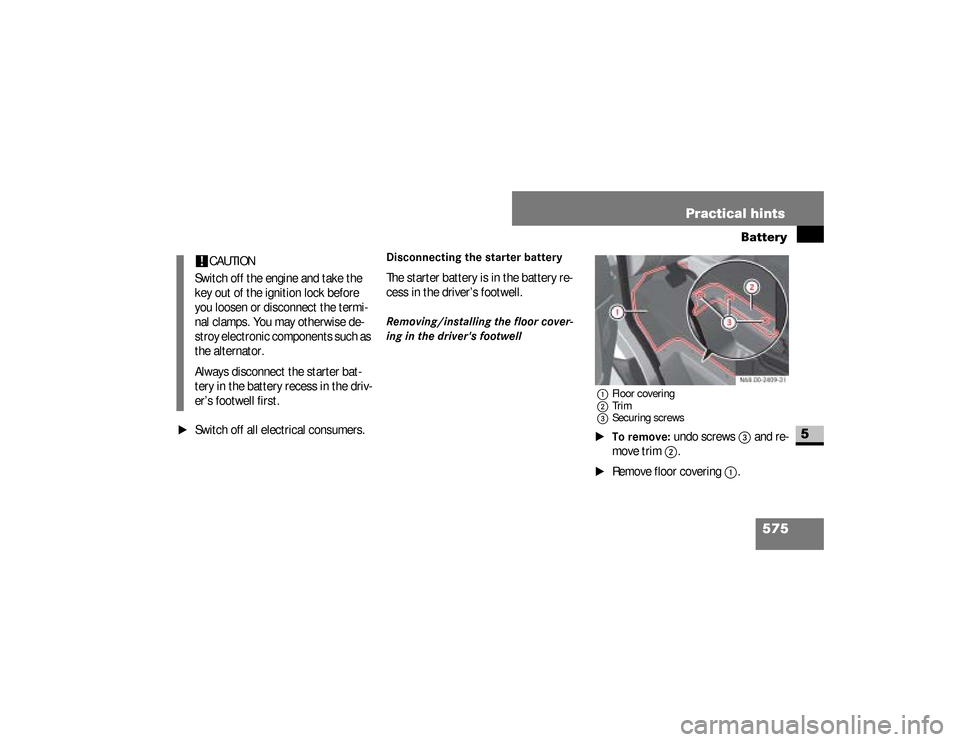
Disconnecting the starter batteryThe starter battery is in the battery re-
cess in the driver’s footwell.Removing/installing the floor cover-
ing in the driver's footwell
1Floor covering
2Trim
3Securing screws\1To remove:
undo screws
3
and re-
move trim
2
.
\1
Remove floor covering
1
.
!
CAUTION
Switch off the engine and take the
key out of the ignition lock before
you loosen or disconnect the termi-
nal clamps. You may otherwise de-
stroy electronic components such as
the alternator.
Always disconnect the starter bat-
tery in the battery recess in the driv-
er’s footwell first.
nf_BA.book Page 575 Friday, January 25, 2008 3:53 PM
Page 578 of 666

576 Practical hintsBattery
5
\1To install:
place floor covering
1
into the driver’s footwell.
\1
Push floor covering
1
under the
plate metal bracket of the accelera-
tor pedal and align it with the driver’s
seat base and the doorway
Make sure the floor covering does
not obstruct the accelerator’s range
of movement.
\1
Position trim
2
and screw
screws
3
back in.
Removing the battery cover in the
driver’s footwell1Cover
2Securing screws\1
Undo screws
2
and slide cover
1
in the direction of the arrow.
The screws must protrude beyond
the recesses.
Warning
G
The movement of the pedals must not be ob-
structed. The vehicle’s operating and road
safety are otherwise jeopardized.
Make sure to push the floor covering under
the plate metal bracket of the accelerator
pedal. The floor covering may not slip bet-
ween the bracket and the accelerator pedal.
Otherwise, you may not be able to fully
depress the accelerator pedal, which will
restrict the vehicle’s acceleration capability,
for example when passing another vehicle.
nf_BA.book Page 576 Friday, January 25, 2008 3:53 PM
Page 582 of 666

580 Practical hintsBattery
5
\1
Switch off all electrical consumers.
\1
Connect the positive terminal and
secure the cover.
\1
Connect the negative terminal.
Warning
G
Only charge the battery in well-ventilated
areas. As the battery is being charged,
gases can escape and generate minor ex-
plosions, which can injure you and others
and may cause damage to the paintwork
or permit acid corrosion on the vehicle.
During the charge procedure, there is a
risk of acid burns due to gases escaping
from the battery. Do not, therefore, lean
over the battery while it is being re-
charged.
iIt is also possible to charge the start-
er battery using the jump-starting
connection point in the engine com-
partment (
\2
page 581).
Reconnecting the battery!
CAUTION
Never swap the terminal clamps.
Otherwise, the vehicle’s electronics
system may be damaged. After re-
connecting the battery, you must re-
set the electric sliding door*
(\2
page 92).
nf_BA.book Page 580 Friday, January 25, 2008 3:53 PM
Page 586 of 666
584 Practical hintsJump-starting
5
Use a rigid towing bar and secure this
only to the front towing eye
(\2
page 585).
Tow-starting!
CAUTION
Your vehicle is equipped with an au-
tomatic transmission. Do not tow-
start your vehicle.
Warning
G
When tow-starting another vehicle, its
weight should not be greater than the per-
missible gross weight of your vehicle.
nf_BA.book Page 584 Friday, January 25, 2008 3:53 PM
Page 589 of 666

587 Practical hints
Towing
5
\1
Switch on the ignition (
\2
page 111).
\1
For a distance of up to 30 miles
(50 km), move the selector lever to
position
N.
\1
For a distance greater than 30 miles
(50 km), remove the propeller shafts
to the driven axles.
Take great care when attempting to tow
the vehicle free if its drive wheels have
become embedded in loose earth or
mud, particularly if the vehicle is loaded.
Tow the vehicle smoothly and straight-
ahead. The chassis could otherwise be
damaged.
Do not attempt to tow out the vehicle if
a trailer is coupled up.Where possible, tow the vehicle out
backwards along the track made by the
vehicle previously.
With transmission damage
\1
Always remove the propeller shafts
to the driven axles.
iDeactivate the automatic locking
while driving function when towing .
You could otherwise become locked
out when pushing or towing the vehi-
cle.!
CAUTION
Do not exceed a towing speed of
50 km / h, otherwise the transmis-
sion could be damaged.
Towing out a vehicle that is stuck
Towing the vehicle in the event of
particular malfunctions!
CAUTION
Use new self-securing nuts when in-
stalling the propeller shafts.
nf_BA.book Page 587 Friday, January 25, 2008 3:53 PM
Page 590 of 666

588 Practical hintsTowing
5
With front axle damage
\1
Turn the key to position
1 in the igni-
tion lock(
\2
page 111).
In the event of a malfunction in the
electrical systemIf the battery is malfunctioning, the auto-
matic transmission will be locked in
position
P. To shift the automatic trans-
mission to position
N, you must provide
power to the vehicle’s electrical system
in the same way as jump-starting
(
\2
page 581).
Have the vehicle transported on a trans-
porter or trailer.The towing eye can be used to pull the
vehicle onto a special transporter or
trailer for transportation.
\1
Shift the transmission to neutral or
move the selector lever to
position
N.
!
CAUTION
The vehicle must not be towed with
its front wheels raised and with the
key in position
2 in the ignition lock.
Active brake intervention by ESP
® or
ASR could otherwise lock the wheels
and damage the brake system.
Transporting the vehicle!
CAUTION
Only secure the vehicle at the
wheels / rims. Your vehicle could oth-
erwise be damaged.
nf_BA.book Page 588 Friday, January 25, 2008 3:53 PM