Page 434 of 528

accumulation of bugs, leaves, etc. If dirty, clean by gently
spraying water from a garden hose vertically down the
face of the condenser.
Check the coolant recovery bottle tubing for brittle rub-
ber, cracking, tears, cuts and tightness of the connection
at the bottle and radiator. Inspect the entire system for
leaks.
Extremely cold ambient temperature may require the
addition of a ªwinter frontº for effective operation of the
cab heating/cooling system. Make certain that a percent-
age of the radiator is exposed for adequate air flow
through the charge air cooler and automatic transmission
oil cooler. The percentage of opening must be increased
with the increasing ambient air temperature and/or
engine load. If the cooling fan can be heard cycling
frequently, increase the size of the opening in the winter
front.Coolant bottle level check
The coolant reserve system provides a quick visual
method of determining that the coolant level is adequate.
With the engine idling, and warmed to the normal
operating temperature, the level of the coolant on the
coolant bottle should be between the fluid level marks.
Check the coolant level whenever the hood is raised.
The radiator normally remains completely full, so there is
no longer a need to remove the coolant pressure cap
except for checking coolant freeze point or replacement
with new antifreeze coolant.
WARNING!
Never add coolant to the radiator when the engine is
overheated. Do not loosen or remove pressure cap to
cool overheated engine! The coolant is under pres-
sure and severe scalding could result.
434 MAINTAINING YOUR VEHICLE
Page 446 of 528

Automatic Transmission (Gas Engine Only)
Selection Of Lubricant
Refer to Fluids, Lubricants and Genuine Parts for the
correct lubricant type. It is important that the transmis-
sion fluid be maintained at the prescribed level using the
recommended fluid.
CAUTION!
Using a transmission fluid other than the manufac-
turers recommended fluid may cause deterioration in
transmission shift quality and/or torque converter
shudder. Using a transmission fluid other than the
manufacturers recommended fluid will result in
more frequent fluid and filter changes. Refer to
Fluids, Lubricants and Genuine Parts for correct
fluid type.
Fluid Level Check ± 545RFE Transmission
Check the fluid level while the transmission is at normal
operating temperature 180É F (82É C). This occurs after at
least 15 mi (25 km) of driving. At normal operating
temperature the fluid cannot be held comfortably be-
tween the fingertips.
Procedure For Checking Fluid Level
To properly check the automatic transmission fluid level,
the following procedure must be used:
1. Operate the engine at idle speed and normal operating
temperature.
2. The vehicle must be on level ground.
3. Fully apply parking brake.
4. Place the gear selector momentarily in each gear
position ending with the lever in P (Park).
446 MAINTAINING YOUR VEHICLE
Page 448 of 528

Automatic Transmission Fluid and Filter Change
Follow the Maintenance Schedule for recommended
transmission fluid and filter change intervals.
NOTE:If the transmission is disassembled for any
reason, the fluid and filter should be changed.
Special Additives
The manufacturer recommends against the addition of
any additives to the transmission. Exception to this
policy is the use of special dyes to aid in detecting fluid
leaks. The use of transmission sealers should be avoided,
since they may adversely affect seals.
Automatic Transmission (Diesel Engine Only)
Selection Of Lubricant
Refer to Fluids, Lubricants and Genuine Parts for the
correct lubricant type. It is important that the transmis-
sion fluid be maintained at the prescribed level using the
recommended fluid.
CAUTION!
Using a transmission fluid other than the manufac-
turers recommended fluid may cause deterioration in
transmission shift quality and/or torque converter
shudder. Using a transmission fluid other than the
manufacturers recommended fluid will result in se-
rious damage to the transmission. Refer to Fluids,
Lubricants and Genuine Parts for correct fluid type.
Fluid Level Check ± AS68RC Transmission
Check the fluid level while the transmission is at normal
operating temperature 167É F (76É C). This occurs after at
least 15 mi (25 km) of driving. At normal operating
temperature the fluid cannot be held comfortably be-
tween the fingertips.
448 MAINTAINING YOUR VEHICLE
Page 449 of 528

Procedure For Checking Fluid Level
To properly check the automatic transmission fluid level,
the following procedure must be used:
1. The vehicle must be on level ground.
2. Operate the engine at idle speed for a minimum of 60
seconds and normal operating temperature.
3. Fully apply parking brake and press the brake pedal.
4. Place the gear selector momentarily in each gear
position ending with the lever in P (Park). Make sure the
engine is running at idle speed.
5. Remove the dipstick and determine if the fluid is hot
or cold. Hot fluid is approximately 160É F - 175É F (70É C
± 82É C), Which is the normal operating temperature after
the vehicle has been driven at least 15 miles. The fluid can
not be comfortably held between the finger tips. Only usethe cold region on the dipstick as a rough reference when
doing initial oil level set after transmission rebuild or
transmission refill.
6. Wipe the dipstick clean and reinsert it until seated.
7. Remove the dipstick again and note the fluid level on
both sides. The fluid level should be between the HOT
(upper) reference holes on the dipstick at normal operat-
ing temperature. Verify that a solid coating of oil is seen
on both sides of the dipstick. If the fluid is low, add
MopartA68SRCŸ Automatic Transmission Fluid as
required into the dipstick tube.Do not overfill. Never
use any ATF other than MopartAS68RCŸ Automatic
Transmission Fluid.After adding any quantity of oil
through the dipstick tube, wait a minimum of two (2)
minutes for the oil to fully drain into the transmission
before rechecking the fluid level.
NOTE:If it is necessary to check the transmission below
the operating temperature, the fluid level should be
MAINTAINING YOUR VEHICLE 449
7
Page 450 of 528

between the two cold (lower) holes on the dipstick with
the fluid at approximately 70É F ± 85É F (20É C ± 30É C). If
the fluid level is correctly established at room tempera-
ture, it should be between the HOT (upper) reference
holes when the transmission reaches 160É F - 175É F (70É
C ± 82É C). Remember it is best to check the level at the
normal operating temperature.
CAUTION!
Be aware that if the fluid temperature is below 50É F
(10É C), it may not register on the dipstick. Do not add
fluid until the temperature is elevated enough to
produce an accurate reading. Never use any ATF
other than MopartAS68RCŸ Automatic Transmis-
sion Fluid.
8. Check for leaks. Release the Parking Brake.NOTE:To prevent dirt and water from entering the
transmission after checking or replenishing fluid, make
certain that the dipstick cap is properly reseated. It is
normal for the dipstick cap to spring back slightly from
its fully seated positions, as long as its seal remains
engaged in the dipstick tube.
Automatic Transmission Fluid and Filter Change
To obtain best performance and long life for automatic
transmissions, the manufacturer recommends that they
be given regular maintenance service by an Authorized
Dodge Dealer or Service Center. It is important that the
transmission fluid is maintained at the correct level, and
that it be drained and refilled as specified.
It is important that proper lubricant is used in the
transmission. Refer to Fluids, Lubricants and Genuine
Parts for the correct lubricant type. A filter change should
be made at the time of the oil change.
450 MAINTAINING YOUR VEHICLE
Page 459 of 528

²Use Moparttouch up paint on scratches as soon as
possible. Your dealer has touch up paint to match the
color of your vehicle.
Wheel and Wheel Trim Care
All wheels and wheel trim, especially aluminum and
chrome plated wheels should be cleaned regularly with a
mild soap and water to prevent corrosion. To remove
heavy soil and/or excessive brake dust, use Mopart
Wheel Cleaner (05066247AB) or equivalent or select a
nonabrasive, non-acidic cleaner. Do not use scouring
pads, steel wool, a bristle brush, or metal polishes. Only
Mopartor equivalent is recommended. Do not use oven
cleaner. Avoid automatic car washes that use acidic
solutions or harsh brushes that may damage the wheels'
protective finish.
YES EssentialstFabric Cleaning Procedure ± If
equipped
YES Essentialstseats may be cleaned in the following
manner:
²Remove as much of the stain as possible by blotting
with a clean, dry towel.
²Blot any remaining stain with a clean, damp towel.
²For tough stains, apply MopartTotal Clean or a mild
soap solution to a clean, damp cloth and remove stain.
Use a fresh, damp towel to remove soap residue.
²For grease stains, apply MopartMulti-purpose
cleaner to a clean, damp cloth and remove stain. Use a
fresh, damp towel to remove soap residue.
²Do not use any solvents or protectants on Yes Essen-
tials products.
MAINTAINING YOUR VEHICLE 459
7
Page 478 of 528
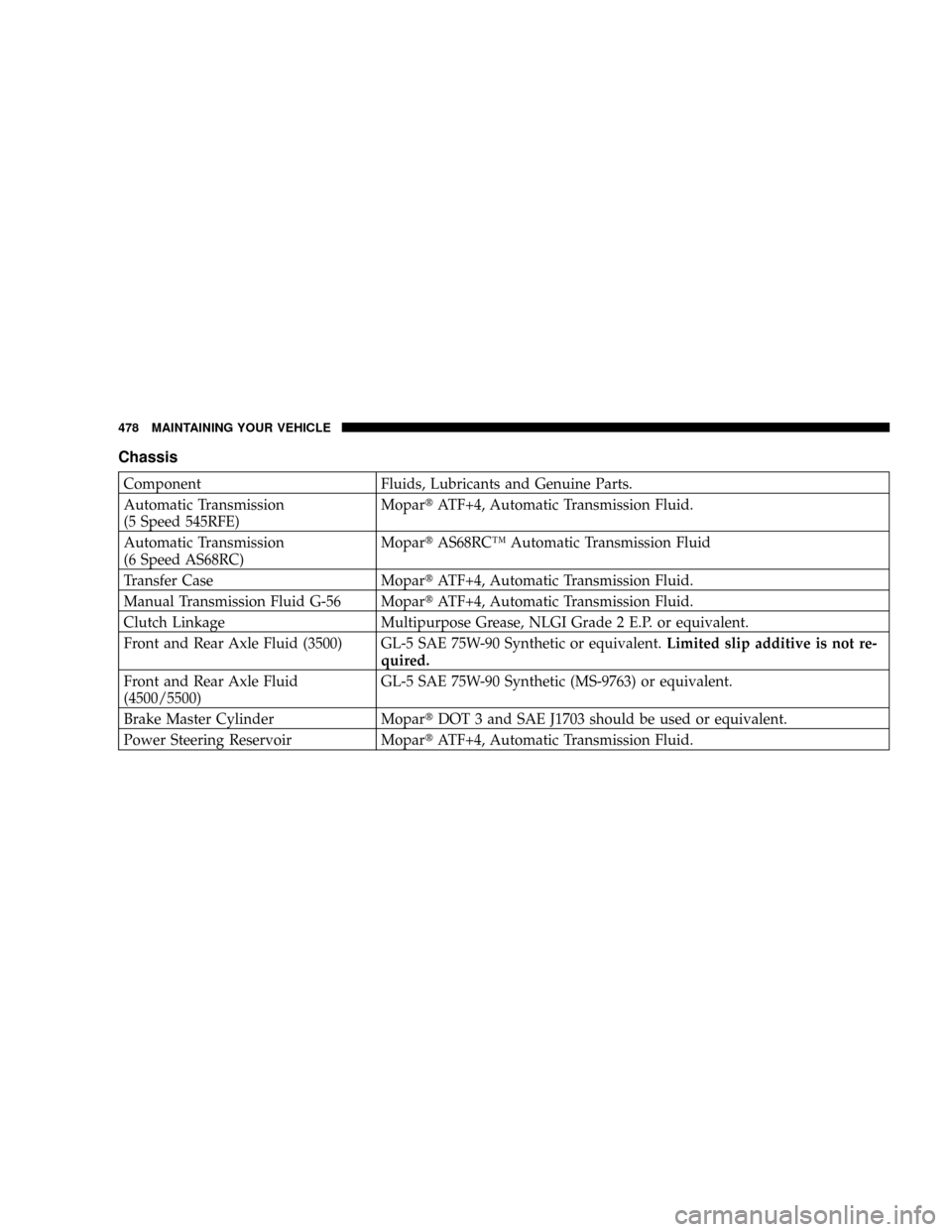
Chassis
Component Fluids, Lubricants and Genuine Parts.
Automatic Transmission
(5 Speed 545RFE)MopartATF+4, Automatic Transmission Fluid.
Automatic Transmission
(6 Speed AS68RC)MopartAS68RCŸ Automatic Transmission Fluid
Transfer Case MopartATF+4, Automatic Transmission Fluid.
Manual Transmission Fluid G-56 MopartATF+4, Automatic Transmission Fluid.
Clutch Linkage Multipurpose Grease, NLGI Grade 2 E.P. or equivalent.
Front and Rear Axle Fluid (3500) GL-5 SAE 75W-90 Synthetic or equivalent.Limited slip additive is not re-
quired.
Front and Rear Axle Fluid
(4500/5500)GL-5 SAE 75W-90 Synthetic (MS-9763) or equivalent.
Brake Master Cylinder MopartDOT 3 and SAE J1703 should be used or equivalent.
Power Steering Reservoir MopartATF+4, Automatic Transmission Fluid.
478 MAINTAINING YOUR VEHICLE
Page 481 of 528

²Check the windshield washer solvent and add if
required. When refilling the washer fluid reservoir,
take some washer fluid and apply it to a cloth or towel
and wipe clean the wiper blades, this will help blade
performance.
Once a Month
²Check tire pressure and look for unusual wear or
damage.
²Inspect the batteries and clean and tighten the termi-
nals as required.
²Check the fluid levels of coolant reservoir, transmis-
sion and transfer case (if equipped), add as needed.
²Check master cylinder reservoir fluid level for indica-
tions of brake maintenance.
²Check Filter MinderŸ. Replace air cleaner filter
element if necessary.
²Check all lights and all other electrical items for correct
operation.
At Each Oil Change
²Change the engine oil filter.
²Inspect the exhaust system.
²Inspect the brake hoses.
²Inspect the U-Joints ( if equipped) and front suspen-
sion components.
²Check the automatic transmission fluid level.
²Check the manual transmission fluid level.
²Check the coolant level, hoses, and clamps.
²Lubricate outer tie rod ends (4X4) models only.
²Lubricate Front Drive Shaft Fitting (4X4).
MAINTENANCE SCHEDULES 481
8
M
A
I
N
T
E
N
A
N
C
E
S
C
H
E
D
U
L
E
S