Page 172 of 554
Cupholder Door HandleCupholders Automatic Transmission
170 UNDERSTANDING THE FEATURES OF YOUR VEHICLE
Page 183 of 554
Positioning the Load Floor for Storage Access Under
the Seat
1. Lift the 60/40 seat cushion(s) to the upward position.
2. Unsnap the securing snap located at either side of the
load floor.
3. Lift the load floor up to access storage under the load
floor.
WARNING!
Do not drive with the load floor in the up position.
When stopping fast or in an accident, the load floor
could move to the down position causing serious
injury.4. Reverse the procedure to put the load floor back in the
secured down position before you operate the vehicle.Load Floor Securing Straps
UNDERSTANDING THE FEATURES OF YOUR VEHICLE 181
3
Page 201 of 554

CAUTION!
Do not leave your vehicle unattended with the en-
gine running as you would not be able to react to the
temperature indicator if the engine overheats.
NOTE:Engine idle speed will automatically increase to
1000 rpm at elevated coolant temperatures to improve
engine cooling.
NOTE:If the gauge pointer moves to either extreme of
the gauge, the ªCheck Gaugesº indicator will illuminate
and a single chime will sound.
14. Security Light
This light will flash rapidly for approximately 15 seconds
when the Vehicle Security Alarm is arming. The light will
flash at a slower speed continuously after the alarm is set.
The Security light will also come on for about three
seconds when the ignition is first turned on.15. Transmission Range Indicator (Automatic
Transmissions Only)
When the gear selector lever is moved, this indicator
shows the automatic transmission gear range selected.
16. Odometer/Trip Odometer
The odometer shows the total distance the vehicle has
been driven. U.S. federal regulations require that upon
transfer of vehicle ownership, the seller certify to the
purchaser the correct mileage that the vehicle has been
driven. Therefore, if the odometer reading is changed
during repair or replacement, be sure to keep a record of
the reading before and after the service so that the correct
mileage can be determined.
The two trip odometers show individual trip mileage. To
switch from odometer to trip odometers, press and
release the Trip Odometer button.
UNDERSTANDING YOUR INSTRUMENT PANEL 199
4
Page 385 of 554

Loading
The actual total weight and the weight of the front and
rear of your vehicle at the ground can best be determined
by weighing it when it is loaded and ready for operation.
The entire vehicle should first be weighed on a commer-
cial scale to insure that the GVWR has not been exceeded.
The weight on the front and rear of the vehicle should
then be determined separately to be sure that the load is
properly distributed over front and rear axle. Weighing
the vehicle may show that the GAWR of either the front
or rear axles has been exceeded but the total load is
within the specified GVWR. If so, weight must be shifted
from front to rear or rear to front as appropriate until the
specified weight limitations are met. Store the heavier
items down low and be sure that the weight is distributed
equally. Stow all loose items securely before driving.Improper weight distributions can have an adverse effect
on the way your vehicle steers and handles and the way
the brakes operate.
CAUTION!
Do not load your vehicle any heavier than the GVWR
or the maximum front and rear GAWR. If you do,
parts on your vehicle can break, or it can change the
way your vehicle handles. This could cause you to
lose control. Also overloading can shorten the life of
your vehicle.
STARTING AND OPERATING 383
5
Page 394 of 554

Towing Requirements
To promote proper break-in of your new vehicle driv-
etrain components the following guidelines are recom-
mended:
CAUTION!
²Avoid towing a trailer for the first 500 miles (805
km) of vehicle operation. Doing so may damage
your vehicle.
²During the first 500 miles (805 km) of trailer
towing, limit your speed to 50 mph (80 km/h).
WARNING!
Your vehicle may require special axle lubricant.
Please refer to the fluids section of this manual.Perform the maintenance listed in Section 8 of this
manual. When towing a trailer, never exceed the GAWR,
or GCWR, ratings.
WARNING!
Improper towing can lead to an injury accident.
Follow these guidelines to make your trailer towing
as safe as possible:
Make certain that the load is secured in the trailer
and will not shift during travel. When trailering
cargo that is not fully secured, dynamic load shifts
can occur that may be difficult for the driver to
control. You could lose control of your vehicle and
have an accident.
²When hauling cargo or towing a trailer, do not over-
load your vehicle or trailer. Overloading can cause a
392 STARTING AND OPERATING
Page 423 of 554
4. Place the jack and tools in the storage position holding
the jack by the jack turn-screw, slip the jack and tools
under the seat so that the bottom slot engages into the
fastener on the floor, and then secure to the floor pan
using the wing bolt. Reinstall the plastic cover.
Jack and Tools TiedJack Wing Bolt
WHAT TO DO IN EMERGENCIES 421
6
Page 426 of 554

²Block both the front and rear
of the wheel diagonally oppo-
site the jacking position. For
example, if the right front
wheel is being changed, block
the left rear wheel.
²Passengers should not remain in the vehicle when the
vehicle is being jacked.
Instructions
WARNING!
Carefully follow these tire changing warnings to help prevent
personal injury or damage to your vehicle:
²Always park on a firm, level surface as far from the edge of the
roadway as possible before raising the vehicle.
²Block the wheel diagonally opposite the wheel to be raised.
²Set the parking brake firmly and set an automatic transmis-
sion in park; a manual transmission in reverse.
²Never start or run the engine with the vehicle on a jack.
²Do not let anyone sit in the vehicle when it is on a jack.
²Do not get under the vehicle when it is on a jack.
²Only use the jack in the positions indicated and for lifting this
vehicle during a tire change.
²If working on or near a roadway, be extremely careful of motor
traffic.
²To assure that spare tires, flat or inflated are securely stowed,
spares must be stowed with the valve stem facing the ground.
²Turn on the Hazard warning flasher.
Jack Warning Label
424 WHAT TO DO IN EMERGENCIES
Page 435 of 554
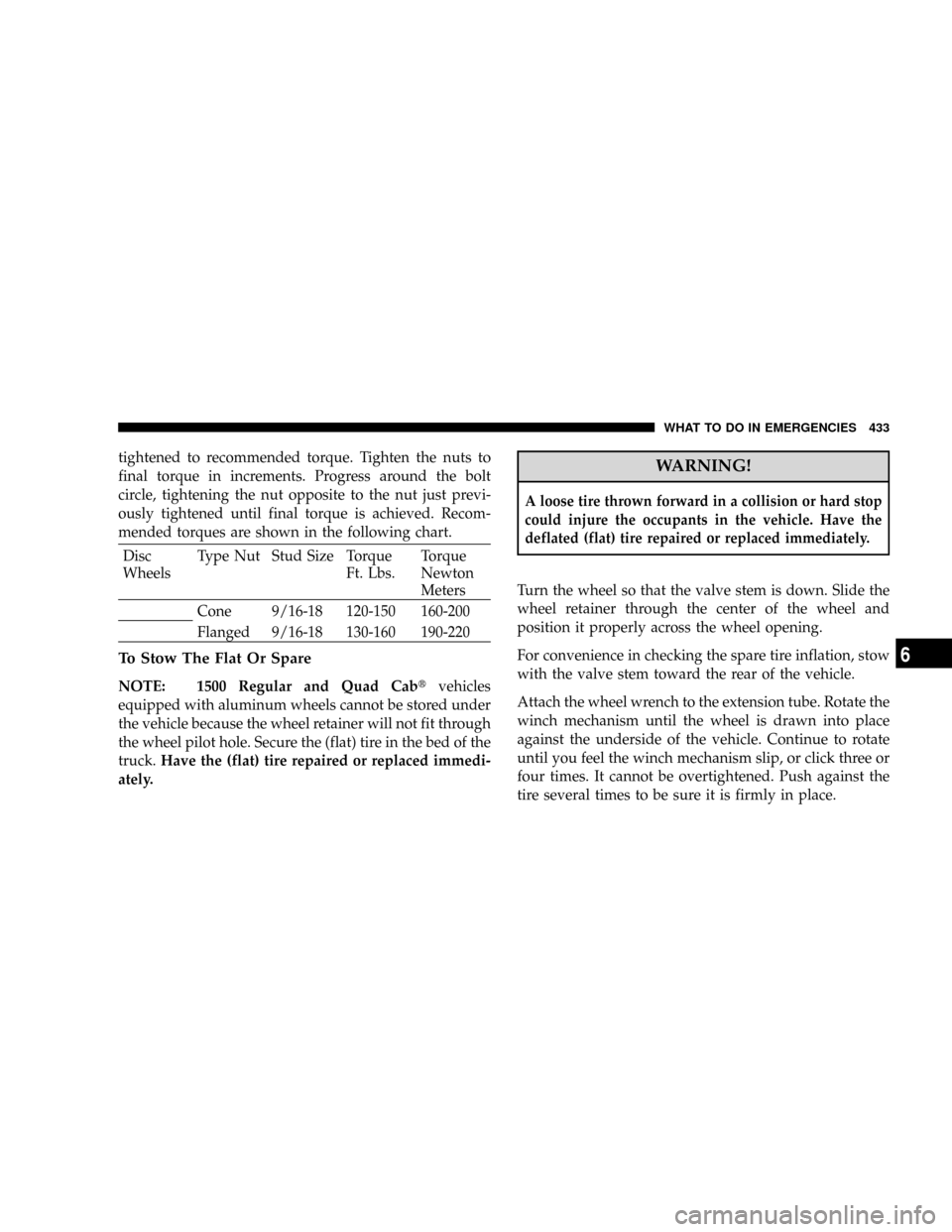
tightened to recommended torque. Tighten the nuts to
final torque in increments. Progress around the bolt
circle, tightening the nut opposite to the nut just previ-
ously tightened until final torque is achieved. Recom-
mended torques are shown in the following chart.
Disc
WheelsType Nut Stud Size Torque
Ft. Lbs.Torque
Newton
Meters
Cone 9/16-18 120-150 160-200
Flanged 9/16-18 130-160 190-220
To Stow The Flat Or Spare
NOTE: 1500 Regular and Quad Cabtvehicles
equipped with aluminum wheels cannot be stored under
the vehicle because the wheel retainer will not fit through
the wheel pilot hole. Secure the (flat) tire in the bed of the
truck.Have the (flat) tire repaired or replaced immedi-
ately.
WARNING!
A loose tire thrown forward in a collision or hard stop
could injure the occupants in the vehicle. Have the
deflated (flat) tire repaired or replaced immediately.
Turn the wheel so that the valve stem is down. Slide the
wheel retainer through the center of the wheel and
position it properly across the wheel opening.
For convenience in checking the spare tire inflation, stow
with the valve stem toward the rear of the vehicle.
Attach the wheel wrench to the extension tube. Rotate the
winch mechanism until the wheel is drawn into place
against the underside of the vehicle. Continue to rotate
until you feel the winch mechanism slip, or click three or
four times. It cannot be overtightened. Push against the
tire several times to be sure it is firmly in place.
WHAT TO DO IN EMERGENCIES 433
6


