Page 372 of 434

are present. Components should be replaced immedi-
ately if there is any evidence of degradation that could
cause failure.
Brake System
In order to assure brake system performance, all brake
system components should be inspected periodically.
Refer to the appropriate ªMaintenance Scheduleº in
Section 8 for suggested service intervals.
WARNING!
Riding the brakes can lead to brake failure and
possibly an accident. Driving with your foot resting
or riding on the brake pedal can result in abnormally
high brake temperatures, excessive lining wear, and
possible brake damage. You wouldn't have your full
braking capacity in an emergency.
Brake and Power Steering System Hoses
When servicing the vehicle for scheduled maintenance,
inspect surface of hoses for evidence of heat and me-
chanical damage. Hard and brittle rubber, cracking, tears,
cuts, abrasion, and excessive swelling suggest deteriora-
tion of the rubber. Particular attention should be made to
examining those hose surfaces nearest to high heat
sources, such as the exhaust manifold.
Inspect all hose clamps and couplings to make sure they
are secure and no leaks are present.
NOTE:Inspection of brake hoses should be done when-
ever the brake system is serviced and every engine oil
change.
372 MAINTAINING YOUR VEHICLE
Page 373 of 434

WARNING!
Worn brake hoses can burst and cause brake failure.
You could have an accident. If you see any signs of
cracking, scuffing, or worn spots, have the brake
hoses replaced immediately.
Brake Master Cylinder
The fluid level in the master cylinder should be checked
when performing under hood services, or immediately if
the BRAKE warning light shows system failure
Be sure to clean the top of the master cylinder area before
removing the cap. If necessary, add fluid to bring the
fluid level up to the requirements described on the brake
fluid reservoir. With disc brakes, fluid level can be
expected to fall as the brake pads wear. Brake fluid levelshould be checked when pads are replaced. However,
low fluid level may be caused by a leak and a checkup
may be needed.
Use only manufacturer's recommended brake fluid, refer
to Fluids, Lubricants, and Genuine Parts for correct fluid
type.
WARNING!
²Use of a brake fluid that may have a lower initial
boiling point or unidentified as to specification,
may result in sudden brake failure during hard
prolonged braking. You could have an accident.
²Overfilling the brake fluid reservoir can result in
spilling brake fluid on hot engine parts and the
brake fluid catching fire.
MAINTAINING YOUR VEHICLE 373
7
Page 389 of 434

REPLACEMENT LIGHT BULBS
LIGHT BULBS Ð Interior Bulb No.
Dome Light........................WL212±2
Liftgate Lamp........................... 567
Overhead Console Lights............. PLW214±2A
Reading Light.......................WL212±2
LIGHT BULBS Ð Outside Bulb No.
Headlight..........................9008 H13
Front Park/Turn......................3157AK
Front Sidemarker......................... 168
Back-Up.............................4057K
Center High Mounted Stoplight.............. 921
Fog Lamp.......................... H109145
License Plate Light....................... 168
Rear Tail, Stop, Turn Signal................4057K
BULB REPLACEMENT
Head Light
1. Open the hood.
2. Reach behind the headlamp unit in the engine com-
partment to access the headlamp bulb lock ring.
3. Firmly grasp the lock ring on the back of the headlamp
unit housing.
4. Rotate the lock ring on the back of the headlamp
housing counter-clockwise to unlock it.
CAUTION!
Do not touch the new bulb with your fingers. Oil
contamination will severely shorten bulb life. If the
bulb comes in contact with any oily surface, clean the
bulb with rubbing alcohol.
MAINTAINING YOUR VEHICLE 389
7
Page 394 of 434
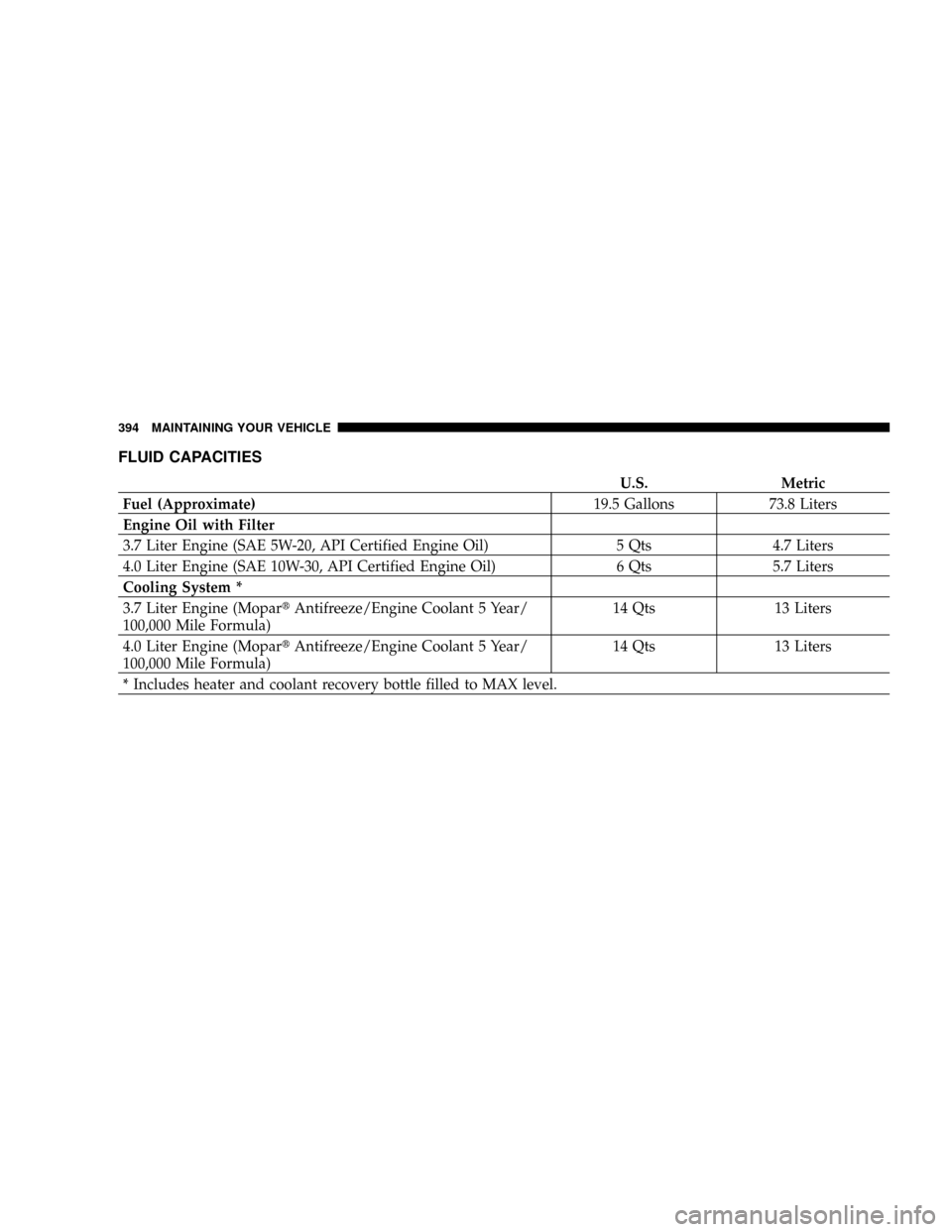
FLUID CAPACITIES
U.S. Metric
Fuel (Approximate)19.5 Gallons 73.8 Liters
Engine Oil with Filter
3.7 Liter Engine (SAE 5W-20, API Certified Engine Oil) 5 Qts 4.7 Liters
4.0 Liter Engine (SAE 10W-30, API Certified Engine Oil) 6 Qts 5.7 Liters
Cooling System *
3.7 Liter Engine (MopartAntifreeze/Engine Coolant 5 Year/
100,000 Mile Formula)14 Qts 13 Liters
4.0 Liter Engine (MopartAntifreeze/Engine Coolant 5 Year/
100,000 Mile Formula)14 Qts 13 Liters
* Includes heater and coolant recovery bottle filled to MAX level.
394 MAINTAINING YOUR VEHICLE
Page 395 of 434
FLUIDS, LUBRICANTS AND GENUINE PARTS
Engine
Component Fluids, Lubricants and Genuine Parts
Engine Coolant MopartAntifreeze/Coolant 5 Year/100,000 Mile Formula HOAT (Hybrid Or-
ganic Additive Technology) or equivalent.
Engine Oil (3.7L Engine) Use API Certified SAE 5W-20 engine oil, meeting material standard MS-6395
or equivalent.
Engine Oil (4.0L Engine) Use API Certified SAE 10W-30 engine oil, refer to oil viscosity chart for cor-
rect SAE grade meeting DaimlerChrysler Material Standard MS-6395.
Engine Oil Filter MopartEngine Oil Filter, P/N 5281090 or equivalent.
Spark Plugs 3.7 Liter ZFR6F-11G (Gap 0.043º)
Spark Plugs 4.0 Liter ZFR5LP-13G (Gap 0.050º)
Fuel Selection (3.7L Engines) 87 Octane, (R+M)/2 Method
Fuel Selection (4.0L Engines) 87 Octane, (R+M)/2 Method Acceptable, 89 Octane, (R+M)/2 Method Pre-
ferred
MAINTAINING YOUR VEHICLE 395
7
Page 398 of 434

EMISSION CONTROL SYSTEM MAINTENANCE
The ªScheduledº maintenance services, listed inbold
typemust be done at the times or mileages specified to
assure the continued proper functioning of the emission
control system. These, and all other maintenance services
included in this manual, should be done to provide best
vehicle performance and reliability. More frequent main-
tenance may be needed for vehicles in severe operating
conditions such as dusty areas and very short trip
driving.
Inspection and service also should be done any time a
malfunction is suspected.
NOTE:Maintenance, replacement, or repair of the emis-
sion control devices and systems on your vehicle may be
performed by any automotive repair establishment or
individual using any automotive part, which has been
certified pursuant to U.S. EPA or, in the State of Califor-
nia, California Air Resources Board regulations.
MAINTENANCE SCHEDULE
The oil change indicator system will remind you that it is
time to take your vehicle in for scheduled maintenance.
On Electronic Vehicle Information Center (EVIC)
equipped vehicles ªOil Change Requiredº will be dis-
played in the EVIC and a single chime will sound,
indicating that an oil change is necessary.
On Non-EVIC equipped vehicles ªChange Oilº will flash
in the instrument cluster odometer and a single chime
will sound, indicating that an oil change is necessary.
Based on engine operation condition the oil change
indicator message will illuminate, this means that service
is required for your vehicle. Have your vehicle serviced
as soon as possible, within the next 500 miles (805 km).
398 MAINTENANCE SCHEDULES
8
M
A
I
N
T
E
N
A
N
C
E
S
C
H
E
D
U
L
E
S
Page 399 of 434

NOTE:
²The oil change indicator message will not monitor the
time since the last oil change. Change your vehicles oil
if it has been 6 months since your last oil change even
if the oil change indicator message is NOT illumi-
nated.
²Change your engine oil more often if you drive your
vehicle off-road for an extended period of time.
²Under no circumstances should oil change intervals
exceed 6,000 miles (10,000 km) or 6 months, whichever
comes first.
Your dealer will reset the oil change indicator message
after completing the scheduled oil change. If this sched-
uled oil change is performed by someone other than yourdealer the message can be reset by referring to the steps
described under ªOil Change Requiredº in ªUse Factory
Settingsº of the EVIC section in this manual or under
ªOdometer/Trip Odometerº in the ªInstrument Cluster
Descriptions section of this manual.
At Each Stop for Fuel
²Check the engine oil level about 5 minutes after a fully
warmed engine is shut off. Checking the oil level while
the vehicle is on level ground will improve the accu-
racy of the oil level reading. Add oil only when the
level is at or below the ADD or MIN mark.
²Check the windshield washer solvent and add if
required.
MAINTENANCE SCHEDULES 399
8
M
A
I
N
T
E
N
A
N
C
E
S
C
H
E
D
U
L
E
S
Page 400 of 434
Once a Month
²Check tire pressure and look for unusual wear or
damage.
²Inspect the battery and clean and tighten the terminals
as required.
²Check the fluid levels of coolant reservoir, brake
master cylinder, power steering and transmission and
add as needed.
²Check all lights and other electrical items for correct
operation.At Each Oil Change
²Change the engine oil filter.
²Inspect the brake hoses and lines.
²Check the manual transmission fluid level.
CAUTION!
Failure to perform the required maintenance items
may result in damage to the vehicle.
400 MAINTENANCE SCHEDULES
8
M
A
I
N
T
E
N
A
N
C
E
S
C
H
E
D
U
L
E
S