Page 312 of 434

NOTE:Tighten the gas cap about 1/4 turn until you
hear one click. This is an indication that cap is properly
tightened.
If the gas cap is not tighten properly, the Malfunction
Indicator Light will come on. Be sure the gas cap is
tightened every time the vehicle is refueled.
WARNING!
A fire may result if gasoline is pumped into a
portable container that is inside of a vehicle. You
could be burned. Always place gas containers on the
ground while filling.
Loose Fuel Filler Cap Message
If the vehicle diagnostic system determines that the fuel
filler cap is loose, improperly installed, or damaged, a
ªCHECK GASCAPº message will be displayed in the
EVIC (Electronic Vehicle Information Center). Refer to
ªElectronic Vehicle Information Centerº in Section 4 of
this manual. Tighten the fuel filler cap until a ªclickingº
sound is heard. This is an indication that the fuel filler
cap is properly tightened. Refer to ªOnboard Diagnostic
System Ð OBDIIº in Section 7 of this manual for more
information.
CAUTION!
Damage to the fuel system or emission control sys-
tem could result from using an improper fuel tank
filler cap (gas cap). A poorly fitting cap could let
impurities into the fuel system.
312 STARTING AND OPERATING
Page 313 of 434

WARNING!
²Never add fuel when the engine is running.
²Never have any smoking materials lit in or near
the vehicle when the fuel cap is removed or the
tank filled.
VEHICLE LOADING
Certification Label
As required by National Highway Traffic Safety Admin-
istration Regulations, your vehicle has a certification
label affixed to the driver's side door or pillar.
This label contains the month and year of manufacture,
Gross Vehicle Weight Rating (GVWR), Gross Axle Weight
Rating (GAWR) front and rear, and Vehicle Identification
Number (VIN). A Month-Day-Hour (MDH) number is
included on this label and indicates the Month, Day, andHour of manufacture. The bar code that appears on the
bottom of the label is your Vehicle Identification Number
(VIN).
Gross Vehicle Weight Rating (GVWR)
The GVWR is the total permissible weight of your vehicle
including driver, passengers, vehicle, options, trailer
tongue weight, and cargo. The label also specifies maxi-
mum capacities of front and rear axle systems (GAWR).
Total load must be limited, so GVWR, and front and rear
GAWR are not exceeded.
Payload
The payload of a vehicle is defined as the allowable load
weight a truck can carry, including the weight of the
driver, all passengers, options and cargo.
Gross Axle Weight Rating (GAWR)
The GAWR is the maximum permissible load on the front
and rear axles. The load must be distributed in the cargo
area so that the GAWR of each axle is not exceeded.
STARTING AND OPERATING 313
5
Page 314 of 434

Each axle GAWR is determined by the components in the
system with the lowest load carrying capacity (axle,
springs, tires, or wheels). Heavier axles or suspension
components sometimes specified by purchasers for in-
creased durability does not necessarily increase the vehi-
cle's GVWR.
Tire Size
The tire size on the Label represents the actual tire size on
your vehicle. Replacement tires must be equal to the load
capacity of this tire size.
Rim Size
This is the rim size that is appropriate for the tire size
listed.
Inflation Pressure
This is the cold tire inflation pressure for your vehicle for
all loading conditions up to full GAWR.
Curb Weight
The curb weight of a vehicle is defined as the total weight
of the vehicle with all fluids, including vehicle fuel, at full
capacity conditions, and with no occupants or cargo
loaded into the vehicle. The front and rear curb weight
values are determined by weighing your vehicle on a
commercial scale before any occupants or cargo are
added.
Loading
The actual total weight and the weight of the front and
rear of your vehicle at the ground can best be determined
by weighing it when it is loaded and ready for operation.
The entire vehicle should first be weighed on a commer-
cial scale to insure that the GVWR has not been exceeded.
The weight on the front and rear of the vehicle should
then be determined separately to be sure that the load is
properly distributed over front and rear axle. Weighing
the vehicle may show that the GAWR of either the front
314 STARTING AND OPERATING
Page 345 of 434
MAINTAINING YOUR VEHICLE
CONTENTS
mEngine Compartment ± 3.7L...............348
mEngine Compartment ± 4.0L...............349
mOnboard Diagnostic System Ð OBD II........350
NLoose Fuel Filler Cap Message............351
mEmissions Inspection And Maintenance
Programs............................351
mReplacement Parts......................353
mDealer Service.........................353
mMaintenance Procedures..................354NEngine Oil..........................354
NDrive Belts Ð Check Condition And Tension . . 358
NSpark Plugs.........................358
NCatalytic Converter....................359
NCrankcase Emission Control System........361
NFuel Filter..........................361
NEngine Air Cleaner Filter................361
NMaintenance-Free Battery................362
NAir Conditioner Maintenance.............362
7
Page 351 of 434

Loose Fuel Filler Cap Message
After fuel is added, the vehicle diagnostic system can
determine if the fuel filler cap is possibly loose, improp-
erly installed, or damaged. A loose fuel filler cap message
will be displayed in the instrument cluster. Tighten the
gas cap until a9clicking9sound is heard. This is an
indication that the gas cap is properly tightened. Press
the odometer reset button to turn the message off. If the
problem persists, the message will appear the next time
the vehicle is started. This might indicate a damaged cap.
If the problem is detected twice in a row, the system will
turn on the Malfunction Indicator Light (MIL). Resolving
the problem will turn the MIL light off.
EMISSIONS INSPECTION AND MAINTENANCE
PROGRAMS
In some localities, it may be a legal requirement to pass
an inspection of your vehicle's emissions control system.
Failure to pass could prevent vehicle registration.
For states, which have an I/M (Inspection and
Maintenance) requirement, this check verifies the
following: the MIL (Malfunction Indicator Light)
is functioning and is not on when the engine is running,
and that the OBD (On Board Diagnostic) system is ready
for testing.
Normally, the OBD system will be ready. The OBD
system maynotbe ready if your vehicle was recently
serviced, if you recently had a dead battery, or a battery
replacement. If the OBD system should be determined
not ready for the I/M test, your vehicle may fail the test.
MAINTAINING YOUR VEHICLE 351
7
Page 356 of 434

Engine Oil Selection
For best performance and maximum protection for all
engines under all types of operating conditions, the
manufacturer recommends engine oils that are API Cer-
tified and meet the requirements of DaimlerChrysler
Material Standard MS-6395.
American Petroleum Institute (API) Engine Oil
Identification Symbol
This symbol means that the oil has
been certified by the American
Petroleum Institute (API). The
manufacturer only recommends
API Certified engine oils.
Engine Oil Viscosity (3.7L Engine)
SAE 5W-20 engine oil is recommended for all operating
temperatures. This engine oil improves low tempera-
ture starting and vehicle fuel economy. Your engine oil
filler cap shows the recommended engine oil viscosity
for your vehicle.
Lubricants which do not have both, the engine oil certi-
fication mark and the correct SAE viscosity grade num-
ber should not be used.
Engine Oil Viscosity (4.0L Engine)
The proper SAE viscosity grade of engine oil should be
selected based on the following recommendation and be
within the operating temperature shown in the engine oil
viscosity chart.
356 MAINTAINING YOUR VEHICLE
Page 394 of 434
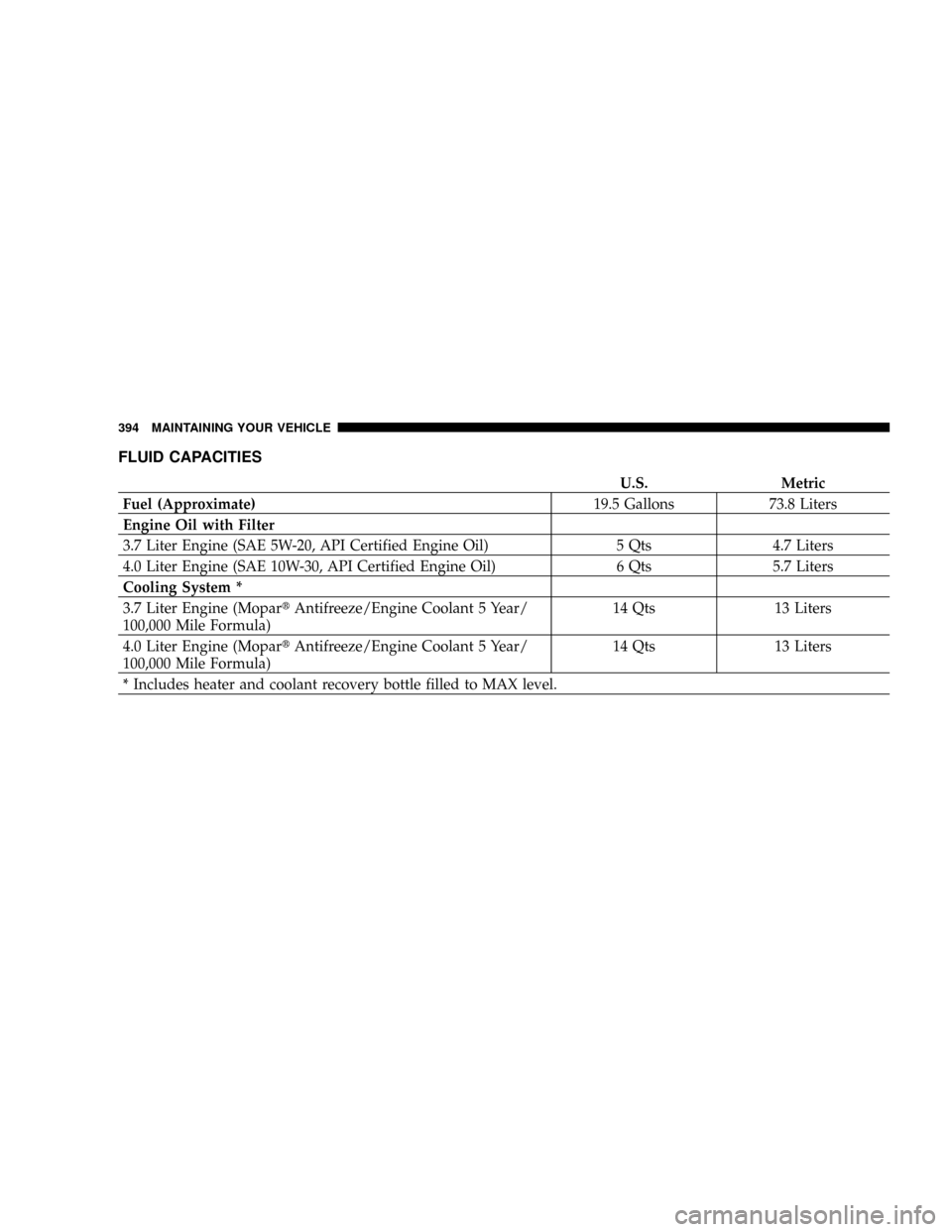
FLUID CAPACITIES
U.S. Metric
Fuel (Approximate)19.5 Gallons 73.8 Liters
Engine Oil with Filter
3.7 Liter Engine (SAE 5W-20, API Certified Engine Oil) 5 Qts 4.7 Liters
4.0 Liter Engine (SAE 10W-30, API Certified Engine Oil) 6 Qts 5.7 Liters
Cooling System *
3.7 Liter Engine (MopartAntifreeze/Engine Coolant 5 Year/
100,000 Mile Formula)14 Qts 13 Liters
4.0 Liter Engine (MopartAntifreeze/Engine Coolant 5 Year/
100,000 Mile Formula)14 Qts 13 Liters
* Includes heater and coolant recovery bottle filled to MAX level.
394 MAINTAINING YOUR VEHICLE
Page 417 of 434

Autostick............................. 262
Auxiliary Electrical Outlet (Power Outlet)...... 147
Auxiliary Power Outlet................... 147
Axle Fluid............................. 396
Battery............................... 362
Charging............................ 341
Emergency Starting..................... 341
Gas Caution.......................... 341
Keyless Transmitter Replacement (RKE)....... 24
Belts, Drive............................ 358
Belts, Seat.............................. 40
Body Mechanism Lubrication............... 364
B-Pillar Location........................ 283
Brake Assist System...................... 132
Brake Control System, Electronic............. 131
Brake Fluid............................ 396
Brake, Parking.......................... 272
Brake System........................... 372Anti-Lock (ABS)....................131,274
Hoses.............................. 372
Master Cylinder....................... 373
Parking............................. 272
Warning Light.....................171,173
Brake/Transmission Interlock............... 254
Break-In Recommendations, New Vehicle........ 76
Bulb Replacement....................... 389
Bulbs, Light............................ 389
Calibration, Compass..................183,190
Capacities, Fluid........................ 394
Caps, Filler
Fuel................................ 310
Power Steering........................ 363
Car Washes............................ 378
Carbon Monoxide Warning...............76,309
Cargo Area Features...................... 153
Cargo Compartment...................... 153
INDEX 417
10