2008 DODGE NITRO cooling
[x] Cancel search: coolingPage 367 of 434

garden hose vertically down the face of the A/C con-
denser (if equipped) or the back of the radiator core.
Check the engine cooling system hoses for brittle rubber,
cracking, tears, cuts, and tightness of the connection at
the coolant recovery bottle and radiator. Inspect the
entire system for leaks.
With the engine at normal operating temperature (but
not running), check the cooling system pressure cap for
proper vacuum sealing by draining a small amount of
antifreeze/coolant from the radiator drain cock. If the cap
is sealing properly, the antifreeze/coolant will begin to
drain from the coolant recovery bottle. DO NOT RE-
MOVE THE COOLANT PRESSURE CAP WHEN THE
COOLING SYSTEM IS HOT.Cooling System Ð Drain, Flush, And Refill
At the intervals shown in the appropriate ªMaintenance
Schedule,º the system should be drained, flushed, and
refilled.
If the solution is dirty and contains a considerable
amount of sediment, clean and flush with reliable cooling
system cleaner. Follow with a thorough rinsing to remove
all deposits and chemicals. Properly dispose of old
antifreeze/coolant solution.
Discard old antifreeze/coolant solution according to rec-
ommended procedure.
Selection Of Engine Coolant
Use only the manufacturer's recommended antifreeze/
coolant, refer to Fluids, Lubricants, and Genuine Parts for
correct antifreeze/coolant type.
MAINTAINING YOUR VEHICLE 367
7
Page 368 of 434

CAUTION!
²Mixing of antifreeze/coolant other than the speci-
fied HOAT antifreeze/coolant may result in de-
creased corrosion protection and engine damage.
If a non-HOAT antifreeze/coolant is introduced
into the cooling system in an emergency, it should
be replaced with the specified antifreeze/coolant
as soon as possible.
²Do not use plain water alone or alcohol base
antifreeze/coolant products. Do not use additional
rust inhibitors or antirust products, as they may
not be compatible with the antifreeze/coolant and
may plug the radiator.
²This vehicle has not been designed for use with
Propylene Glycol based antifreeze/coolant. Use of
Propylene Glycol base antifreeze/coolant is not
recommended.
Adding Engine Coolant
Your vehicle has been built with an improved antifreeze/
coolant that allows extended maintenance intervals. This
antifreeze/coolant can be used up to 5 Years or 100,000
miles before replacement. To prevent reducing this ex-
tended maintenance period, it is important that you use
the same antifreeze/coolant throughout the life of your
vehicle. Please review these recommendations for using
Hybrid Organic Additive Technology (HOAT)
antifreeze/coolant.
When adding antifreeze/coolant, a minimum solution of
50% recommended Mopar Antifreeze/ Coolant 5 Year/
100,000 Mile Formula HOAT (Hybrid Organic Additive
Technology), or equivalent, in water should be used. Use
higher concentrations (not to exceed 70%) if temperatures
below -34ÉF (-37ÉC) are anticipated.
368 MAINTAINING YOUR VEHICLE
Page 369 of 434

Use only high purity water such as distilled or deionized
water when mixing the water/antifreeze (coolant) solu-
tion. The use of lower quality water will reduce the
amount of corrosion protection in the engine cooling
system.
Please note that it is the owner's responsibility to main-
tain the proper level of protection against freezing ac-
cording to the temperatures occurring in the area where
the vehicle is operated.
NOTE:Mixing antifreeze/coolant types will decrease
the life of the antifreeze/coolant and will require more
frequent antifreeze/coolant changes.
Cooling System Pressure Cap
The cap must be fully tightened to prevent loss of
antifreeze/coolant, and to insure that antifreeze/coolant
will return to the radiator from the coolant reserve tank.The cap should be inspected and cleaned if there is any
accumulation of foreign material on the sealing surfaces.
WARNING!
The warning words DO NOT OPEN HOT on the
cooling system pressure cap are a safety precaution.
Never add antifreeze/coolant when the engine is
overheated. Do not loosen or remove the cap to cool
an overheated engine. Heat causes pressure to build
up in the cooling system. To prevent scalding or
injury, do not remove the pressure cap while the
system is hot or under pressure.
Disposal of Used Engine Coolant
Used ethylene glycol based antifreeze/coolant is a regu-
lated substance requiring proper disposal. Check with
your local authorities to determine the disposal rules for
your community. To prevent ingestion by animals or
MAINTAINING YOUR VEHICLE 369
7
Page 371 of 434

²Check antifreeze/coolant freeze point in the radiator
and in the coolant recovery bottle. If antifreeze/
coolant needs to be added, contents of coolant recov-
ery bottle must also be protected against freezing.
²If frequent antifreeze/coolant additions are required,
or if the level in the recovery bottle does not drop
when the engine cools, the cooling system should be
pressure tested for leaks.
²Maintain antifreeze/coolant concentration at 50%
HOAT antifreeze/coolant (minimum) and distilled
water for proper corrosion protection of your engine
which contains aluminum components.
²Make sure that the radiator and coolant recovery
bottle hoses are not kinked or obstructed.
²Keep the front of the radiator clean. If your vehicle is
equipped with air conditioning, keep the front of the
condenser clean, also.
²Do not change the thermostat for summer or winter
operation. If replacement is ever necessary, install
ONLY the correct type thermostat. Other designs may
result in unsatisfactory cooling performance, poor gas
mileage, and increased emissions.
Hoses and Vacuum/Vapor Harnesses
Inspect surfaces of hoses and nylon tubing for evidence
of heat and mechanical damage. Hard or soft spots,
brittle rubber, cracking, tears, cuts, abrasions, and exces-
sive swelling indicate deterioration of the rubber.
Pay particular attention to the hoses nearest to high heat
sources such as the exhaust manifold. Inspect hose rout-
ing to be sure hoses do not touch any heat source or
moving component that may cause heat damage or
mechanical wear.
Insure nylon tubing in these areas has not melted or
collapsed. Inspect all hose connections such as clamps
and couplings to make sure they are secure and no leaks
MAINTAINING YOUR VEHICLE 371
7
Page 394 of 434
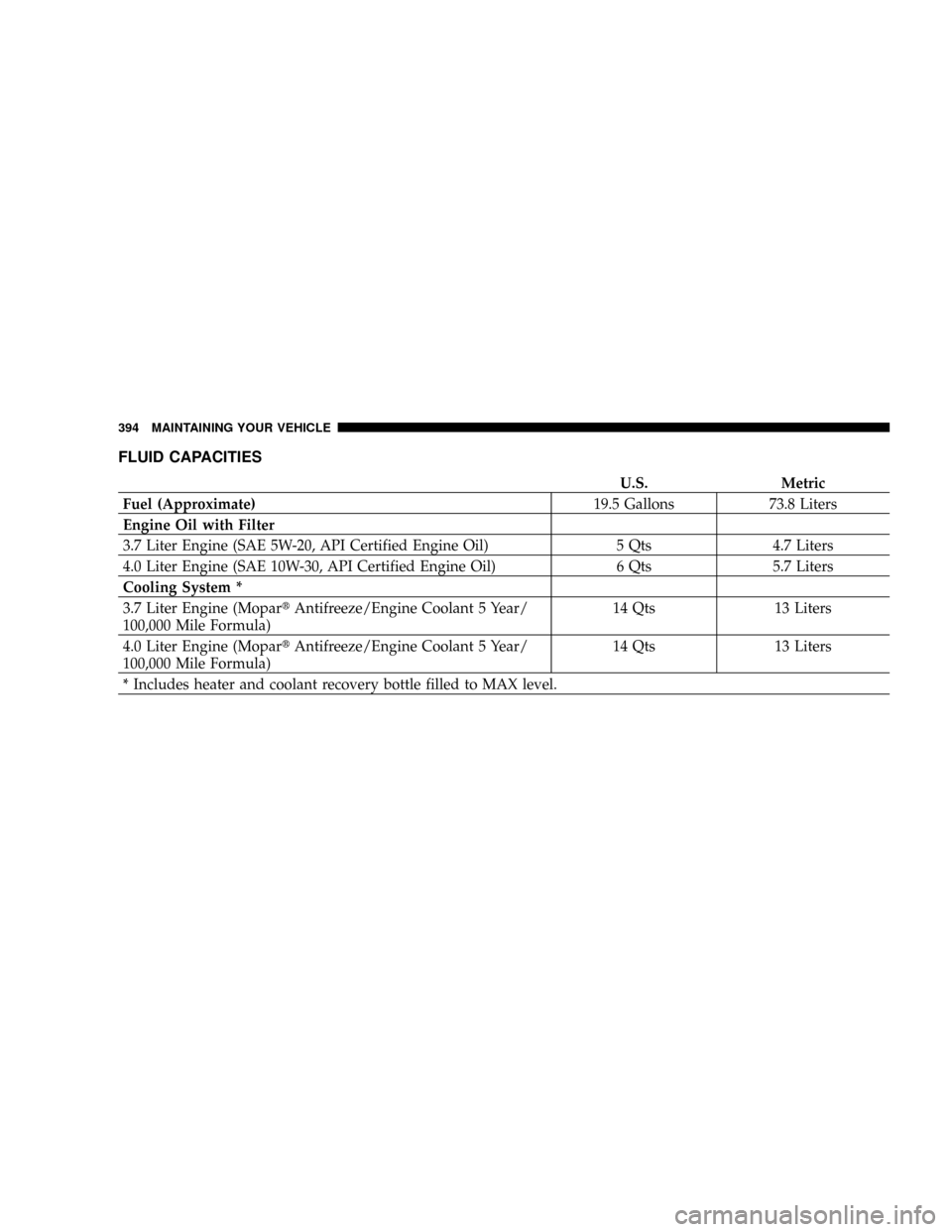
FLUID CAPACITIES
U.S. Metric
Fuel (Approximate)19.5 Gallons 73.8 Liters
Engine Oil with Filter
3.7 Liter Engine (SAE 5W-20, API Certified Engine Oil) 5 Qts 4.7 Liters
4.0 Liter Engine (SAE 10W-30, API Certified Engine Oil) 6 Qts 5.7 Liters
Cooling System *
3.7 Liter Engine (MopartAntifreeze/Engine Coolant 5 Year/
100,000 Mile Formula)14 Qts 13 Liters
4.0 Liter Engine (MopartAntifreeze/Engine Coolant 5 Year/
100,000 Mile Formula)14 Qts 13 Liters
* Includes heater and coolant recovery bottle filled to MAX level.
394 MAINTAINING YOUR VEHICLE
Page 418 of 434

Light............................... 153
Cargo Light............................ 153
Cargo Load Floor........................ 154
Cargo Slide Out System
LoadNGo ........................... 156
Cargo Tie-Downs........................ 153
Cargo (Vehicle Loading)................... 313
Catalytic Converter...................... 359
CD (Compact Disc) Player Maintenance........ 234
Cellular Phone.......................... 87
Center High Mounted Stop Light............ 393
Certification Label....................... 313
Changing A Flat Tire..................... 336
Charging.............................. 341
Chart, Tire Sizing........................ 280
Check Engine Light (Malfunction Indicator
Light)................................ 351
Checks, Safety.........................77,78
Child Restraint....................66,67,71,73Child Restraint Tether Anchors.............70,71
Child Safety Locks........................ 32
Climate Control......................... 235
Clock...........................199,215,226
Coin Holder........................... 152
Compact Disc (CD) Maintenance............. 234
Compass........................180,183,189
Compass Calibration..................183,190
Compass Variance....................182,190
Computer, Trip/Travel.................... 188
Console.............................. 152
Console, Floor.......................... 152
Contract, Service........................ 408
Converter, Catalytic...................... 359
Cooling System......................... 366
Adding Coolant (Antifreeze).............. 368
Coolant Capacity...................... 394
Coolant Level......................... 370
Disposal of Used Coolant................ 369
418 INDEX
Page 431 of 434

General Information.................... 287
High Speed.......................... 290
Inflation Pressures..................... 288
Jacking............................. 336
Life of Tires.......................... 292
Load Capacity.....................283,284
Pressure Monitor System (TPMS)........... 296
Quality Grading....................... 412
Radial.............................. 290
Replacement......................... 292
Rotation............................. 295
Safety............................78,279
Sizes............................... 280
Spare Tire........................... 337
Spinning............................ 290
Tread Wear Indicators................... 291
Tongue Weight/Trailer Weight.............. 323
Torque Converter Clutch................259,264
Towing............................... 315Disabled Vehicle....................... 343
Guide.............................. 320
Recreational.......................... 330
Weight.............................. 320
Traction Control......................132,173
Trailer Towing.......................... 315
Cooling System Tips.................... 330
Hitches............................. 319
Minimum Requirements................. 324
Trailer and Tongue Weight................ 323
Wiring.............................. 327
Trailer Towing Guide..................... 320
Trailer Weight.......................... 320
Transaxle............................. 252
Automatic........................... 252
Operation........................... 252
Transfer Case........................... 376
Fluid............................... 396
Maintenance.......................... 376
INDEX 431
10
Page 434 of 434

INTRODUCTION INTRODUCTION ROLLOVER WARNING HOW TO USE THIS MANUAL WARNINGS AND CAUTIONS VEHICLE IDENTIFICATION NUMBER VEHICLE MODIFICATIONS/ALTERATIONS THINGS TO KNOW BEFORE STARTING YOUR VEHICLE A WORD
ABOUT YOUR KEYS Ignition Key RemovalKey-In-Ignition ReminderSENTRY KEY Replacement KeysCustomer Key ProgrammingGeneral InformationSTEERING WHEEL LOCK - IF EQUIPPED To Manually Lock the Steering WheelTo Release the Steering Wheel Lock
SECURITY ALARM SYSTEM - IF EQUIPPED To Arm the SystemTo Disarm the SystemILLUMINATED ENTRY REMOTE KEYLESS ENTRY To Unlock the Doors and LiftgateTo Lock the Doors and LiftgateUsing the Panic AlarmProgramming Additional TransmittersBattery
ReplacementGeneral InformationREMOTE STARTING SYSTEM - IF EQUIPPED DOOR LOCKS Manual Door LocksPower Door LocksAutomatic Door LocksAutomatic Unlock Doors on ExitChild-Protection Door Lock System (Rear Doors)WINDOWS Power WindowsWind
BuffetingLIFTGATE OCCUPANT RESTRAINTS Lap/Shoulder BeltsLap/Shoulder Belt Operating InstructionsAdjustable Upper Shoulder Belt AnchorageAutomatic Locking Mode - If EquippedEnergy Management FeatureSeat Belt PretensionersEnhanced Seat Belt Use
Reminder System (BeltAlert)Seat Belts and Pregnant WomenSeat Belt ExtenderDriver And Front Passenger Supplemental Restraint Systems (SRS) ChildRestraintENGINE BREAK-IN RECOMMENDATIONS SAFETY TIPS Exhaust GasSafety Checks You Should Make
Inside The VehicleSafety Checks You Should Make Outside The VehicleUNDERSTANDING THE FEATURES OF YOUR VEHICLE MIRRORS Inside Day/Night MirrorAutomatic Dimming Mirror - If EquippedOutside MirrorsExterior Mirrors Folding FeaturePower Remote Control
MirrorsIlluminated Vanity Mirrors - If EquippedHANDS-FREE COMMUNICATION (UConnect) - IF EQUIPPED OperationPhone Call FeaturesUConnect System FeaturesAdvanced Phone ConnectivityThings You Should Know About Your UConnect SystemGeneral Information
SEATS Front Manual Seat AdjustmentFront Seat Adjustment - Recline6-Way Drivers Power Seat with Manual ReclinerFold Flat Front Passenger SeatHead RestraintsHeated Seats - If Equipped60/40 Split Folding Rear Seat with Fold Flat FeatureTO OPEN AND CLOSE
THE HOOD LIGHTS Interior LightsMulti-Function Control LeverParking Lights, Instrument Panel Lights, and HeadlightsLights-On ReminderHeadlight Dimmer SwitchPassing LightFront Fog Lights - If EquippedTurn SignalsDaytime Running Lights - If EquippedWINDSHIELD
WIPERS AND WASHERS Intermittent Wiper SystemWindshield Wiper OperationWindshield WashersMist FeatureTILT STEERING COLUMN ELECTRONIC SPEED CONTROL - IF EQUIPPED Electronic Speed Control OperationTo ActivateTo Set At A Desired SpeedTo
DeactivateTo Resume SpeedTo Vary The Speed SettingManual TransmissionTo Accelerate For PassingELECTRONIC BRAKE CONTROL SYSTEM ABS (Anti-Lock Brake System)TCS (Traction Control System)BAS (Brake Assist System)ERM (Electronic Roll Mitigation)
ESP (Electronic Stability Program)ESP/BAS Warning LampGARAGE DOOR OPENER - IF EQUIPPED Programming HomeLinkGate Operator/Canadian ProgrammingUsing HomeLinkReprogramming a Single HomeLink ButtonSecurityTroubleshooting TipsGeneral
InformationPOWER SUNROOF - IF EQUIPPED Opening Sunroof - ExpressClosing Sunroof - ExpressPinch Protect FeaturePinch Protect OverrideVenting Sunroof - ExpressSunshade OperationWind BuffetingSunroof MaintenanceELECTRICAL POWER OUTLET Electrical
Outlet Use With Engine OffPOWER INVERTER CUP HOLDERS STORAGE Front Storage CompartmentConsole Storage CompartmentCARGO AREA FEATURES Cargo LightCargo Tie-Down HooksCargo Load Floor - If EquippedRear Cargo Slide Out System (LOAD N
GO) - If EquippedREAR WINDOW FEATURES Rear Window Wiper/Washer - If EquippedRear Window Defroster - If EquippedROOF LUGGAGE RACK- NON FUNCTIONAL INSTRUMENT PANEL AND CONTROLS INSTRUMENT PANEL AND CONTROLS INSTRUMENT
CLUSTER INSTRUMENT CLUSTER DESCRIPTION COMPASS AND TRIP COMPUTER - IF EQUIPPED Control ButtonsTrip ConditionsCompass/Temperature DisplayELECTRONIC VEHICLE INFORMATION CENTER (EVIC) - IF EQUIPPED Electronic Vehicle Information
Center (EVIC) DisplaysOil Change RequiredTrip FunctionsCompass DisplayTelephone - If EquippedPersonal Settings (Customer Programmable Features)RADIO GENERAL INFORMATION Radio Broadcast SignalsTwo Types of SignalsElectrical DisturbancesAM Reception
FM ReceptionSALES CODE REQ - AM/FM STEREO RADIO AND 6-DISC CD/DVD CHANGER (MP3/WMA AUX JACK) Operating Instructions - Radio ModeOperation Instructions - (DISC MODE for CD and MP3/WMA Audio Play, DVD-VIDEO)Notes On Playing MP3/WMA
FilesLIST Button (DISC Mode for MP3/WMA Play)INFO Button (DISC Mode for MP3/WMA Play)SALES CODE RES - AM/FM STEREO RADIO WITH CD PLAYER (MP3 AUX JACK) Operating Instructions - Radio ModeOperation Instructions - CD MODE for CD and MP3
Audio PlayNotes On Playing MP3 FilesLIST Button (CD Mode for MP3 Play)INFO Button (CD Mode for MP3 Play)SALES CODE RER - AM/FM/CD/DVD RADIO WITH NAVIGATION SYSTEM - IF EQUIPPED Operating Instructions - Satellite RadioClock Setting Procedure
SATELLITE RADIO (RSC) - IF EQUIPPED (RER/REQ/REN RADIOS ONLY) System ActivationElectronic Serial Number/Sirius Identification Number (ENS/SID)Selecting Satellite ModeSatellite AntennaReception QualityOperating Instructions - Satellite ModeOperating
Instructions - Hands Free Phone (If Equipped)Operating Instructions - Video Entertainment System (VES) (If Equipped)VIDEO ENTERTAINMENT SYSTEM (SALES CODE XRV) - IF EQUIPPED REMOTE SOUND SYSTEM CONTROLS - IF EQUIPPED Radio Operation
CD PlayerCD/DVD DISC MAINTENANCE CLIMATE CONTROLS Manual Air Conditioning and Heating SystemOperating TipsSTARTING AND OPERATING STARTING PROCEDURES Manual TransmissionAutomatic TransmissionNormal StartingExtreme Cold Weather
(below -20 degrees F or -29 degrees C)If Engine Fails to StartAfter StartingENGINE BLOCK HEATER - IF EQUIPPED MANUAL TRANSMISSION - IF EQUIPPED 6-Speed Manual TransmissionAUTOMATIC TRANSMISSION Shift Lock Manual Override - If Equipped
Brake/Transmission Interlock System4-Speed Automatic Transmission (3.7L Engine)5-Speed Automatic Transmission (4.0L Engine)Gear RangesFOUR-WHEEL DRIVE OPERATION MP 143 Single-Speed Part-Time Transfer Case - If EquippedShifting Procedure -
Electronically Shifted Transfer CaseMP 140 Single-Speed Full-Time Transfer Case - If EquippedON-ROAD DRIVING TIPS OFF-ROAD DRIVING TIPS When To Use 4L or 4LO (Low) RangeDriving Through WaterDriving In Snow, Mud and SandHill ClimbingTraction Downhill
After Driving Off-RoadPARKING BRAKE ANTI-LOCK BRAKE SYSTEM POWER STEERING TIRE SAFETY INFORMATION Tire Markings Tire Identification Number (TIN)Tire Loading and Tire PressureTIRES - GENERAL INFORMATION Tire PressureTire Inflation Pressures
Tire Pressures for High Speed OperationRadial-Ply TiresTire SpinningTread Wear IndicatorsLife of TireReplacement TiresAlignment and BalanceTIRE CHAINS TIRE ROTATION RECOMMENDATIONS TIRE PRESSURE MONITOR SYSTEM (TPMS) - IF EQUIPPED Base
System - If EquippedPremium System - If EquippedGeneral InformationFUEL REQUIREMENTS 3.7L Engine (If Equipped)4.0L Engine (If Equipped)Reformulated GasolineGasoline/Oxygenate BlendsMMT In GasolineMaterials Added To FuelFuel System CautionsCarbon
Monoxide WarningsADDING FUEL Fuel Filler Cap (Gas Cap)Loose Fuel Filler Cap MessageVEHICLE LOADING Certification LabelTRAILER TOWING Common Towing DefinitionsTrailer Hitch ClassificationTrailer Towing Weights (Maximum Trailer Weight Ratings)Trailer
and Tongue WeightTowing RequirementsTowing TipsRECREATIONAL TOWING (BEHIND MOTORHOME, ETC.) Towing - 2WD ModelsTowing - 4WD or All-Wheel Drive ModelsWHAT TO DO IN EMERGENCIES HAZARD WARNING FLASHERS IF YOUR ENGINE
OVERHEATS JACKING AND TIRE CHANGING Jack LocationSpare Tire StowageSpare Tire RemovalPreparations For JackingJacking InstructionsJUMP STARTING TOWING A DISABLED VEHICLE Two-Wheel Drive VehiclesFour-Wheel Drive VehiclesMAINTAINING YOUR
VEHICLE ENGINE COMPARTMENT - 3.7L ENGINE COMPARTMENT - 4.0L ONBOARD DIAGNOSTIC SYSTEM - OBD II Loose Fuel Filler Cap MessageEMISSIONS INSPECTION ANDMAINTENANCE PROGRAMS REPLACEMENT PARTS DEALER SERVICE
MAINTENANCE PROCEDURES Engine OilDrive Belts - Check Condition and TensionSpark PlugsCatalytic ConverterCrankcase Emission Control SystemFuelFilterEngine Air Cleaner FilterMaintenance-Free BatteryAir Conditioner MaintenancePower Steering Fluid Check
Driveline And Steering Component LubricationBody LubricationWindshield Wiper BladesWindshield WashersExhaust SystemCooling SystemHoses andVacuum/Vapor HarnessesBrake SystemAutomatic TransmissionHydraulic Clutch Fluid - Manual TransmissionManual
TransmissionTransfer CaseFront/Rear Axle FluidAppearance Care And Protection From CorrosionFUSES (INTEGRATED POWER MODULE) REPLACEMENT LIGHTBULBS BULB REPLACEMENT Head LightLeft Front Turn SignalRight Front Turn SignalFront Side Marker
Front Fog Light (Front Fascia Mounted)Rear Tail, Stop, Turn Signal, and Back-Up LightsCenter High Mounted Stop Light (CHMSL)FLUID CAPACITIES FLUIDS, LUBRICANTS AND GENUINE PARTS EngineChassisMAINTENANCE SCHEDULES EMISSION CONTROL
SYSTEM MAINTENANCE MAINTENANCE SCHEDULE Required Maintenance IntervalsIF YOU NEED CONSUMER ASSISTANCE SUGGESTIONS FOR OBTAINING SERVICE FOR YOUR VEHICLE Prepare For The AppointmentPrepare A ListBe Reasonable With
RequestsIF YOU NEED ASSISTANCE WARRANTY INFORMATION (U.S. Vehicles Only) MOPAR PARTS REPORTING SAFETY DEFECTS In CanadaPUBLICATION ORDER FORMS DEPARTMENT OF TRANSPORTATION UNIFORM TIRE QUALITY GRADES Treadwear
Traction GradesTemperature GradesINDEX