Page 277 of 402

NOTE:Your vehicle is equipped with a compact spare
wheel and tire assembly.
1. The compact spare tire does not have a tire pressure
monitoring sensor. Therefore, the TPMS will not monitor
the tire pressure in the compact spare tire.
2. If you install the compact spare tire in place of a road
tire that has a pressure below the low-pressure warning
limit, upon the next ignition key cycle, a chime will
sound and the Tire Pressure Monitoring Telltale Light
will still turn ON due to the low tire.
3. However, after driving the vehicle for up to 10 min-
utes above 15 mph (25 km/h), the Tire Pressure Moni-
toring Telltale Light will flash on and off for 75 seconds
and then remain on solid.4. For each subsequent ignition key cycle, a chime will
sound and the Tire Pressure Monitoring Telltale Light
will flash on and off for 75 seconds and then remain on
solid.
5. Once you repair or replace the original road tire and
reinstall it on the vehicle in place of the compact spare
tire, the TPMS will update automatically and the Tire
Pressure Monitoring Telltale Light will turn OFF, as long
as no tire pressure is below the low-pressure warning
limit in any of the four active road tires. The vehicle may
need to be driven for up to 10 minutes above 15 mph (25
km/h) in order for the TPMS to receive this information.
Premium System — If Equipped
The TPMS uses wireless technology with wheel rim
mounted electronic sensors to monitor tire pressure lev-
els. Sensors, mounted to each wheel as part of the valve
stem, transmit tire pressure readings to the receiver
module.
STARTING AND OPERATING 275
5
Page 278 of 402

NOTE:It is particularly important for you to check the
tire pressure in all of your tires regularly and to maintain
the proper pressure.
The TPMS consists of the following components:
•Receiver Module
•Four Tire Pressure Monitoring Sensors
•Three Trigger Modules (mounted in three of the four
wheel wells)
•Various Tire Pressure Monitoring System Messages,
which display in the Electronic Vehicle Information
Center (EVIC)
•Yellow Tire Pressure Monitoring Telltale Light
Tire Pressure Monitoring Low Pressure Warnings
The Tire Pressure Monitoring Telltale Light will illumi-
nate in the instrument cluster and an audible chime will
be activated when one or more of the four active road tirepressures are low. The audible chime will sound once
every ignition cycle for each condition that it detects. In
addition, the EVIC will display a graphic of the pressure
value(s) with the low tire(s) flashing.
Should a low tire condition occur on any of the four
active road tire(s), you should stop as soon as possibleLow Tire Pressure Display
276 STARTING AND OPERATING
Page 280 of 402

will be displayed instead of dashes. A system fault can
occur with any of the following scenarios:
1. Jamming due to electronic devices or driving next to
facilities emitting the same radio frequencies as the TPM
sensors.
2. Installing some form of aftermarket window tinting
that affects radio wave signals.
3. Snow or ice around the wheels or wheel housings.
4. Using tire chains on the vehicle.
5. Using wheels/tires not equipped with TPM sensors.
NOTE:Your vehicle is equipped with a compact spare
wheel and tire assembly.
1. The compact spare tire does not have a tire pressure
monitoring sensor. Therefore, the TPMS will not monitor
the tire pressure in the compact spare tire.2. If you install the compact spare tire in place of a road
tire that has a pressure below the low-pressure warning
limit, upon the next ignition key cycle, a chime will
sound and the Tire Pressure Monitoring Telltale Light
will still turn ON due to the low tire.
3. However, after driving the vehicle for up to 10 min-
utes above 15 mph (25 km/h), the Tire Pressure Moni-
toring Telltale Light will flash on and off for 75 seconds
and then remain on solid.
4. For each subsequent ignition key cycle, a chime will
sound and the Tire Pressure Monitoring Telltale Light
will flash on and off for 75 seconds and then remain on
solid.
5. Once you repair or replace the original road tire and
reinstall it on the vehicle in place of the compact spare
tire, the TPMS will update automatically and the Tire
Pressure Monitoring Telltale Light will turn OFF, as long
as no tire pressure is below the low-pressure warning
278 STARTING AND OPERATING
Page 293 of 402

Trailer Towing Weights (Maximum Trailer Weight Ratings)
The following chart provides the maximum trailer weight ratings towable for your given drivetrain.
Engine/Transmission Frontal Area Max. GTW
(Gross Trailer Wt.)Max. Tongue Wt.
(See Note 1)
2.0L Auto 22 sq ft (2.04 sq m) 1000 lbs (450 kg) 150 lbs (50 kg)
2.4L Auto 22 sq ft (2.04 sq m) 1000 lbs (450 kg) 150 lbs (50 kg)
1.8L Manual 22 sq ft (2.04 sq m) 1000 lbs (450 kg) 150 lbs (50 kg)
2.4L Auto/Man with
Trailer Tow Prep Package
(AHC)32 sq ft (3.0 sq m) 2000 lbs (907 kg) 300 lbs (136 kg)
Refer to local laws for maximum trailer towing speeds.
Note 1 – The trailer tongue weight must be considered as
part of the combined weight of occupants and cargo and
should never exceed the weight referenced on the Tire
and Loading Information placard. Refer to “Tire–Safety
Information” under “Starting and Operating” in Section
5.
Trailer And Tongue Weight
Always load a trailer with 60% to 65% of the weight in
the front of the trailer. This places 10% to 15% of the GTW
on the tow hitch of your vehicle. Loads balanced over the
wheels or heavier in the rear can cause the trailer to sway
STARTING AND OPERATING 291
5
Page 296 of 402

•Safety chains must always be used between your
vehicle and trailer. Always connect the chains to the
frame or hook retainers of the vehicle hitch. Cross the
chains under the trailer tongue and allow enough
slack for turning corners.
•Vehicles with trailers should not be parked on a grade.
When parking, apply the parking brake on the tow
vehicle. Put the tow vehicle automatic transmission in
PARK. With a manual transmission, shift the transmis-
sion into REVERSE. Always block or�chock�the trailer
wheels.
•GCWR must not be exceeded.
•Total weight must be distributed between the tow
vehicle and the trailer such that the following four
ratings are not exceeded:
1. GVWR
2. GTW3. GAWR
4. Tongue weight rating for the trailer hitch utilized
(this requirement may limit the ability to always
achieve the 10% to 15% range of tongue weight as a
percentage of total trailer weight).
Towing Requirements — Tires
Do not attempt to tow a trailer while using a compact
spare tire.
Proper tire inflation pressures are essential to the safe
and satisfactory operation of your vehicle. Refer to the
“Tires–General Information” section of this manual
under Tire Pressures for proper tire inflation proce-
dures.
Also, check the trailer tires for proper tire inflation
pressures before trailer usage.
294 STARTING AND OPERATING
Page 301 of 402
RECREATIONAL TOWING (BEHIND MOTORHOME, ETC.)
Towing This Vehicle Behind Another Vehicle (Flat Towing With All Four Wheels On The Ground)
Recreational Towing Chart
Recreational Towing Condition Manual Transmission Vehicles Automatic Transmission Vehicles
Four Wheel Flat Tow (all wheels on
ground)Yes Never
Two Wheel Dolly Tow (rear wheels
on ground)Never Never
Flat Bed Tow (all wheels on bed of
truck)Ye s Ye s
NOTE: ONLYvehicles equipped withMANUAL
TRANSAXLESmay be recreationally towed (flat towed)
at any legal highway speed, for any distance, if the
MANUAL TRANSAXLEis inNEUTRALand the igni-
tion key is in the ACC position.
STARTING AND OPERATING 299
5
Page 302 of 402
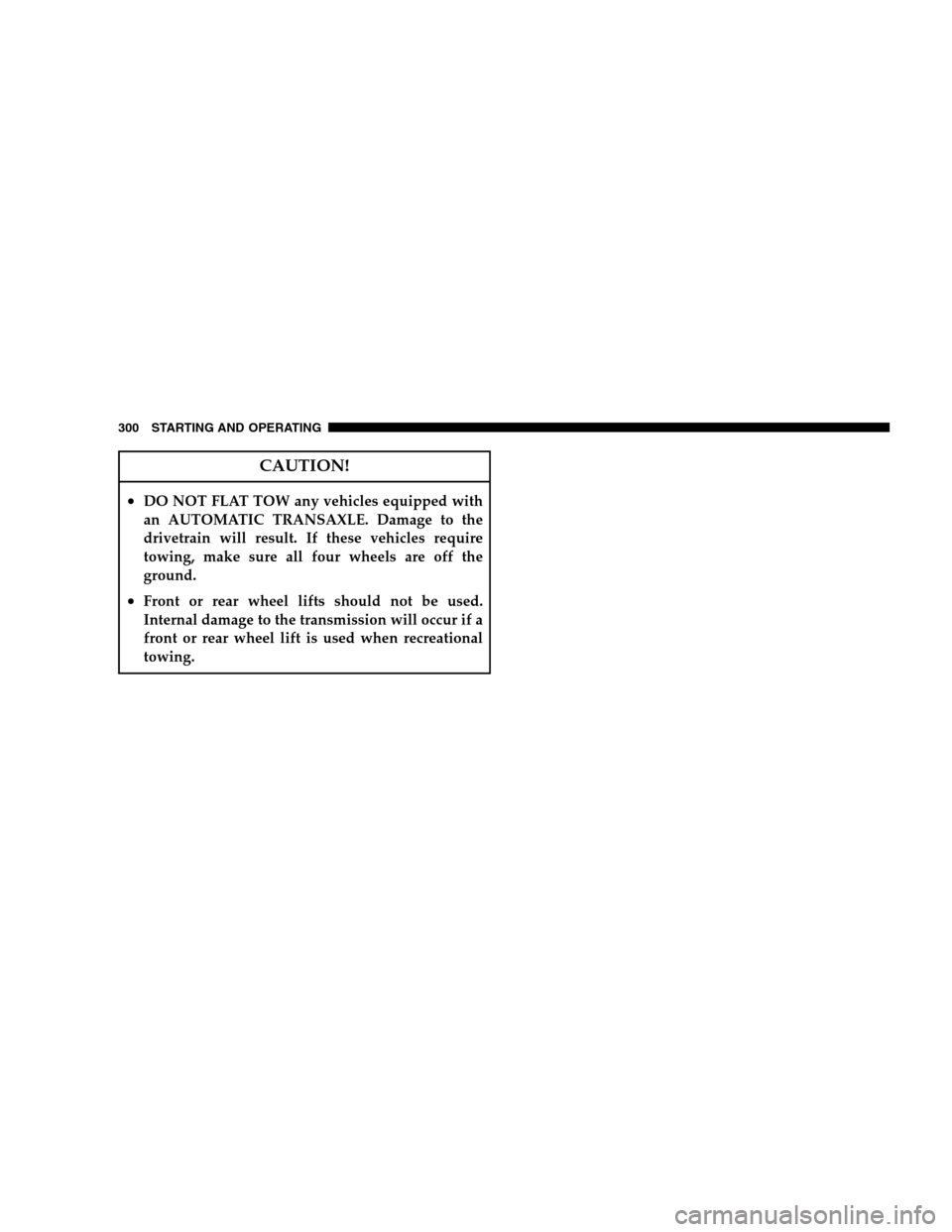
CAUTION!
•DO NOT FLAT TOW any vehicles equipped with
an AUTOMATIC TRANSAXLE. Damage to the
drivetrain will result. If these vehicles require
towing, make sure all four wheels are off the
ground.
•Front or rear wheel lifts should not be used.
Internal damage to the transmission will occur if a
front or rear wheel lift is used when recreational
towing.
300 STARTING AND OPERATING
Page 307 of 402
Jack Location
The jack and jack-handle are stowed under the load floor
in the cargo area.
Spare Tire Stowage
The compact spare tire is stowed under the rear load floor
in the cargo area.
Spare Tire Removal
Lift up the load floor cover and remove the hold down.
Preparations For Jacking
Park the vehicle on a firm level surface, avoiding ice or
slippery areas,set the parking brakeand place the shift
lever in PARK (automatic transaxle) or REVERSE
(manual transaxle). Turn OFF the ignition.
WARNING!
Do not attempt to change a tire on the side of the
vehicle close to moving traffic. Pull far enough off
the road to avoid the danger of being hit when
operating the jack or changing the wheel.
Spare Tire and Jack Stowage
WHAT TO DO IN EMERGENCIES 305
6