Page 235 of 402

STARTING PROCEDURES
Before starting your vehicle, adjust your seat, adjust both
inside and outside mirrors, and fasten your seat belts.
WARNING!
Never leave children alone in a vehicle. Leaving
unattended children in a vehicle is dangerous for a
number of reasons. A child or others could be seri-
ously or fatally injured. Don’t leave the key in the
ignition. A child could operate power windows,
other controls, or move the vehicle.
Manual Transmission
Before starting the engine fully apply the parking brake,
press the clutch pedal to the floor, and place the shift
lever in NEUTRAL.NOTE:The engine will not start unless the clutch pedal
is pressed to the floor.
NOTE:If the key won’t turn and the steering wheel is
locked, rotate the wheel in either direction to relieve
pressure on the locking mechanism and then turn the
key.
Automatic Transmission
The shift lever must be in the PARK or NEUTRAL
position before you can start the engine. Apply the brakes
before shifting to any driving gear.
NOTE:You must press the brake pedal before shifting
out of PARK.
Normal Starting
Normal starting of either a cold or a warm engine does
not require pumping or depressing the accelerator pedal.
Simply turn the ignition switch to the START position
and release when the engine starts. If the engine fails to
STARTING AND OPERATING 233
5
Page 241 of 402

REVERSE
Shift into this range only after the vehicle has come to a
complete stop.
NEUTRAL
The engine may be started in this range.
DRIVE
This should be used for most driving and provides the
best ratio for optimum drivability, fuel economy, and
performance.
LOW
This range should be used for maximum engine braking
when descending steep grades. In this range, the trans-
axle will ratio up only to prevent transaxle damage or
engine over speed while ratio down will occur as early as
possible
AUTOSTICK�— IF EQUIPPED
Autostick�is a driver-interactive transmission that offers
six manual ratio changes to provide you with more
control. Autostick�allows you to maximize engine brak-
ing, eliminate undesirable upshifts and downshifts, and
improve overall vehicle performance. This system can
also provide you with more control during passing, city
driving, cold slippery conditions, mountain driving,
trailer towing, and many other situations. Automatic
ratio changes upward will only occur to protect the
Continuously Variable Automatic Transaxle (CVT)
and/or the engine from overspeed. Changes down will
only happen at minimum engine speed to prevent stall-
ing.
STARTING AND OPERATING 239
5
Page 242 of 402
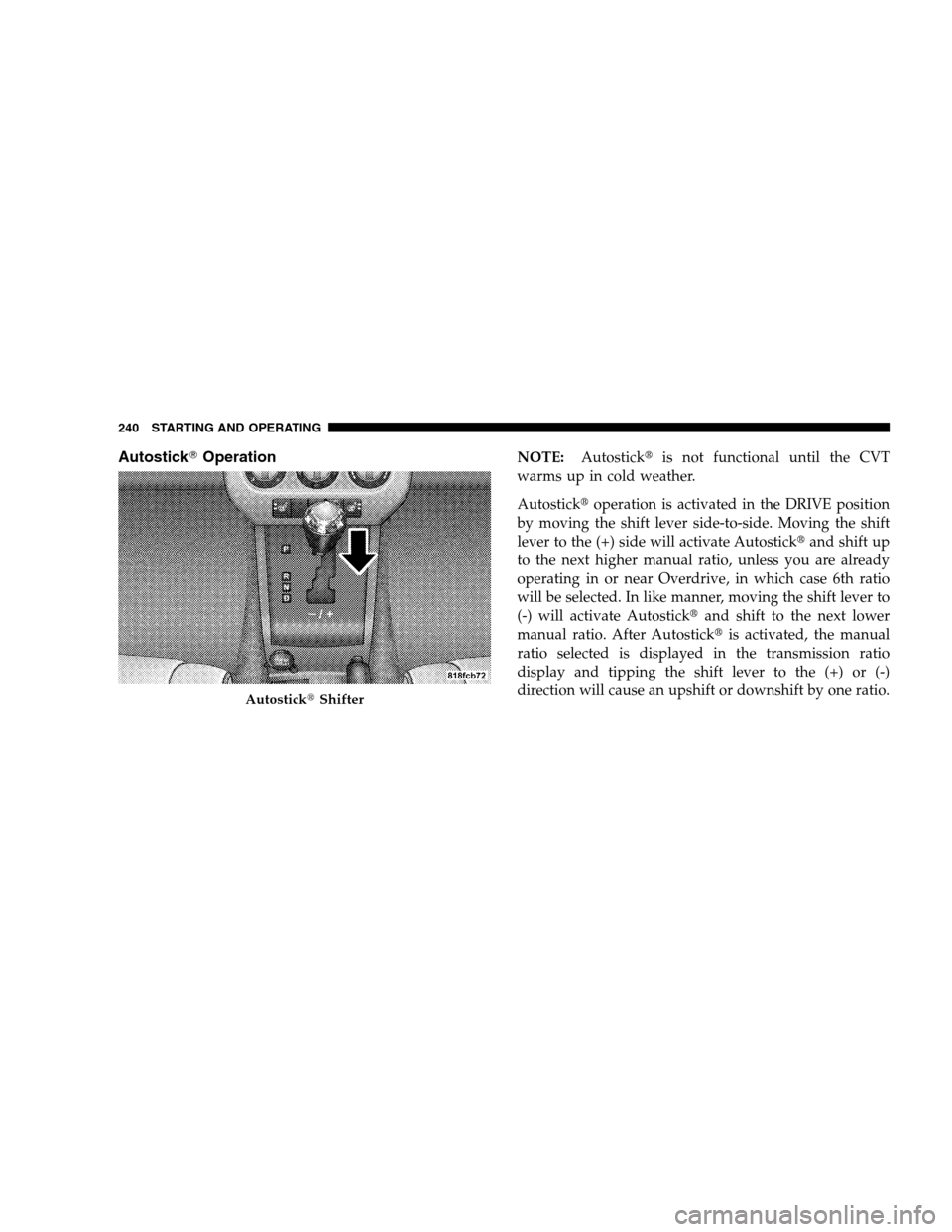
Autostick�OperationNOTE:Autostick�is not functional until the CVT
warms up in cold weather.
Autostick�operation is activated in the DRIVE position
by moving the shift lever side-to-side. Moving the shift
lever to the (+) side will activate Autostick�and shift up
to the next higher manual ratio, unless you are already
operating in or near Overdrive, in which case 6th ratio
will be selected. In like manner, moving the shift lever to
(-) will activate Autostick�and shift to the next lower
manual ratio. After Autostick�is activated, the manual
ratio selected is displayed in the transmission ratio
display and tipping the shift lever to the (+) or (-)
direction will cause an upshift or downshift by one ratio.
Autostick�Shifter
240 STARTING AND OPERATING
Page 243 of 402

Autostick�is deactivated:
•By holding the shift lever to (+) momentarily
•When the shift lever is shifted out of DRIVE
•When in 6th position, touching the shift lever to the
right
•When heavy Anti-Lock Brake System (ABS) applica-
tion is detected
Autostick�General Information
•
If a ratio other than 1st is selected and the vehicle is
brought to a stop, the transaxle control logic will
automatically select the 1st gear ratio.
•If a low range is selected and the engine accelerates to
the rev limit, the transaxle will automatically select the
next higher ratio.
•If a downshift would cause the engine to overspeed,
that shift will not occur until it is safe for the engine.
However. the CVT will stay in the manually selected
ratio.
•If the system detects powertrain overheating, the
transmission will revert to the automatic shift mode
and remain in that mode until the powertrain cools off.
•If the system detects a problem, it will disable the
Autostick�mode and the transmission will return to
the automatic mode until the problem is corrected.
STARTING AND OPERATING 241
5
Page 245 of 402

For most city driving, you will find it easier to use only
the lower gears. For steady highway driving with light
accelerations, 5th gear is recommended.
Never drive with your foot resting on the clutch pedal,
and never try to hold the vehicle on a hill with the clutch
pedal partially engaged. This will cause abnormal wear
on the clutch.
Never shift into REVERSE until the vehicle has come to a
complete stop.
NOTE:During cold weather, until the transaxle lubri-
cant is warm, you may experience slightly higher shift
efforts. This is normal and not harmful to the transaxle.
Recommended Shift Speeds
To use your manual transaxle for optimal fuel economy,
it should be upshifted as listed in the following table.
Manual Transaxle Recommended Shift Speeds
Units in mph (km/h)
Engine
SizeAccel-
eration
Rate1to2 2to3 3to4 4to5
All En-
ginesAccel 14 (23) 23 (37) 29 (47) 45 (72)
Cruise 12 (19) 18 (29) 25 (40) 32 (52)
Downshifting
Proper downshifting will improve fuel economy and
prolong engine life.
CAUTION!
If you skip more than one gear while downshifting
or downshift at too high a vehicle speed, you could
damage the engine, transmission, or clutch.
STARTING AND OPERATING 243
5
Page 247 of 402
Before leaving the vehicle, make sure that the parking
brake is set. To set the parking brake, pull up firmly on
the lever. Also, place the shift lever in the PARK position
(automatic transmission) or REVERSE position (manual
transmission). To release the parking brake, apply the
brake pedal, pull up slightly on the lever, then depress
the button on the end of the lever and push the lever fully
down toward the floor.
NOTE:The parking brake lever will not release unless
the lever is pulled up slightly past its applied position.
When parking on a hill, it is important to set the parking
brake before placing the shift lever in PARK, otherwise,
the load on the automatic transmission locking mecha-
nism may make it difficult to move the shift lever out of
Parking Brake Lever
STARTING AND OPERATING 245
5
Page 293 of 402

Trailer Towing Weights (Maximum Trailer Weight Ratings)
The following chart provides the maximum trailer weight ratings towable for your given drivetrain.
Engine/Transmission Frontal Area Max. GTW
(Gross Trailer Wt.)Max. Tongue Wt.
(See Note 1)
2.0L Auto 22 sq ft (2.04 sq m) 1000 lbs (450 kg) 150 lbs (50 kg)
2.4L Auto 22 sq ft (2.04 sq m) 1000 lbs (450 kg) 150 lbs (50 kg)
1.8L Manual 22 sq ft (2.04 sq m) 1000 lbs (450 kg) 150 lbs (50 kg)
2.4L Auto/Man with
Trailer Tow Prep Package
(AHC)32 sq ft (3.0 sq m) 2000 lbs (907 kg) 300 lbs (136 kg)
Refer to local laws for maximum trailer towing speeds.
Note 1 – The trailer tongue weight must be considered as
part of the combined weight of occupants and cargo and
should never exceed the weight referenced on the Tire
and Loading Information placard. Refer to “Tire–Safety
Information” under “Starting and Operating” in Section
5.
Trailer And Tongue Weight
Always load a trailer with 60% to 65% of the weight in
the front of the trailer. This places 10% to 15% of the GTW
on the tow hitch of your vehicle. Loads balanced over the
wheels or heavier in the rear can cause the trailer to sway
STARTING AND OPERATING 291
5
Page 295 of 402

Towing Requirements
To promote proper break-in of your new vehicle driv-
etrain components, the following guidelines are recom-
mended:
CAUTION!
•Avoid towing a trailer for the first 500 mi (805 km)
of vehicle operation. Doing so may damage your
vehicle.
•During the first 500 mi (805 km) of trailer towing,
limit your speed to 50 mph (80 km/h).
Perform the maintenance listed in Section 8 of this
manual. When towing a trailer, never exceed the GAWR
or GCWR ratings.
WARNING!
Improper towing can lead to an injury accident.
Follow these guidelines to make your trailer towing
as safe as possible:
Make certain that the load is secured in the trailer
and will not shift during travel. When trailering
cargo that is not fully secured, dynamic load shifts
can occur that may be difficult for the driver to
control. You could lose control of your vehicle and
have an accident.
•When hauling cargo or towing a trailer, do not over-
load your vehicle or trailer. Overloading can cause a
loss of control, poor performance or damage to the
brakes, axle, engine, transmission, steering, suspen-
sion, chassis structure or tires.
STARTING AND OPERATING 293
5