2008 CHRYSLER TOWN AND COUNTRY suspension
[x] Cancel search: suspensionPage 369 of 531
WARNING!
²DO NOT use a tire, wheel size or rating other than that
specified for your vehicle. Some combinations of un-
approved tires and wheels may change suspension
dimensions and performance characteristics, resulting
in changes to steering, handling, and braking of your
vehicle. This can cause unpredictable handling and
stress to steering and suspension components. You
could lose control and have an accident resulting in
serious injury or death. Use only the tire and wheel
sizes with load ratings approved for your vehicle.
²NEVER use a tire with a smaller load index or capacity,
other than what was originally equipped on your
vehicle. Using a tire with a smaller load index could
result in tire overloading and failure. You could lose
control and have an accident.
²Failure to equip your vehicle with tires having ad-
equate speed capability can result in sudden tire fail-
ure and loss of vehicle control.
CAUTION!
Replacing original tires with tires of a different size
may result in false speedometer and odometer
readings.
Alignment and Tire Balance
Poor suspension alignment may result in:
²Fast tire wear.
²Uneven tire wear, such as feathering and one-sided
wear.
²Vehicle pull to right or left.
Tires may also cause the vehicle to pull to the left or right.
Alignment will not correct this condition. See your
authorized dealer for proper diagnosis.
STARTING AND OPERATING 367
5
Page 370 of 531
Improper alignment will not cause vehicle vibration.
Vibration may be a result of tire and wheel out-of-
balance. Proper balancing will reduce vibration and
avoid tire cupping and spotty wear.
TIRE CHAINS
Use only compact chains, or other traction aids that meet
SAE type ªClass Sº specifications. Chains must be the
proper size for the vehicle, as recommended by the chain
manufacturer.
NOTE:Do not use tire chains on a compact spare tire.
CAUTION!
To avoid damage to your vehicle or tires, observe the following
precautions:
²Because of restricted chain clearance between tires and other
suspension components, it is important that only chains in
good condition are used. Broken chains can cause serious
damage. Stop the vehicle immediately if noise occurs that
could indicate chain breakage. Remove the damaged parts of
the chain before further use.
²Do not exceed 45 mph (70 km/h).
²Drive cautiously and avoid severe turns and large bumps,
especially with a loaded vehicle.
²Install chains on the front wheels as tightly as possible and
then retighten after driving about oneÐhalf mile (0.8 km).
²Do not drive for prolonged period on dry pavement.
²Observe the tire chain manufacturer's instructions on the
method of installation, operating speed, and conditions for
use. Always use the lower suggested operating speed of the
chain manufacturer if different from the speed recommended
by the manufacturer.
368 STARTING AND OPERATING
Page 394 of 531
Overloading
The load carrying components (axle, springs, tires,
wheels, etc.) of your vehicle will provide satisfactory
service as long as you do not exceed the GVWR and front
and rear GAWR.
The best way to figure out the total weight of your
vehicle is to weigh it when it is fully loaded and ready for
operation. Weigh it on a commercial scale to ensure that
it is not over the GVWR.
Figure out the weight on the front and rear of the vehicle
separately. It is important that you distribute the load
evenly over the front and rear axles.
Overloading can cause potential safety hazards and
shorten useful service life. Heavier axles or suspension
components do not necessarily increase the vehicle's
GVWR.
Loading
To load your vehicle properly, first figure out its empty
weight, axle by axle and side by side. Store heavier items
down low and be sure you distribute their weight as
evenly as possible. Stow all loose items securely before
driving. If weighing the loaded vehicle shows that you
have exceeded either GAWR, but the total load is within
the specified GVWR, you must redistribute the weight.
Improper weight distribution can have an adverse effect
on the way your vehicle steers and handles and the way
the brakes operate.
392 STARTING AND OPERATING
Page 404 of 531
WARNING!
Improper towing can lead to an injury accident.
Follow these guidelines to make your trailer towing
as safe as possible:
Make certain that the load is secured in the trailer
and will not shift during travel. When trailering
cargo that is not fully secured, dynamic load shifts
can occur that may be difficult for the driver to
control. You could lose control of your vehicle and
have an accident.
²When hauling cargo or towing a trailer, do not over-
load your vehicle or trailer. Overloading can cause a
loss of control, poor performance or damage to brakes,
axle, engine, transmission, steering, suspension, chas-
sis structure or tires.
²Safety chains must always be used between your
vehicle and trailer. Always connect the chains to the
frame or hook retainers of the vehicle hitch. Cross the
chains under the trailer tongue and allow enough
slack for turning corners.
²Vehicles with trailers should not be parked on a grade.
When parking, apply the parking brake on the tow
vehicle. Put the tow vehicle automatic transmission in
PARK. Always, block or9chock9the trailer wheels.
²GCWR must not be exceeded.
²Total weight must be distributed between the tow
vehicle and the trailer such that the following four
ratings are not exceeded:
1. GVWR
2. GTW
3. GAWR
402 STARTING AND OPERATING
Page 432 of 531
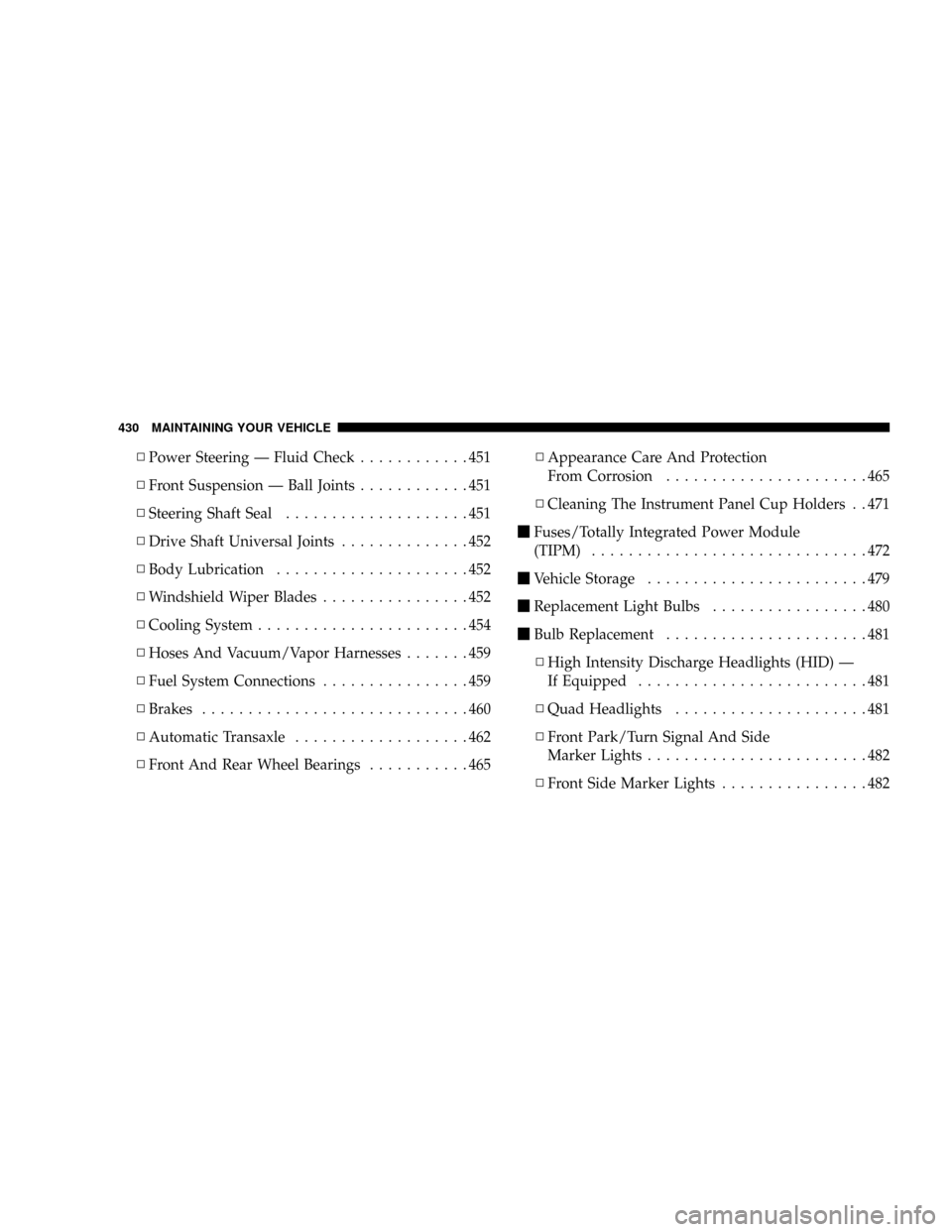
NPower Steering Ð Fluid Check............451
NFront Suspension Ð Ball Joints............451
NSteering Shaft Seal....................451
NDrive Shaft Universal Joints..............452
NBody Lubrication.....................452
NWindshield Wiper Blades................452
NCooling System.......................454
NHoses And Vacuum/Vapor Harnesses.......459
NFuel System Connections................459
NBrakes.............................460
NAutomatic Transaxle...................462
NFront And Rear Wheel Bearings...........465NAppearance Care And Protection
From Corrosion......................465
NCleaning The Instrument Panel Cup Holders . . 471
mFuses/Totally Integrated Power Module
(TIPM)..............................472
mVehicle Storage........................479
mReplacement Light Bulbs.................480
mBulb Replacement......................481
NHigh Intensity Discharge Headlights (HID) Ð
If Equipped.........................481
NQuad Headlights.....................481
NFront Park/Turn Signal And Side
Marker Lights........................482
NFront Side Marker Lights................482
430 MAINTAINING YOUR VEHICLE
Page 453 of 531
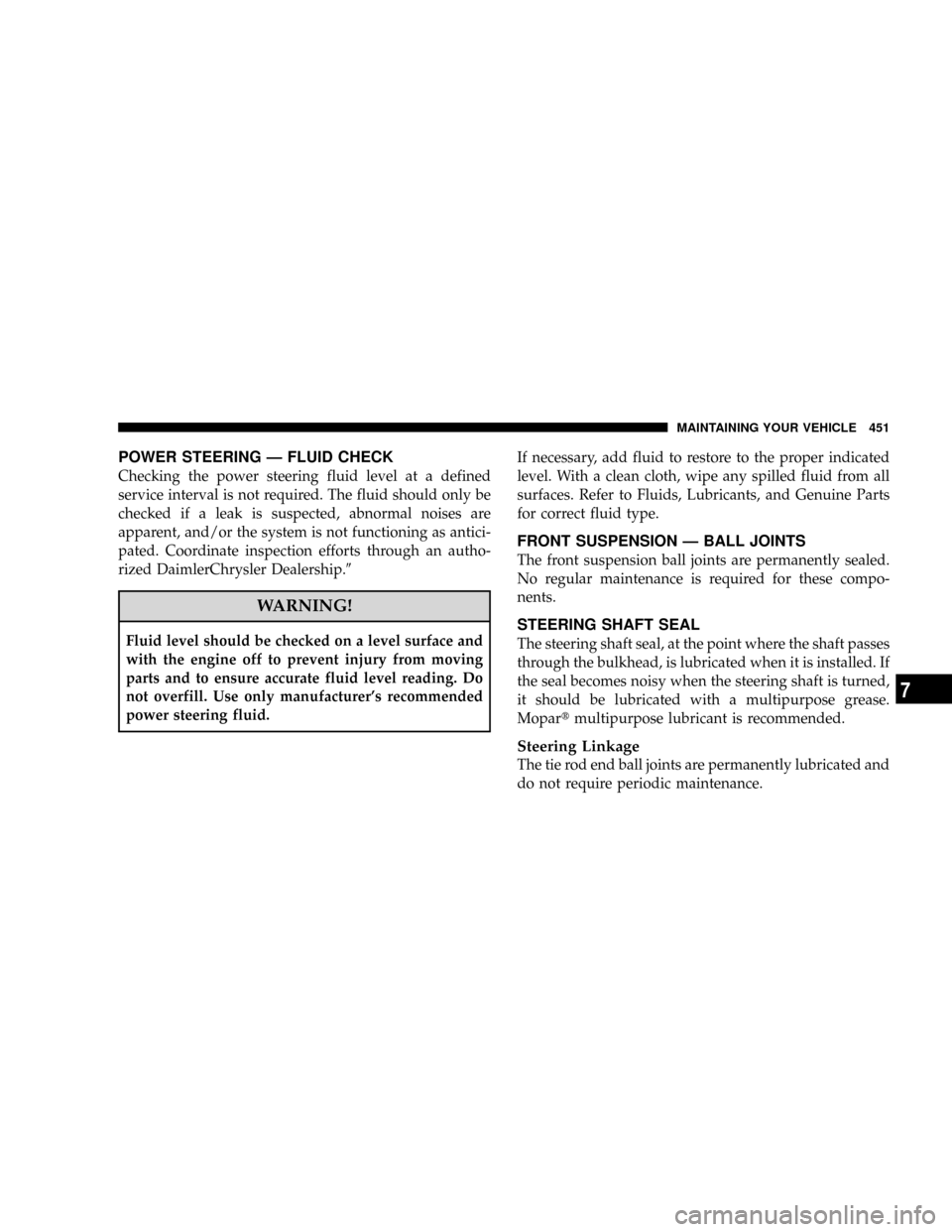
POWER STEERING Ð FLUID CHECK
Checking the power steering fluid level at a defined
service interval is not required. The fluid should only be
checked if a leak is suspected, abnormal noises are
apparent, and/or the system is not functioning as antici-
pated. Coordinate inspection efforts through an autho-
rized DaimlerChrysler Dealership.9
WARNING!
Fluid level should be checked on a level surface and
with the engine off to prevent injury from moving
parts and to ensure accurate fluid level reading. Do
not overfill. Use only manufacturer's recommended
power steering fluid.If necessary, add fluid to restore to the proper indicated
level. With a clean cloth, wipe any spilled fluid from all
surfaces. Refer to Fluids, Lubricants, and Genuine Parts
for correct fluid type.
FRONT SUSPENSION Ð BALL JOINTS
The front suspension ball joints are permanently sealed.
No regular maintenance is required for these compo-
nents.
STEERING SHAFT SEAL
The steering shaft seal, at the point where the shaft passes
through the bulkhead, is lubricated when it is installed. If
the seal becomes noisy when the steering shaft is turned,
it should be lubricated with a multipurpose grease.
Mopartmultipurpose lubricant is recommended.
Steering Linkage
The tie rod end ball joints are permanently lubricated and
do not require periodic maintenance.
MAINTAINING YOUR VEHICLE 451
7
Page 495 of 531
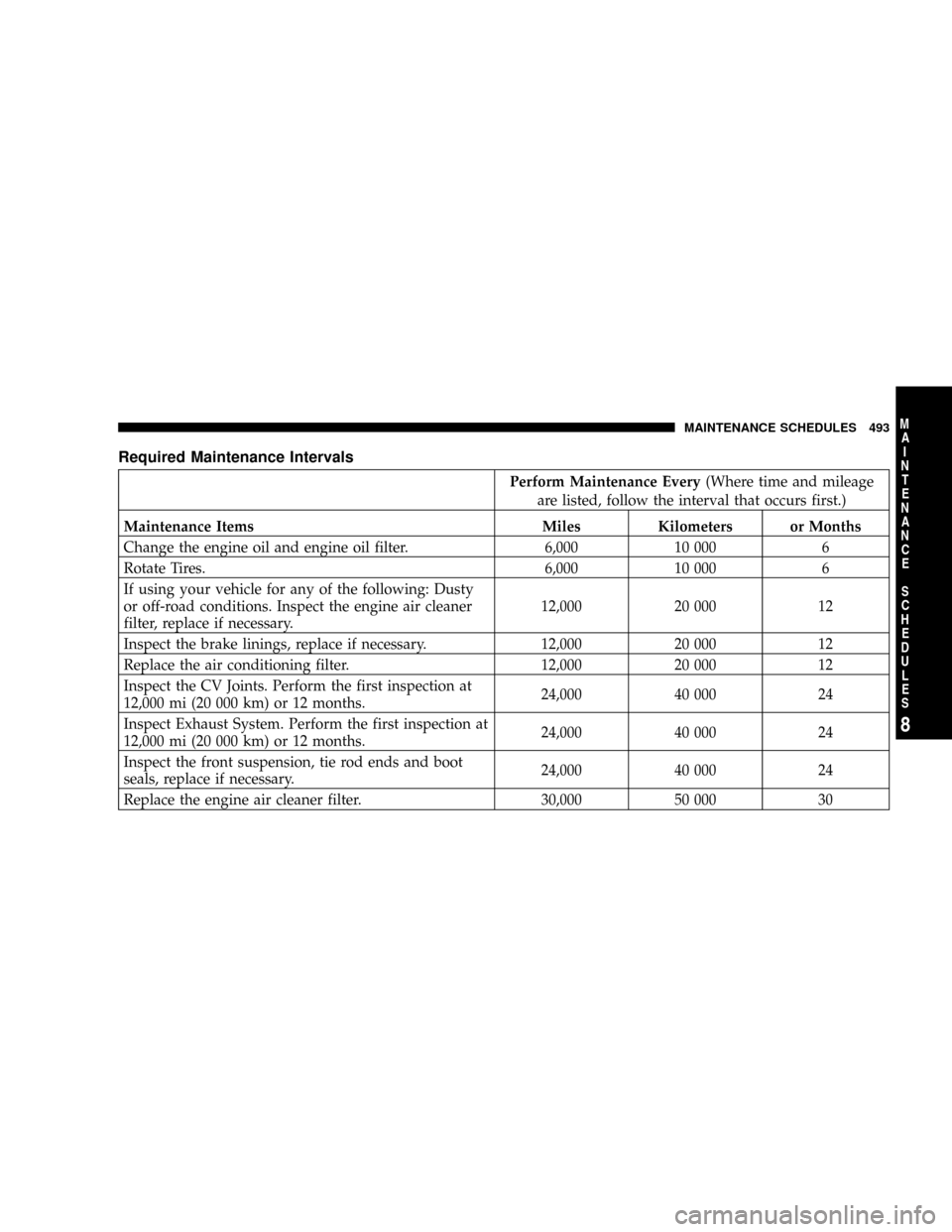
Required Maintenance Intervals
Perform Maintenance Every(Where time and mileage
are listed, follow the interval that occurs first.)
Maintenance Items Miles Kilometers or Months
Change the engine oil and engine oil filter. 6,000 10 000 6
Rotate Tires. 6,000 10 000 6
If using your vehicle for any of the following: Dusty
or off-road conditions. Inspect the engine air cleaner
filter, replace if necessary.12,000 20 000 12
Inspect the brake linings, replace if necessary. 12,000 20 000 12
Replace the air conditioning filter. 12,000 20 000 12
Inspect the CV Joints. Perform the first inspection at
12,000 mi (20 000 km) or 12 months.24,000 40 000 24
Inspect Exhaust System. Perform the first inspection at
12,000 mi (20 000 km) or 12 months.24,000 40 000 24
Inspect the front suspension, tie rod ends and boot
seals, replace if necessary.24,000 40 000 24
Replace the engine air cleaner filter. 30,000 50 000 30
MAINTENANCE SCHEDULES 493
8
M
A
I
N
T
E
N
A
N
C
E
S
C
H
E
D
U
L
E
S