Page 295 of 494

Shallow Standing Water
Although your vehicle is capable of driving through
shallow standing water, consider the following Caution
and Warning before doing so.
CAUTION!
•Always check the depth of the standing water
before driving through it. Never drive through
standing water that is deeper than the bottom of
the tire rims mounted on the vehicle.
•Determine the condition of the road or the path
that is under water, and if there are any obstacles
in the way, before driving through the standing
water.
•Do not exceed 5 mph (8 km/h) when driving
through standing water. This will minimize wave
effects.
CAUTION!
•Driving through standing water may cause dam-
age to your vehicle’s drivetrain components. Al-
ways inspect your vehicle’s fluids (i.e., engine oil,
transmission, axle, etc.) for signs of contamination
(i.e., fluid that is milky or foamy in appearance)
after driving through standing water. Do not con-
tinue to operate the vehicle if any fluid appears
contaminated, as this may result in further dam-
age. Such damage is not covered by the New
Vehicle Limited Warranty.
•Getting water inside your vehicle’s engine can
cause it to lock up and stall out, and cause serious
internal damage to the engine. Such damage is not
covered by the New Vehicle Limited Warranty.
STARTING AND OPERATING 293
5
Page 332 of 494
For best results, a refueling pattern that alternates be-
tween E-85 and unleaded gasoline should be avoided.
When you do switch fuels, it is recommended that:
•you do not switch when the fuel gauge indicates less
than14full
•you do not add less than 5 gallons when refueling
•you operate the vehicle immediately after refueling for
a period of at least 5 minutes
Observing these precautions will avoid possible hard
starting and/or significant deterioration in drivability
during warm up.
NOTE:When the ambient temperature is above 90° F
(32° C), you may experience hard starting and rough idle
following start up even if the above recommendations are
followed.
Selection Of Engine Oil For Flexible Fuel Vehicles
(E-85) and Gasoline Vehicles
FFV vehicles operated on E85 require specially formu-
lated engine oils. These special requirements are included
in Mopar�engine oils, and in equivalent oils meeting
DaimlerChrysler Specification MS-6395. The manufac-
turer only recommends engine oils that are API Certified
and meet the requirements of Material Standard MS-
6395. MS-6395 contains additional requirements, devel-
oped during extensive fleet testing, to provide additional
protection to DaimlerChrysler Corporation engines. Use
Mopar�or an equivalent oil meeting the specification
MS-6395.
NOTE:Your engine oil filler cap also describes the
correct engine oil to use.
330 STARTING AND OPERATING
Page 353 of 494
WHAT TO DO IN EMERGENCIES
CONTENTS
�Hazard Warning Flasher..................353
�If Your Engine Overheats.................353
▫Engine Oil Overheating — 2.4L Engine Only
(If Equipped)........................355
�Jacking And Tire Changing................356
▫Jack Location........................356
▫Spare Tire Stowage....................356
▫Spare Tire Removal....................356
▫Preparations For Jacking................357▫Jacking Instructions....................358
�Jump-Starting Procedures Due To A Low
Battery..............................364
�Freeing A Stuck Vehicle..................367
�Towing A Disabled Vehicle................368
▫With The Ignition Key..................368
▫Without The Ignition Key...............369
▫Towing This Vehicle Behind Another Vehicle
(Flat Towing With All Four Wheels On The
Ground)............................369
6
Page 357 of 494
WARNING!
A hot engine cooling system is dangerous. You or
others could be badly burned by steam or boiling
coolant. You may want to call a service center if your
vehicle overheats. If you decide to look under the
hood yourself, refer to Section 7, Maintenance, of this
manual. Follow the warnings under the Cooling
System Pressure Cap paragraph.
Engine Oil Overheating — 2.4L Engine Only (If
Equipped)
During sustained high-speed driving or trailer tow up
long grades on a hot day, the engine oil temperature may
become too hot. If this happens, the “HOTOIL” message
flashes in the odometer and the vehicle speed will be
reduced to 53 mph (85 km/h) until the engine oil
temperature is reduced.
NOTE:The vehicle speed is reduced to a maximum of
53 mph (85 km/h). You may of course, reduce your
vehicle speed further if needed.
WHAT TO DO IN EMERGENCIES 355
6
Page 373 of 494
MAINTAINING YOUR VEHICLE
CONTENTS
�2.4L Gas Engine Compartment.............374
�2.7L Gas Engine Compartment.............375
�3.5L Engine Compartment................376
�Onboard Diagnostic System — OBD II........377
▫Loose Fuel Filler Cap Message............377
�Emissions Inspection And Maintenance
Programs............................378
�Replacement Parts......................379
�Authorized Dealer Service................380�Maintenance Procedures..................380
▫Engine Oil..........................380
▫Engine Oil Filter......................384
▫DriveBelt...........................384
▫Spark Plugs.........................385
▫Engine Air Cleaner Filter................385
▫Catalytic Converter....................385
▫Maintenance-Free Battery................387
▫Air Conditioner Maintenance.............388
7
Page 382 of 494

AUTHORIZED DEALER SERVICE
Your authorized dealer has the qualified service person-
nel, special tools, and equipment to perform all service
operations in an expert manner. Service manuals are
available which include detailed service information for
your vehicle. Refer to these Service manuals before
attempting any procedure yourself.
NOTE:Intentional tampering with emissions control
systems can result in civil penalties being assessed
against you.
WARNING!
You can be badly injured working on or around a
motor vehicle. Only do service work for which you
have the knowledge and the proper equipment. If you
have any doubt about your ability to perform a service
job, take your vehicle to a competent mechanic.
MAINTENANCE PROCEDURES
The pages that follow contain therequiredmaintenance
services determined by the engineers who designed your
vehicle.
Besides the maintenance items for which there are fixed
maintenance intervals, there are other items that should
operate satisfactorily without periodic maintenance.
However, if a malfunction of these items does occur, it
could adversely affect the engine or vehicle performance.
These items should be inspected if a malfunction is
observed or suspected.
Engine Oil
Checking Oil Level
To assure proper engine lubrication, the engine oil must
be maintained at the correct level. Check the oil level at
regular intervals, such as every fuel stop.
380 MAINTAINING YOUR VEHICLE
Page 383 of 494
The best time to check the engine oil level is about 5
minutes after a fully warmed engine is shut off. Do not
check oil level before starting the engine after it has sat
overnight. Checking engine oil level when the engine is
cold will give you an incorrect reading.
Checking the oil while the vehicle is on level ground and
only when the engine is hot, will improve the accuracy of
the oil level readings. Maintain the oil level between the
range markings on the dipstick. Either the range mark-
ings consist of a crosshatch zone marked SAFE or a
crosshatch zone marked with MIN at the low end of the
range and MAX at the high end of the range. Adding one
quart of oil when the reading is at the low end of the
range marking will raise the oil level to the high end of
the range marking.
Engine Oil Dipstick
MAINTAINING YOUR VEHICLE 381
7
Page 384 of 494
CAUTION!
Do not overfill the engine. Overfilling the engine
will cause oil aeration, which can lead to loss of oil
pressure and an increase in oil temperature. This
could damage your engine.
Change Engine Oil
The oil change indicator system will remind you that it is
time to take your vehicle in for scheduled maintenance.
Refer to “Maintenance Schedule” in Section 8 of this
manual for information on this system.
NOTE: Under no circumstances should oil change
intervals exceed 6,000 miles (10 000 km) or 6 months,
whichever occurs first.
Engine Oil Selection
For best performance and maximum protection under all
types of operating conditions, the manufacturer recom-
mends engine oils that are API Certified and meet the
requirements of DaimlerChrysler Material Standard MS-
6395.
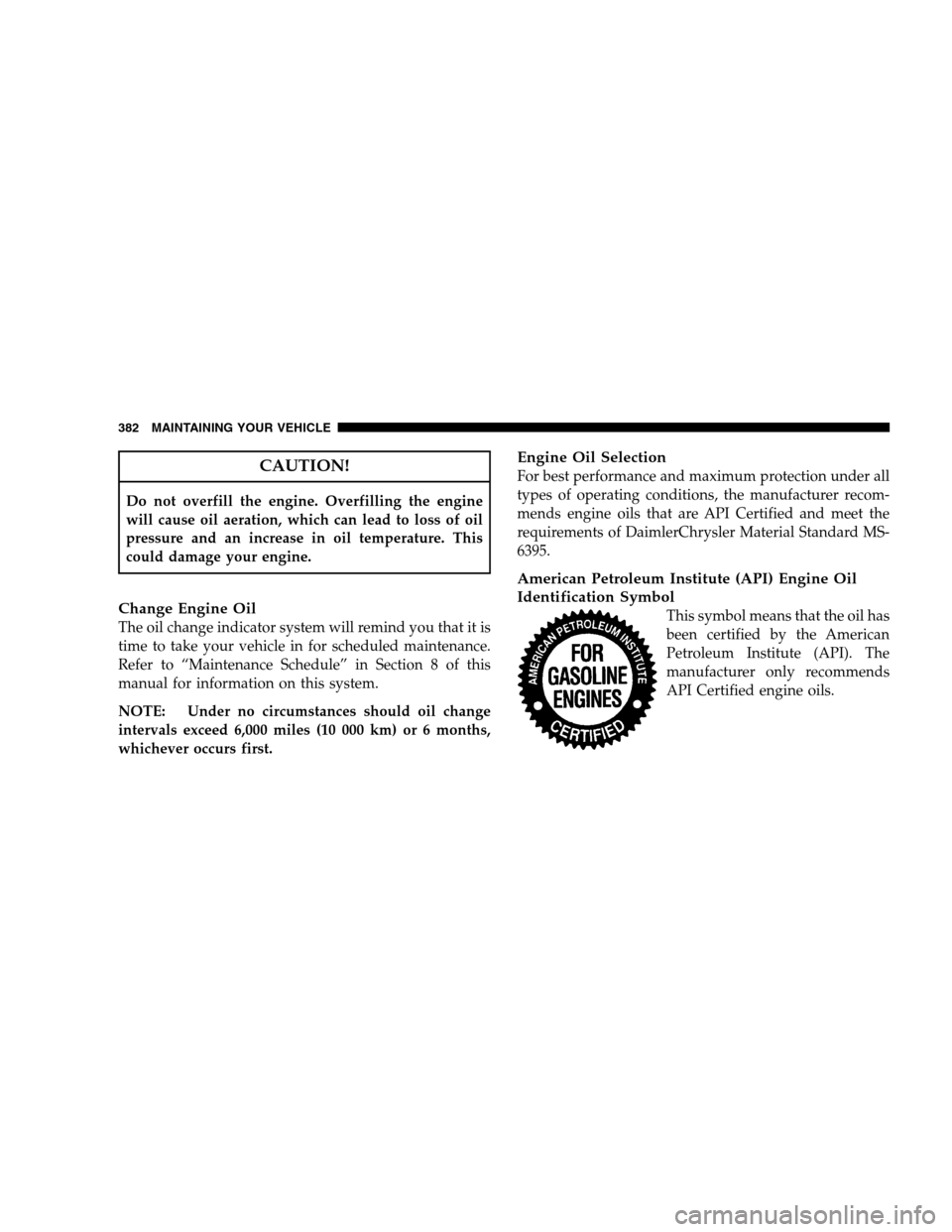
American Petroleum Institute (API) Engine Oil
Identification Symbol
This symbol means that the oil has
been certified by the American
Petroleum Institute (API). The
manufacturer only recommends
API Certified engine oils.
382 MAINTAINING YOUR VEHICLE