Page 355 of 494
HAZARD WARNING FLASHER
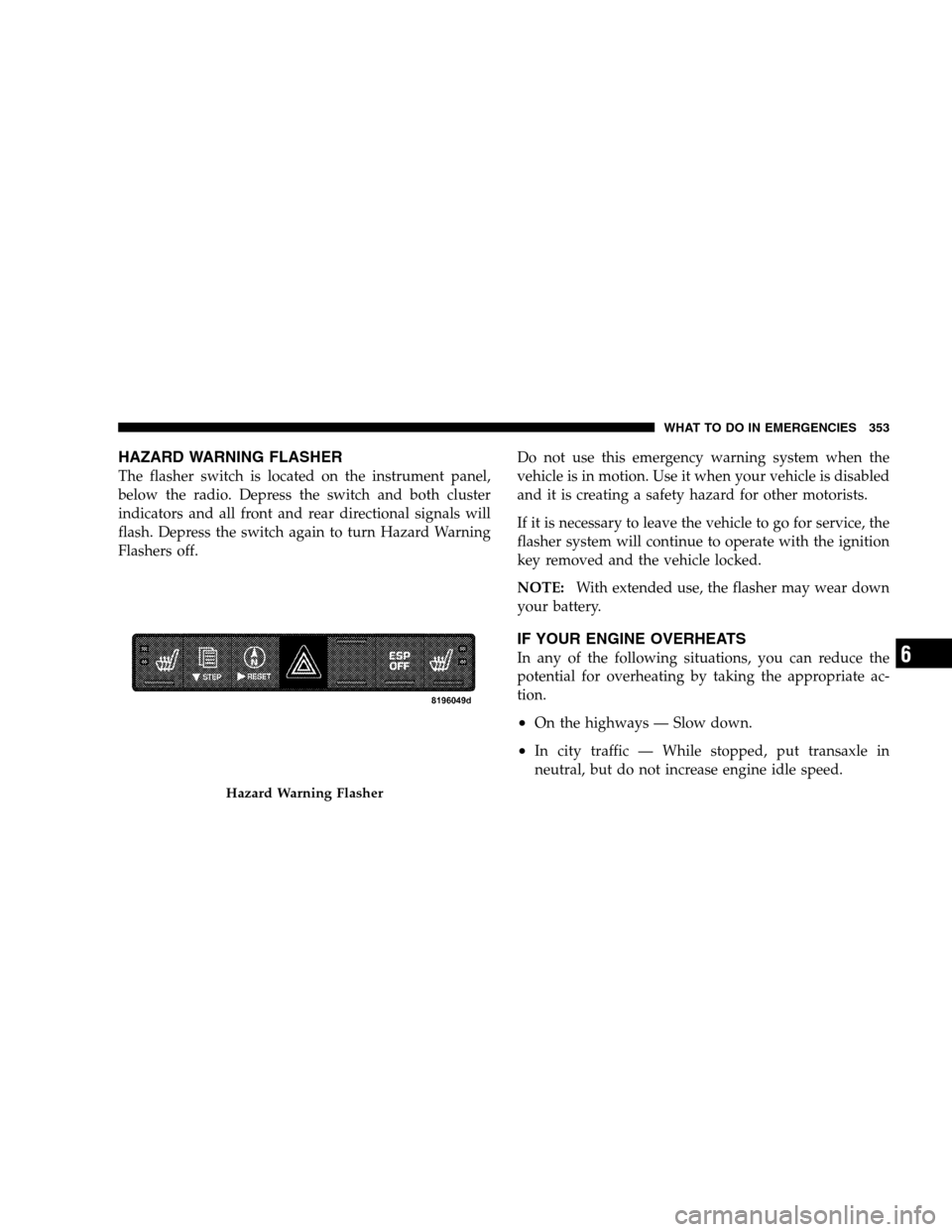
The flasher switch is located on the instrument panel,
below the radio. Depress the switch and both cluster
indicators and all front and rear directional signals will
flash. Depress the switch again to turn Hazard Warning
Flashers off.Do not use this emergency warning system when the
vehicle is in motion. Use it when your vehicle is disabled
and it is creating a safety hazard for other motorists.
If it is necessary to leave the vehicle to go for service, the
flasher system will continue to operate with the ignition
key removed and the vehicle locked.
NOTE:With extended use, the flasher may wear down
your battery.
IF YOUR ENGINE OVERHEATS
In any of the following situations, you can reduce the
potential for overheating by taking the appropriate ac-
tion.
•On the highways — Slow down.
•In city traffic — While stopped, put transaxle in
neutral, but do not increase engine idle speed.
Hazard Warning Flasher
WHAT TO DO IN EMERGENCIES 353
6
Page 359 of 494
Preparations For Jacking
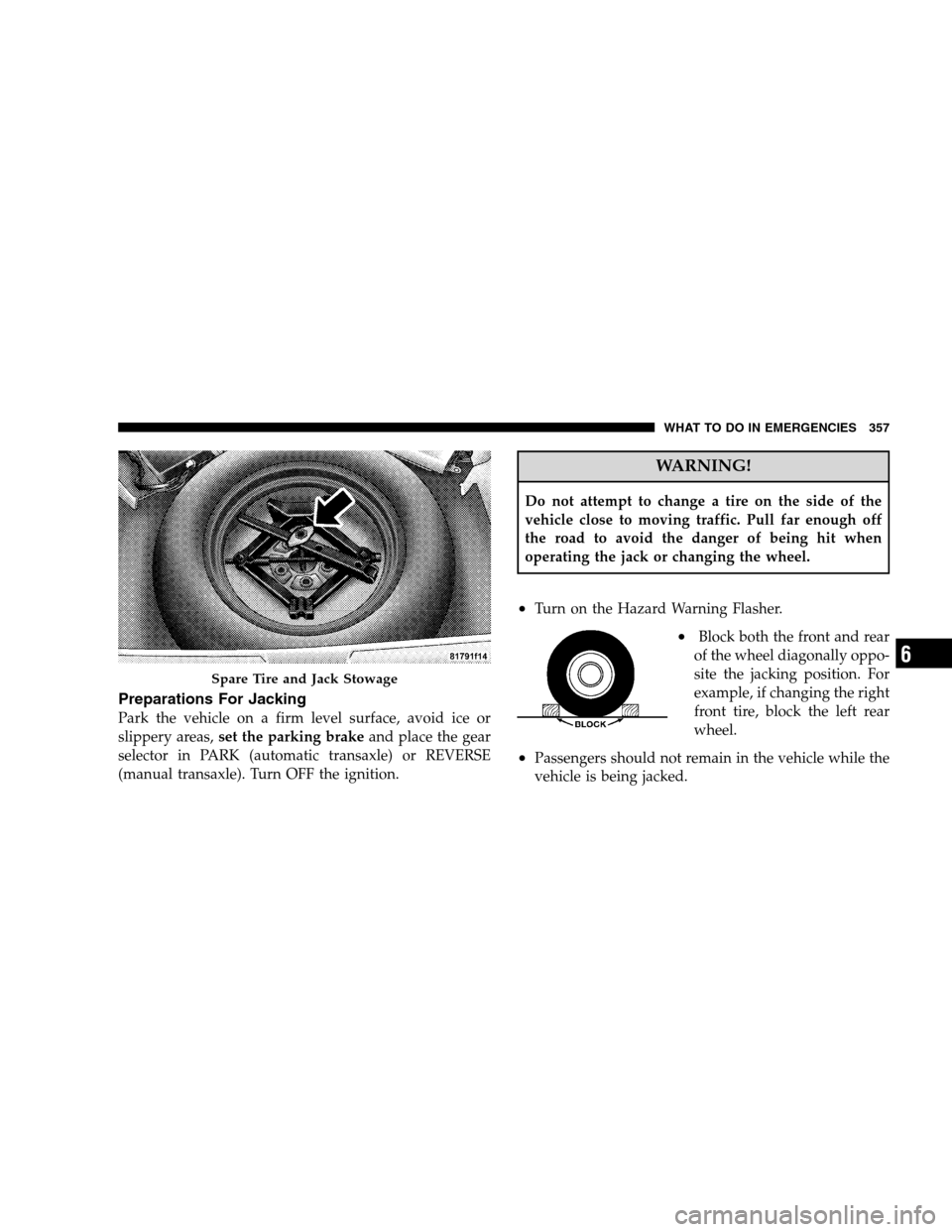
Park the vehicle on a firm level surface, avoid ice or
slippery areas,set the parking brakeand place the gear
selector in PARK (automatic transaxle) or REVERSE
(manual transaxle). Turn OFF the ignition.
WARNING!
Do not attempt to change a tire on the side of the
vehicle close to moving traffic. Pull far enough off
the road to avoid the danger of being hit when
operating the jack or changing the wheel.
•Turn on the Hazard Warning Flasher.
•Block both the front and rear
of the wheel diagonally oppo-
site the jacking position. For
example, if changing the right
front tire, block the left rear
wheel.
•Passengers should not remain in the vehicle while the
vehicle is being jacked.
Spare Tire and Jack Stowage
WHAT TO DO IN EMERGENCIES 357
6
Page 360 of 494
Jacking InstructionsWARNING!
Carefully follow these tire changing warnings to
help prevent personal injury or damage to your
vehicle:
•Always park on a firm, level surface as far from
the edge of the roadway as possible before raising
the vehicle.
•Block the wheel diagonally opposite the wheel to
be raised.
•Set the parking brake firmly and set an automatic
transmission in park; a manual transmission in
reverse.
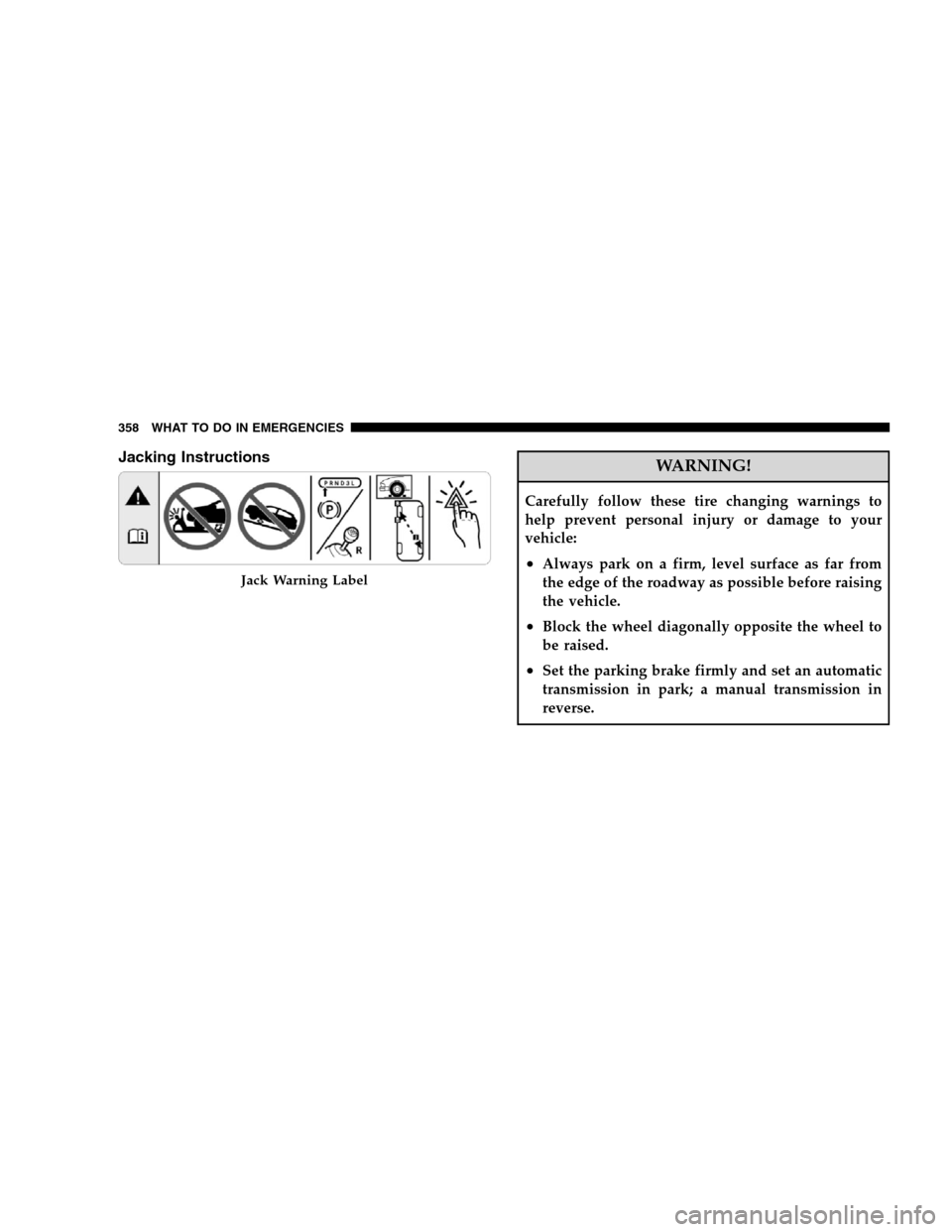
Jack Warning Label
358 WHAT TO DO IN EMERGENCIES
Page 365 of 494
WARNING!
To avoid possible personal injury, handle the wheel
covers with care to avoid contact with any sharp
edges.
7. Lower the vehicle by turning the jack screw to the left.
8. Finish tightening the nuts. Push down on the wrench
while tightening the wheel nuts. Alternate nuts, until
each nut has been tightened twice. Correct wheel nut
torque is 100 ft. lbs (135 N·m). If you doubt that you have
tightened the nuts correctly, have them checked with a
torque wrench by your dealer or at a service station.
9. Remove the wheel blocks and lower the jack until it is
free. Reassemble the lug wrench to the jack assembly and
stow it in the spare tire area. Secure the assembly using
the means provided.
WARNING!
A loose tire or jack thrown forward in a collision or
hard stop could endanger the occupants of the ve-
hicle. Always stow the jack parts and the spare tire in
the places provided. Have the deflated (flat) tire
repaired or replaced immediately.
10. Place the deflated (flat) tire in the cargo area andhave
the tire repaired or replaced as soon as possible.
11. Check the spare tire pressure as soon as possible.
Correct pressure as required.
WHAT TO DO IN EMERGENCIES 363
6
Page 367 of 494

1. Wear eye protection and remove any metal jewelry
such as watchbands or bracelets that might make an
inadvertent electrical contact.
2. When boosting from a battery in another vehicle, park
that vehicle within booster cable reach, but without
allowing the vehicles to touch. Set parking brake, place
automatic transaxle in PARK and turn ignition to LOCK
for both vehicles.
WARNING!
Do not permit vehicles to touch each other as this
could establish a ground connection and personal
injury could result.3. Turn off the heater, radio, and all unnecessary electri-
cal loads.
4. Remove the protective cover over the remote jump-
start positive battery post(+)in the engine compartment.
Connect one end of the jumper cable to the positive
battery post. Connect the other end of the same cable to
the positive terminal of the booster battery. Refer to the
following illustration for jump-starting connections.
5. Connect the other cable, first to the negative terminal
of the booster battery andthen to the engine ground (-)
of the vehicle with the discharged battery.Make sure
you have a good contact on the engine ground. Refer to
the following illustration for jump-starting connections.
WHAT TO DO IN EMERGENCIES 365
6
Page 371 of 494
CAUTION!
•If the vehicle being towed requires steering, the
ignition switch must be in the ON position, not in
the LOCK or ACC position.
•Do not attempt to tow this vehicle from the front
with sling type towing equipment. Damage to the
front fascia will result.
•Do not push or tow this vehicle with another
vehicle as damage to the bumper fascia and trans-
axle may result.
If you must use the accessories (wipers, defrosters, etc.)
while being towed, the key must be in the ON position,
not the ACC position. Make certain the transaxle remains
in NEUTRAL.
WITHOUT THE IGNITION KEY
Special care must be taken when the vehicle is towed
with the ignition in the LOCK position. Flat bed towing
is the preferred towing method. However, if a flat bed
towing vehicle is not available, a wheel lift towing
vehicle may be used. Furthermore, rear towing is not
recommended with the front wheels on the ground, as
transaxle damage can result. If rear towing is the only
alternative, a front end dolly must be used. Proper
towing equipment is necessary to prevent damage to the
vehicle.
TOWING THIS VEHICLE BEHIND ANOTHER
VEHICLE (Flat towing with all four wheels on the
ground)
Flat towing of vehicles equipped with an automatic
transmission, is only permitted within the limitations
described in this section.
WHAT TO DO IN EMERGENCIES 369
6
Page 372 of 494
TOWING THIS VEHICLE BEHIND ANOTHER
VEHICLE WITH A TOW DOLLY
Rear towing is not recommended with the front wheels
on the ground, as transaxle damage can result. If rear
towing is the only alternative, a front end dolly must be
used. Proper towing equipment is necessary to prevent
damage to the vehicle.
Without Power — Override Transaxle Interlock
System
Special care must be taken when the vehicle is towed
with the ignition in the LOCK position. A dolly should be
used under the front wheels if the rear wheels are raised.
Proper towing equipment is necessary to prevent dam-
age to the vehicle.
Battery power is required to release the brake/transaxle
interlock system. There is an override system that allows
you to shift out of PARK in case of loss of power. To
activate the override system:
•Firmly apply the parking brake.
•Insert the ignition key and rotate it to the ON position.
•Remove the cup holder liner.
•Insert a key, screwdriver, or finger into the front hole
then push and hold the manual override release lever
forward.
•While holding the release lever forward, move the
shift lever from Park to Neutral.
•Release the override.
370 WHAT TO DO IN EMERGENCIES
Page 394 of 494
Steering Linkage
The tie rod end ball joints should be inspected for
external leakage and damage when other maintenance is
performed.
Body Lubrication
Locks and all body pivot points, including seat tracks,
door hinges, trunk hinges, and hood hinges, should be
lubricated periodically to assure quiet, easy operation
and to protect against rust and wear. Prior to the appli-
cation of any lubricant, the parts concerned should be
wiped clean to remove dust and grit; after lubricating
excess oil and grease should be removed. Particular
attention should also be given to hood latching compo-
nents to insure proper function. When performing other
underhood services, the hood latch, release mechanism,
and safety catch should be cleaned and lubricated.
The external lock cylinders should be lubricated twice a
year, preferably in the fall and spring. Apply a smallamount of a high quality lubricant such as Mopar�Lock
Cylinder Lubricant or equivalent directly into the lock
cylinder.
Windshield Wiper Blades
Clean the rubber edges of the wiper blades and the
windshield periodically with a sponge or soft cloth and a
mild non-abrasive cleaner or use the washer solvent. This
will remove accumulations of salt, waxes, or road film
and help reduce streaking and smearing.
Operation of the wipers on dry glass for long periods
may cause deterioration of the wiper blades. Always use
washer fluid when using the wipers to remove salt or dirt
from a dry windshield.
Avoid using the wiper blades to remove frost or ice from
the windshield. Make sure that they are not frozen to the
glass before turning them on to avoid damaging the
blade.
392 MAINTAINING YOUR VEHICLE