Page 307 of 454

TPM Telltale Light will turn OFF and the graphic in the
EVIC will display a new pressure value instead of dashes
(- -), as long no tire pressure is below the low-pressure
warning limit in any of the four active road tires. The
vehicle may need to be driven for up to 10 minutes above
15 mph (25 km/h) in order for the TPMS to receive this
information.
General Information
This device complies with part 15 of the FCC rules and
RSS 210 of Industry Canada. Operation is subject to the
following conditions:
²This device may not cause harmful interference.
²This device must accept any interference received,
including interference that may cause undesired op-
eration.The tire pressure sensors are covered under one of the
following licenses:
United States.....................KR5S120123
Canada........................2671-S120123
FUEL REQUIREMENTS
2.4L and 2.7L Engines
2.4L and 2.7L engines are designed to meet
all emission regulations and provide excel-
lent fuel economy and performance when
using high quality unleaded ªregularº
gasolines having an octane rating of 87.
The use of premium gasoline is not recom-
mended. Under normal conditions, the use of premium
gasoline will not provide a benefit over high quality
unleaded ªregularº gasolines, and in some circumstances
may result in poorer performance.
STARTING AND OPERATING 307
5
Page 320 of 454

Gross Axle Weight Rating (GAWR)
The GAWR is the maximum capacity of the front and rear
axles. Distribute the load over the front and rear axles
evenly. Make sure that you do not exceed either front or
rear GAWR.
WARNING!
Because the front wheels steer the vehicle, it is
important that you do not exceed the maximum front
or rear GAWR. A dangerous driving condition can
result if either rating is exceeded. You could lose
control of the vehicle and have an accident.
Overloading
The load carrying components (axle, springs, tires,
wheels, etc.) of your vehicle will provide satisfactory
service as long as you do not exceed the GVWR and front
and rear GAWR.
The best way to figure out the total weight of your
vehicle is to weigh it when it is fully loaded and ready for
operation. Weigh it on a commercial scale to insure that it
is not over the GVWR.
Figure out the weight on the front and rear of the vehicle
separately. It is important that you distribute the load
evenly over the front and rear axles.
Overloading can cause potential safety hazards and
shorten useful service life. Heavier axles or suspension
components do not necessarily increase the vehicle's
GVWR.
320 STARTING AND OPERATING
Page 328 of 454

WARNING!
Improper towing can lead to an injury accident.
Follow these guidelines to make your trailer towing
as safe as possible:
Make certain that the load is secured in the trailer
and that it will not shift during travel. When traile-
ring cargo that is not fully secured, dynamic load
shifts can occur that may be difficult for the driver to
control. You could lose control of your vehicle and
have an accident.
²When hauling cargo, or towing a trailer, do not
overload your vehicle or trailer. Overloading can cause
a loss of control, poor performance, or damage to
brakes, axle, engine, transaxle, steering, suspension,
chassis structure, or tires.
²Safety chains must always be used between your
vehicle and trailer. Always connect the chains to the
frame or hook retainers of the vehicle hitch. Cross the
chains under the trailer tongue and allow enough
slack for turning corners.
²Vehicles with trailers should not be parked on a grade.
When parking, apply the parking brake on the tow
vehicle. Put the tow vehicle automatic transaxle in P
for Park. Always, block or9chock9the trailer wheels.
²GCWR must not be exceeded.
²Total weight must be distributed between the tow
vehicle and the trailer such that the following four
ratings are not exceeded:
1. GVWR
2. GTW
3. GAWR
328 STARTING AND OPERATING
Page 329 of 454

4. Tongue weight rating for the trailer hitch utilized
(This requirement may limit the ability to always
achieve 10% of tongue weight as a percentage of total
trailer weight).
Towing Requirements Ð Tires
þ
Do not attempt to tow a trailer while using a compact
spare tire.
þProper tire inflation pressures are essential to the safe
and satisfactory operation of your vehicle. Refer to the
ªTires Ð General Informationº in this section for
information on tire pressures and for proper tire
inflation procedures.
þAlso, check the trailer tires for proper tire inflation
pressures before trailer usage.
þCheck for signs of tire wear or visible tire damage
before towing a trailer. Refer to ªTires Ð GeneralInformationº in this section for information on tread
wear indicators and for proper inspection procedure.
þWhen replacing tires, refer to ªTires Ð General Infor-
mationº in this section for information on replacement
tires and for proper tire replacement procedures. Re-
placing tires with a higher load carrying capacity will
not increase the vehicle's GVWR and GAWR limits.
Towing Requirements Ð Trailer Brakes
þ
Donotinterconnect the hydraulic brake system or
vacuum system of your vehicle with that of the trailer.
This could cause inadequate braking and possible
personal injury.
þAn electronically actuated trailer brake controller is
required when towing a trailer with electronically
actuated brakes. When towing a trailer equipped with
a hydraulic surge actuated brake system, an electronic
brake controller is not required.
STARTING AND OPERATING 329
5
Page 338 of 454

JACKING AND TIRE CHANGING
WARNING!
²Do not attempt to change a tire on the side of the
vehicle close to moving traffic. Pull far enough off
the road to avoid the danger of being hit when
operating the jack or changing the wheel.
²Getting under a jacked-up vehicle is dangerous.
The vehicle could slip off the jack and fall on you.
You could be crushed. Never get any part of your
body under a vehicle that is on a jack. Never start
or run the engine while the vehicle is on a jack. If
you need to get under a raised vehicle, take it to a
service center where it can be raised on a lift.
²The jack is designed to use as a tool for changing
tires only. The jack should not be used to lift the
vehicle for service purposes. The vehicle should be
jacked on a firm level surface only. Avoid ice or
slippery areas.
Preparations For Jacking
1. Park the vehicle on a firm level surface as far from the
edge of the roadway as possible. Avoid icy or slippery
areas.
2.Set the parking brakeand place the gear selector in
PARK (automatic transaxle) or REVERSE (manual trans-
axle).
3. Turn the ignition switch to the LOCK position.
4. Turn on the Hazard Warning Flasher.
5. Passengers should not remain in the vehicle when the
vehicle is being jacked.
338 WHAT TO DO IN EMERGENCIES
Page 348 of 454

FREEING A STUCK VEHICLE
If your vehicle becomes stuck in mud, sand, or snow, it
can often be moved by a rocking motion. Turn your
steering wheel right and left to clear the area around the
front wheels. Then shift back and forth between Reverse
and First gear. Usually the least accelerator pedal pres-
sure to maintain the rocking motion without spinning the
wheels is most effective.
NOTE:
If your vehicle is equipped with Traction Con-
trol, turn the system OFF before attempting to
ªrockº the vehicle. Refer to ªPartial Off Modeº
under ªElectronic Stability Program (ESP)º in
Section 5 of this manual.WARNING!
Fast spinning tires can be dangerous. Forces gener-
ated by excessive wheel speeds may cause axle and
tire damage or failure. A tire could explode and
injure someone. Do not spin your vehicle's wheels
faster than 30 mph (48 km/h) or for longer than 30
seconds continuously without stopping when you
are stuck, and don't let anyone near a spinning
wheel, no matter what the speed.
CAUTION!
Racing the engine or spinning the wheels too fast
may lead to transaxle overheating and failure. It can
also damage the tires. Do not spin the wheels above
30 mph (48 km/h). Do not spin the wheels continu-
ously for more than 30 seconds.
348 WHAT TO DO IN EMERGENCIES
Page 417 of 454
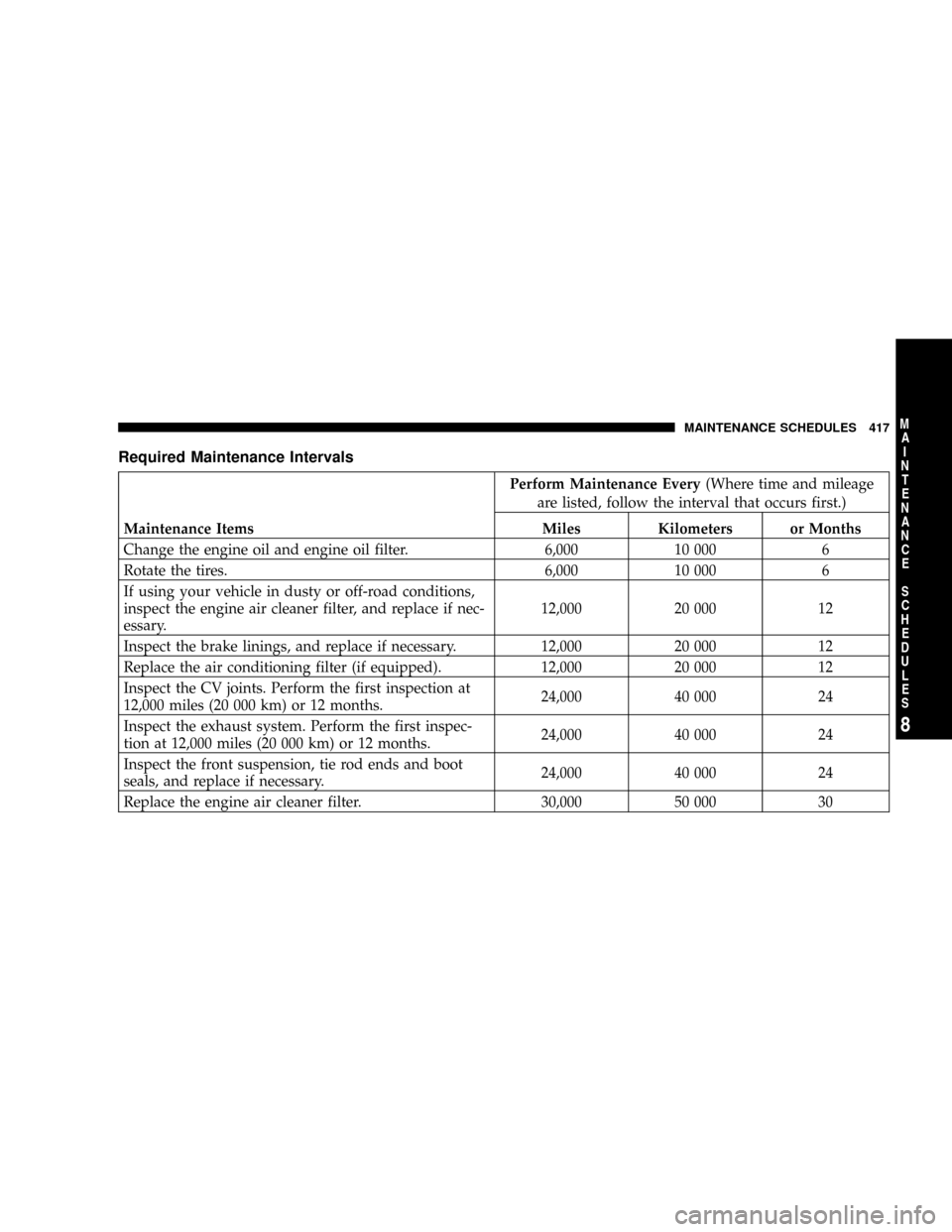
Required Maintenance Intervals
Perform Maintenance Every(Where time and mileage
are listed, follow the interval that occurs first.)
Maintenance Items Miles Kilometers or Months
Change the engine oil and engine oil filter. 6,000 10 000 6
Rotate the tires. 6,000 10 000 6
If using your vehicle in dusty or off-road conditions,
inspect the engine air cleaner filter, and replace if nec-
essary.12,000 20 000 12
Inspect the brake linings, and replace if necessary. 12,000 20 000 12
Replace the air conditioning filter (if equipped). 12,000 20 000 12
Inspect the CV joints. Perform the first inspection at
12,000 miles (20 000 km) or 12 months.24,000 40 000 24
Inspect the exhaust system. Perform the first inspec-
tion at 12,000 miles (20 000 km) or 12 months.24,000 40 000 24
Inspect the front suspension, tie rod ends and boot
seals, and replace if necessary.24,000 40 000 24
Replace the engine air cleaner filter. 30,000 50 000 30
MAINTENANCE SCHEDULES 417
8
M
A
I
N
T
E
N
A
N
C
E
S
C
H
E
D
U
L
E
S
Page 429 of 454

Call Toll Free at:
²1±800±890±4038 (U.S.)
²1±800±387±1143 (Canada)
Or
Visit us on the World Wide Web at:
²www.techauthority.daimlerchrysler.com
²www.daimlerchrysler.ca/manuals
DEPARTMENT OF TRANSPORTATION UNIFORM
TIRE QUALITY GRADES
The following describes the tire grading categories estab-
lished by the National Highway Traffic Safety Adminis-
tration. The specific grade rating assigned by the tire's
manufacturer in each category is shown on the sidewall
of the tires on your car.All passenger car tires must conform to Federal safety
requirements in addition to these grades.
Treadwear
The treadwear grade is a comparative rating based on the
wear rate of the tire when tested under controlled con-
ditions on a specified government test course. For ex-
ample, a tire graded 150 would wear one anda11/2
times as well on the government course as a tire graded
100. The relative performance of tires depends upon the
actual conditions of their use, however, and may depart
significantly from the norm due to variations in driving
habits, service practices and differences in road charac-
teristics and climate.
Traction Grades
The traction grades, from highest to lowest, are AA, A, B,
and C. Those grades represent the tire's ability to stop on
wet pavement as measured under controlled conditions
IF YOU NEED CONSUMER ASSISTANCE 429
9