Page 384 of 457
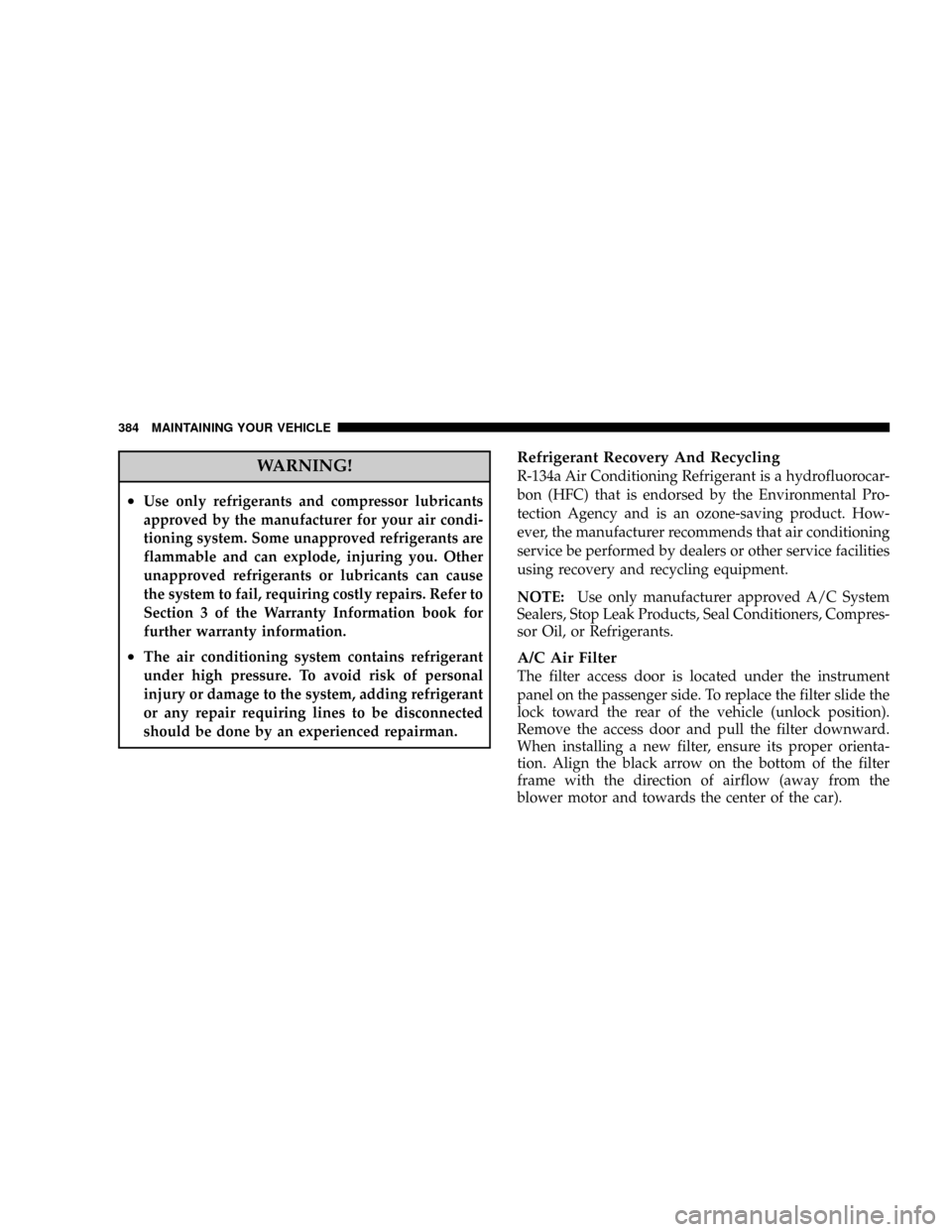
WARNING!
²Use only refrigerants and compressor lubricants
approved by the manufacturer for your air condi-
tioning system. Some unapproved refrigerants are
flammable and can explode, injuring you. Other
unapproved refrigerants or lubricants can cause
the system to fail, requiring costly repairs. Refer to
Section 3 of the Warranty Information book for
further warranty information.
²The air conditioning system contains refrigerant
under high pressure. To avoid risk of personal
injury or damage to the system, adding refrigerant
or any repair requiring lines to be disconnected
should be done by an experienced repairman.
Refrigerant Recovery And Recycling
R-134a Air Conditioning Refrigerant is a hydrofluorocar-
bon (HFC) that is endorsed by the Environmental Pro-
tection Agency and is an ozone-saving product. How-
ever, the manufacturer recommends that air conditioning
service be performed by dealers or other service facilities
using recovery and recycling equipment.
NOTE:Use only manufacturer approved A/C System
Sealers, Stop Leak Products, Seal Conditioners, Compres-
sor Oil, or Refrigerants.
A/C Air Filter
The filter access door is located under the instrument
panel on the passenger side. To replace the filter slide the
lock toward the rear of the vehicle (unlock position).
Remove the access door and pull the filter downward.
When installing a new filter, ensure its proper orienta-
tion. Align the black arrow on the bottom of the filter
frame with the direction of airflow (away from the
blower motor and towards the center of the car).
384 MAINTAINING YOUR VEHICLE
Page 385 of 457

Refer to the ªMaintenance Scheduleº section of this
manual for the recommended air conditioning filter
replacement intervals.
Power Steering Ð Fluid Check
Checking the power steering fluid level at a defined
service interval is not required. The fluid should only be
checked if a leak is suspected, abnormal noises are
apparent, and/or the system is not functioning as antici-
pated. Coordinate inspection efforts through a certified
DaimlerChrysler Dealership.9
WARNING!
Fluid level should be checked on a level surface and
with the engine off to prevent injury from moving
parts and to insure accurate fluid level reading. Do
not overfill. Use only manufacturers recommended
power steering fluid.If necessary, add fluid to restore to the proper indicated
level. With a clean cloth, wipe any spilled fluid from all
surfaces. Refer to Fluids, Lubricants, and Genuine Parts
for correct fluid type.
Front & Rear Suspension Ball Joints
The suspension ball joints are permanently sealed. No
regular maintenance is required for these components.
Steering Shaft Seal
The steering shaft seal, at the point where the shaft passes
through the bulkhead, is lubricated when it is installed. If
the seal becomes noisy when the steering shaft is turned,
it should be lubricated with a multi-purpose grease.
Mopar multi-purpose lubricant is recommended.
MAINTAINING YOUR VEHICLE 385
7
Page 393 of 457

When additional coolant is needed to maintain the
proper level, it should be added to the coolant bottle. Do
not overfill.
Points To Remember
NOTE:When the vehicle is stopped after a few miles (a
few kilometers) of operation, you may observe vapor
coming from the front of the engine compartment. This is
normally a result of moisture from rain, snow, or high
humidity accumulating on the radiator and being vapor-
ized when the thermostat opens, allowing hot coolant to
enter the radiator.
If an examination of your engine compartment shows no
evidence of radiator or hose leaks, the vehicle may be
safely driven. The vapor will soon dissipate.
²Do not overfill the coolant recovery bottle.
²Check coolant freeze point in the radiator and in the
coolant recovery bottle. If antifreeze needs to be
added, contents of coolant recovery bottle must also be
protected against freezing.
²If frequent coolant additions are required, or if the
level in the coolant recovery bottle does not drop when
the engine cools, the cooling system should be pres-
sure tested for leaks.
²Maintain coolant concentration at 50% HOAT engine
coolant (minimum) and distilled water for proper
corrosion protection of your engine which contains
aluminum components.
²Make sure that the radiator and coolant recovery
bottle overflow hoses are not kinked or obstructed.
²Keep the front of the radiator clean. If your vehicle is
equipped with air conditioning, keep the front of the
condenser clean, also.
MAINTAINING YOUR VEHICLE 393
7
Page 400 of 457
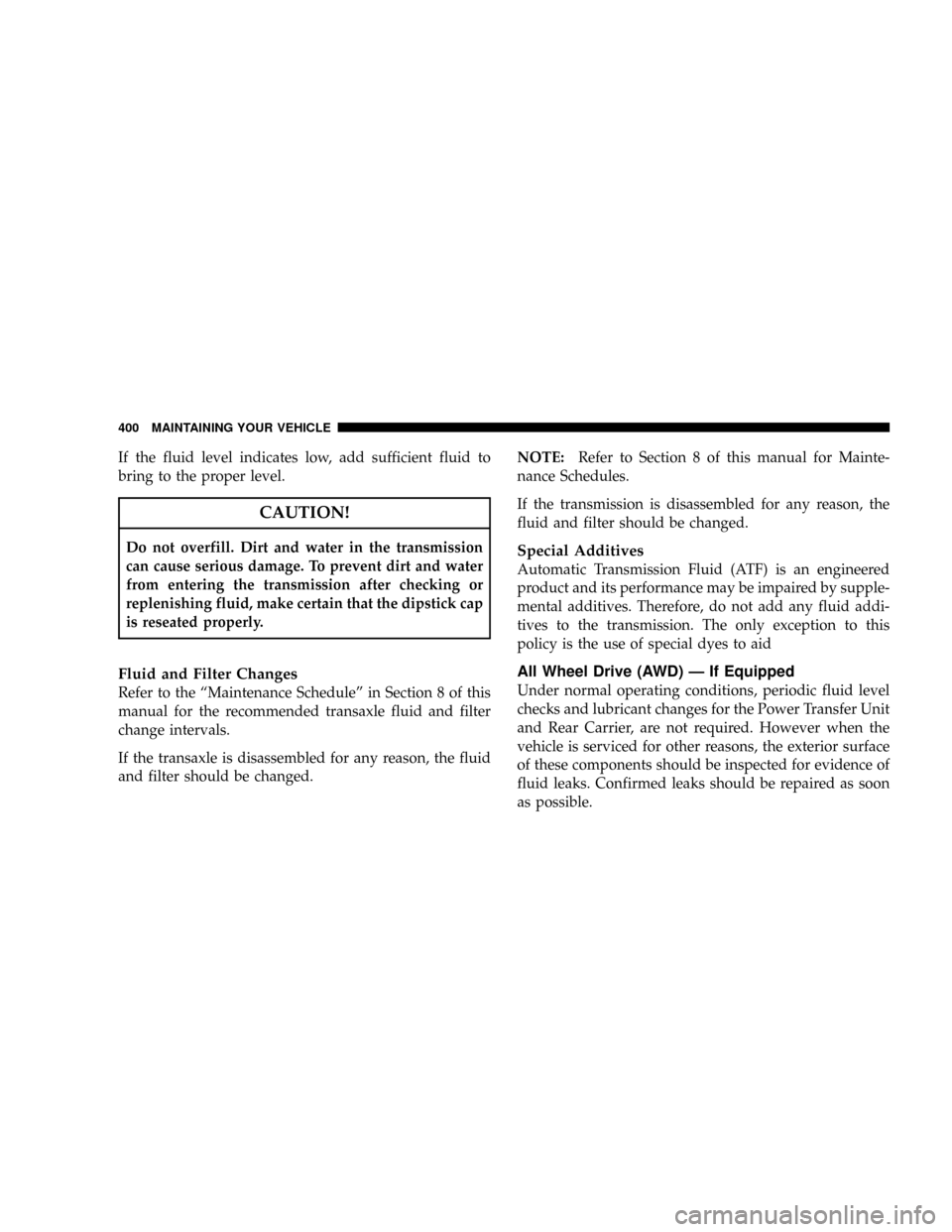
If the fluid level indicates low, add sufficient fluid to
bring to the proper level.
CAUTION!
Do not overfill. Dirt and water in the transmission
can cause serious damage. To prevent dirt and water
from entering the transmission after checking or
replenishing fluid, make certain that the dipstick cap
is reseated properly.
Fluid and Filter Changes
Refer to the ªMaintenance Scheduleº in Section 8 of this
manual for the recommended transaxle fluid and filter
change intervals.
If the transaxle is disassembled for any reason, the fluid
and filter should be changed.NOTE:Refer to Section 8 of this manual for Mainte-
nance Schedules.
If the transmission is disassembled for any reason, the
fluid and filter should be changed.
Special Additives
Automatic Transmission Fluid (ATF) is an engineered
product and its performance may be impaired by supple-
mental additives. Therefore, do not add any fluid addi-
tives to the transmission. The only exception to this
policy is the use of special dyes to aid
All Wheel Drive (AWD) Ð If Equipped
Under normal operating conditions, periodic fluid level
checks and lubricant changes for the Power Transfer Unit
and Rear Carrier, are not required. However when the
vehicle is serviced for other reasons, the exterior surface
of these components should be inspected for evidence of
fluid leaks. Confirmed leaks should be repaired as soon
as possible.
400 MAINTAINING YOUR VEHICLE
Page 402 of 457

hot or cold weather and other extreme conditions will
have an adverse effect on paint, metal trim, and under-
body protection.
The following maintenance recommendations will enable
you to obtain maximum benefit from the corrosion
resistance built into your vehicle.
What Causes Corrosion?
Corrosion is the result of deterioration or removal of
paint and protective coatings from your vehicle.
The most common causes are:
²Road salt, dirt and moisture accumulation.
²Stone and gravel impact.
²Insects, tree sap and tar.
²Salt in the air near seacoast localities.
²Atmospheric fallout/industrial pollutants.
Washing
²
Wash your vehicle regularly. Always wash your ve-
hicle in the shade using Mopar Car Wash or a mild car
wash soap, and rinse the panels completely with clear
water.
²If insects, tar or other similar deposits have accumu-
lated on your vehicle, use Mopar Super Kleen Bug and
Tar Remover to remove.
²Use Mopar Cleaner Wax to remove road film, stains
and to protect your paint finish. Take care never to
scratch the paint.
²Avoid using abrasive compounds and power buffing
that may diminish the gloss or thin out the paint
finish.
402 MAINTAINING YOUR VEHICLE
Page 410 of 457
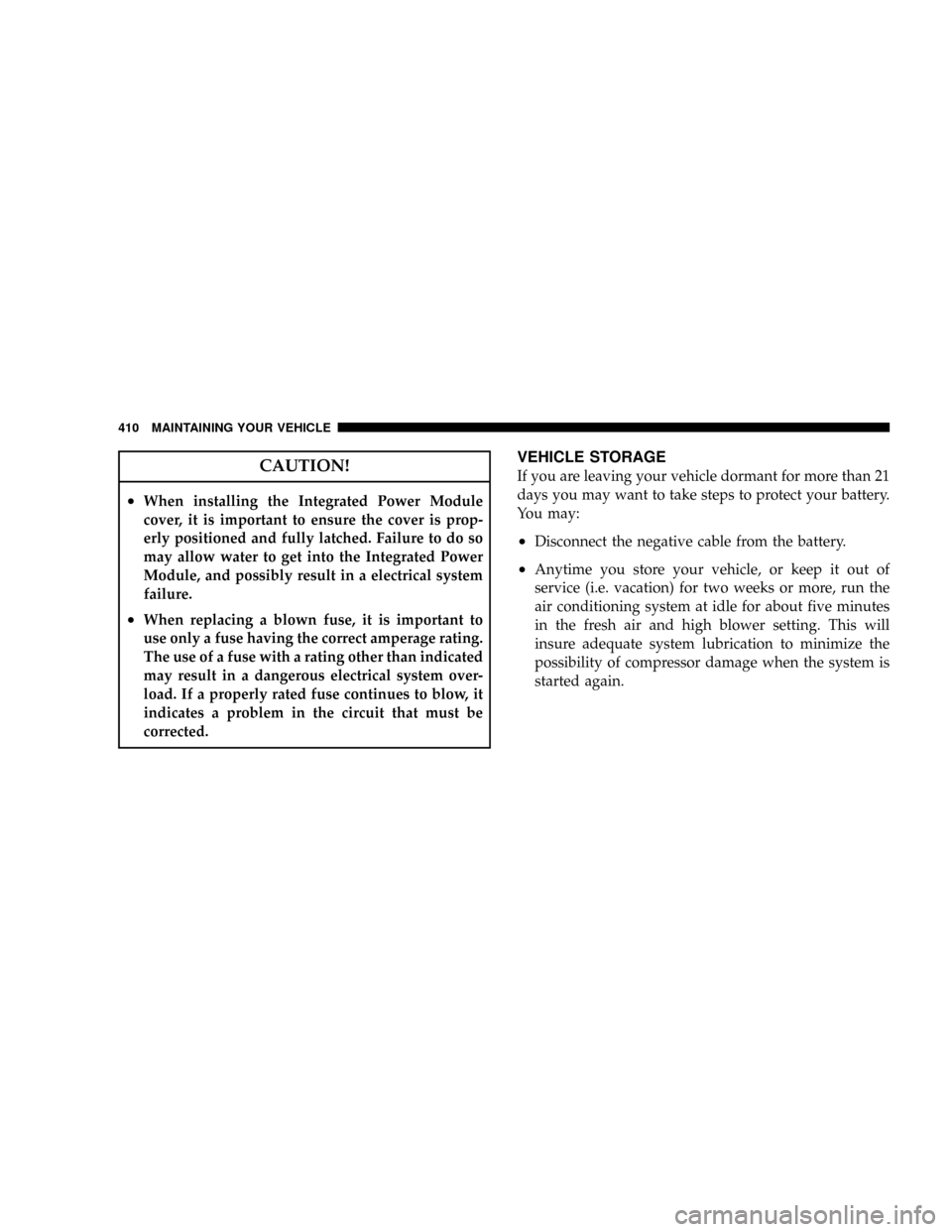
CAUTION!
²When installing the Integrated Power Module
cover, it is important to ensure the cover is prop-
erly positioned and fully latched. Failure to do so
may allow water to get into the Integrated Power
Module, and possibly result in a electrical system
failure.
²When replacing a blown fuse, it is important to
use only a fuse having the correct amperage rating.
The use of a fuse with a rating other than indicated
may result in a dangerous electrical system over-
load. If a properly rated fuse continues to blow, it
indicates a problem in the circuit that must be
corrected.
VEHICLE STORAGE
If you are leaving your vehicle dormant for more than 21
days you may want to take steps to protect your battery.
You may:
²Disconnect the negative cable from the battery.
²Anytime you store your vehicle, or keep it out of
service (i.e. vacation) for two weeks or more, run the
air conditioning system at idle for about five minutes
in the fresh air and high blower setting. This will
insure adequate system lubrication to minimize the
possibility of compressor damage when the system is
started again.
410 MAINTAINING YOUR VEHICLE
Page 420 of 457
EMISSION CONTROL SYSTEM MAINTENANCE
The ªScheduledº maintenance services, listed inbold
typemust be done at the times or mileages specified to
assure the continued proper functioning of the emission
control system. These, and all other maintenance services
included in this manual, should be done to provide best
vehicle performance and reliability. More frequent main-
tenance may be needed for vehicles in severe operating
conditions such as dusty areas and very short trip
driving.
Inspection and service also should be done any time a
malfunction is suspected.
NOTE:Maintenance, replacement, or repair of the emis-
sion control devices and systems on your vehicle may be
performed by any automotive repair establishment or
individual using any automotive part, which has been
certified pursuant to U.S. EPA or, in the State of Califor-
nia, California Air Resources Board regulations.
MAINTENANCE SCHEDULE
The oil change indicator system will remind you that it is
time to take your vehicle in for scheduled maintenance.
On Electronic Vehicle Information Center (EVIC)
equipped vehicles ªOil Change Requiredº will be dis-
played in the EVIC and a single chime will sound,
indicating that an oil change is necessary.
On Non-EVIC equipped vehicles ªChange Oilº will flash
in the instrument cluster odometer and a single chime
will sound, indicating that an oil change is necessary.
Based on engine operation conditions the oil change
indicator message will illuminate, this means that service
is required for your vehicle. Have your vehicle serviced
as soon as possible, within the next 500 miles (805 km).
420 MAINTENANCE SCHEDULES
8
M
A
I
N
T
E
N
A
N
C
E
S
C
H
E
D
U
L
E
S
Page 423 of 457
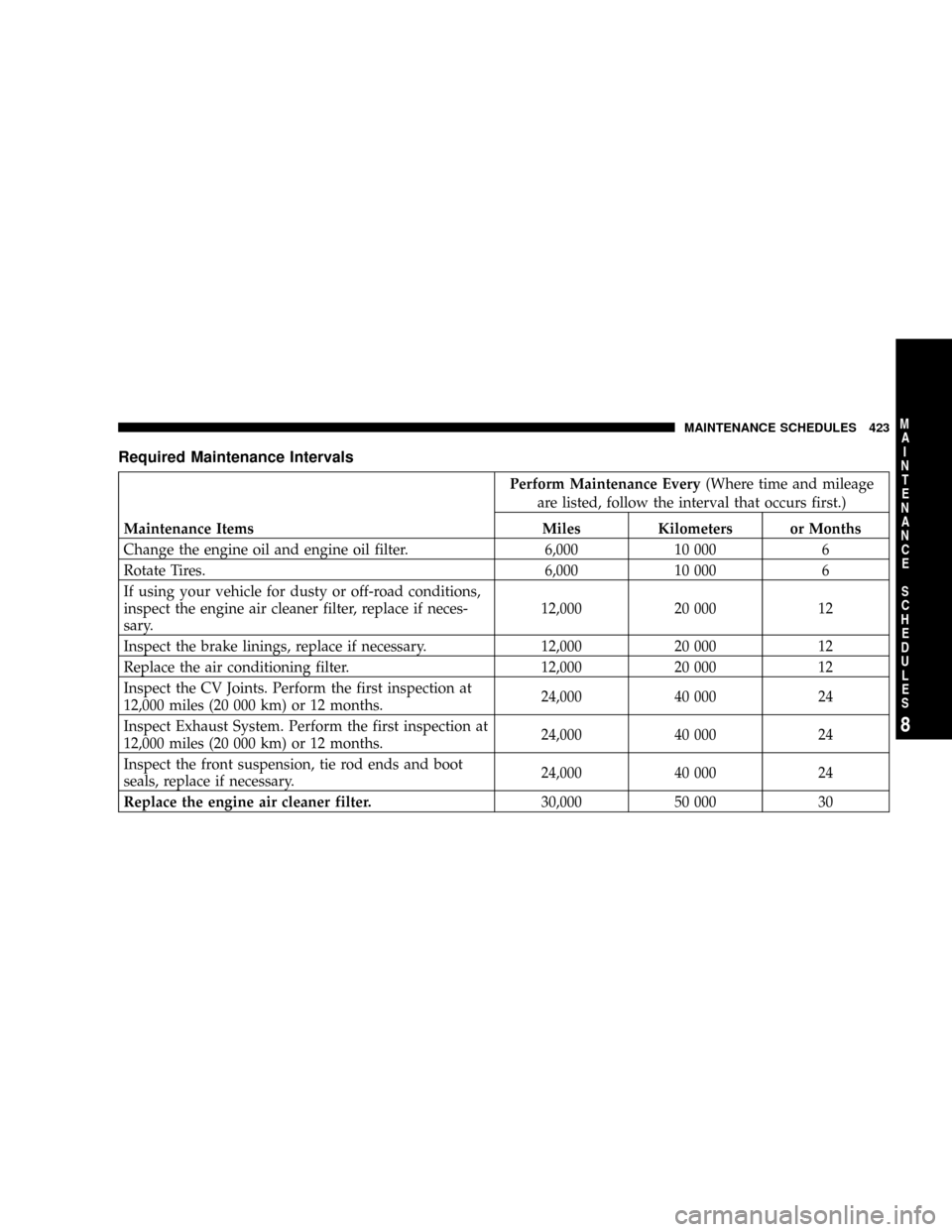
Required Maintenance Intervals
Perform Maintenance Every(Where time and mileage
are listed, follow the interval that occurs first.)
Maintenance Items Miles Kilometers or Months
Change the engine oil and engine oil filter. 6,000 10 000 6
Rotate Tires. 6,000 10 000 6
If using your vehicle for dusty or off-road conditions,
inspect the engine air cleaner filter, replace if neces-
sary.12,000 20 000 12
Inspect the brake linings, replace if necessary. 12,000 20 000 12
Replace the air conditioning filter. 12,000 20 000 12
Inspect the CV Joints. Perform the first inspection at
12,000 miles (20 000 km) or 12 months.24,000 40 000 24
Inspect Exhaust System. Perform the first inspection at
12,000 miles (20 000 km) or 12 months.24,000 40 000 24
Inspect the front suspension, tie rod ends and boot
seals, replace if necessary.24,000 40 000 24
Replace the engine air cleaner filter.30,000 50 000 30
MAINTENANCE SCHEDULES 423
8
M
A
I
N
T
E
N
A
N
C
E
S
C
H
E
D
U
L
E
S