Page 272 of 358

CAUTION!
Damage to the catalytic converter can result if your
vehicle is not kept in proper operating condition. In
the event of engine malfunction, particularly involv-
ing engine misfire or other apparent loss of perfor-
mance, have your vehicle serviced promptly. Contin-
ued operation of your vehicle with a severe
malfunction could cause the converter to overheat,
resulting in possible damage to the converter and the
vehicle.
WARNING!
A hot exhaust system can start a fire if you park over
materials that can burn. Such materials might be
grass or leaves coming into contact with your exhaust
system. Do not park or operate your vehicle in areas
where your exhaust system can contact anything that
can burn.
In unusual situations involving grossly malfunctioning
engine operation, a scorching odor may suggest severe
and abnormal catalyst overheating. If this occurs, stop
the vehicle, turn off the engine and allow it to cool.
Service, including a tune up to DaimlerChrysler Corpo-
ration's specifications, should be obtained immediately.
270 MAINTAINING YOUR VEHICLE
Page 275 of 358
Air Conditioner
Check the air conditioning system at the start of the
warm weather season.
NOTE:If your air conditioning performance seems
lower than expected, check the front of the A/C con-
denser for an accumulation of dirt or insects. Clean with
a gentle water spray from behind the radiator and
through the condenser as required. Fabric front fascia
protectors may reduce air flow to the condenser, reducing
air conditioning performance.WARNING!
The air conditioning system contains refrigerant un-
der high pressure. To avoid risk of personal injury or
damage to the system, adding refrigerant or any
repair requiring lines to be disconnected should be
done by an experienced repair person.
Refrigerant Recovery And Recycling
The air conditioning system of your vehicle contains
R-134a, a refrigerant that does not deplete the ozone layer
in the upper atmosphere. The DaimlerChrysler
Corporation recommends that air conditioning service be
done by facilities using refrigerant recycling and recovery
equipment that meets SAE standard J1991.
MAINTAINING YOUR VEHICLE 273
7
Page 276 of 358
Power Steering Fluid
No power steering fluid service is required. The system is
filled at the factory with Pentosin CHF 11S. Steering noise
and reduced component life may result if an unapproved
fluid is used.During scheduled maintenance, check the power steering
fluid level at the power steering fluid reservoir. Nor-
mally, it will not be necessary to add power steering
fluid.
Before removing the reservoir cap, wipe the outside of
the cap and reservoir so that no dirt can fall into the
reservoir.
The power steering pump has a dipstick. Fluid level
should be maintained at the proper level indicated on the
dipstick. If the indicated level of power steering fluid is
low, see your authorized dealer. With a clean cloth, wipe
any spilled fluid from all surfaces.
274 MAINTAINING YOUR VEHICLE
Page 277 of 358
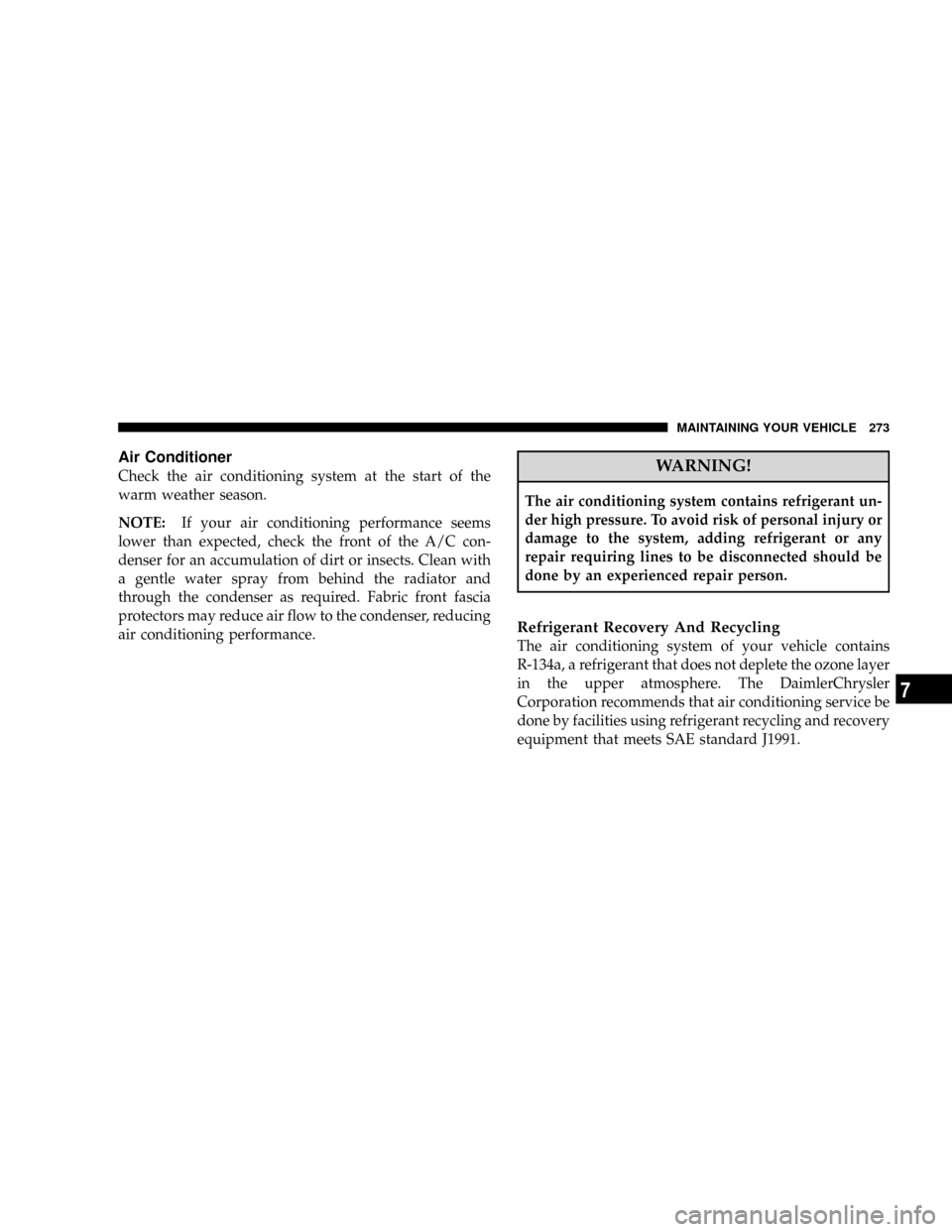
Chassis Lubrication
Front Suspension Ball Joints
There are two front suspension lower ball joints that are
permanently lubricated. Inspect these ball joints when-
ever under-vehicle service is done.
Steering Linkage
Inspect tie rod ends whenever the vehicle is serviced.
They are permanently lubricated and do not require
periodic lubrication.
Drive Shaft Universal Joints
Your vehicle has four constant velocity universal joints.
Periodic lubrication of these joints is not required. How-
ever, the joint boots should be inspected for external
leakage or damage when other maintenance is per-
formed.
If leakage or damage is evident, replace the universal
joint boot and grease immediately.
Continued operation could result in failure of the univer-
sal joint due to water and dirt contamination of the
grease. This would require complete replacement of the
joint assembly.
MAINTAINING YOUR VEHICLE 275
7
Page 278 of 358

Body Lubrication
Locks and all body pivot points, including such items as
seat tracks, doors, and rear liftgate/decklid hinges,
should be lubricated periodically to assure quiet, easy
operation and to protect against rust and wear.
Hood Latch
When performing other under hood services, the hood
latch release mechanism and safety catch should be
inspected, cleaned, and lubricated.
It is important to maintain proper lubrication to insure
that the hood mechanisms work properly and safely.
Multi-Purpose Lubricant, NLGI Grade 2, should be ap-
plied sparingly to all pivot and sliding contact areas.
Driver's Door Lock Cylinder
The driver's door lock cylinder should be lubricated
twice a year, preferably in the fall and spring. Apply asmall amount of a high quality lubricant, such as Mopart
Lock Cylinder Lubricant directly into the lock cylinder
(avoid excess lubricant).
Insert the key into the lock cylinder and rotate from the
unlocked to the locked position without adding more
lubricant. Repeat this procedure three or four times. Wipe
all the lubricant off the key with a clean cloth, to avoid
soiling clothing.
Windshield Wiper Blades
Clean the rubber edges of the wiper blades and the
windshield periodically with a sponge or soft cloth and a
mild non-abrasive cleaner, or use the washer solvent.
This will remove accumulations of salt or road film and
help reduce streaking, chatter, and smearing.
Operation of the wipers on dry glass for long periods
may cause deterioration of the wiper blades. Always use
washer fluid when using the wipers to remove salt or dirt
from a dry windshield. Avoid using the wiper blades to
276 MAINTAINING YOUR VEHICLE
Page 287 of 358

Brakes
In order to assure brake system performance, all brake
system components should be inspected periodically.
Suggested service intervals can be found in the Mainte-
nance section.
WARNING!
Riding the brakes can lead to brake failure and
possibly an accident. Driving with your foot resting
or riding on the brake pedal can result in abnormally
high brake temperatures, excessive lining wear, and
possible brake damage. You wouldn't have your full
braking capacity in an emergency.
Brake and Power Steering System Hoses
When servicing the vehicle for scheduled maintenance,
inspect surface of hoses and nylon tubing for evidence of
heat and mechanical damage. Hard and brittle rubber,cracking, checking, tears, cuts, abrasions, and excessive
swelling suggest deterioration of the rubber. Particular
attention should be made to examining those hose sur-
faces nearest to high heat sources, such as the exhaust
manifold.
Inspect all hose clamps and couplings to make sure they
are secure and no leaks are present.
Ensure the nylon tubing in these areas has not melted or
collapsed.
NOTE:Often, fluids such as oil, power steering fluid,
and brake fluid are used during assembly plant opera-
tions to ease the assembly of hoses to couplings. There-
fore, oil wetness at the hose-coupling area is not neces-
sarily an indication of leakage. Actual dripping of hot
fluid when systems are under pressure (during vehicle
operation) should be noted before a hose is replaced
based on leakage.
MAINTAINING YOUR VEHICLE 285
7
Page 288 of 358
NOTE:Inspection of brake hoses should be done when-
ever the brake system is serviced and at every engine oil
change.
WARNING!
Worn brake hoses can burst and cause brake failure.
You could have an accident. If you see any signs of
cracking, scuffing, or worn spots, have the brake
hoses replaced immediately.
Brake Master Cylinder
The fluid level in the master cylinder should be checked
when performing under hood services, or immediately if
the brake system warning light is on.Be sure to clean the top of the master cylinder area before
removing the cap. If necessary, add fluid to bring the
fluid level up to the requirements described on the brake
fluid reservoir. Fluid level can be expected to fall as the
brake pads wear. Brake fluid level should be checked
when pads are replaced. However, low fluid level may be
caused by a leak and a checkup may be needed.
286 MAINTAINING YOUR VEHICLE
Page 291 of 358

Fluid and Filter Changes
Automatic transmission fluid and filter should be
changed at 80,000 mi (129 000 km). The fluid is then filled
for life.
NOTE:Refer to Section 8 of this manual for Mainte-
nance Schedules.
Manual Transmission
Selection of Lubricant
No fluid service is required. Use only fluid approved to
MB 236.2. SAE 5W-20 engine oil, meeting API SL or GF-3,
may be substituted. Refer to the Recommended Fluids,
Lubricants and Genuine Parts section for the correct fluid
type.
Fluid Level Check
Check the fluid level by removing the fill plug. The fluid
level should be between the bottom of the fill hole and a
point not more than 3/16 in (4.76 mm) below the bottom
of the hole.
CAUTION!
Do not overfill. Dirt and water in the transmission
can cause serious damage. To prevent dirt and water
from entering the transmission after checking or
replenishing fluid, make certain that the dipstick cap
is seated properly.
Add fluid, if necessary, to maintain the proper level.
MAINTAINING YOUR VEHICLE 289
7