Page 233 of 358
WHAT TO DO IN EMERGENCIES
CONTENTS
mHazard Warning Flasher..................232
mIf Your Engine Overheats.................232
mTIREFIT Tire Repair And Jacking............234
NTIREFIT............................234
NPreparations For Jacking................237
NJack Location And Instructions............239
mJump-Starting The Battery.................241mFreeing A Stuck Vehicle..................244
mTowing A Disabled Vehicle................245
NTowing Eyes.........................247
NTow-Away Alarm.....................248
mConvertible Top Emergency Operation........249
NRelieving Hydraulic Pressure.............250
NOpening a Locked Decklid...............256
6
Page 241 of 358
NOTE:The jack is designed exclusively for jacking up
the vehicle at the specified jack location points built
beneath either side of the vehicle.
Jack Location and Instructions
1. Remove the jack and jack handle from stowage be-
neath the cargo compartment carpet.
2. The lifting points for the jack are located beneath the
outer edge of the body side, directly behind the front
wheel housings, and in front of the rear wheel housings.
WHAT TO DO IN EMERGENCIES 239
6
Page 243 of 358
parked on an incline. Raise the vehicle only until the tire
just clears the surface. Minimum tire lift provides maxi-
mum stability.
4. Replace the tire.
5. Lower the vehicle by cranking the handle counter-
clockwise, then remove the jack assembly.
NOTE:Before storing the jack, it should be fully col-
lapsed.
6. Ensure proper tire pressure.
WARNING!
Raising the vehicle higher than necessary can make
the vehicle less stable. It could slip off the jack and
hurt someone near it. Raise the vehicle only enough
to make the necessary repair.
WARNING!
A loose jack or tool thrown forward in a collision or
hard stop could endanger the occupants of the ve-
hicle. Always stow the jack parts and tools in the
places provided.
JUMP-STARTING THE BATTERY
WARNING!
Take care to avoid the radiator cooling fan whenever
the hood is raised. It can start any time the ignition
switch is ON. You can be hurt by the fan.
WHAT TO DO IN EMERGENCIES 241
6
Page 244 of 358
CAUTION!
Do not try to push or tow your vehicle to get it
started. Your vehicle cannot be started this way.
Pushing with another vehicle may damage the trans-
mission or the rear of your vehicle. If your vehicle
has a discharged (dead) battery, booster cables may
be used to obtain a start from another vehicle. This
type of start can be dangerous if done improperly, so
follow the procedure carefully.
WARNING!
Battery fluid is a corrosive acid solution; do not allow
battery fluid to contact eyes, skin or clothing. Don't
lean over battery when attaching clamps or allow the
clamps to touch each other. If acid splashes in eyes or
on skin, flush contaminated area immediately with
large quantities of water.
A battery generates hydrogen gas that is flammable
and explosive. Keep flame or spark away from the
vent holes. Do not use a booster battery or any other
booster source with an output that exceeds 12 volts.
242 WHAT TO DO IN EMERGENCIES
Page 247 of 358
CAUTION!
Racing the engine or spinning the wheels too fast
may lead to transmission/axle overheating and fail-
ure. It can also damage the tires. Do not spin the
wheels above 35 mph (55 km/h).
TOWING A DISABLED VEHICLE
We recommend that the vehicle be transported using flat
bed equipment. This method is preferable to other types
of towing.
CAUTION!
Important! If towing the vehicle, please note the
following: With the automatic central locking acti-
vated and the key in the ignition switch turned to the
ON/RUN position, the vehicle doors lock if the left
front wheel and the right rear wheel are turning at
vehicle speeds of approximately 9 mph (15 km/h) or
more. To prevent the vehicle door locks from locking,
deactivate the automatic central locking.
WHAT TO DO IN EMERGENCIES 245
6
Page 248 of 358

CAUTION!
If the vehicle is towed with the front wheels raised, the
engine must be shut off (key in the ignition switch
turned to the OFF/LOCK or ACC positions). Other-
wise, the ESP will immediately be engaged and will
apply the rear wheel brakes. Switch OFF the tow-away
alarm as well as the automatic central locking system.
Towing restrictions for vehicles with automatic transmis-
sion: The vehicle may be towed with all wheels on the
ground and the transmission shift lever in the NEUTRAL
position for distances up to 30 mi (48 km) and at a speed
not to exceed 30 mph (48 km/h). The key must be turned
to the ON/RUN position in the ignition. To be certain to
avoid a possibility of damage to the transmission; how-
ever, we recommend the drive shaft be disconnected at
the rear axle drive flange for any towing beyond a short
tow to a nearby garage.Always comply with applicable state or local towing
ordinances.
CAUTION!
²Do not attempt to tow this vehicle from the front
with sling-type towing equipment. Damage to the
front fascia will result.
²Always use wheel lift equipment when towing
from the front. The only other approved method of
towing is with a flatbed truck.
²Do not tow the vehicle from the rear. Damage to
the rear sheet metal and fascia will occur.
²Do not push or tow this vehicle with another
vehicle as damage to the bumper fascia and trans-
mission may result.
246 WHAT TO DO IN EMERGENCIES
Page 249 of 358
Towing Eyes
The vehicle is equipped with front and rear towing eyes
to allow towing with the wheels on the ground or to
allow the vehicle to be easily drawn up on a flatbed tow
truck. The rear towing eye is located on the right side of
the vehicle below the rear fascia. The front hook is
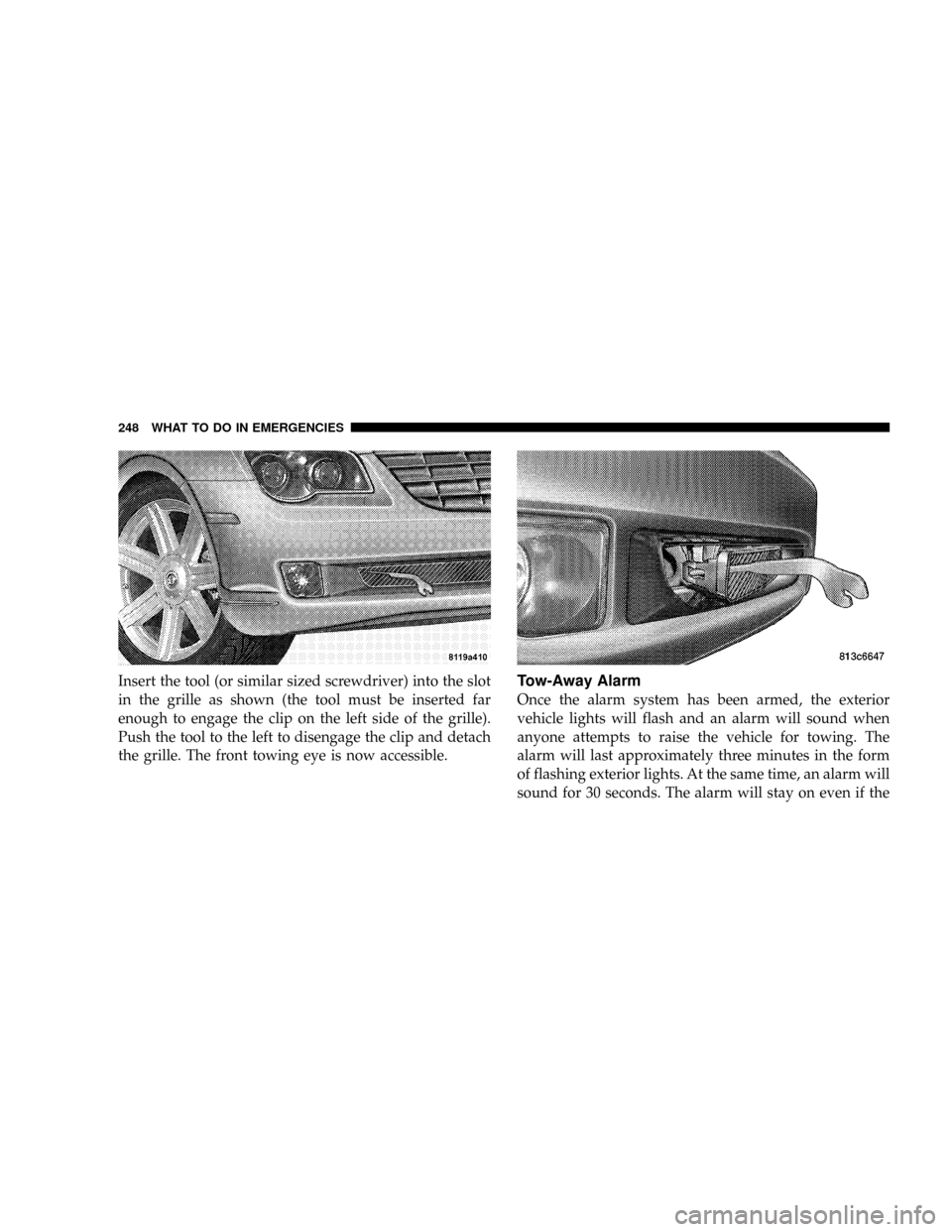
located behind the lower grille in the fascia. For access, a
snap-in grille must be removed using the multifunction
tool from the glovebox.
WHAT TO DO IN EMERGENCIES 247
6
Page 250 of 358
Insert the tool (or similar sized screwdriver) into the slot
in the grille as shown (the tool must be inserted far
enough to engage the clip on the left side of the grille).
Push the tool to the left to disengage the clip and detach
the grille. The front towing eye is now accessible.Tow-Away Alarm
Once the alarm system has been armed, the exterior
vehicle lights will flash and an alarm will sound when
anyone attempts to raise the vehicle for towing. The
alarm will last approximately three minutes in the form
of flashing exterior lights. At the same time, an alarm will
sound for 30 seconds. The alarm will stay on even if the
248 WHAT TO DO IN EMERGENCIES