Page 223 of 358

If you need snow tires, the recommended size for the
front and rear tires is the same size as the original
equipment front tires. This size tire on the rear allows the
use of tire chains on the rear wheels. Selection of this size
tire also requires the purchase of two additional wheels
with the same size specification as the original equip-
ment front wheels.
Snow tires may have a lower speed rating than factory
equipped tires and may not match the maximum vehicle
speed.
Snow tires should not be operated at sustained speeds
over 75 mph (120 km/h).TIRE ROTATION RECOMMENDATIONS
Tires on the front and rear axles of vehicles operate at
different loads and perform different steering, driving,
and braking functions. For these reasons, they wear at
unequal rates, and tend to develop irregular wear pat-
terns.
These effects can be reduced by timely rotation of tires.
The benefits of rotation are especially worthwhile with
aggressive tread designs such as those on all season type
tires. Rotation will increase tread life, help to maintain
mud, snow, and wet traction levels, and contribute to a
smooth, quiet ride.
Follow the recommended tire rotation frequency for your
type of driving found in the ªMaintenance Schedulesº
Section of this manual. More frequent rotation is permis-
sible if desired. The reasons for any rapid or unusual
wear should be corrected prior to rotation being per-
formed.
STARTING AND OPERATING 221
5
Page 246 of 358

4. Connect one end of a jumper cable to the positive
jump-start attachment of the booster battery. Connect the
other end of the same cable to the positive jump-start
attachment of the discharged battery.
5. Connect the other cable, first to the negative jump-
start attachment of the booster battery and then to the
engine of the vehicle with the discharged battery. Make
sure you have good contact on the engine.
6. Start the engine in the vehicle which has the booster
battery, let the engine idle a few minutes, then start the
engine in the vehicle with the discharged battery.
7. When removing the jumper cables, reverse the above
sequence exactly. Be careful of the moving belts and fans.
NOTE:If engine does not run after several unsuccessful
starting attempts, have it checked at the nearest autho-
rized dealer.FREEING A STUCK VEHICLE
In order to free a stuck vehicle you must turn off the
Electronic Stability Program (ESP) before attempting to
ªrockº the vehicle.
If your vehicle becomes stuck in mud, sand or snow, it
can often be moved by a rocking motion. Turn your
steering wheel right and left to clear the area around the
front wheels. Then shift back and forth between RE-
VERSE and DRIVE. Usually the least accelerator pedal
pressure to maintain the rocking motion without spin-
ning the wheels is most effective.
NOTE:ESP should be turned on again after freeing the
vehicle from a stuck condition.
244 WHAT TO DO IN EMERGENCIES
Page 259 of 358
MAINTAINING YOUR VEHICLE
CONTENTS
m3.2L Engine...........................260
mOnboard Diagnostic System (OBD II).........261
mEmissions Inspection And Maintenance
Programs............................262
mReplacement Parts......................263
mAuthorized Dealer Service................263
mMaintenance Procedures..................264
NEngine Oil..........................264
NIgnition Wiring System.................271NCrankcase Emission Control System........271
NMaintenance-Free Battery................271
NAir Conditioner......................273
NPower Steering Fluid...................274
NChassis Lubrication....................275
NBody Lubrication.....................276
NWindshield Wiper Blades................276
NWindshield Wiper Blade Replacement.......277
NWindshield Washer Reservoir.............278
7
Page 276 of 358
Power Steering Fluid
No power steering fluid service is required. The system is
filled at the factory with Pentosin CHF 11S. Steering noise
and reduced component life may result if an unapproved
fluid is used.During scheduled maintenance, check the power steering
fluid level at the power steering fluid reservoir. Nor-
mally, it will not be necessary to add power steering
fluid.
Before removing the reservoir cap, wipe the outside of
the cap and reservoir so that no dirt can fall into the
reservoir.
The power steering pump has a dipstick. Fluid level
should be maintained at the proper level indicated on the
dipstick. If the indicated level of power steering fluid is
low, see your authorized dealer. With a clean cloth, wipe
any spilled fluid from all surfaces.
274 MAINTAINING YOUR VEHICLE
Page 277 of 358
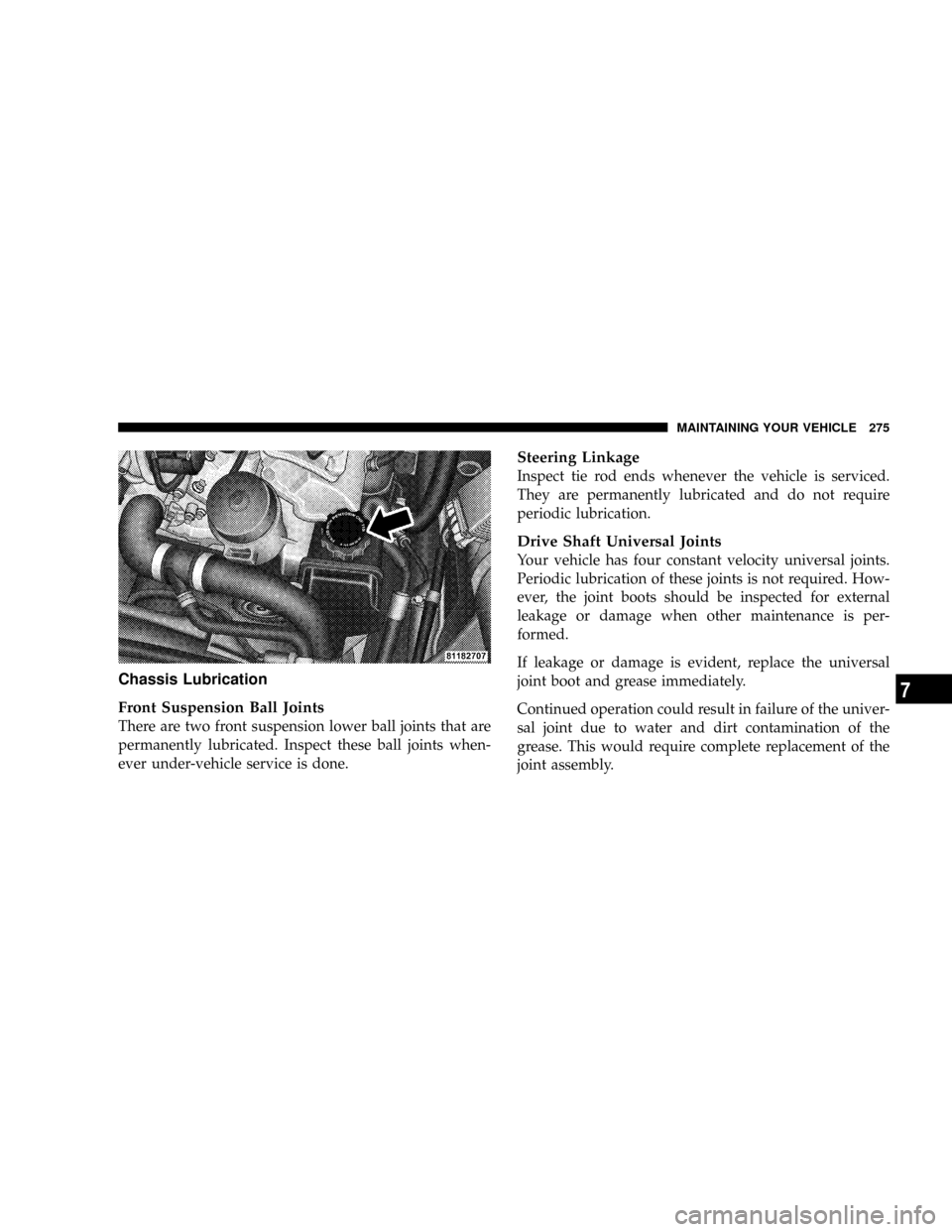
Chassis Lubrication
Front Suspension Ball Joints
There are two front suspension lower ball joints that are
permanently lubricated. Inspect these ball joints when-
ever under-vehicle service is done.
Steering Linkage
Inspect tie rod ends whenever the vehicle is serviced.
They are permanently lubricated and do not require
periodic lubrication.
Drive Shaft Universal Joints
Your vehicle has four constant velocity universal joints.
Periodic lubrication of these joints is not required. How-
ever, the joint boots should be inspected for external
leakage or damage when other maintenance is per-
formed.
If leakage or damage is evident, replace the universal
joint boot and grease immediately.
Continued operation could result in failure of the univer-
sal joint due to water and dirt contamination of the
grease. This would require complete replacement of the
joint assembly.
MAINTAINING YOUR VEHICLE 275
7
Page 287 of 358

Brakes
In order to assure brake system performance, all brake
system components should be inspected periodically.
Suggested service intervals can be found in the Mainte-
nance section.
WARNING!
Riding the brakes can lead to brake failure and
possibly an accident. Driving with your foot resting
or riding on the brake pedal can result in abnormally
high brake temperatures, excessive lining wear, and
possible brake damage. You wouldn't have your full
braking capacity in an emergency.
Brake and Power Steering System Hoses
When servicing the vehicle for scheduled maintenance,
inspect surface of hoses and nylon tubing for evidence of
heat and mechanical damage. Hard and brittle rubber,cracking, checking, tears, cuts, abrasions, and excessive
swelling suggest deterioration of the rubber. Particular
attention should be made to examining those hose sur-
faces nearest to high heat sources, such as the exhaust
manifold.
Inspect all hose clamps and couplings to make sure they
are secure and no leaks are present.
Ensure the nylon tubing in these areas has not melted or
collapsed.
NOTE:Often, fluids such as oil, power steering fluid,
and brake fluid are used during assembly plant opera-
tions to ease the assembly of hoses to couplings. There-
fore, oil wetness at the hose-coupling area is not neces-
sarily an indication of leakage. Actual dripping of hot
fluid when systems are under pressure (during vehicle
operation) should be noted before a hose is replaced
based on leakage.
MAINTAINING YOUR VEHICLE 285
7
Page 317 of 358
FLUID CAPACITIES
U.S. Metric
Fuel (Approximate)15.8 Gal 60.0 L
Fuel Tank Reserve2 Gal 7.5 L
Engine Oil (with filter)
3.2 L Engine 8.5 Qt 8.0 L
Cooling System *
3.2 L Engine 11.8 Qt 11.2 L
Manual Transmission1.9 Qt 1.8 L
Automatic Transmission8.5 Qt 8.0 L
Rear Axle1.4 Qt 1.3 L
Power Steering Reservoir1.1 Qt 1.0 L
Brake Reservoir.5 Qt .5 L
Windshield Washer Reservoir(MAX fill when empty) 7.4 Qt 7.0 L
* Includes heater and coolant recovery bottle filled to MAX level.
MAINTAINING YOUR VEHICLE 315
7
Page 319 of 358

Chassis
Component Fluids, Lubricants and Genuine Parts
Automatic Transmission Only use ATF approved to MB 236.10, MB 236.12. Synthetic Dexron IIItTransmis-
sion Fluid may be substituted.
Brake Master Cylinder Use brake fluid approved to MB 331.0, or a DOT 4 brake fluid with: minimum dry
boiling point (ERBP) 500ÉF (260ÉC), minimum wet boiling point (WERBP) 356ÉF
(180ÉC), maximum viscosity 1500 mm
2/s, conforming to FMVSS 116 and ISO 4925.
Clutch Fluid Use brake fluid approved to MB 331.0, or a DOT 4 brake fluid with: minimum dry
boiling point (ERBP) 500ÉF (260ÉC), minimum wet boiling point (WERBP) 356ÉF
(180ÉC), maximum viscosity 1500 mm
2/s, conforming to FMVSS 116 and ISO 4925.
Manual Transmission Fluid No fluid service required. Only use fluid approved to MB 236.2. SAE 5W-20 engine
oil, meeting API SL or GF-3, may be substituted.
Power Steering Reservoir No fluid service required. Filled at the factory with Pentosin CHF 11S. Steering
noise and reduced component life may result if an unapproved fluid is used.
Rear Axle Fluid Only use synthetic SAE 75W-85 axle lubricant that meets MB 231.1. Reduced axle
durability may result if an unapproved product is used.
Tire Pressure Refer to label on driver's door frame.
MAINTAINING YOUR VEHICLE 317
7