Page 276 of 358
Power Steering Fluid
No power steering fluid service is required. The system is
filled at the factory with Pentosin CHF 11S. Steering noise
and reduced component life may result if an unapproved
fluid is used.During scheduled maintenance, check the power steering
fluid level at the power steering fluid reservoir. Nor-
mally, it will not be necessary to add power steering
fluid.
Before removing the reservoir cap, wipe the outside of
the cap and reservoir so that no dirt can fall into the
reservoir.
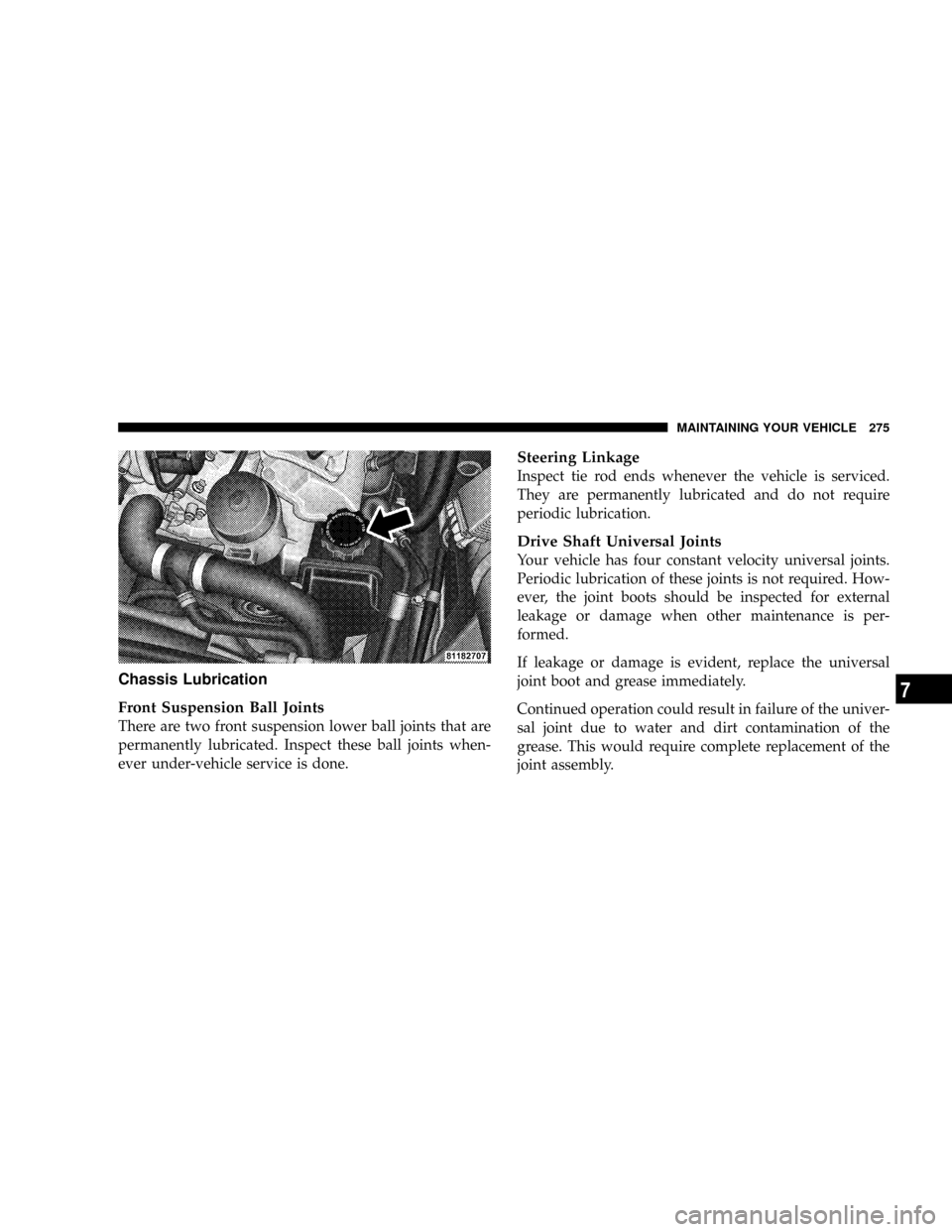
The power steering pump has a dipstick. Fluid level
should be maintained at the proper level indicated on the
dipstick. If the indicated level of power steering fluid is
low, see your authorized dealer. With a clean cloth, wipe
any spilled fluid from all surfaces.
274 MAINTAINING YOUR VEHICLE
Page 277 of 358
Chassis Lubrication
Front Suspension Ball Joints
There are two front suspension lower ball joints that are
permanently lubricated. Inspect these ball joints when-
ever under-vehicle service is done.
Steering Linkage
Inspect tie rod ends whenever the vehicle is serviced.
They are permanently lubricated and do not require
periodic lubrication.
Drive Shaft Universal Joints
Your vehicle has four constant velocity universal joints.
Periodic lubrication of these joints is not required. How-
ever, the joint boots should be inspected for external
leakage or damage when other maintenance is per-
formed.
If leakage or damage is evident, replace the universal
joint boot and grease immediately.
Continued operation could result in failure of the univer-
sal joint due to water and dirt contamination of the
grease. This would require complete replacement of the
joint assembly.
MAINTAINING YOUR VEHICLE 275
7
Page 283 of 358

Cooling System - Drain, Flush and Refill
At the intervals shown on the Maintenance Schedules,
the system should be drained, flushed and refilled.
If the solution is dirty and contains a considerable
amount of sediment, clean and flush with a reliable
cooling system cleaner. Follow with a thorough rinsing to
remove all deposits and chemicals.
Engine Coolant Disposal
Used ethylene glycol based engine coolant is a regulated
substance requiring proper disposal. Check with your
local authorities to determine the disposal rules for your
community. Do not store ethylene glycol based engine
coolant in open containers or allow it to remain in
puddles on the ground. Prevent ingestion by animals or
children. If ingested by a child, contact a physician
immediately.
Selection Of Coolant
Use only coolant approved to MB 325.0, such as Valvoline
GO5, or an equivalent extended life coolant. Refer to the
recommended Fluids, Lubricants and Genuine Parts for
correct coolant type.
MAINTAINING YOUR VEHICLE 281
7
Page 287 of 358

Brakes
In order to assure brake system performance, all brake
system components should be inspected periodically.
Suggested service intervals can be found in the Mainte-
nance section.
WARNING!
Riding the brakes can lead to brake failure and
possibly an accident. Driving with your foot resting
or riding on the brake pedal can result in abnormally
high brake temperatures, excessive lining wear, and
possible brake damage. You wouldn't have your full
braking capacity in an emergency.
Brake and Power Steering System Hoses
When servicing the vehicle for scheduled maintenance,
inspect surface of hoses and nylon tubing for evidence of
heat and mechanical damage. Hard and brittle rubber,cracking, checking, tears, cuts, abrasions, and excessive
swelling suggest deterioration of the rubber. Particular
attention should be made to examining those hose sur-
faces nearest to high heat sources, such as the exhaust
manifold.
Inspect all hose clamps and couplings to make sure they
are secure and no leaks are present.
Ensure the nylon tubing in these areas has not melted or
collapsed.
NOTE:Often, fluids such as oil, power steering fluid,
and brake fluid are used during assembly plant opera-
tions to ease the assembly of hoses to couplings. There-
fore, oil wetness at the hose-coupling area is not neces-
sarily an indication of leakage. Actual dripping of hot
fluid when systems are under pressure (during vehicle
operation) should be noted before a hose is replaced
based on leakage.
MAINTAINING YOUR VEHICLE 285
7
Page 292 of 358
Frequency of Fluid Change
Under normal operation conditions, the fluid installed at
the factory will give satisfactory lubrication for the life of
the vehicle. Fluid changes are not necessary unless the
lubricant has become contaminated with water. If con-
taminated with water, the fluid should be changed im-
mediately.
Special Additives
Do not add any fluid additives to the transmission. The
only exception to this policy is the use of special dyes to
aid in detecting fluid leaks. The use of transmission
sealers should be avoided as this may adversely affect
seals.
Appearance Care and Protection from Corrosion
Protection of Body and Paint from Corrosion
Vehicle body protection requirements vary according to
geographic locations and usage. Chemicals that make
roads passable in snow and ice, and those that aresprayed on trees and road surfaces during other seasons,
are highly corrosive to the metal in your vehicle. Outside
parking, which exposes your vehicle to airborne contami-
nants, road surfaces on which the vehicle is operated,
extreme hot or cold weather and other extreme condi-
tions will have an adverse effect on paint, metal trim, and
underbody protection.
The following maintenance recommendations will enable
you to obtain maximum benefit from the corrosion
resistance built into your vehicle.
What Causes Corrosion?
Corrosion is the result of deterioration or removal of
paint and protective coatings from your vehicle.
The most common causes are:
²Road salt, dirt and moisture accumulation.
²Stone and gravel impact.
290 MAINTAINING YOUR VEHICLE
Page 297 of 358
protectants or other products which may cause undesir-
able reflections. Use soap and warm water to restore the
low glare surface.
Cleaning Plastic Instrument Cluster Lenses
The lenses in front of the instruments in the vehicle are
molded in clear plastic. When cleaning the lenses, care
must be taken to avoid scratching the plastic.
²Clean with a wet soft rag. A mild soap solution may be
used, but do not use high alcohol content or abrasive
cleaners. If soap is used, wipe clean with a clean damp
rag.
²Dry with a soft cloth.
Seat Belt Maintenance
Do not bleach, dye or clean the seat belts with chemical
solvents or abrasive cleaners. This will weaken the fabric.If the seat belts need cleaning, use a mild soap solution or
lukewarm water. Do not remove the seat belts from the
vehicle to wash them.
Replace the seat belts if they appear frayed or worn or if
the buckles do not work properly.
CONVERTIBLE TOP CARE
CAUTION!
Due not use sharp-edged instruments to remove
snow or ice from the soft top.
NOTE:Place a suitable cover over the top if you are
going to park the vehicle outside for a extended period of
time.
MAINTAINING YOUR VEHICLE 295
7
Page 321 of 358
MAINTENANCE SCHEDULES
CONTENTS
mIntroduction..........................320
mWarranty.............................320
mEmission Control System Maintenance........321
mMaintenance Schedules...................322
NScope Of Work For ªAº Schedule Maintenance
Service.............................322
NScope Of Work For ªBº Schedule Maintenance
Service.............................323
mFSS System...........................325mRegular Check-Ups.....................326
NAdditional Periodic Maintenance..........327
mSpecial Maintenance Requirements..........329
NCoolant............................329
NDust Filter For Heating/Ventilation
Replacement (If Equipped)...............329
mEngine Oil Change And Filter Replacement....330
8
M
A
I
N
T
E
N
A
N
C
E
S
C
H
E
D
U
L
E
S
Page 322 of 358

INTRODUCTION
This is intended as a guide to the service requirements of
your vehicle.
It contains all necessary instructions concerning service
intervals and operations which have to be carried out.
Scope and frequency of maintenance work primarily
depend on the vehicle's operating conditions. In the
interest of maintaining the vehicle's operating safety, the
specified work should be performed regularly and in
good time.
Our vehicles are subject to ongoing development. Tech-
nical progress may also affect the scope of service work
performed.
ªDaily vehicle checksº before starting a journey are the
responsibility of the driver.
WARRANTY
The DaimlerChrysler Corporation Dealer network is at
your disposal for maintenance work. Each of these work-
shops has the equipment and tools, the specially trained,
skilled and experienced personnel and receives regular
technical instruction from DaimlerChrysler Corporation
to ensure that your vehicle is inspected and maintained
thoroughly and in accordance with the latest procedures.
Please follow the instructions given in this Owner's
Manual and ensure that they are observed, even if you
hand the vehicle over to a third party for use or care. By
not observing these instructions you may void your
warranty rights.
If the specified oil and maintenance services are not
carried out regularly or at the time intervals specified, a
decision as to the validity of a warranty claim can only be
made after DaimlerChrysler Corporation has investi-
gated your claim.
320 MAINTENANCE SCHEDULES
8
M
A
I
N
T
E
N
A
N
C
E
S
C
H
E
D
U
L
E
S