Page 161 of 358
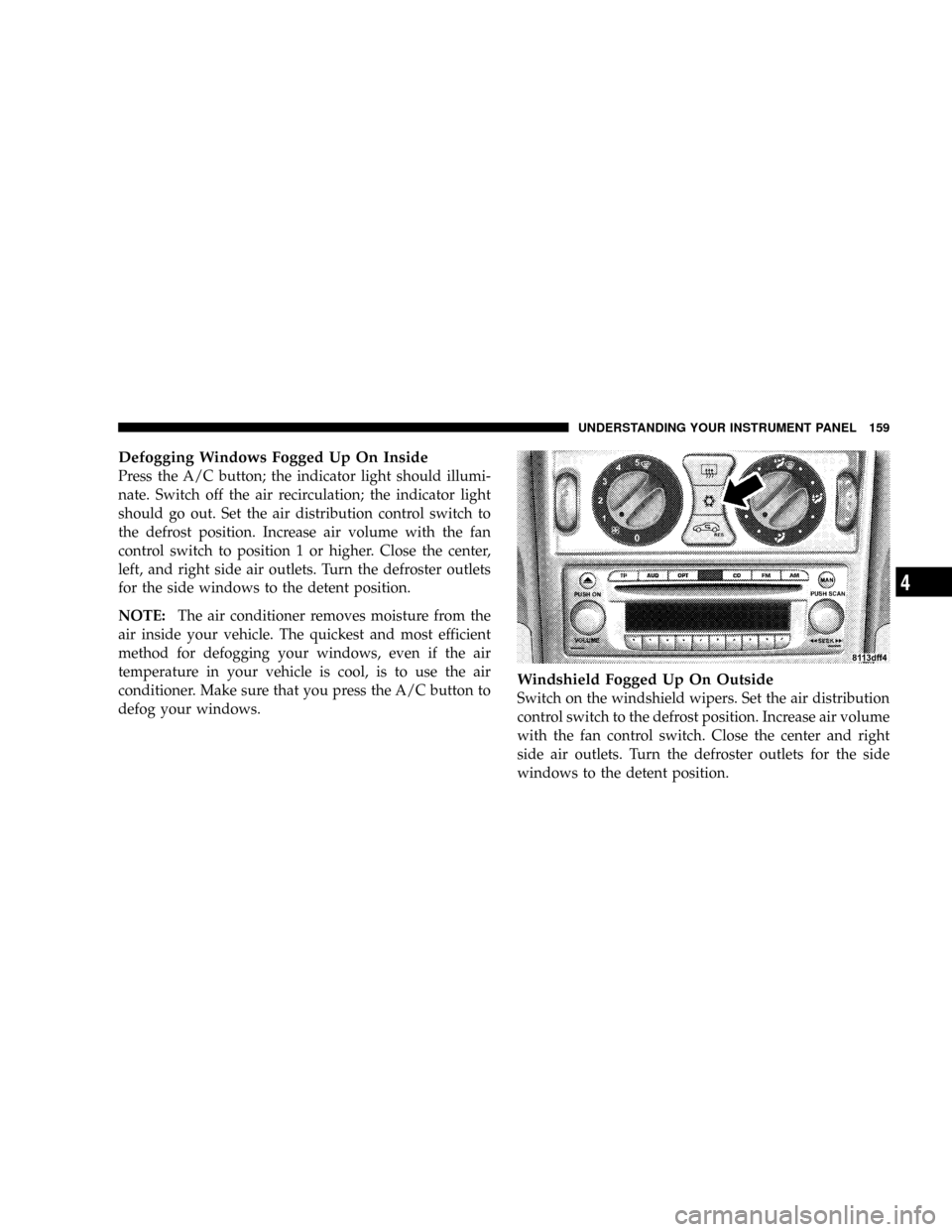
Defogging Windows Fogged Up On Inside
Press the A/C button; the indicator light should illumi-
nate. Switch off the air recirculation; the indicator light
should go out. Set the air distribution control switch to
the defrost position. Increase air volume with the fan
control switch to position 1 or higher. Close the center,
left, and right side air outlets. Turn the defroster outlets
for the side windows to the detent position.
NOTE:The air conditioner removes moisture from the
air inside your vehicle. The quickest and most efficient
method for defogging your windows, even if the air
temperature in your vehicle is cool, is to use the air
conditioner. Make sure that you press the A/C button to
defog your windows.
Windshield Fogged Up On Outside
Switch on the windshield wipers. Set the air distribution
control switch to the defrost position. Increase air volume
with the fan control switch. Close the center and right
side air outlets. Turn the defroster outlets for the side
windows to the detent position.
UNDERSTANDING YOUR INSTRUMENT PANEL 159
4
Page 162 of 358

Ventilation
To receive outside air through the panel outlets, turn off
the Air Conditioning ON/OFF switch. The light in the
switch should be off. Set the controls as above for basic
air conditioning.
Climate Control - OFF
To switch the climate control off, set the air volume
control switch to position 0. The fresh air supply to the
vehicle interior is shut off. While driving, use this setting
only temporarily, otherwise the windshield could fog up.
Rear Window Defroster
Turn the key in the ignition switch to the
ON/RUN position. To select, press the rear
window defroster button once and release. The
indicator light in the switch should illuminate.
To cancel, press the rear window defroster button again
and release.
NOTE:Heavy accumulation of snow and ice should be
removed before activating the defroster. The rear win-
dow defroster uses a large amount of power. To keep the
battery drain to a minimum, turn off the defroster as soon
as the window is clear. The defroster is automatically
turned off after a maximum of 12 minutes of operation.
160 UNDERSTANDING YOUR INSTRUMENT PANEL
Page 164 of 358

Residual Engine Heat Utilization (REST)
With the engine switched off, it is possible to
continue heating the interior for a short while.
Air volume is controlled automatically. Select a
temperature for each side of the passenger
compartment. Set the air distribution control switch to
the desired position.
To select, turn the key in the ignition switch to the ACC
or the OFF/LOCK position or remove. Press the recircu-
lation button. The indicator light in the button illumi-
nates. This function selection will not activate if the
battery charge level is insufficient.
To cancel, press the recirculation button. The indicator
light in the button goes out. The system will automati-
cally shut off if you turn the key in the ignition switch to
the ON/RUN position, after approximately 30 minutes,
or if the battery voltage drops.NOTE:This vehicle is equipped with an air conditioner
system that uses R-134a (HFC: hydrofluorocarbon) as a
refrigerant. Repairs should always be performed by a
qualified technician, and refrigerant should be collected
in a recovery system for recycling.
Dust Filter (If Equipped)
Nearly all dust particles and pollen are filtered out before
outside air enters the passenger compartment through
the air distribution system.
NOTE:Keep the air intake grille in front of windshield
free of snow and debris.
162 UNDERSTANDING YOUR INSTRUMENT PANEL
Page 211 of 358
check tire pressure. Do not make a visual judgement
when determining proper inflation. Radial tires may look
properly inflated even when they are underinflated.
CAUTION!
After inspecting or adjusting the tire pressure, al-
ways reinstall the valve stem cap (if equipped). This
will prevent moisture and dirt from entering the
valve stem, which could damage it.
Inflation pressures specified on the placard are always
cold tire inflation pressure. Cold tire inflation pressure is
defined as the tire pressure after the vehicle has not been
driven for at least three hours, or driven less than 1 mi
(1.6 km) after a three-hour period. The cold tire inflation
pressure must not exceed the maximum inflation pres-
sure molded into the tire sidewall.Check tire pressures more often if subject to a wide range
of outdoor temperatures, as tire pressures vary with
temperature changes.
Tire pressures change by approximately 1 psi (7 kPa) per
12ÉF (7ÉC) of air temperature change. Keep this in mind
when checking tire pressure inside a garage, especially in
the winter.
Example: If garage temperature = 68ÉF (20ÉC) and the
outside temperature = 32ÉF (0ÉC) then the cold tire
inflation pressure should be increased by 3 psi (21 kPa),
which equals 1 psi (7 kPa) for every 12ÉF (7ÉC) for this
outside temperature condition.
Tire pressure may increase from 2 to 6 psi (13 to 40 kPa)
during operation. DO NOT reduce this normal pressure
build-up, or your tire pressure will be too low.
STARTING AND OPERATING 209
5
Page 235 of 358

In any of the following situations, you can reduce the
potential for overheating by taking the appropriate ac-
tion.
²On the highways ±Slow down and use the highest
gear possible.
²In city traffic ±While stopped, put the transmission in
NEUTRAL, but do not increase engine idle speed.
²In city traffic ±While moving, shift into the highest
gear possible to reduce engine RPM.
NOTE:There are steps that you can take to slow down
an impending overheat condition. If your air conditioner
is on, turn it off. The air conditioning system adds heat to
the cooling system and turning off the A/C removes this
heat. You can also turn the temperature control to maxi-
mum heat, the mode control to floor, and the fan controlto HIGH. This allows the heater core to act as a supple-
ment to the radiator and aids in removing heat from the
cooling system.
CAUTION!
Driving with a hot cooling system could damage
your vehicle. If temperature gauge reads ªH,º pull
over and stop the vehicle. Idle the vehicle with the air
conditioner turned OFF until the pointer drops back
into the normal range. If the pointer remains on the
ªH,º turn the engine OFF immediately, and call for
service.
WHAT TO DO IN EMERGENCIES 233
6
Page 259 of 358
MAINTAINING YOUR VEHICLE
CONTENTS
m3.2L Engine...........................260
mOnboard Diagnostic System (OBD II).........261
mEmissions Inspection And Maintenance
Programs............................262
mReplacement Parts......................263
mAuthorized Dealer Service................263
mMaintenance Procedures..................264
NEngine Oil..........................264
NIgnition Wiring System.................271NCrankcase Emission Control System........271
NMaintenance-Free Battery................271
NAir Conditioner......................273
NPower Steering Fluid...................274
NChassis Lubrication....................275
NBody Lubrication.....................276
NWindshield Wiper Blades................276
NWindshield Wiper Blade Replacement.......277
NWindshield Washer Reservoir.............278
7
Page 269 of 358
CAUTION!
Overfilling or underfilling the crankcase will cause
oil aeration or loss of oil pressure. This could damage
your engine.
Engine Oil Selection
For best performance and maximum protection under all
types of operating conditions, only use synthetic engine
oils, approved to MB 229.3 or MB 229.5, such as Mobil 1
SAE 0W-40. The FSS may not alert for an oil change at the
proper interval if an unapproved engine oil is used;
engine damage and reduced engine life may result.
Materials Added To Engine Oils
Do not add materials (other than leak detection dyes) to
engine oil. Engine oil is an engineered product and its
performance may be impaired by supplemental addi-
tives.
MAINTAINING YOUR VEHICLE 267
7
Page 271 of 358

there is any malfunction due to a faulty spark plug.
Check the specifications section for the proper type of
spark plug for use in your vehicle.
Engine Air Cleaner Filter
Under normal driving conditions, replace the air filter at
each interval called out by FSS.
WARNING!
The air cleaner can provide a measure of protection
in the case of engine backfire. Do not remove the air
cleaner unless such removal is necessary for repair or
maintenance. Make sure that no one is near the
engine compartment before starting the vehicle with
the air cleaner removed. Failure to do so can result in
serious personal injury.
Engine Fuel Filter
A plugged fuel filter can cause hard starting or limit the
speed at which a vehicle can be driven. Should an
excessive amount of dirt accumulate in the fuel tank,
frequent fuel filter replacement may be necessary. See
your authorized dealer for service.
Catalytic Converter
The catalytic converter requires the use of unleaded fuel
only. Leaded gasoline will destroy the effectiveness of the
catalyst as an emission control device.
Under normal operating conditions, the catalytic con-
verter will not require maintenance. However, it is im-
portant to keep the engine properly serviced to assure
proper catalyst operation and prevent possible catalyst
damage.
If the CHECK ENGINE light is flashing, immediate
service is required.
MAINTAINING YOUR VEHICLE 269
7

