Page 206 of 358

Loading
The vehicle maximum load on the tire must not exceed
the load carrying capacity of the tire on your vehicle. You
will not exceed the tire's load carrying capacity if you
adhere to the loading conditions, tire size, and cold tire
inflation pressures specified on the Tire and Loading
Information placard and in the ªVehicle Loadingº section
of this manual.
NOTE:Under a maximum loaded vehicle condition,
gross axle weight ratings (GAWRs) for the front and rear
axles must not be exceeded. For further information on
GAWRs, vehicle loading, and trailer towing, refer to
ªVehicle Loadingº in this section.
To determine the maximum loading conditions of your
vehicle, locate the statement ªThe combined weight of
occupants and cargo should never exceed XXX kg or XXX
lbs.º on the Tire and Loading Information placard. Thecombined weight of occupants, cargo/luggage and
trailer tongue weight (if applicable) should never exceed
the weight referenced here.
Steps for Determining Correct Load Limit
1. Locate the statement ªThe combined weight of occu-
pants and cargo should never exceed XXX kg or XXX lbsº
on your vehicle's placard.
2. Determine the combined weight of the driver and
passengers that will be riding in your vehicle.
3. Subtract the combined weight of the driver and pas-
sengers from XXX kg or XXX lbs.
4. The resulting figure equals the available amount of
cargo and luggage load capacity. For example, if ªXXXº
amount equals 1,400 lbs (635 kg) and there will be five
150 lb (68 kg) passengers in your vehicle, the amount of
available cargo and luggage load capacity is 650 lbs (295
kg) (since 5 x 150 = 750, and 1400 ± 750 = 650 lbs [295 kg]).
204 STARTING AND OPERATING
Page 207 of 358
5. Determine the combined weight of luggage and cargo
being loaded on the vehicle. That weight may not safely
exceed the available cargo and luggage load capacity
calculated in Step 4.
6. If your vehicle will be towing a trailer, load from your
trailer will be transferred to your vehicle. Consult this
manual to determine how this reduces the available
cargo and luggage load capacity of your vehicle.NOTE:The following table shows examples on how to
calculate total load, cargo/luggage, and towing capaci-
ties of your vehicle with varying seating configurations
and number and size of occupants. This table is for
illustration purposes only and may not be accurate for
the seating and load carry capacity of your vehicle.
NOTE:For the following example, the combined weight
of occupants and cargo should never exceed 865 lbs (392
kg).
STARTING AND OPERATING 205
5
Page 312 of 358
NOTE:Always test the operation of all lights after
service operations have been performed to validate an
effective repair.Headlight Aiming
The headlights on your new vehicle were aimed at the
factory. The factory setting was made at a no load setting.
A great increase in weight will change the aiming and it
may be necessary to readjust the headlights if carrying an
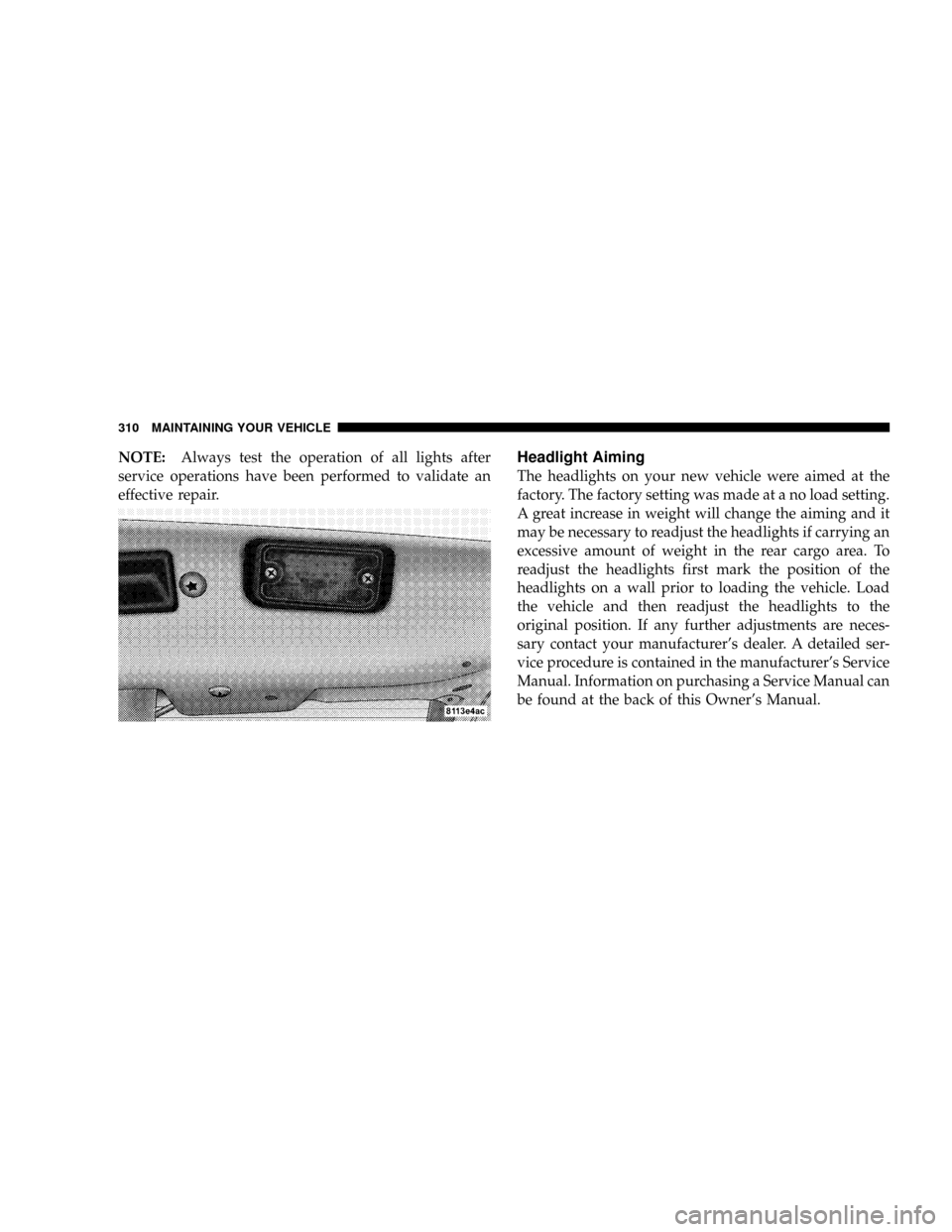
excessive amount of weight in the rear cargo area. To
readjust the headlights first mark the position of the
headlights on a wall prior to loading the vehicle. Load
the vehicle and then readjust the headlights to the
original position. If any further adjustments are neces-
sary contact your manufacturer's dealer. A detailed ser-
vice procedure is contained in the manufacturer's Service
Manual. Information on purchasing a Service Manual can
be found at the back of this Owner's Manual.
310 MAINTAINING YOUR VEHICLE
Page 316 of 358
Gear Ratios - 5-Speed Automatic Transmission
First 3.95
Second 2.423
Third 1.486
Fourth 1.00
Fifth 0.833
Reverse 3.147/1.93
Body Specifications
Overall Length 159.8 in (4058 mm)
Maximum Width 69.5 in (1766 mm)
Maximum Width With
Mirrors76.9 in (1954 mm)
Overall Height
Coupe: 51.5 in (1307 mm)
Roadster: 51.8 in (1315 mm)
Front Track 58.8 in (1493 mm)
Rear Track 59.1 in (1502 mm)
Wheelbase 94.5 in (2400 mm)
Front Overhang 32.4 in (822 mm)
Rear Overhang 32.9 in (836 mm)
Front Ground Clearance 5.0 in (127 mm)
Rear Ground Clearance 5.8 in (147 mm)
Turning Radius 32.2 ft (9.8 m)
Weight
Coupe: 3010 lbs (1365 kg)
Roadster: 3097 lbs (1405 kg)
Maximum Vehicle Load 415 lbs (188 kg)
Luggage Capacity
Coupe: 7.7 cu ft (215 l)
Roadster: 6.5 cu ft (190 l) - Top Up
3.6 cu ft (104 l) - Top
Down
314 MAINTAINING YOUR VEHICLE
Page 345 of 358

Brake System........................186,285
Anti-Lock (ABS)....................... 186
Hoses.............................. 285
Master Cylinder....................... 286
Break-In Recommendations, New Vehicle.....61,196
Bulbs, Light............................ 305
Capacities, Fluid........................ 313
Capacity, Cargo Weight................... 227
Carbon Monoxide Warning................. 61
Cargo Compartment
Capacity............................ 227
Catalytic Converter...................... 269
CD (Compact Disc) Player...............144,149
Chains, Tire............................ 219
Changing A Flat Tire..................... 234
Charging System Light.................... 135
Chart, Tire Sizing........................ 199
Checks, Safety........................... 61Child Restraint.......................... 52
Child Restraint Tether Anchors............... 59
Cigar Lighter........................... 83
Circuit Breakers......................... 297
Clean Air Gasoline....................... 223
Cleaning
Glass............................... 294
Headlights........................... 294
Climate Control......................... 155
Coin Holder............................ 83
Compact Disc (CD) Maintenance............. 154
Console............................... 80
Contract, Service........................ 335
Converter, Catalytic...................... 237
Convertible............................. 68
Convertible Top.......................... 68
Convertible Top Maintenance............... 295
Convertible Top Manual Override............ 249
Coolant (Antifreeze)...................281,329
INDEX 343
10