Page 362 of 479

NOTE:The NV 244 Generation II transfer case must be
shifted into NEUTRAL for recreational towing. The NEU-
TRAL selection button is located on the lower left-hand
corner of the 4WD Control Switch. Shifts into and out of
transfer case NEUTRAL can take place with the selector
switch in any mode position.
Shifting into NEUTRAL
Use the following procedure to prepare your vehicle for
recreational towing.
CAUTION!
It is necessary to follow these steps to be certain that
the transfer case is fully in NEUTRAL before recre-
ational towing to prevent damage to internal parts.
1. Bring vehicle to a complete stop.
2. Shut engine OFF.3. Turn the ignition key to the ON position without
starting the engine.
4. Depress brake pedal.
5. Shift automatic transmission to NEUTRAL.
6. Using the point of a ballpoint pen or similar object,
depress the recessed transfer case NEUTRAL button for
four seconds.
7. After shift is completed and the NEUTRAL light
comes on, release the NEUTRAL button.
8. Start the engine.
9. Shift the automatic transmission into REVERSE.
10. Release brake pedal for five seconds and ensure that
there is no vehicle movement.
11. Repeat steps 9 and 10 with the transmission in
DRIVE.
STARTING AND OPERATING 361
5
Page 363 of 479

12. Turn ignition key to the unlocked OFF position.
13. Shift the automatic transmission into PARK.
14. Attach vehicle to tow vehicle with tow bar.
NOTE:Items 1 through 5 are requirements that must be
met prior to depressing the NEUTRAL selection button,
and must continue to be met until the four seconds
elapses and the shift has been completed.
If any of these requirements (with the exception of Step 3
- Key ON) are not met prior to depressing the NEUTRAL
button or are no longer met during the four second timer,
then the NEUTRAL indicator light will flash continu-
ously until all requirements are met or until the NEU-
TRAL button is released.
NOTE:The ignition key must be ON for a shift to take
place and for the position indicator lights to be operable.
If the key is not ON, the shift will not take place and no
position indicator lights will be on or flashing.CAUTION!
Damage to the transmission may occur if the trans-
mission is shifted into PARK with the transfer case in
NEUTRAL and the engine RUNNING. With the
transfer case in NEUTRAL, ensure that the engine is
OFF prior to shifting the transmission into PARK.
Shifting Out of NEUTRAL
Use the following procedure to prepare your vehicle for
normal usage.
1. Bring vehicle to a complete stop.
2. Shut engine OFF.
3. Turn the ignition key to the ON position without
starting the engine.
4. Depress brake pedal.
362 STARTING AND OPERATING
Page 364 of 479

5. Shift the automatic transmission to NEUTRAL.
6. Using the point of a ballpoint pen or similar object,
depress the recessed transfer case NEUTRAL button for
one second.
7. After the NEUTRAL indicator light turns off, release
the NEUTRAL button.
8. After the NEUTRAL button has been released, the
transfer case will shift to the position identified by the
selector switch.
9. Shift the automatic transmission into PARK.
10. Start the engine.
11. Shift the automatic transmission into DRIVE.NOTE:Steps 1 through 5 are requirements that must be
met prior to depressing the NEUTRAL selection button,
and must continue to be met until one second elapses and
the shift has been completed.
If any of these requirements are not met prior to depress-
ing the NEUTRAL button or are no longer met during the
one second time, then all of the position indicator lights
will flash continuously until all requirements are met or
until the NEUTRAL button is released.
NOTE:The ignition key must be ON for a shift to take
place and for the position indicator lights to be operable.
If the key is not ON, the shift will not take place and no
position indicator lights will be on or flashing.
NOTE:A flashing NEUTRAL position indicator light
indicates that shift requirements have not been met.
STARTING AND OPERATING 363
5
Page 372 of 479
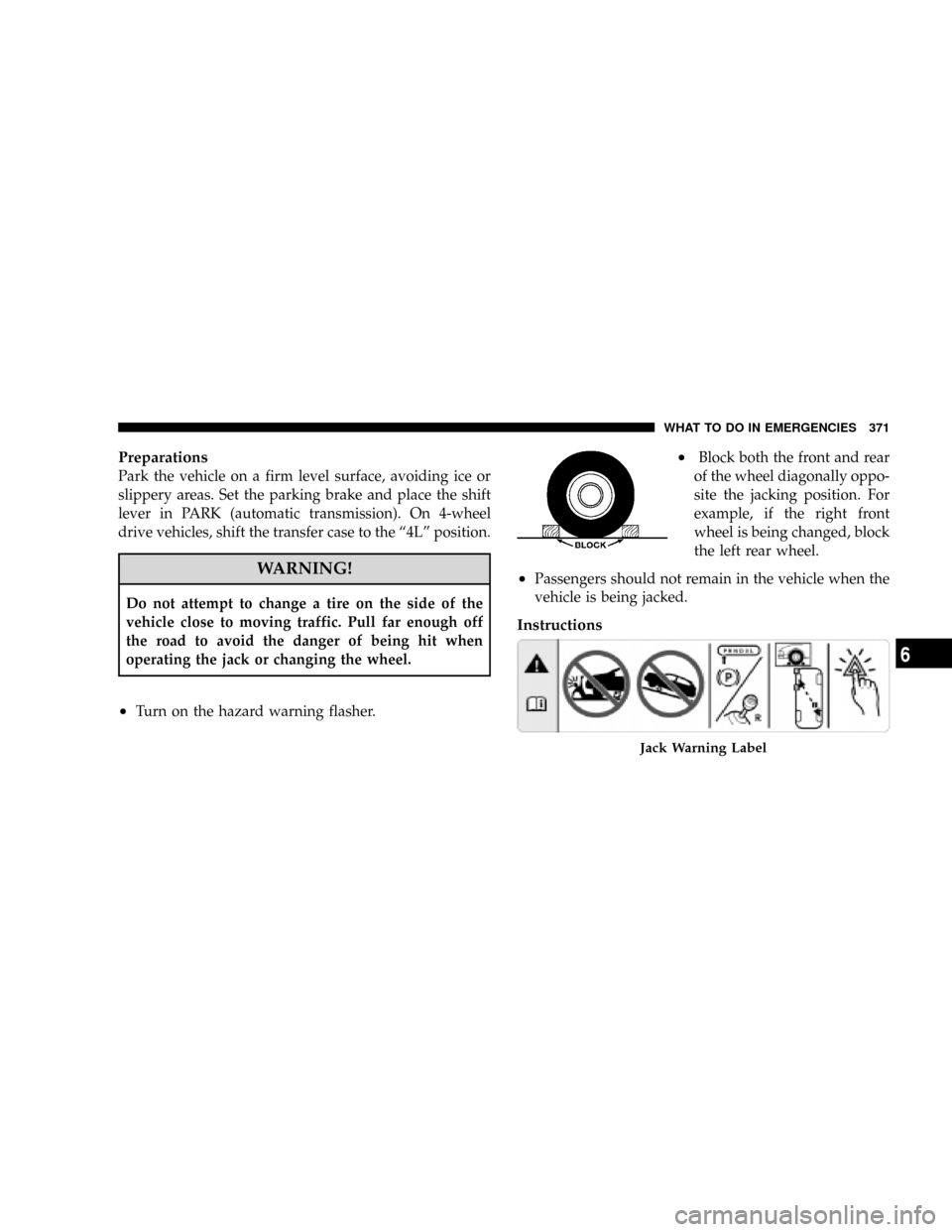
Preparations
Park the vehicle on a firm level surface, avoiding ice or
slippery areas. Set the parking brake and place the shift
lever in PARK (automatic transmission). On 4-wheel
drive vehicles, shift the transfer case to the ª4Lº position.
WARNING!
Do not attempt to change a tire on the side of the
vehicle close to moving traffic. Pull far enough off
the road to avoid the danger of being hit when
operating the jack or changing the wheel.
²Turn on the hazard warning flasher.
²Block both the front and rear
of the wheel diagonally oppo-
site the jacking position. For
example, if the right front
wheel is being changed, block
the left rear wheel.
²Passengers should not remain in the vehicle when the
vehicle is being jacked.
Instructions
Jack Warning Label
WHAT TO DO IN EMERGENCIES 371
6
Page 377 of 479

JUMP±STARTING PROCEDURES
WARNING!
²Battery fluid is a corrosive acid solution; do not
allow battery fluid to contact eyes, skin or cloth-
ing. Don't lean over battery when attaching
clamps or allow the clamps to touch each other. If
acid splashes in eyes or on skin, flush the contami-
nated area immediately with large quantities of
water.
²A battery generates hydrogen gas which is flam-
mable and explosive. Keep flame or spark away
from the vent holes. Do not use a booster battery
or any other booster source with an output that
exceeds 12 volts.Check the Battery Test Indicator (if equipped). If a light or
bright colored dot is visible in the indicator (if equipped),
DO NOT jump-start the battery.
If the indicator (if equipped) is dark or shows a green dot,
proceed as follows:
1. Wear eye protection and remove all metal jewelry such
as watch bands or bracelets which might make an
unintended electrical contact.
2. Park the booster vehicle within cable reach but with-
out letting the vehicles touch. Set the parking brake, place
the automatic transmission in PARK and turn the ignition
OFF on both vehicles.
3. Turn OFF heater, radio and all unnecessary electrical
loads.
376 WHAT TO DO IN EMERGENCIES
Page 383 of 479

NAir Conditioner Maintenance.............398
NFront Suspension Ball Joints..............399
NDrive Shaft Constant Velocity Joints........400
NBody Lubrication.....................400
NWindshield Wiper Blades................400
NWindshield And Rear Window Washers.....401
NExhaust System......................401
NCooling System.......................402
NEmission Related Components............407
NBrake System........................408
NAutomatic Transmission................410
NTransfer Case........................413
NAxles..............................413NAppearance Care And Protection From
Corrosion...........................414
mFuse Block............................419
NFuses (Interior).......................420
NFuses (Power Distribution Center).........423
NFuses (Integrated Power Module)..........426
mVehicle Storage........................428
mReplacement Light Bulbs.................429
mBulb Replacement......................429
NHeadlights/Parking/Turn Signal..........429
NTail Lights, Turn Signals And Backup Lights Ð
Replacement.........................431
NLicense Lights........................433
NCenter High-Mounted Stoplight...........434
382 MAINTAINING YOUR VEHICLE
Page 387 of 479

ONBOARD DIAGNOSTIC SYSTEM Ð OBD II
Your vehicle is equipped with a sophisticated onboard
diagnostic system called OBD II. This system monitors
the performance of the emissions, engine, and automatic
transmission control systems. When these systems are
operating properly, your vehicle will provide excellent
performance and fuel economy, as well as engine emis-
sions well within current government regulations.
If any of these systems require service, the OBD II system
will turn on the Malfunction Indicator Light (MIL). It will
also store diagnostic codes and other information to
assist your service technician in making repairs. Al-
though your vehicle will usually be drivable and not
need towing, see your authorized dealer for service as
soon as possible.CAUTION!
²Prolonged driving with the MIL on could cause
further damage to the emission control system. It
could also affect fuel economy and driveability.
The vehicle must be serviced before any emissions
tests can be performed.
²If the MIL is flashing while the engine is running,
severe catalytic converter damage and power loss
will soon occur. Immediate service is required.
Loose Fuel Filler Cap Message
After fuel is added, the vehicle diagnostic system can
determine if the fuel filler cap is possibly loose, improp-
erly installed, or damaged. A loose fuel filler cap message
will be displayed in the instrument cluster. Tighten the
gas cap until a9clicking9sound is heard. This is an
indication that the gas cap is properly tightened. Press
386 MAINTAINING YOUR VEHICLE
Page 411 of 479

CAUTION!
Do not allow a petroleum-base fluid to contaminate
the brake fluid. Seal damage may result.
Brake Hoses
Inspection should be performed whenever the brake
system is serviced or at intervals specified. Inspect hy-
draulic brake hoses for surface cracking, scuffing or worn
spots. If there is any evidence of cracking, scuffing, or
worn spots, the hose should be replaced immediately!
Eventual deterioration of the hose can take place with
possible burst failure.
WARNING!
Worn brake hoses can burst and cause brake failure.
You could have an accident. If you see any sign of
cracking, scuffing, or worn spots, have the brake
hoses replaced immediately.
Automatic Transmission
Fluid Level Check
NOTE:If equipped with a dipstick, use the following
procedure. If your vehicle has a capped dipstick, it is
sealed and should not be tampered with. Your authorized
dealer has the proper tools to ensure that the fluid level
is set properly.
Check the fluid level while the transmission is at normal
operating temperature 180ÉF (82ÉC). This occurs after at
410 MAINTAINING YOUR VEHICLE